
Advanced Aluminium Alloys for Electric Vehicles
Introduction
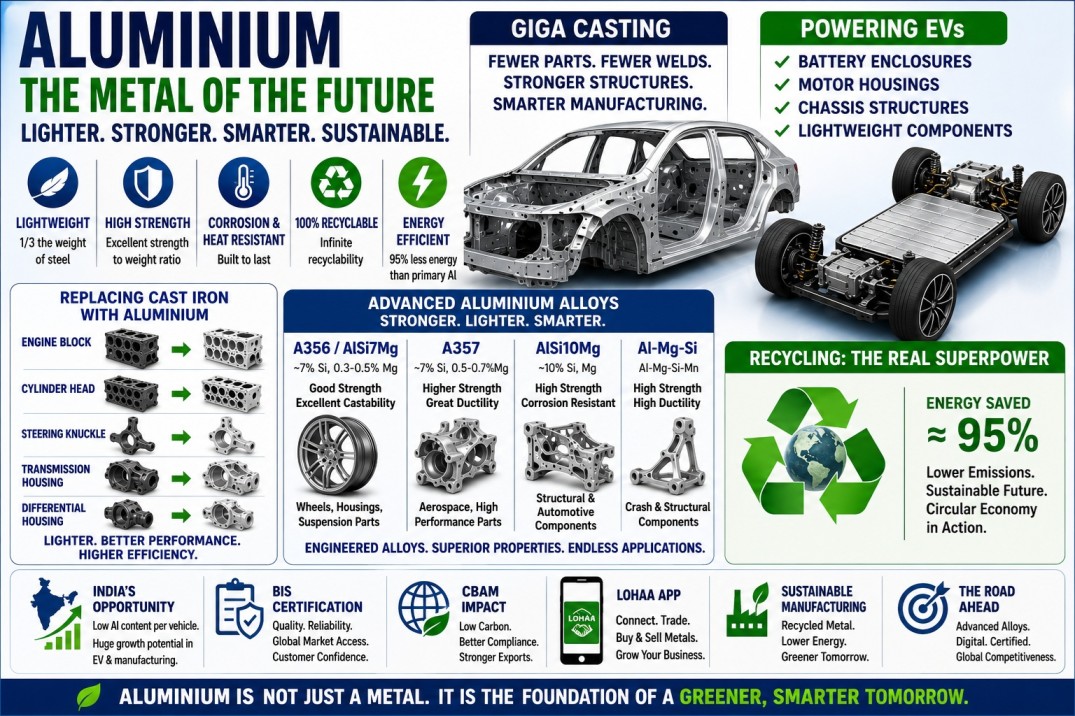
Aluminium is rapidly evolving from a conventional lightweight material into a strategic engineering metal for the next generation of automobiles, electric vehicles, machinery, aerospace and energy systems. Its low density, high strength-to-weight ratio, corrosion resistance, thermal conductivity, recyclability and compatibility with high-speed casting make it particularly attractive for vehicle lightweighting. The emergence of giga casting, advanced Al-Si-Mg and Al-Mg alloys, structural castings and large battery enclosures is accelerating this transformation. At the same time, aluminium is replacing selected cast-iron components while recycled aluminium is becoming increasingly important because it requires about 95% less energy than primary aluminium production. (International Aluminium Institute)
1. Why Aluminium Is Becoming a Revolutionary Metal
Six major developments are changing the aluminium industry:
Driver Why it matters
- Giga casting Integrates many steel/aluminium parts into one large structural casting
- Light weighting Aluminium density is about one-third that of steel/cast iron
- EV growth Battery boxes, motor housings, chassis and structural components require lightweight materials
- Cast-iron substitution Engine blocks, cylinder heads, knuckles, housings and other components can be redesigned in aluminium
- Advanced alloys Higher strength, ductility, fatigue resistance and crash performance are expanding applications
- Recycling Aluminium can be recycled repeatedly while retaining its fundamental material value
European passenger cars were projected to reach nearly 199 kg aluminium/vehicle by 2025, with approximately 118 kg/vehicle in cast form. (Scribd)
In Europe, aluminium content is projected to rise further to approximately 237 kg/vehicle in 2026 and 256 kg/vehicle by 2030.
India has substantially greater headroom: a Government of India aluminium vision document notes that Indian vehicles historically use only about 40–45 kg aluminium/vehicle, versus a global average of roughly 160–200 kg. (Ministry of Mines)
2. Giga Casting: A Major Manufacturing Revolution
Giga casting is perhaps the most visible technological revolution in aluminium manufacturing.
The concept gained worldwide attention after Tesla adopted very large high-pressure die-casting machines to manufacture major vehicle structures. Tesla's early giga-casting approach reportedly reduced a rear-floor assembly from around 70 individual parts to one major casting. (ScienceDirect)
Modern machines have progressed from approximately 4,000-tonne locking force to 13,000-tonne-class machines, with Chinese OEMs and suppliers rapidly expanding the technology. (ScienceDirect)
Benefits
• Fewer components
• Fewer welds
• Lower assembly cost
• Lower tooling and logistics complexity
• Improved dimensional consistency
• Reduced vehicle weight
• Better crash-energy management
• Shorter manufacturing cycle
• Potentially lower factory footprint
Typical giga-casting components
• Front/rear underbody
• Rear floor
• Front structure
• Shock towers
• Battery trays
• Chassis cross-members
• Suspension structures
• Motor housings
• Integrated EV structural modules
However, giga casting is not simply a matter of buying a large die-casting machine. Alloy selection, vacuum filling, die thermal management, porosity control, heat treatment, distortion, fatigue performance, joining and repairability are equally important.
3. Cast Iron Components Being Replaced by Aluminium
Aluminium is increasingly replacing cast iron where the combination of lower weight + adequate strength + thermal performance justifies redesign.
Examples include:
a) Cast-iron engine block
- Aluminium alternative: Aluminium cylinder block
- Typical alloy/material direction: A319, A356, Al-Si-Cu
b) Cast-iron cylinder head
- Aluminium alternative: Aluminium cylinder head
- Typical alloy/material direction: Al-Si alloys
c) Cast-iron steering knuckle
- Aluminium alternative: Aluminium knuckle
- Typical alloy/material direction: A356, A357, A206 and advanced alloys
d) Cast-iron differential housing
- Aluminium alternative: Aluminium housing
- Typical alloy/material direction: Al-Si alloys
e) Cast-iron transmission housing
- Aluminium alternative: Aluminium housing
- Typical alloy/material direction: A380/ADC12/Al-Si-Cu
f) Cast-iron motor housing
- Aluminium alternative: Aluminium motor housing
- Typical alloy/material direction: Al-Si alloys
g) Cast-iron suspension components
- Aluminium alternative: Aluminium structural castings
- Typical alloy/material direction: Al-Mg-Si / Al-Si-Mg
h) Heavy steel/cast structures
- Aluminium alternative: Giga-cast aluminium structures
- Typical alloy/material direction: Low-iron structural alloys
A particularly important example is the engine block. A recent technical review describes a 50 kg aluminium A319 engine-block design compared with approximately 120 kg for a comparable grey cast-iron block. (MDPI)
Steering knuckles are another important substitution opportunity; research has specifically investigated replacing conventional cast-iron knuckles with aluminium low-pressure die castings to reduce unsprung mass and improve vehicle efficiency. (ATNA MAM)
4. Aluminium Batteries: Where Do We Stand?
The phrase "aluminium battery" needs careful qualification.
Aluminium is being investigated in several battery concepts, including:
• Aluminium-ion batteries
• Aluminium-air batteries
• Aluminium-based anodes
• Aluminium current collectors
• Aluminium battery casings
• Hybrid aluminium battery concepts
However, aluminium batteries have not replaced lithium-ion batteries in mainstream EVs as of 2026.
The commercial EV battery market remains dominated by lithium-ion chemistries, particularly LFP and NMC. Meanwhile, sodium-ion batteries are entering scale-up, while solid-state batteries remain at pilot/early-commercialisation stages. The IEA notes that sodium-ion cells have reached around 175 Wh/kg, versus up to approximately 205 Wh/kg for LFP and 265 Wh/kg for NMC, illustrating why lithium-ion remains difficult to displace in mainstream long-range EVs. (IEA)
Current status
a) Lithium-ion LFP
- 2026 status: Mass production
- EV potential: Very high
b) Lithium-ion NMC
- 2026 status: Mass production
- EV potential: Very high
c) Sodium-ion
- 2026 status': Scale-up
- EV potential: Medium/high for selected vehicles
d) Solid-state
- 2026 status: Pilot/early commercialisation
- EV potential: Potentially very high
e) Aluminium-ion
- 2026 status: R&D/prototype
- EV potential: Long-term
f) Aluminium-air
- 2026 status: Demonstration/research
- EV potential: Long-term/range-extender possibilities
Therefore, the near-term aluminium opportunity is not replacing lithium-ion cells, but increasing aluminium use in:
battery enclosures + cooling systems + structural trays + busbars + current collectors + crash structures + motor housings.
The IEA reported global EV battery demand exceeding 950 GWh in 2024, demonstrating the enormous material opportunity surrounding EV batteries. (IEA)
5. Aluminium Recycling: The Numbers Are Revolutionary
Recycling is arguably aluminium's biggest sustainability advantage.
The International Aluminium Institute reports:
• Primary aluminium: approximately 186 GJ/tonne primary energy
• Recycled aluminium: approximately 8.3 GJ/tonne
• Energy saving: approximately 95.5%
• Global primary aluminium carbon footprint: about 15.1 t CO?e/t
• Recycled aluminium processing emissions: approximately 0.52 t CO?e/t on a gate-to-gate basis. (International Aluminium Institute)
Energy saving
For every 1 tonne of aluminium recycled, approximately:
177.7 GJ of primary energy can be avoided
That is approximately 49 MWh of energy equivalent.
Global recycled aluminium production/scrap processing is already measured in tens of millions of tonnes annually. McKinsey's outlook places secondary aluminium supply at about 32 Mt in 2025, potentially reaching 48 Mt by 2035. (McKinsey & Company)
India's secondary aluminium demand is expected to increase from approximately 1.7 Mt in 2023 to 2.4–2.5 Mt by 2028, with automotive being the largest demand sector.
Strategic implication
For Indian foundries, the future opportunity is not simply "buy scrap and melt it."
It is:
scrap segregation → alloy identification → controlled melting → melt treatment → composition correction → filtration → hydrogen/oxide control → advanced alloy production → certified component manufacturing.
That is the pathway from low-value scrap to high-value engineering aluminium.
6. Advanced Aluminium Alloys
The next generation of aluminium components will increasingly depend on alloy engineering rather than aluminium alone.
a) Alloy: A356 / AlSi7Mg
- Approximate composition: ~7% Si, 0.3–0.5% Mg
- Typical properties*: Excellent castability; good strength after T6
- Applications: Wheels, housings, suspension, structural parts
b) Alloy: A357
- Approximate composition: ~7% Si, ~0.5–0.7% Mg
- Typical properties*: Higher strength/ductility than standard A356
- Applications: Aerospace, high-performance castings
c) Alloy: 319
- Approximate composition: ~6–7% Si, ~3–4% Cu
- Typical properties*: Good strength, machinability
- Applications: Engine blocks, housings
d) Alloy: A380 / AlSi9Cu3
- Approximate composition: ~9% Si, ~3% Cu
- Typical properties*: Excellent die casting and machinability
- Applications: Transmission, motor and machinery housings
e) Alloy: Silafont-36
- Applications: Al-Si-Mn-Mg
- Typical properties*: High ductility and structural capability
- Applications: Shock towers, cross-members, structural castings
f) Alloy: Magsimal-59
- Approximate composition: ~5–6% Mg, ~2% Si, Mn
- Typical properties*: High strength + high ductility
- Applications: Crash and structural components
g) Alloy: A206
- Approximate composition: Al-Cu-Mg-Mn
- Typical properties*: Very high casting strength
- Applications: Suspension/knuckle applications
h) Alloy: AlSi10Mg
- Approximate composition: ~10% Si, Mg
- Typical properties*: Good strength/corrosion resistance
- Applications: Structural and automotive castings
i) Alloy: Al-Mg-Si-Mn-Zr/Sc
- Approximate composition: Al-Mg-Si + microalloying
- Typical properties*: Advanced strength/ductility
- Applications: Next-generation structural HPDC
*Actual properties vary significantly with casting process, wall thickness, porosity, heat treatment and sampling location.
For example, Silafont-36 can provide approximately 210–280 MPa yield strength, 290–340 MPa tensile strength and 7–12% elongation in T6, depending on casting conditions. (Rheinfelden Alloys)
Magsimal-59 is based approximately on Al-5Mg-2Si-0.6Mn and has reported as-cast yield strength of up to about 220 MPa with elongation up to 22%, making it particularly attractive for safety-critical structural components. (DOI)
7. Where Advanced Aluminium Components Are Going
Automobiles
• Battery trays
• Battery housings
• Motor housings
• Inverter housings
• E-axle housings
• Shock towers
• Suspension knuckles
• Control arms
• Cross-members
• Crash structures
• Front/rear underbody
• Giga-castings
• Wheels
• Brake components
Other engineering industries
- Aerospace: structural components, housings, brackets and lightweight castings
- Railways: structural and braking components
- Defence: lightweight structures, housings and mobility components
- Renewable energy: motor housings, inverter housings and structural parts
- Power industry: electrical housings and heat-transfer components
- Industrial machinery: pumps, gearboxes, compressor housings and robotics
- Marine: lightweight corrosion-resistant components
8. Countries Leading Advanced Aluminium Component Manufacturing
A critical data point must be highlighted: there is no globally consistent public database reporting "advanced aluminium alloy component production tonnes" by country. Therefore, it would be misleading to present precise country-by-country advanced-component tonnage as official statistics.
Automotive aluminium demand/component potential and primary aluminium scale as market indicators, rather than claiming that all the aluminium shown is advanced castings.
a) China
2025 indicator: ~5.9 Mt automotive Al-alloy use
2030 direction: ~8.67 Mt
Position: Global leader
b) Europe
2025 indicator: ~3.6 Mt automotive Al content*
2030 direction: ~4.2 Mt
Position: Advanced structural technology leader
c) Japan
2025 indicator: ~1.5 Mt
2030 direction: automotive Al demand historically
Position: Rising/moderate Mature technology
d) North America
2025 indicator: 26.65 bn lb total Al demand ≈ 12.1 Mt
2030 direction: Rising/moderate
Position: Major structural/giga-casting market
e) India
2025 indicator: Rapidly growing; secondary Al demand 1.7 Mt in 2023
2030 direction: Strong growth
Position: High-growth opportunity
f) South Korea
2025 indicator: Major automotive/EV manufacturing base
2030 direction: Rising
Position: Advanced EV components
g) Germany
2025 indicator: Major OEM/Tier-1 ecosystem
2030 direction: Rising
Position: Premium/structural applications
h) USA
2025 indicator: Major EV/automotive casting ecosystem
2030 direction: Rising
Position: Giga casting + structural parts
China's automotive aluminium alloy consumption was estimated at 5.9 Mt in 2025, rising toward 8.67 Mt by 2030. (China Report Network)
European automotive aluminium demand is projected at around 4.2 Mt in 2030, compared with approximately 2.5 Mt in 2022. (MDPI)
For context, China produced about 44.2 Mt of primary aluminium in 2025, approximately 60% of global primary output. (Mysteel)
Important interpretation
These figures should not be described as advanced-alloy casting production. They are better used as indicators of the size of the aluminium automotive ecosystem.
9. India's Opportunity
India's aluminium consumption is entering a structural growth phase.
India's aluminium demand is estimated at approximately 5.5 Mt in 2025, with projections toward around 9.0 Mt by 2033. (NALCO)
At the same time, Indian automotive aluminium usage remains much lower than Europe, China and North America.
This creates an enormous opportunity for Indian foundries to move from:
ADC12 commodity castings → engineered alloys → structural castings → safety-critical components → giga castings.
The opportunity is particularly strong in:
• Hyderabad
• Pune
• Chennai
• Bengaluru
• Ahmedabad
• Rajkot
• Coimbatore
• Belagavi
• NCR
• Aurangabad/Chhatrapati Sambhaji nagar
10. Importance of BIS Certification for Indian Aluminium Component Manufacturers
BIS certification should be viewed as a market-access and quality-assurance tool, not merely a compliance exercise.
BIS states that certification is generally voluntary, but specific products become mandatory where the Government introduces Quality Control Orders. (BIS)
For manufacturers, the process involves:
a) Identifying the applicable Indian Standard
b) Establishing manufacturing infrastructure
c) Establishing process controls
d) Developing testing capability
e) Meeting product requirements
f) Factory assessment
g) Product testing
h) Conformity assessment
i) Maintaining surveillance
BIS specifically states that manufacturers must document manufacturing infrastructure, process controls, quality control and testing capabilities, and certification may involve factory assessment and laboratory testing. (BIS)
Why it matters
a) Benefit: Product conformity
- Commercial impact: Builds OEM confidence
b) Benefit: Traceability
- Commercial impact: Supports quality investigations
c) Benefit: Testing discipline
- Commercial impact: Reduces casting failures
d) Benefit: Customer qualification
- Commercial impact: Easier Tier-1/OEM approval
e) Benefit: Export credibility
- Commercial impact: Supports international customer audits
f) Benefit: Standardisation
- Commercial impact: Reduces batch-to-batch variation
g) Benefit: Brand value
- Commercial impact: Moves supplier from commodity to engineered product
Indian manufacturers should also identify whether their specific component/product falls under a mandatory QCO or applicable BIS standard rather than assuming that every aluminium casting requires BIS certification.
11. CBAM: Impact on Indian Aluminium Component Exports
The EU's Carbon Border Adjustment Mechanism (CBAM) entered its definitive regime on 1 January 2026 and includes aluminium. (Taxation and Customs Union)
This is highly relevant to Indian aluminium manufacturers exporting to Europe.
What changes?
EU importers must account for embedded emissions in covered CBAM goods.
For imports above the single mass threshold of 50 tonnes of CBAM goods, the EU importer generally needs authorised CBAM declarant status. (Taxation and Customs Union)
The first annual CBAM declaration covering 2026 imports is due by 30 September 2027, with corresponding certificates surrendered. (Taxation and Customs Union)
Impact on Indian manufacturers
Indian suppliers will increasingly need:
• Electricity consumption data
• Furnace fuel consumption
• Aluminium input composition
• Primary vs recycled aluminium ratio
• Scrap origin
• Production yield
• Process emissions
• Allocation methodology
• Product-level traceability
• Verified emissions information
This means low-carbon aluminium becomes a commercial advantage.
A foundry using high recycled content and renewable electricity can potentially offer a more competitive carbon profile than a high-primary-metal, coal-intensive competitor.
The EU has already published definitive-period default values, benchmarks and detailed guidance for non-EU operators. (Taxation and Customs Union)
12. SWOT Analysis – Indian Aluminium Component Industry
Strengths
- Large domestic automotive market
- Strong primary aluminium availability
- Growing EV ecosystem
- Large engineering/foundry base
- Competitive manufacturing cost
- Strong technical manpower Limited giga-casting experience
Weaknesses
- Low aluminium content per Indian vehicle
- Technology gap in advanced alloys
- Limited high-end casting R&D
- Scrap segregation remains weak
- Quality consistency varies among SMEs
- Limited giga-casting experience
Opportunities
- Giga casting
- EV structural components
- Export to Europe
- Advanced recycled alloys
- Aerospace/defence
- Battery enclosures
Threats
- China competition
- Steel substitution
- CBAM carbon costs
- Raw-material volatility
- Carbon-fibre composites
- High capital investment
13. Constraints in Developing Next-Generation Aluminium Alloy Castings
The biggest challenge is not simply developing a new chemical composition.
It is achieving repeatable industrial performance at competitive cost.
Major constraints
a). Scrap chemistry variability
Mixed aluminium scrap may contain Cu, Fe, Zn, Mg, Mn and other elements outside the target chemistry.
b). Iron contamination
Excess Fe can generate harmful intermetallic phases and reduce ductility.
c). Hydrogen and porosity
Structural HPDC components require extremely low internal defects.
d). Oxide films
Aluminium's affinity for oxidation can create bifilm-related defects.
e). Heat-treatment distortion
Large thin-wall castings can distort during T6/T7 treatment.
f). Die temperature control
Giga castings have enormous thermal management requirements.
g). Alloy-development cost
Developing and validating a new alloy requires:
• laboratory melts
• casting trials
• metallography
• tensile testing
• fatigue testing
• corrosion testing
• crash testing
• weldability studies
• machining trials
• customer validation
h). Lack of domestic databases
India needs more comprehensive property databases connecting:
composition → process → microstructure → defects → mechanical properties → component performance.
i). Limited recycling metallurgy
High-value recycled structural alloys require much better scrap sorting and alloy separation.
j). OEM qualification time
Safety-critical components can take years to qualify.
14. SWOT – Development of Next-Generation Aluminium Alloys
Strengths
- Excellent light weighting potential
- Large alloy design space
- Excellent recyclability
- High strength-to-weight ratio
- Suitable for HPDC
- Potential for AI-assisted alloy design
Weaknesses
- High R&D cost
- Sensitive to impurities
- Complex metallurgy
- Porosity risk
- Heat-treatment challenges
- Limited Indian databases
Opportunities
- EV structural components
- Giga casting
- Low-carbon recycled alloys
- Aerospace
- Defence
- Hydrogen/energy systems
Threats
- Advanced steels
- Carbon-fibre composites
- Chinese technology leadership
- High qualification barriers
- Commodity-price volatility
- Poor-quality recycled scrap
15. Usage of LOHAA Mobile Application of Android and iPhone / Portal for Aluminium and its alloys Commercial Transactions
The digitalisation of aluminium and metal trading can become an important part of this ecosystem.
LOHAA official website
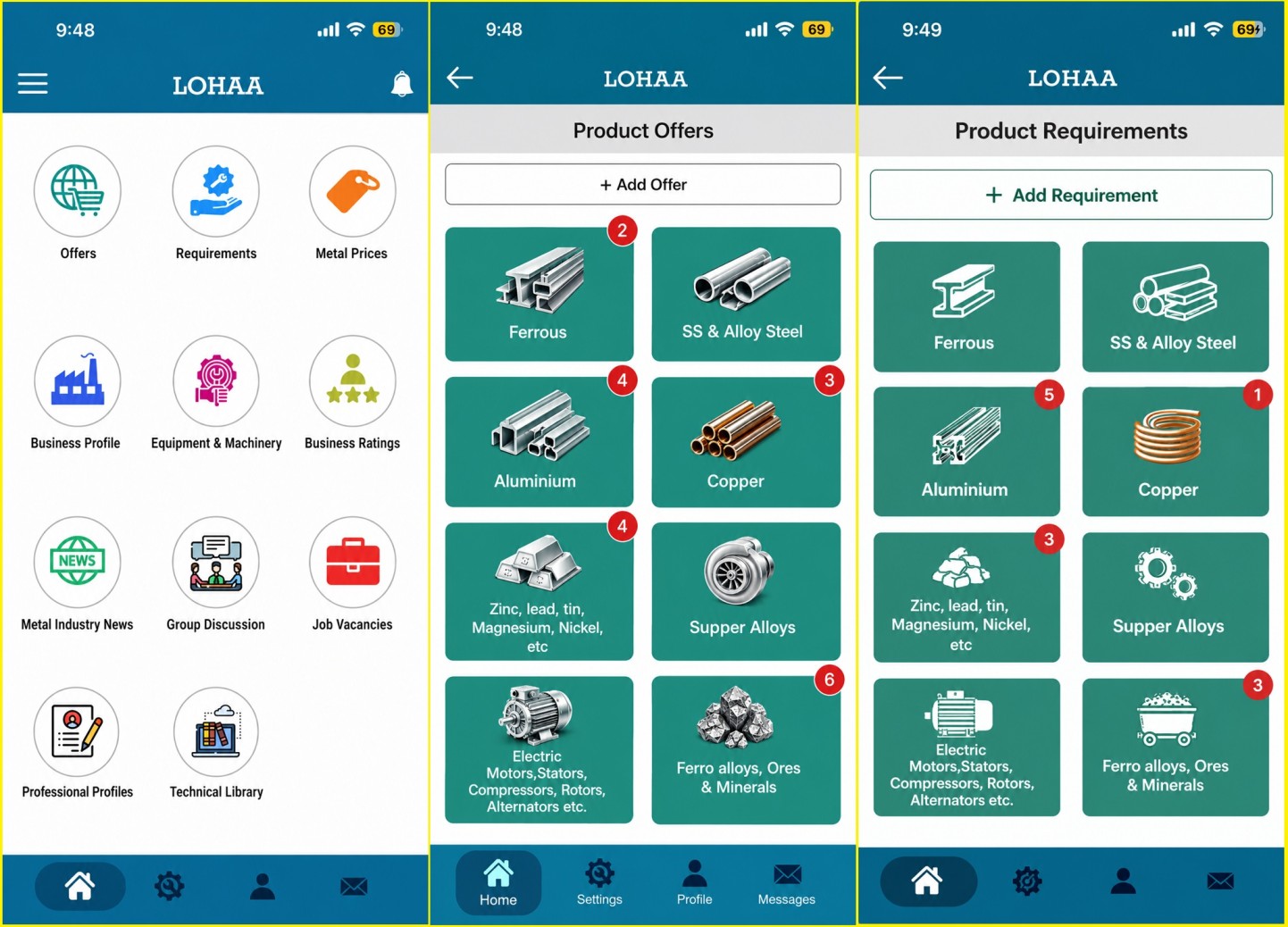
The LOHAA mobile platform is positioned as a B2B marketplace for ferrous and non-ferrous scrap, ferro alloys, ores, minerals, industrial machinery and related metal-industry transactions. (App Store)
Applications for aluminium businesses
Scrap buyers
Post requirements for:
• Aluminium scrap
• Tense
• Tabor
• Twitch
• Troma
• Zorba
• UBC
• Wheels
• Aluminium turnings
• Foundry returns
Scrap sellers
Publish:
• Quantity
• Alloy/grade
• Location
• Inspection terms
• Delivery terms
• Domestic/export offer
Foundries
Can use the platform to identify:
• Scrap suppliers
• Alloy ingot suppliers
• Ferro-alloy suppliers
• Machinery suppliers
• Used equipment
• Potential customers
The LOHAA App Android and iPhone also provides market rates/trends, machinery listings, verified business profiles, industry information and commercial offer/requirement functions.
16. Key Industry Figures at a Glance
Parameter Figure
- Global primary aluminium production, 2025: ~73.8 Mt
- China's primary aluminium production, 2025: ~44.2 Mt
- India's primary aluminium production, 2024 : ~4.2 Mt
- Global secondary aluminium supply, 2025 outlook: ~32 Mt
- Energy used: primary aluminium: 186 GJ/t
- Energy used: recycled aluminium: 8.3 GJ/t
- Energy saving through recycling: ~95.5%
- Primary aluminium carbon footprint :~15.1 t CO?e/t
- Recycled aluminium processing emissions: ~0.52 t CO?e/t
- China automotive Al-alloy use, 2025: ~5.9 Mt
- China automotive Al-alloy use, 2030 forecast :~8.67 Mt
- European automotive Al demand, 2030: ~4.2 Mt
- India aluminium demand, 2025: ~5.5 Mt
- India aluminium demand, 2033 projection: ~9.0 Mt
- EU CBAM definitive regime From 1 Jan 2026
Sources: IAI, IEA, European Aluminium, EU Commission, Indian government/industry sources. (Mysteel)
Conclusion
Aluminium is moving beyond its traditional role as a lightweight metal and is becoming a strategic engineering material for the next generation of mobility and manufacturing. Giga casting is changing vehicle architecture, while advanced Al-Si-Mg, Al-Mg-Si and micro-alloyed compositions are enabling stronger, more ductile and more integrated structural components. The replacement of selected cast-iron components, rapid EV adoption and increasing battery-enclosure requirements will further expand aluminium consumption. Equally important, recycling offers approximately 95% energy savings, making secondary aluminium central to future low-carbon manufacturing. For India, the opportunity is particularly large because domestic vehicle aluminium content remains substantially below mature markets. However, success requires investment in metallurgy, scrap segregation, process automation, testing, BIS compliance, carbon accounting and OEM qualification. CBAM will make product-level emissions increasingly important for exports. Indian foundries that combine advanced alloys + recycled metal + digital manufacturing + certification + global B2B connectivity can move from commodity casting toward high-value international engineering components.
References
1. International Aluminium Institute — Primary Aluminium Production and recycling data. (International Aluminium Institute)
2. International Energy Agency — Global EV Outlook 2025/2026, battery technology and EV trends. (IEA)
3. European Commission — Carbon Border Adjustment Mechanism, definitive regime and aluminium guidance. (Taxation and Customs Union)
4. Bureau of Indian Standards — Product certification, compulsory certification and manufacturer requirements. (BIS)
5. European Aluminium/Ducker research — Aluminium content in European vehicles. (Ducker Carlisle)
6. China Foundry Association — Chinese casting industry production data. (Expo China)
7. Research on vehicle giga casting — Journal of Alloys and Compounds, 2025. (ScienceDirect)
8. Rheinfelden Alloys — Silafont-36 technical data. (Rheinfelden Alloys)
9. Research on advanced HPDC alloys and Magsimal-59. (DOI)
10. Government of India, Ministry of Mines — Vision Document on Aluminium Metal for India. (Ministry of Mines)
11. NALCO — Annual/Sustainability reporting and Indian aluminium demand outlook. (NALCO)
12. LOHAA — Metal B2B marketplace and mobile application information. (App Store)
By using digital trade platforms like LOHAA Mobile application, you can reach global buyers, source quality material, and strengthen long-term partnerships.
Download the Lohaa Metal Trading App for Android to access live scrap prices and real-time market updates anytime, anywhere.
Download the Lohaa Metal Trading App for iOS to access live scrap prices and real-time market updates anytime, anywhere.
(Notes: market and production volume estimates are synthesized from public market reports and industrial press; exact tonne figures for materials are not centrally published in a single comprehensive public dataset, therefore the numeric projection above is a conservative, documented estimate built from available intelligence and reasonable regional share assumptions.)


