
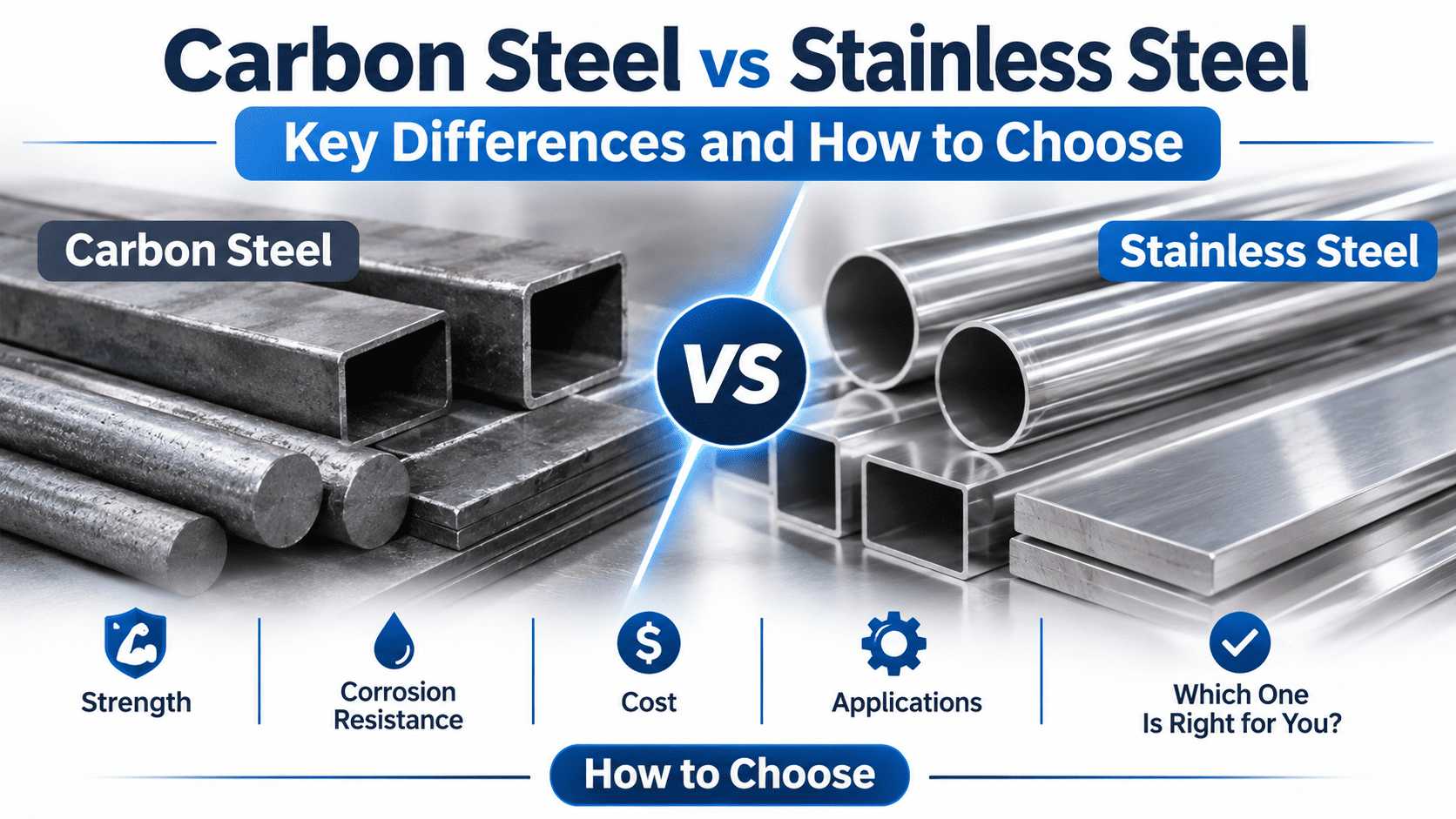
Carbon Steel vs Stainless Steel: Differences & Uses
Carbon steel is usually stronger per rupee and cheaper, but it rusts unless it is coated. Stainless steel resists rust on its own and costs more. For dry, structural work, carbon steel is normally the better buy. For wet, hygienic or coastal conditions, stainless earns back its premium. This guide covers the grades, the cost trade-offs and how to check what you are actually buying.
Both metals are iron-based alloys, and on a yard floor they can look alike. They behave very differently once they are welded, painted, left in the rain or put under load. In India, low-carbon steel is often called mild steel (MS), so you will see "mild steel vs stainless steel" used for the same comparison.
What is the difference between carbon steel and stainless steel?
The short answer is chromium. Stainless steel contains at least about 10.5% chromium, which forms a thin oxide film on the surface that blocks rust. Carbon steel has no such film, so its strength comes from carbon and its rust protection has to come from a coating.
Stainless steel also contains carbon, but very little. Common grades such as 304 and 316 cap it at 0.08%, and the low-carbon "L" versions cap it at 0.03%. Carbon steel runs from a few hundredths of a percent up to about 1.5%.
What is carbon steel?
Carbon steel is iron with carbon as its main alloying element, plus small amounts of manganese. The carbon content sets how it behaves:
- Low carbon (mild) steel has up to roughly 0.25% carbon. It is soft, ductile and easy to weld, and it makes up most structural sections, plates, rebar and sheet. IS 2062 is the usual Indian reference for structural steel.
- Medium carbon steel has roughly 0.25% to 0.6% carbon. It is stronger and harder, and it goes into shafts, gears, axles and forgings.
- High carbon steel has roughly 0.6% to 1.5% carbon. It is very hard and holds an edge, so it is used for springs, cutting tools and wire.
More carbon means more hardness and strength, but less ductility and harder welding.
What is stainless steel?
Stainless steel is steel with at least about 10.5% chromium. Nickel, molybdenum and other elements are added to improve toughness and corrosion resistance. These are the grades you will meet most often:
- 304 (18/8) is the general-purpose austenitic grade. It resists corrosion well, forms and welds easily, and is generally non-magnetic. You will find it in kitchens, food equipment, tanks and architecture.
- 316 is 304 with added molybdenum, which improves resistance to chlorides. It is the usual choice near the sea and in chemical and pharmaceutical plants.
- 430 is a ferritic grade with no nickel. It is magnetic and cheaper than 304, and it suits appliances and trim in mild environments.
- The low-nickel 200 series (201, 202) is widely traded in India as a cheaper option. Its corrosion resistance is clearly weaker than 304, so it fits indoor and decorative jobs better than wet or salty ones.
Carbon steel vs stainless steel at a glance
|
Factor |
Carbon steel |
Stainless steel |
|
Corrosion resistance |
Poor unless coated, galvanised or painted |
Good to excellent, depending on grade |
|
Strength and hardness |
High, and heat treatment can raise it further |
Good; austenitic grades work-harden, duplex grades are very strong |
|
Upfront cost |
Lower |
Higher, especially 304 and 316 |
|
Weldability |
Easy in low-carbon grades; high-carbon needs preheat |
Good, with the right filler and heat control |
|
Maintenance |
Needs coating or oiling |
Little beyond cleaning |
|
Appearance |
Dull grey, usually painted |
Bright finishes available |
|
Magnetic |
Yes |
304 and 316 mostly no; 430 yes |
|
Scrap value |
Lower |
Higher, driven by nickel and chromium content |
Corrosion resistance
Carbon steel rusts when it meets moisture and oxygen. Paint, galvanising, powder coating or regular oiling will hold that off, but the protection has to be maintained for the life of the part, and a scratch through the coating lets rust start underneath.
Stainless steel carries its protection inside the metal, and the oxide film re-forms after a scratch. It still has limits. Chlorides in coastal air or bleach can pit lower grades, which is why 316 is preferred near the sea and why 304 or 200-series grades can struggle there.
Strength and workability
For most structural work, carbon steel gives more strength for the money. It also cuts and machines more easily, and it responds well to heat treatment. Austenitic stainless work-hardens as you cut and form it, so it needs sharp tools and slow, steady machining. In return it stays tough at low temperatures and holds up at high ones.
Cost: purchase price vs lifetime cost
Carbon steel almost always wins on price per tonne. Stainless costs more because of the chromium and nickel in it, and its price moves with the global nickel market.
The cheaper metal is not always the cheaper choice. Once you add painting, recoating, shutdowns and replacement, stainless can come out ahead in wet, hygienic or hard-to-reach applications. For a dry indoor frame nobody will touch again, carbon steel is usually the smarter buy.
Where each one fits best
Uses of carbon steel
- Building frames, beams, columns and general fabrication
- Reinforcement bars and construction work
- Machinery parts, shafts, gears and forgings
- Pipelines and pressure vessels in non-corrosive service
- Tools, springs and wear parts (high-carbon grades)
Uses of stainless steel
- Food, dairy, beverage and pharma equipment
- Kitchens and hospitals, where hygiene matters
- Chemical, marine and coastal installations (316)
- Architectural cladding, railings and lifts
- Storage tanks and process piping where rust would contaminate the product
How to tell carbon steel from stainless steel
A magnet separates carbon steel and 430 from 304 and 316, since those two are mostly non-magnetic. It is not a full test. Cold-worked 304 can pick up some magnetism, and a magnet cannot tell 304 from a 202. A spark test helps too: carbon steel throws bright, branching sparks, while stainless throws fewer and shorter ones.
For a purchase, ask for the mill test certificate (MTC), which lists chemistry and mechanical properties against the grade you ordered. If the order is large or the supplier is new, positive material identification (PMI) testing settles the grade on the spot.
Tips for buying
- Define the environment first: indoor or outdoor, dry or wet, coastal or inland, food contact or not. This decides the grade more than anything else.
- Check finish and thickness tolerance as well as grade, since both affect price and performance.
- Compare current market rates before you commit. Steel and stainless prices move often, so last month's quote may not be fair today.
Frequently asked questions
Is stainless steel stronger than carbon steel?
Not necessarily. Many carbon steels are harder and stronger than common stainless grades. Stainless wins on corrosion resistance, and duplex grades combine high strength with it.
Are carbon steel and stainless steel the same thing?
No. Both are steel, but stainless contains at least 10.5% chromium and carbon steel does not. That chromium is what lets stainless resist rust.
Which is better for cooking, carbon steel or stainless steel?
Stainless steel needs no seasoning and does not react with acidic food, so it is the easier choice. Carbon steel pans heat quickly and can build a non-stick seasoned surface, but they rust if left wet and need more care. This post focuses on industrial metal, so check the cookware maker's guidance for a specific pan.
Can carbon steel be made rust resistant?
Yes. Galvanising, painting, powder coating and plating all work, and weathering steel forms a stable rust layer outdoors. None match stainless in harsh, wet conditions, but they are often good enough and far cheaper.
Which is easier to weld?
Low-carbon steel is the easiest. Stainless welds well with the right filler and heat control, but it can distort and lose corrosion resistance if it gets too hot.
Is stainless steel scrap worth more than carbon steel scrap?
Usually yes, because of its nickel and chromium content. Correct grade identification matters a great deal when you sell stainless scrap.
Which one should you choose?
Pick carbon steel when the part is dry or well protected and strength per rupee matters most. Pick stainless when the part will sit in water, salt, chemicals or food, and when repainting or replacing it would cost more than the premium. Start from the conditions the metal will face, choose the grade second, and confirm it with test certificates.
If you buy or sell ferrous and non-ferrous metals, LOHAA is a metal trading marketplace that connects buyers and sellers across the industry and publishes daily metal prices.


