
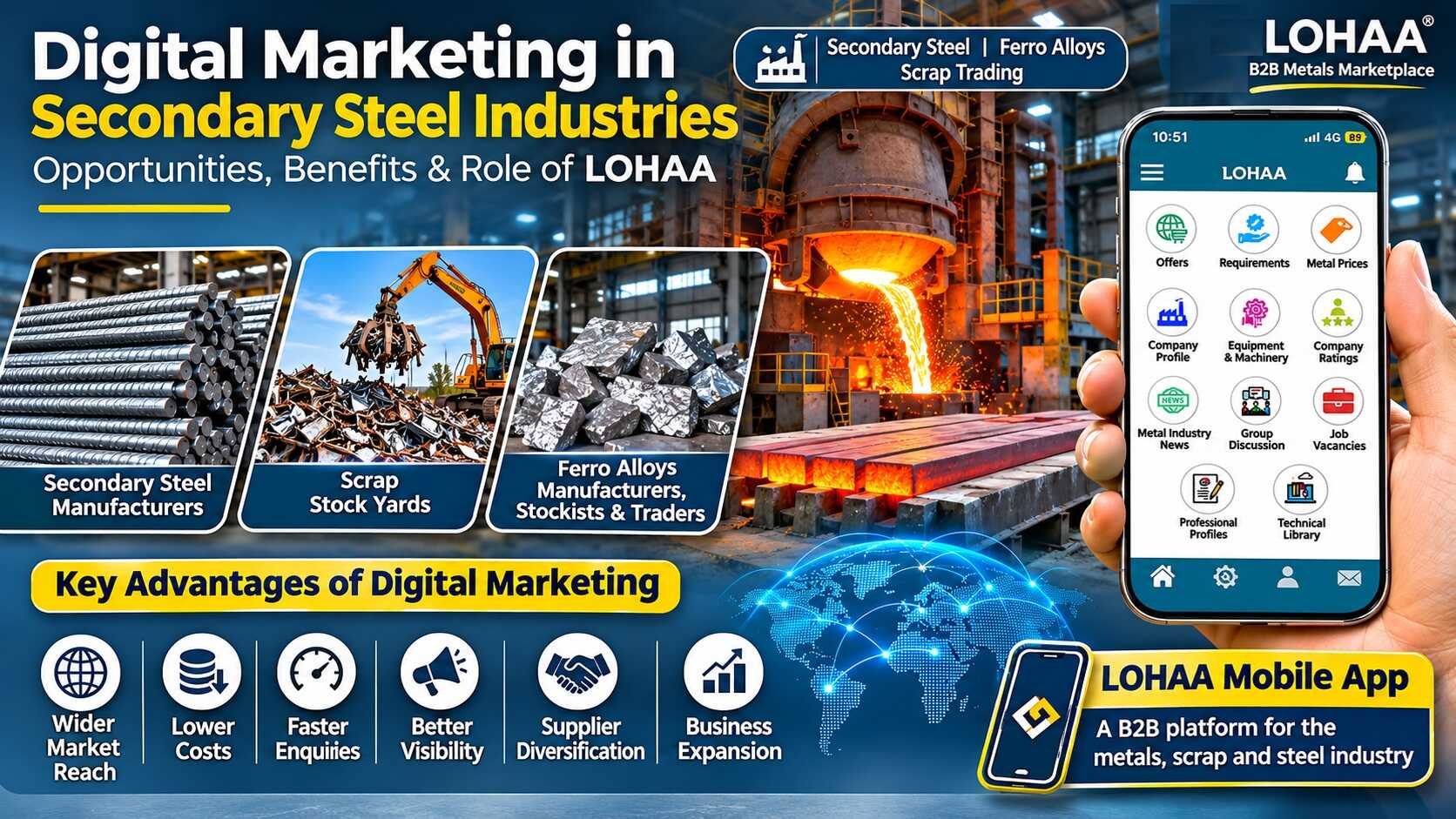
Digital Marketing in Secondary Steel Industries
1. Introduction
Digital marketing is transforming how secondary steel manufacturers, ferro alloy producers, scrap stockyards, traders and industrial buyers discover suppliers, compare offers and develop business relationships.
Traditionally, India's secondary steel industry has relied on personal contacts, brokers, telephone enquiries, physical visits and long-established supplier networks. Although these methods remain important, digital platforms increasingly help businesses identify new customers, improve market visibility and reduce the time required to source raw materials.
Secondary steel manufacturers depend on ferrous scrap, sponge iron, pig iron, ferro alloys and other inputs to manufacture billets, ingots, TMT bars, structural steel and alloy steel products.
Digital marketing provides opportunities to connect these businesses through websites, B2B marketplaces, mobile applications, search engines and professional networking platforms.
This article examines digital marketing adoption, opportunities, challenges and the role of LOHAA in the secondary steel and ferro alloy industries.
2. Digital Marketing Usage in Secondary Steel Industries
Digital marketing in secondary steel refers to using online channels to promote products, locate suppliers, publish buying requirements, obtain quotations and develop industrial trading relationships.
Major digital marketing channels include:
a) B2B marketplaces: Connect manufacturers, scrap suppliers, stockists and industrial buyers.
b) Mobile applications: Enable enquiries, product listings and direct communication.
c) Search engine optimisation (SEO): Helps suppliers appear in Google and Bing searches.
d) WhatsApp and email marketing: Communicate product availability and quotations.
e) LinkedIn: Develop professional connections with procurement teams.
f) Company websites: Display product specifications, certifications and manufacturing capabilities.
Unlike consumer e-commerce, secondary steel transactions generally require technical verification, commercial negotiations, logistics arrangements and quality assurance.
3. How Successful Is Digital Marketing in Secondary Steel?
Digital marketing can be particularly effective for supplier discovery, lead generation, market intelligence and business expansion.
Its success should be measured through qualified enquiries, quotations, customer acquisition, repeat orders and completed transactions rather than website traffic alone.
|
Business activity |
Digital marketing benefit |
|
Supplier discovery |
Wider sourcing network |
|
Scrap procurement |
Faster enquiry circulation |
|
Ferro alloy marketing |
Access to new industrial buyers |
|
Finished steel sales |
Wider regional visibility |
|
Price comparison |
Improved market transparency |
|
Export marketing |
International buyer discovery |
Digital marketing works best when online enquiries are supported by verified product specifications, reliable communication and established commercial procedures.
4. Digital Marketing for Manufacturers
4.1 Secondary Steel Manufacturers
Induction furnace operators, rolling mills and secondary steel producers can use digital platforms to source scrap, sponge iron, pig iron, ferro alloys and other inputs.
Manufacturers can also promote MS billets, ingots, TMT bars, wire rods and structural steel to industrial customers.
Online marketing can improve procurement planning, reduce dependence on limited supplier networks and support enquiries from new geographical markets.
4.2 Ferro Alloy Manufacturers
Ferro silicon, silico manganese, ferro manganese, ferro chrome and other ferro alloy producers can reach steelmakers, foundries and international buyers through digital channels.
Technical product listings should include chemical composition, size, packing, available quantity, origin and delivery location.
These details help buyers assess suitability before requesting samples or negotiating contracts.
5. Digital Marketing for Scrap Stockyards
Ferrous scrap stockyards are essential suppliers to secondary steel manufacturers.
They handle materials such as HMS 1&2, shredded scrap, plate and structural scrap, turning scrap and industrial steel scrap.
Digital platforms allow stockyards to advertise available quantities, grades, loading locations and delivery conditions.
For example, a scrap yard holding 200 tonnes of HMS scrap can publish an offer and receive enquiries from multiple induction furnace operators.
This can improve stock visibility and potentially reduce inventory holding periods. However, material inspection, weighment, contamination checks and payment verification remain essential.
6. Digital Marketing for Ferro Alloy Stockists and Traders
Ferro alloy stockists and traders connect manufacturers with steel plants, foundries and specialised alloy producers.
Digital marketing helps them communicate stock availability, chemical specifications, delivery schedules and import offers.
A trader holding ferro silicon 70–75% or silico manganese 60/14 can reach potential customers beyond existing telephone-based networks.
Digital platforms are particularly useful for locating buyers for specialised grades, comparing supplier offers and expanding into new regions.
7. Key Advantages and Opportunities
|
No. |
Advantage |
Business opportunity |
|
1 |
Wider market access |
Reach domestic and export customers |
|
2 |
Lower promotional costs |
Reduce dependence on traditional advertising |
|
3 |
Faster communication |
Shorten enquiry response times |
|
4 |
Product visibility |
Promote available scrap and alloys |
|
5 |
Supplier diversification |
Identify alternative raw-material sources |
|
6 |
Market intelligence |
Monitor prices and industry developments |
|
7 |
Direct networking |
Build manufacturer-to-manufacturer relationships |
|
8 |
Digital records |
Improve enquiry and quotation tracking |
|
9 |
MSME participation |
Give smaller companies wider visibility |
|
10 |
Business expansion |
Develop customers in new industrial regions |
Digital marketing also creates opportunities for inventory-based selling, export enquiries, procurement analytics and more structured customer relationship management.
8. Top 10 Countries for Digital B2B Steel Marketing
The following countries are important markets for industrial steel trading and digital supplier discovery. This is an indicative list based on industrial and trading relevance, not a statistically verified ranking of digital marketing adoption.
|
No. |
Country |
Digital marketing opportunity |
|
1 |
China |
Steel, ferro alloys and industrial sourcing |
|
2 |
India |
Secondary steel, scrap and MSME trading |
|
3 |
United States |
Scrap recycling and industrial procurement |
|
4 |
Germany |
Specialised steel and industrial supply chains |
|
5 |
Türkiye |
Ferrous scrap imports and steel exports |
|
6 |
Japan |
Quality-focused industrial sourcing |
|
7 |
South Korea |
Steel and alloy procurement |
|
8 |
Vietnam |
Growing steel manufacturing networks |
|
9 |
United Arab Emirates |
Regional steel and scrap trading |
|
10 |
Italy |
Electric arc furnace steel and scrap sourcing |
Digital opportunities differ significantly by country, business size, product category and purchasing practices.
9. Digital Marketing vs Direct Marketing: Percentage of Usage
There is currently no reliable, publicly established global percentage specifically measuring digital versus direct marketing transactions in the secondary steel and ferro alloy industries.
However, broader industrial e-commerce statistics demonstrate growing digital participation.
According to Eurostat, 23.59% of EU enterprises recorded electronic sales in 2024, across covered industries. This figure should not be interpreted as the percentage of secondary steel transactions completed digitally.
European Commission
All covered EU enterprises, not secondary steel specifically. The remainder includes enterprises without recorded e-sales, not necessarily exclusively direct marketers.
For secondary steel companies, a practical approach is to combine digital lead generation with traditional commercial negotiations, inspections and supplier relationships.
Companies can measure their own digital adoption using the percentage of enquiries received online, quotations generated digitally and orders secured through digital leads.
10. Why Secondary Steel Industries Have Not Fully Adopted Digital Marketing
Several operational and commercial factors limit complete digital adoption.
a) Quality verification: Scrap grades, contamination and alloy chemistry often require physical inspection or laboratory testing.
b) Established relationships: Long-term supplier networks remain central to procurement.
c) Price volatility: Scrap and ferro alloy prices can change rapidly.
d) Payment risks: Buyers and sellers require financial verification and secure payment terms.
e) Limited digital skills: Some MSMEs lack trained digital marketing personnel.
f) Logistics complexity: Freight, loading, weighment and delivery influence final costs.
g) Trust concerns: Businesses may hesitate to engage with unfamiliar online counterparties.
These challenges indicate that a hybrid digital and traditional trading model is currently more practical than fully automated online purchasing for many businesses.
11. Role of LOHAA Mobile Application in Secondary Steel Industries
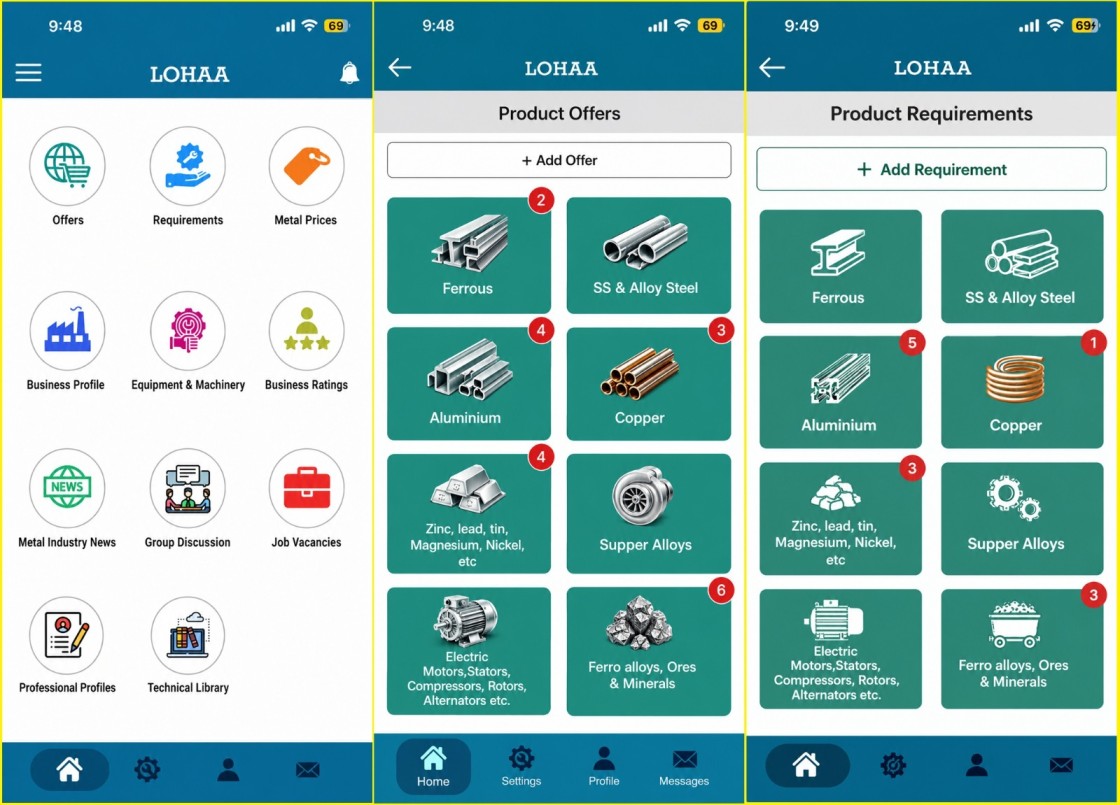
LOHAA Mobile Application
LOHAA Mobile Application of Android and iPhone / Portal digital marketplace is business-focused connecting
participants in the metals, scrap, steel, ferro alloy and recycling industries.
11.1 Opportunities for Secondary Steel Businesses
LOHAA enables participating businesses to publish buying requirements, advertise available materials, communicate with potential customers and follow market developments.
Its business-oriented features include company profiles, offers, enquiries, direct messaging, group communication and market news.
11.2 Benefits for MSMEs and Industrial Traders
For smaller secondary steel manufacturers and scrap stockyards, LOHAA provides an additional channel to reach prospective industrial buyers without depending exclusively on established contacts.
Ferro alloy manufacturers and traders can promote available grades, quantities and delivery locations to relevant businesses.
The platform can support supplier discovery and business networking, while buyers and sellers remain responsible for verifying specifications, commercial terms and counterparty reliability.
12. Conclusion
Digital marketing is becoming an important business development tool for secondary steel manufacturers, scrap stockyards, ferro alloy producers and industrial traders.
Its greatest advantages include wider market reach, faster enquiries, improved product visibility and opportunities for supplier diversification.
Nevertheless, physical inspection, quality certification, commercial negotiations and established business relationships remain essential.
The future of secondary steel marketing is likely to be hybrid: digital platforms for discovery and communication, supported by trusted industrial trading practices.
Platforms such as LOHAA can help manufacturers, MSMEs and traders participate in this transition and expand their business networks.
13. Top 10 Frequently Asked Questions
1. What is digital marketing in secondary steel?
It involves using websites, B2B marketplaces, mobile apps and online communication to promote and source steel, scrap and ferro alloys.
2. Can secondary steel manufacturers purchase scrap digitally?
Yes. They can discover suppliers and negotiate online, while arranging material verification, logistics and payments separately.
3. How does digital marketing benefit ferro alloy manufacturers?
It increases visibility among steel plants, foundries, stockists and potential international customers.
4. Is digital marketing suitable for small scrap stockyards?
Yes. It helps smaller yards advertise stock and reach industrial buyers beyond their existing networks.
5. Which countries offer digital steel trading opportunities?
China, India, the US, Germany, Türkiye, Japan, South Korea, Vietnam, the UAE and Italy are relevant markets.
6. What percentage of secondary steel trading is digital?
No verified global sector-specific percentage is available. Companies should measure digital enquiries and completed orders internally.
7. Can digital marketing replace traditional steel trading?
Not completely. Inspections, credit checks, logistics and relationship-based negotiations remain important.
8. What information should ferro alloy sellers publish?
Chemical composition, size, quantity, packing, origin, delivery location and relevant certificates.
9. How does LOHAA support secondary steel industries?
It provides business listings, buying requirements, selling offers, communication features and metals market information.
10. What is the future of digital marketing in secondary steel?
Greater online supplier discovery, digital quotations, procurement analytics and integration with traditional industrial trading.
14. References
1. World Steel Association – World Steel in Figures 2026. Global steel production and country statistics.
2. World Steel Association – Steel Statistical Yearbook 2025. Steel production, trade and scrap statistics.
3. Eurostat – E-commerce Statistics, October 2026. Enterprise electronic sales and digital commerce indicators.
4. OECD – Digital Transformation. Digitalisation and business adoption context.
5. LOHAA – B2B Metals Marketplace. Platform and business services.
Research note: Country opportunities are qualitative assessments. No unverified secondary-steel-specific digital adoption percentages or sales performance claims have been presented as established facts.


