
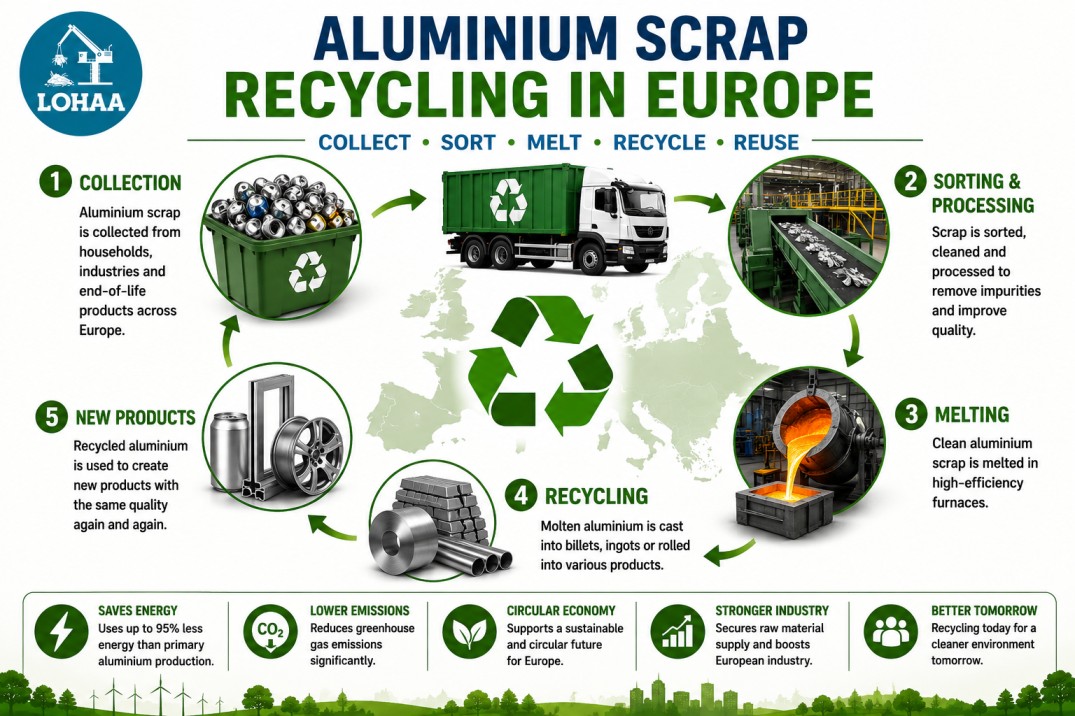
Europe Aluminium Scrap Recycling Market 2026
Introduction
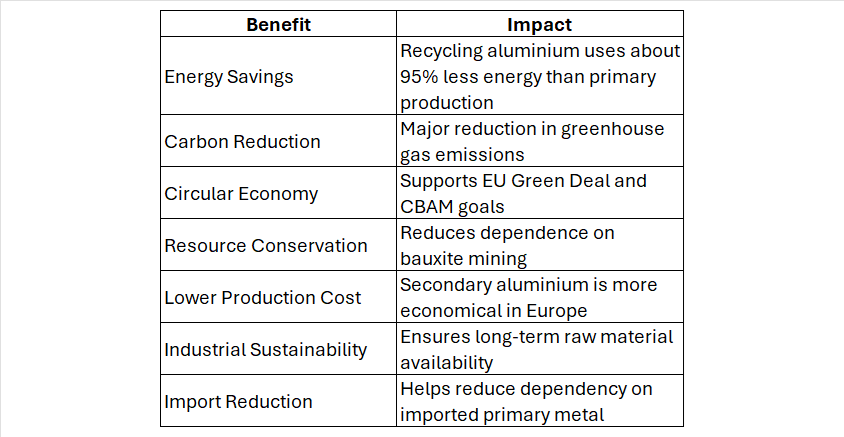
Europe’s aluminium industry is undergoing a major transformation driven by sustainability regulations, energy transition policies, carbon reduction targets, and increasing dependence on recycled aluminium. Secondary aluminium production has become strategically important because recycled aluminium requires nearly 95 percent lower energy consumption compared to primary aluminium production.
European countries are increasingly focusing on domestic scrap collection, closed-loop recycling systems, beverage can recycling, automotive aluminium recovery, and industrial scrap processing. The transition toward electric vehicles, renewable energy infrastructure, lightweight transportation, and sustainable packaging is significantly increasing aluminium demand across the region.
At the same time, Europe faces major challenges such as rising energy costs, dependence on imported primary aluminium, limited domestic scrap availability for certain alloy categories, and growing competition from Asian scrap buyers.
According to the International Aluminium Institute, Europe remains one of the world leaders in aluminium recycling efficiency with recovery rates above 80 percent in several applications. (international-aluminium.org)
Importance of Aluminium Recycling
Key Benefits
Strategic Importance in Europe
• Aluminium recycling supports EU decarbonisation targets.
• Automotive light weighting increases demand for recycled alloys.
• Beverage can recycling systems are expanding rapidly.
• Construction and transport sectors rely heavily on secondary aluminium.
• Europe is attempting to reduce aluminium scrap exports to retain domestic supply.
Reuters reported that EU aluminium scrap exports reached approximately 1.26 million tonnes in 2024, increasing pressure on domestic recyclers. (reuters.com)
Applications of Secondary Aluminium in European Countries
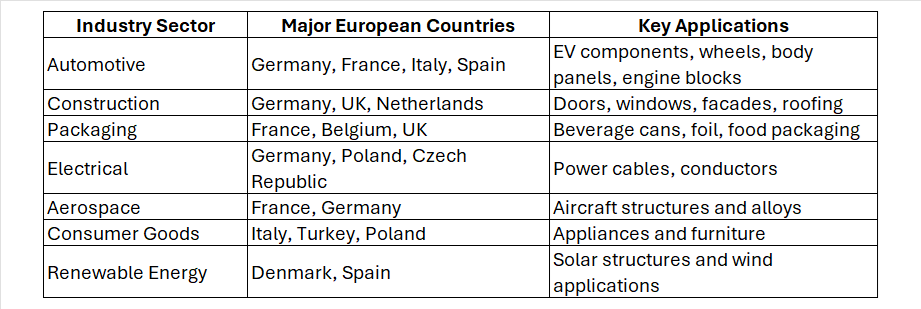 Major Secondary Aluminium Consuming Industries
i) Automotive die casting
ii) Packaging rolling mills
iii) Extrusion plants
iv) Foundries
v) Construction product manufacturers
vi) Electrical transmission manufacturers
Worldwide Aluminium Demand by Continent
Estimated 2025 Aluminium Demand (Million Tonnes)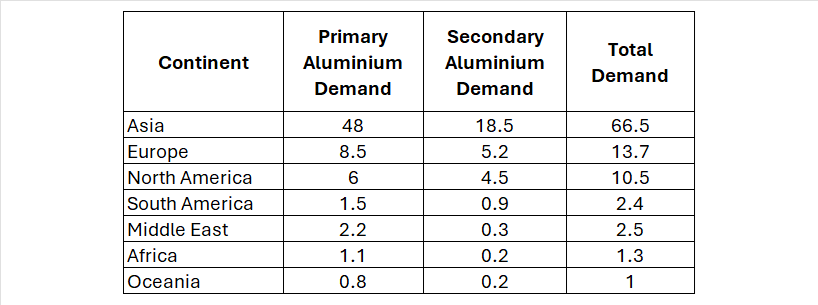 Global Market Highlights
• China dominates global primary aluminium production.
• Europe depends heavily on imports and recycling.
• Secondary aluminium demand is growing faster than primary demand.
• Automotive and packaging sectors remain key growth drivers.
Global primary aluminium production crossed 73 million tonnes in 2025 according to industry estimates. (alcircle.com)
Sources of Aluminium Scrap in Europe
Major Scrap Categories
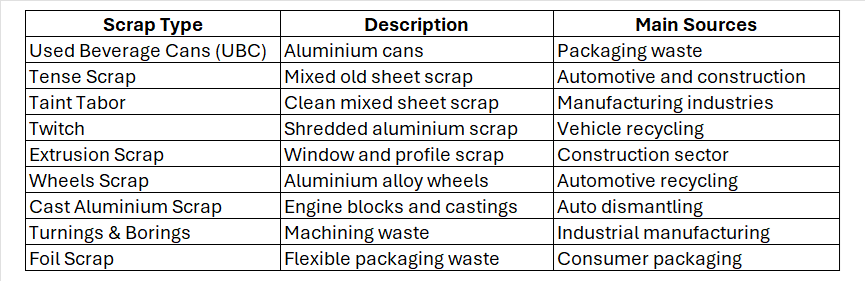
Country-wise Aluminium Scrap Sources in Europe
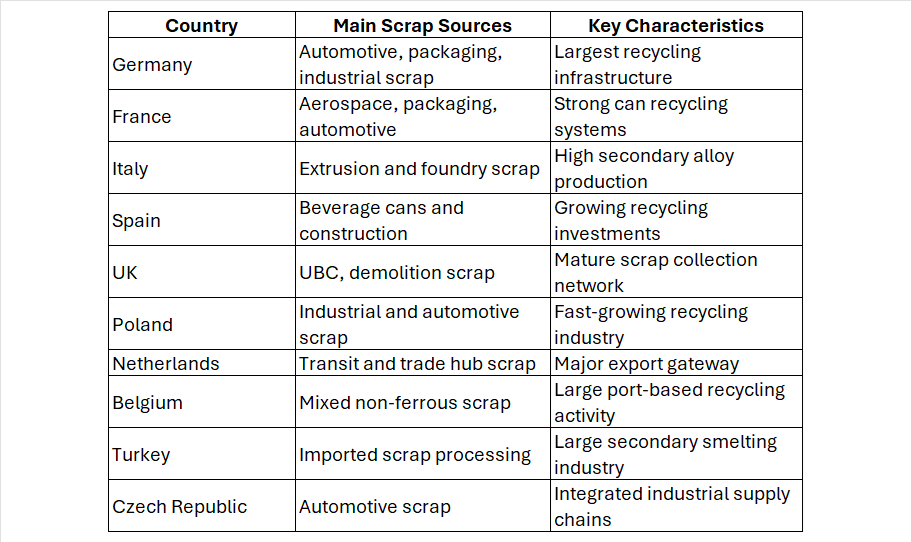 Country-wise Domestic Recycling of Aluminium Scrap in Europe
Estimated Domestic Recycling Quantities by Scrap Type (2025)
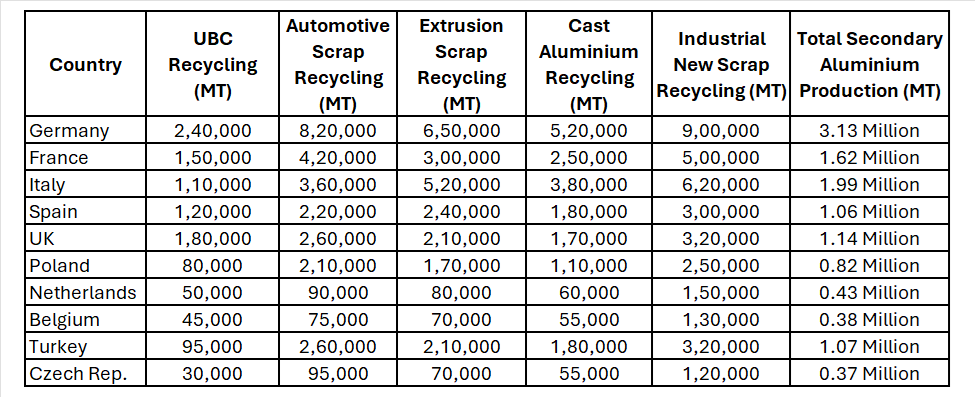
Key Observations
• Germany remains Europe’s largest secondary aluminium producer.
• Italy has strong extrusion and foundry recycling infrastructure.
• Turkey heavily depends on imported aluminium scrap for alloy production.
• Beverage can recycling rates in Europe exceeded 76% in 2025. (alcircle)
• Europe increasingly relies on recycled aluminium due to declining primary smelting capacity. (OilPrice.com)
Europe Country-wise Aluminium Scrap Surplus or Deficit
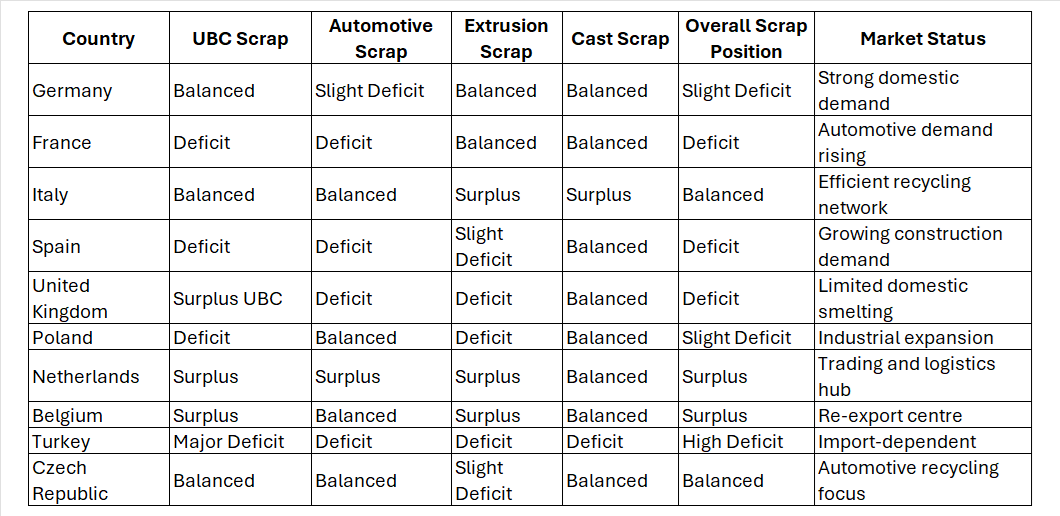 European Market Trends
• EU aluminium scrap exports reached around 1.26 million tonnes in 2024, increasing concerns about domestic shortages. (Reuters)
• About 75% of EU aluminium scrap exports move toward Asian markets. (European Aluminium)
• Europe faces increasing scrap competition from the United States and Asia. (Reuters)
• European regulators are considering export restrictions to protect domestic recycling industries. (Reuters)
Country-wise Aluminium Recycling Cost in Europe (2025)
Estimated Recycling Cost Structure (USD per tonne) approximate value, material cost is extra 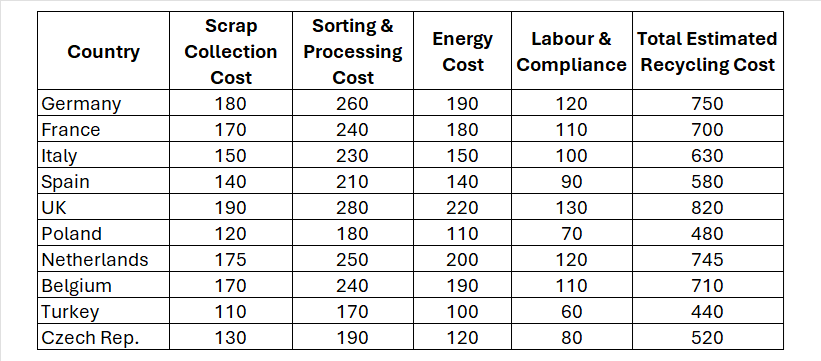
Main Cost Drivers
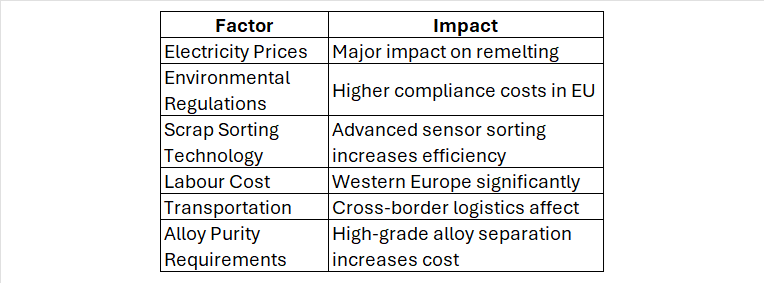 Market Insights
• European recyclers face rising energy and environmental compliance costs. (Discovery Alert)
• Scrap shortages are pushing secondary aluminium prices higher across Europe. (S&P Global)
• Europe’s recycling sector increasingly depends on stable scrap supply chains to maintain production. (European Aluminium)
Domestic Recycling Capacity in Europe
Country-wise Recycling Capacity & Domestic Fulfilment
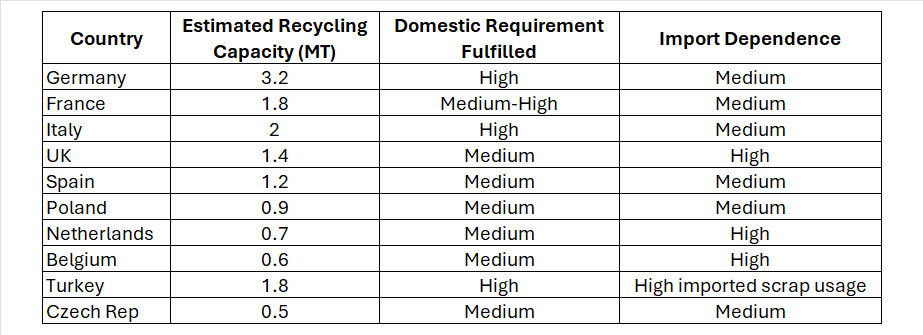
Key Observations
• Germany leads Europe in aluminium scrap processing.
• Italy is a major secondary aluminium producer.
• Turkey imports significant quantities of scrap for secondary alloy production.
• The UK relies heavily on imports after domestic smelting decline.
• Europe overall remains dependent on imported primary aluminium.
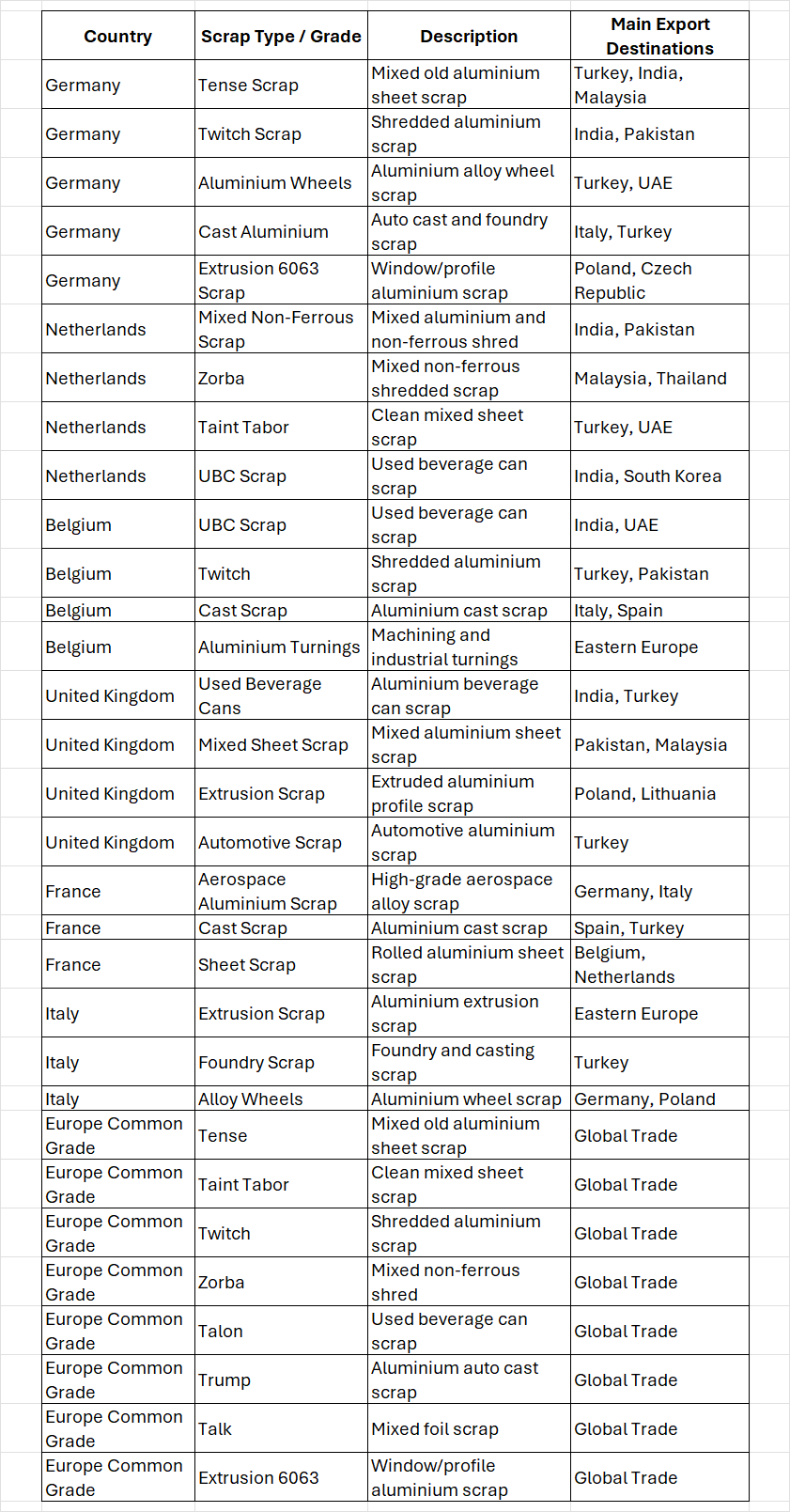
Aluminium Scrap Export Trade Flow
Major Aluminium Scrap Exporting Countries in Europe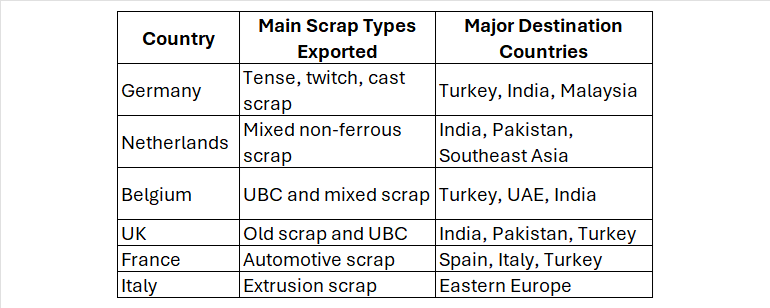
Major Importing Countries Outside Europe
1. India
2. Turkey
3. Malaysia
4. Pakistan
5. UAE
6. South Korea
7. Thailand
Common Exported Scrap Grades
• Tense
• Taint Tabor
• Twitch
• Zorba
• Aluminium Wheels
• UBC
• Extrusion 6063 Scrap
• Cast Aluminium Scra
Europe Aluminium Scrap Export Trade Flow & Common Scrap Grades
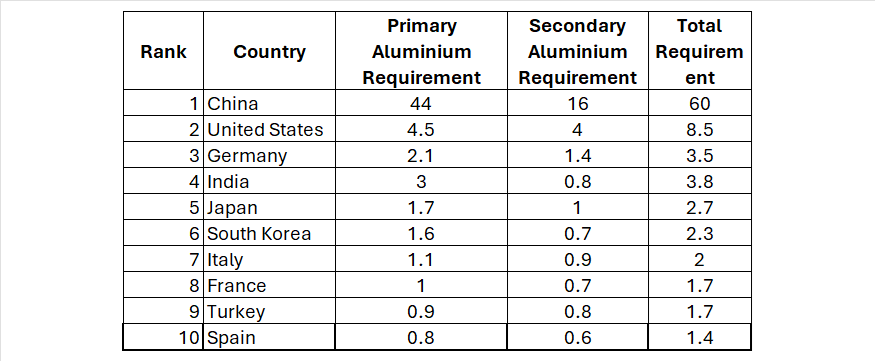
 Top 10 Countries by Aluminium Requirement
Estimated Annual Aluminium Requirement (Million Tonnes)
 European Aluminium Recycling Trends
Emerging Trends
a). Closed-loop Recycling: Automotive and beverage companies are increasingly adopting closed-loop recycling systems.
b). CBAM & Sustainability Regulations: European carbon policies are encouraging low-carbon secondary aluminium production.
c). Scrap Export Restrictions: Europe is considering restrictions on scrap exports to protect domestic recycling capacity.
d). AI-Based Scrap Sorting: Advanced sensor-based sorting and AI technologies are improving scrap purity.
e). EV Growth: Electric vehicle manufacturing is increasing demand for recycled aluminium alloys.
f). Beverage Can Recycling Expansion: Europe achieved aluminium beverage can recycling rates above 76 percent in 2023. (aluminiumtoday.com)
Effect of CBAM on Aluminium Scrap Exports
What is CBAM?
The European Union’s Carbon Border Adjustment Mechanism (CBAM) imposes carbon-related costs on imported carbon-intensive products including aluminium. CBAM aims to protect EU industries from “carbon leakage” by equalising carbon costs between domestic and imported products. (Taxation and Customs Union)
Impact of CBAM on Aluminium Scrap & Secondary Aluminium
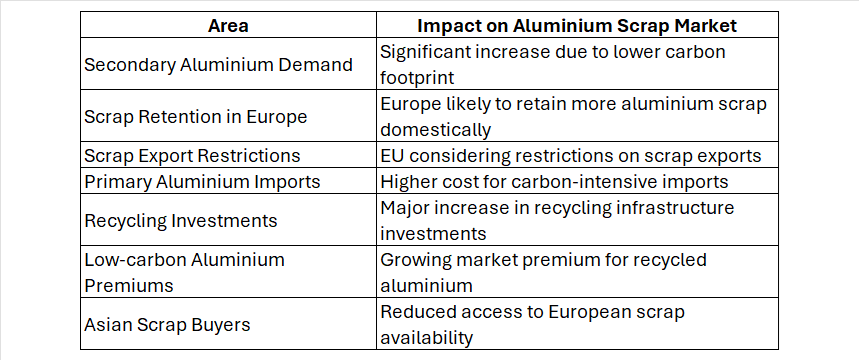
Major CBAM Effects
a)Increased Domestic Scrap Consumption
European recyclers are aggressively increasing domestic aluminium scrap procurement because recycled aluminium carries significantly lower carbon emissions compared to primary aluminium.
b). Reduced Scrap Exports
The EU is increasingly concerned that exporting aluminium scrap weakens Europe’s circular economy objectives. Discussions around export restrictions and strategic scrap retention are intensifying. (European Aluminium)
c). Higher Value for Secondary Aluminium
Secondary aluminium producers are benefiting because automotive and packaging companies prefer low-carbon aluminium supply chains.
d). Increased Compliance Cost
Exporters supplying aluminium products into Europe now face carbon reporting and verification costs under CBAM. (Vajiram and Ravi)
Countries Most Affected by CBAM
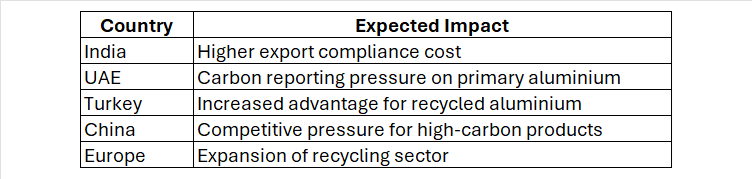 Strategic Industry Shift
CBAM is accelerating:
• Aluminium recycling investments
• Closed-loop recycling systems
• Domestic scrap collection
• Green aluminium certification
• Scrap retention policies in Europe
Reuters estimates aluminium imports into Europe may face carbon costs ranging from €50–168 per tonne depending on origin and carbon intensity. (Reuters)
Effect of Gulf War on Aluminium Scrap Generation & Exports
Gulf Conflict Impact on Global Aluminium Market
The Gulf region contributes around 8–9% of global primary aluminium production, making the Middle East strategically critical for world aluminium supply.
Major Effects on Aluminium Scrap Market
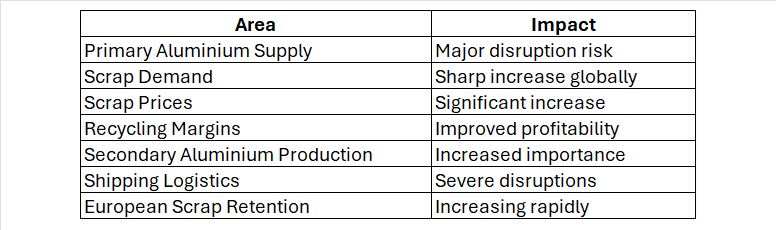
Impact on Aluminium Scrap Generation
a). Increased Recycling Activity
Higher aluminium prices encourage:
• Greater scrap collection
• Faster recycling turnover
• Increased industrial scrap recovery
• Improved automotive dismantling
b). Reduced Export Availability
Many countries are retaining scrap domestically due to:
• Supply insecurity
• High metal premiums
• Energy market volatility
c). Logistics & Shipping Disruptions
The Strait of Hormuz disruption has severely affected:
• Scrap movement
• Alumina shipments
• Aluminium exports from GCC countries
• Container freight costs
Reuters reported that aluminium prices surged to four-year highs amid Gulf supply disruption fears. (Reuters)
Impact on Europe
 Impact on India
India imports substantial quantities of aluminium scrap from the Middle East and Europe. Supply disruptions have:
• Increased aluminium scrap prices
• Reduced import availability
• Forced secondary producers to cut output
• Increased automotive alloy costs
Reuters reported Indian secondary aluminium producers reduced operations by 20–40% due to Middle East scrap disruptions. (Reuters)
Future Outlook
The European aluminium recycling industry is expected to grow strongly over the next decade due to:
• Green energy transition
• Electric vehicle expansion
• Circular economy regulations
• Packaging sustainability targets
• Carbon reduction commitments
• Reduced availability of low-cost primary aluminium
Secondary aluminium is likely to become Europe’s most strategic non-ferrous raw material. Increasing investments in scrap processing infrastructure, advanced alloy separation technologies, and domestic recycling systems will shape the future of the industry.
Europe’s dependence on recycling is expected to rise further as primary smelting capacity remains constrained by energy prices and carbon policies.
Here’s a country-wise list of some of the most reputed aluminium scrap yards, recyclers, and exporters in Europe. These companies are widely active in global aluminium scrap trading, recycling, zorba/twitch/taint-tabor exports, secondary aluminium production, and non-ferrous metal recovery.
Germany
Germany is Europe’s largest aluminium scrap processing and export hub, especially for twitch, tense, taint-tabor, extrusion scrap, wheels, and cast aluminium. (Volza)
Major Companies
• EMR European Metal Recycling
• EMR Duisburg
• Scanmetals Deutschland GmbH
• Thyssen Dück commodity trading GmbH & Co. KG
• RMR - Rhein Main commodities GmbH
• WEICK Recycling GmbH
• SM Metals GmbH
• ISR Itzehoer scrap and recycling GmbH & Co. KG
• Aluminium-Krüger GmbH
• Scholz Recycling GmbH
• TSR Recycling GmbH
• Indra Recycling GmbH
• Nord Schrott GmbH & Co. KG
Main Export Destinations
India, Turkey, Pakistan, Malaysia, Thailand, UAE, Poland, Czech Republic.
Netherlands
The Netherlands is a major European export gateway due to Rotterdam Port and strong logistics infrastructure. (Volza)
Major Companies
• Overdie Metals B.V.
• Reukema Blocq & Maneschijn B.V.
• Myne Circular Metals B.V.
• Jansen Recycling Group
• HKS Metals
• Sims Lifecycle Services Netherlands
• Europe Metals B.V.
Common Scrap Grades
Zorba, Twitch, Mixed Aluminium Scrap, Taint-Tabor, UBC Scrap.
Main Export Markets
India, Malaysia, Indonesia, Thailand, Pakistan, Turkey.
United Kingdom
The UK remains a major exporter of aluminium scrap despite Brexit, especially twitch and mixed non-ferrous scrap. (Volza)
Major Companies
• European Metal Recycling (EMR)
• Sims Metal UK
• European Metal Recycling Limited
• Tandom Metallurgical Midlands Ltd
• Evmet Ltd
• Sackers Metals
• John Lawrie Metals
Main Export Destinations
India, Turkey, UAE, Pakistan, Bangladesh.
Belgium
Belgium is a strong trading and redistribution hub for European non-ferrous scrap.
Major Companies
• Galloo Recycling
• Comet Group
• Recymet
• Metallo Group
• Aurubis Belgium
• Van Dalen Metals Recycling
Main Export Destinations
India, Turkey, China, Southeast Asia.
France
France has a strong automotive and industrial aluminium scrap recycling network.
Major Companies
• Derichebourg Recycling
• Veolia Metal Recycling
• Ecore Group
• Guy Dauphin Environnement (GDE)
• Baudelet Environnement
Main Scrap Types
Cast aluminium, wheels scrap, extrusion scrap, mixed aluminium.
Italy
Italy is both a large consumer and exporter of secondary aluminium scrap.
Major Companies
• Raffmetal
• Montello S.p.A.
• Metra Group Recycling
• Centro Rottami
• Metalleghe Recycling
Main Export Destinations
Turkey, India, Eastern Europe.
Spain
Spain exports large quantities of mixed non-ferrous and aluminium scrap.
Major Companies
• Recuperaciones Masnou
• Lyrsa Recycling
• Ferimet
• Sims Metal Spain
• Recuperaciones Perez
Poland
Poland has become an important secondary aluminium and scrap processing center in Eastern Europe.
Major Companies
• Stena Recycling Poland
• Elemental Holding
• Europejskie Centrum Recyklingu
• Tom Group Recycling
Sweden
Known for high-quality industrial and clean aluminium scrap.
Major Companies
• Stena Recycling
• Kuusakoski Sweden
• Svensk Metallåtervinning
Denmark
Strong in automotive aluminium and clean alloy scrap recycling.
Major Companies
• Scanmetals
• HJHansen Recycling Group
• Rimeco
Switzerland
High-value aluminium alloy scrap trading and specialty recycling.
Major Companies
• Thommen Group
• Metallum Group
• Immark AG
Austria
Major Companies
• Saubermacher Recycling
• Loacker Recycling
• Schaufler Recycling
Finland
Major Companies
• Kuusakoski Group
• Stena Recycling Finland
Largest European Aluminium Scrap Exporters (Widely Recognized)
These companies are among the most active in international aluminium scrap exports from Europe: (Volza)
1.EMR (European Metal Recycling)
2. Sims Metal
3. Scholz Recycling
4. TSR Recycling
5. Galloo Recycling
6. Derichebourg
7. Overdie Metals
8. Stena Recycling
9. Kuusakoski
10. Indra Recycling
Major Aluminium Scrap Grades Exported from Europe
• Tense
• Taint Tabor
• Twitch
• Zorba
• Talon
• Aluminium Wheels
• Extrusion 6063
• Cast Aluminium
• UBC Scrap
• Mixed Non-Ferrous Scrap
Key Export Ports in Europe
• Rotterdam (Netherlands)
• Hamburg (Germany)
• Antwerp (Belgium)
• Felixstowe (UK)
• Genoa (Italy)
• Barcelona (Spain)
The buyer has to do due diligence at the time of finalizing the order. The above data is for reference purposes only.
Market Trend
Europe is increasingly becoming a strategic global supplier of aluminium scrap due to growing secondary aluminium demand in India, Turkey, and Southeast Asia. The EU is also considering tighter controls on aluminium scrap exports because of rising domestic recycling demand. (reuters.com)
Conclusion
Aluminium recycling has become central to Europe’s industrial sustainability and decarbonisation strategy. Secondary aluminium now plays a vital role in automotive manufacturing, packaging, construction, renewable energy, and infrastructure development.
Although Europe possesses one of the world’s most advanced recycling ecosystems, the region still faces challenges related to scrap availability, rising energy costs, and increasing competition for recyclable materials. Countries such as Germany, Italy, France, and Turkey continue investing heavily in recycling infrastructure and advanced scrap processing technologies.
The future growth of Europe’s aluminium industry will increasingly depend on efficient scrap collection systems, domestic recycling expansion, and the development of circular supply chains capable of meeting growing demand for low-carbon aluminium.
References
- International Aluminium Institute – Global Recycling Data
- European Aluminium Association Reports
- Metal Packaging Europe Recycling Reports
- Reuters – EU Aluminium Scrap Export Policy
- World Bureau of Metal Statistics (WBMS)
- USGS Aluminium Mineral Commodity Summary
- AlCircle Global Aluminium Market Reports
- European Commission Circular Economy Action Plan
- International Energy Agency (IEA) Metals Outlook
- Industry trade publications and recycling market estimates
- International Aluminium Institute recycling data
- European aluminium recycling performance
- Global aluminium production estimates
- EU scrap export developments
By using digital trade platforms like LOHAA Mobile application, you can reach global buyers, source quality material, and strengthen long-term partnerships.
Download the LOHAA Mobile application today and connect with verified scrap suppliers and manufacturers.
(Notes: market and production volume estimates are synthesized from public market reports and industrial press; exact tonne figures for materials are not centrally published in a single comprehensive public dataset, therefore the numeric projection above is a conservative, documented estimate built from available intelligence and reasonable regional share assumptions.)


