
Ferro Alloys in India 2025–2030: Manufacturers & Outlook
1. Introduction
Ferro alloys are essential materials in modern steelmaking because they control chemical composition, deoxidation, grain refinement, strength, hardness, toughness, wear resistance and corrosion resistance. India has developed a substantial ferro alloy industry, particularly in ferrochrome, ferromanganese, silicomanganese and ferrosilicon, supported by mineral resources and rapidly growing steel production. The Indian Ferro Alloy Producers' Association (IFAPA) reports industry capacity of about 5.15 million tonnes, covering manganese alloys, chrome alloys, ferrosilicon and noble ferro alloys. India's crude steel production reached 164.9 million tonnes in 2025, up 10.4% year-on-year, creating an important domestic demand base for alloying materials. (World Steel Association) Between 2026 and 2030, the industry is likely to move toward higher-value, low-carbon and application-specific ferro alloys.
2. What Are Ferro Alloys?
Ferro alloys are alloys containing iron and one or more alloying elements.
The principal products include:
a) Ferrochrome
b) Ferromanganese
c) Silicomanganese
d) Ferrosilicon
e) Silico chrome
f) Ferrovanadium
g) Ferromolybdenum
h) Ferroniobium
i) Ferrotitanium
j) Ferroboron
k) Ferrotungsten
l) Ferrosilicon-magnesium
m) Other specialty and customised ferro alloys
IFAPA's industry classification includes manganese alloys, chrome alloys, ferro silicon and noble ferro alloys such as ferro molybdenum, ferro vanadium, ferro tungsten, ferro silicon magnesium, ferro boron and ferro titanium.
Ferro alloys are generally produced through electric arc/submerged arc furnace processes for bulk alloys, while several noble alloys are manufactured using specialised metallothermic processes.
3. Importance of Ferro Alloys to End Users
Ferro alloys are critical to the performance of finished steel.
They are used not simply because steelmakers need alloying elements, but because they enable manufacturers to produce specific steel grades for specific applications.
a) Ferrochrome
- Main metallurgical function: Corrosion and oxidation resistance
- Major end users: Stainless steel
b) Ferromanganese
- Main metallurgical function: Strength, hardness and deoxidation
- Major end users: Carbon/alloy steel
c) Silicomanganese
- Main metallurgical function: Mn and Si addition/deoxidation
- Major end users: Construction, automotive, rail
d) Ferrosilicon
- Main metallurgical function: Deoxidation and silicon addition
- Major end users: Steel, foundries, electrical steel
e) Ferrovanadium
- Main metallurgical function: Strength and grain refinement
- Major end users: HSLA, automotive, pipelines
f) Ferromolybdenum
- Main metallurgical function: Heat and corrosion resistance
- Major end users: Stainless, energy, defence
g) Ferroniobium
- Main metallurgical function: Grain refinement and high strength
- Major end users: Automotive, pipelines, HSLA
h) Ferrotitanium
- Main metallurgical function: Grain refinement/stabilisation
- Major end users: Stainless and special steel
i) Ferroboron
- Main metallurgical function: Hardenability
- Major end users: Automotive and special steel
j) Ferrotungsten
- Main metallurgical function: High-temperature hardness
- Major end users: Tool steel and aerospace
3.1 Stainless steel
Ferrochrome is indispensable for stainless steel. Chromium enables the corrosion-resistant passive layer that distinguishes stainless steel from ordinary carbon steel.
3.2 Automotive steel
Automotive manufacturers increasingly require stronger steel without proportionally increasing weight.
This supports demand for:
• Manganese
• Vanadium
• Niobium
• Titanium
• Molybdenum
3.3 Construction and infrastructure
High-strength steels containing manganese, silicon, vanadium and niobium are used in:
• Bridges
• Buildings
• Railways
• Pipelines
• Heavy machinery
• Transmission infrastructure
3.4 Defence and aerospace
Specialty steels and high-performance alloys require tightly controlled alloy chemistry.
3.5 Energy
Ferro alloys are used in materials for:
• Power plants
• Oil and gas
• Renewable-energy equipment
• Electrical steel
• High-temperature applications
• Nuclear-related applications
Therefore, demand for ferro alloys is closely linked to the development of the steel, stainless steel, automotive, infrastructure, defence and energy sectors.
4. India's Ferro Alloy Industry in 2025
India has one of the world's significant ferro alloy manufacturing bases.
IFAPA reports approximately 5.15 million tonnes of industry capacity. Its published capacity structure is approximately:
- Manganese alloys: 3.16 Mt
- Chromium alloys: 1.69 Mt
- Ferro silicon: 0.25 Mt
- Noble alloys :0.05 Mt
IFAPA also notes that electricity accounts for approximately 40%–70% of ferro alloy production costs, depending on the product.
This makes electricity one of the most important variables in Indian ferro alloy competitiveness.
The industry therefore benefits from:
• Captive power
• Renewable energy
• Efficient furnaces
• Low-cost electricity
• Captive mineral resources
• Efficient logistics
5. Indian Steel Growth and Ferro Alloy Demand
India's ferro alloy industry is closely connected to steel production.
World Steel Association data show that India produced 164.9 million tonnes of crude steel in 2025, an increase of 10.4% over 2024. (World Steel Association)
This creates a structural advantage for domestic ferro alloy manufacturers.
India's growing steel production supports demand for:
• Ferrochrome
• Ferromanganese
• Silicomanganese
• Ferrosilicon
• Ferrovanadium
• Ferroniobium
• Ferrotitanium
• Ferromolybdenum
The growth of high-strength steel and stainless steel can be particularly beneficial to higher-value ferro alloys.
6. Leading Indian Ferro Alloy Manufacturers
6.1 Indian Metals & Ferro Alloys – IMFA
Indian Metals & Ferro Alloys (IMFA) is one of India's most important value-added ferrochrome producers.
IMFA reports:
• 434,000 tonnes ferro alloy production capacity
• 289 MVA furnace capacity
• 1 million tonnes ore-raising capacity
• 200 MW + 4.55 MWp captive power
• 100,000 tonnes upcoming ferro alloy capacity
• 135 MW upcoming renewable energy capacity. (IMFA)
Its integrated business model covers:
Chrome ore → captive power → ferrochrome → global customers
This provides an important cost and supply-chain advantage.
6.2. Tata Steel Ferro Alloys & Minerals Division
Tata Steel's Ferro Alloys & Minerals Division is one of India's leading ferrochrome and manganese alloy producers.
Its integrated value chain covers:
• Chrome mining
• Manganese mining
• Ferrochrome
• Manganese alloys
• Sales and distribution
Tata Steel operates captive ferrochrome plants at Athagarh, Bamnipal and Gopalpur and manganese alloy plants at Joda and Balasore. (Tata Steel)
Its Gopalpur ferrochrome plant has installed capacity of 55,000 tonnes per year, while Bamnipal has 65,000 tpa capacity; the Joda and Athagarh facilities add further capacity. (Tata Steel)
6.3. Shyam Metalics & Energy
Shyam Metalics is a major integrated Indian metals company with a significant ferro alloy business.
Its reported effective ferro-product capacity is approximately 219,920 tonnes per year.
Its principal ferro alloy products include:
• Ferrochrome
• Ferromanganese
• Silicomanganese
Its integrated steel and ferro alloy model provides an important domestic demand advantage.
6.4. Balasore Alloys
Balasore Alloys is a major Indian ferrochrome producer.
The company reports:
• 2 manufacturing plants
• 175,000 MTPA total ferrochrome capacity
• Captive chrome mines
It produces different grades of ferrochrome using multiple furnaces, giving it product-mix flexibility. (Balasore Alloys)
This flexibility is increasingly valuable as stainless steel customers demand different specifications.
6.5 FACOR
FACOR is one of India's established producers of high-carbon ferrochrome/charge chrome.
FACOR reports:
• 145,000 tpa ferrochrome capacity
• 320,000 tpa chrome ore mining capacity
• 100 MW power plant. (Facor Group)
Its expansion plans are significant.
FACOR's published environmental documentation identifies a proposed expansion from 145,000 tpa to 445,000 tpa. (Facor Group)
If implemented, this would materially increase India's ferrochrome capacity.
6.6. VISA Steel
VISA Steel operates a 150,000-tpa high-carbon ferrochrome plant at Kalinganagar, Odisha.
The facility has six submerged arc furnaces and captive power-generation facilities. (Vista Steel)
The plant is strategically located near Odisha's chrome and steel ecosystem.
6.7 Jai Balaji Industries
Jai Balaji Industries reports 166,000 tonnes per year of ferro alloy capacity.
Its ferrochrome portfolio includes premium high-carbon grades with controlled:
• Chromium
• Silicon
• Carbon
• Phosphorus
• Sulphur
• Titanium
• Nitrogen
This illustrates the direction of the industry toward customer-specific chemistry rather than generic commodity grades. (Jai Balaji Group)
6.8. Sarda Energy & Minerals
Sarda Energy & Minerals is an integrated producer of ferro alloys, iron ore, coal and power.
Its FY2024–25 annual report records 183,190 tonnes of ferro alloy production and 180,910 tonnes of ferro alloy sales. (Sarda Energy & Minerals)
This is an important example of why production capacity and actual annual output should not be confused in industry comparisons.
6.9. Maithan Alloys
Maithan Alloys specialises in:
• Ferromanganese
• Silicomanganese
• Ferrosilicon
The company is particularly relevant to new-generation ferro alloys because its portfolio includes customised manganese alloy grades.
Its 2024–25 annual reports and investor disclosures provide current operating information. (Maithan Alloys)
6.10. Nava Bharat Ventures
Nava Bharat has an established ferro alloy and power business, particularly around manganese alloy production.
Its integrated energy and ferro alloy operations provide a competitive model where electricity availability is critical.
7. Top Ten Indian Ferro Alloy Manufacturers – 2025
The following table is intended as an industry comparison, not an official ranking by the Government of India.
a) IMFA
- Main ferro alloys: Value-added ferrochrome
- Approx. 2025 capacity / scale: 434,000 tpa
- 2026–30 direction: Expansion + renewable power
b) Maithan Alloys
- Main ferro alloys: FeMn, SiMn, FeSi
- Approx. 2025 capacity / scale: Large multi-product capacity
- 2026–30 direction: Higher specialty grades
c) Shyam Metalics
- Main ferro alloys: FeCr, FeMn, SiMn
- Approx. 2025 capacity / scale: 219,920 tpa effective capacity
- 2026–30 direction: Capacity/value addition
d) Tata Steel FAMD
- Main ferro alloys: FeCr, FeMn, SiMn
- Approx. 2025 capacity / scale: Multiple Odisha facilities
- 2026–30 direction: Integrated/green alloys
e) Balasore Alloys
- Main ferro alloys: HC/LC FeCr
- Approx. 2025 capacity / scale: 175,000 tpa
- 2026–30 direction: Product diversification
f) Jai Balaji Industries
- Main ferro alloys: Ferrochrome/ferro alloys
- Approx. 2025 capacity / scale: 166,000 tpa
2026–30 direction: Premium grades
g) VISA Steel
- Main ferro alloys: HCFeCr
- Approx. 2025 capacity / scale: 150,000 tpa
- 2026–30 direction: Capacity utilisation/value
h) FACOR
- Main ferro alloys: HCFeCr/Charge Chrome
- Approx. 2025 capacity / scale: 145,000 tpa current
- 2026–30 direction: Expansion potential to 445,000 tpa
j) Sarda Energy & Minerals
- Main ferro alloys: Ferro alloys
- Approx. 2025 capacity / scale: 183,190 t FY25 production
- 2026–30 direction: Integration/efficiency
k) Nava Bharat
- Main ferro alloys: SiMn/FeMn
- Approx. 2025 capacity / scale: Established capacity
- 2026–30 direction: Value addition
Data note: These numbers should not be added together. Different companies report rated capacity, effective capacity, furnace capacity or actual production. The table uses the most useful publicly available measure for each company. (IMFA)
8. New-Generation Ferro Alloys
The next major growth opportunity is likely to be new-generation and specialty ferro alloys.
These include:
i. Low-carbon ferrochrome
ii. Low-carbon ferromanganese
iii. Low-phosphorus ferrochrome
iv. Low-boron silicomanganese
v. High-purity ferrosilicon
vi. Ferrovanadium
vii. Ferromolybdenum
viii. Ferroniobium
ix. Ferrotitanium
x. Ferroboron
xi. Ferrotungsten
xii. Ferrosilicon-magnesium
xiii. Other customised alloy additions
These products are important because customers increasingly want specific chemistry, predictable performance and traceability.
9. Indian Companies and Capabilities in New-Generation Ferro Alloys
India has a smaller but strategically important specialty ferro alloy sector.
Examples include producers and processors working with:
• Ferrovanadium
• Ferromolybdenum
• Ferrotitanium
• Ferroboron
• Ferrotungsten
• Ferrosilicon-magnesium
• Low-carbon ferrochrome
• Customised manganese alloys
IFAPA itself lists ferro molybdenum, ferro vanadium, ferro tungsten, ferro silicon magnesium, ferro boron and ferro titanium among the country's noble ferro alloy products.
The opportunity is significant because specialty alloys can provide higher value per tonne than commodity ferro alloys.
10. Why New-Generation Ferro Alloys Matter
Automotive
High-strength lightweight steels require precise alloy additions.
Defence
Defence steels require combinations of:
• Strength
• Hardness
• Toughness
• Fatigue resistance
• Corrosion resistance
Aerospace
Aerospace materials require extremely tight specifications.
Energy
Power generation and energy infrastructure require high-temperature and corrosion-resistant materials.
Pipelines
Niobium, vanadium and molybdenum-containing steels can improve performance.
Thus, the growth of advanced manufacturing directly increases the strategic importance of specialty ferro alloys.
11. Top Ten Ferro Alloy Producing Countries
A key technical limitation must be stated clearly: there is no single global database providing directly comparable total ferro alloy capacity for every country.
Ferrochrome, ferromanganese, silicomanganese, ferrosilicon and noble alloys are reported separately.
The principal producing countries are:
i. China
ii. India
iii. South Africa
iv. Kazakhstan
v. Russia
vi. Brazil
vii. Norway
viii. Malaysia
ix. Japan
x. South Korea
11.1. China – Global Leader
China is the world's dominant ferro alloy producer across several categories.
The International Chromium Development Association reports 2025 global ferrochrome production of 15.939 million tonnes, of which China produced approximately 9.907 million tonnes. India produced approximately 1.304 million tonnes. (ICD-ACR)
China's advantages include:
• Huge steel industry
• Large domestic ferro alloy market
• Large-scale furnaces
• Extensive supply chain
• Broad product range
• Established export infrastructure
However, environmental regulation and overcapacity remain important long-term issues.
11.2. India – Major Global Producer
India is particularly competitive in:
• Ferrochrome
• Silicomanganese
• Ferromanganese
• Ferrosilicon
Its approximately 5.15 Mt industry capacity gives it significant scale.
India's domestic steel expansion provides a major advantage.
11.3. South Africa
South Africa is one of the world's major ferrochrome producers.
Its primary advantage is its enormous chrome ore resource base.
However, challenges include:
• Electricity
• Logistics
• Infrastructure
• Production costs
• Carbon intensity
11.4. Kazakhstan
Kazakhstan is a major ferrochrome competitor.
Its competitive advantages include:
• Chrome ore
• Established ferroalloy technology
• Integrated production
• Access to regional markets
Kazakhstan is therefore particularly relevant to India's ferrochrome export competitiveness.
11.5. Russia
Russia is a significant producer of:
• Ferrosilicon
• Ferromanganese
• Ferrochrome
• Other ferroalloys
Geopolitical conditions and trade restrictions have affected its access to some international markets.
11.6. Brazil
Brazil is important in:
• Ferrosilicon
• Manganese alloys
• Ferroniobium
Its position in niobium gives Brazil an especially important role in advanced steel alloying.
11.7. Norway
Norway is a different kind of competitor.
It may not always compete with India on production cost, but it has advantages in:
• Hydropower
• Renewable electricity
• Low-carbon production
• European market access
• Premium alloy positioning
As carbon becomes a commercial factor, this model becomes increasingly relevant.
11.8. Malaysia
Malaysia has developed a significant ferro alloy manufacturing base and competes in Asian export markets, especially in manganese and silicon-related products.
11.9. Japan and South Korea
Japan and South Korea have stronger positions in:
• Specialty alloys
• High-quality materials
• Automotive supply chains
• Advanced steel applications
Their competitive advantage is more about technology and quality than bulk volume.
12. Top Ten Ferro Alloy Countries – 2025 and 2030 Outlook
Because globally comparable total capacity is unavailable, the following is a strategic outlook rather than an official capacity forecast.
a) China
- Major ferro alloys: FeCr, FeMn, SiMn, FeSi, specialty
- 2025 position: Global leader
- 2030 outlook: Very large; consolidation likely
b) India
- Major ferro alloys: FeCr, FeMn, SiMn, FeSi
- 2025 position: Major producer/exporter
- 2030 outlook: Strong expansion
c) South Africa
- Major ferro alloys: FeCr, Mn alloys
- 2025 position: Major
- 2030 outlook: Moderate
d) Kazakhstan
- Major ferro alloys: FeCr, FeSi
- 2025 position: Major
- 2030 outlook: Strong
e) Russia
- Major ferro alloys: FeSi, Fen, FeCr
- 2025 position: Major
- 2030 outlook: Moderate
f) Brazil
- Major ferro alloys: FeSi, FeNb, Mn alloys
- 2025 position: Major/specialty
- 2030 outlook: Strong
g) Norway
- Major ferro alloys: FeSi, Mn alloys
- 2025 position: Premium/green
- 2030 outlook: Strong green opportunity
h) Malaysia
- Major ferro alloys: SiMn, FeMn, FeSi
- 2025 position: Growing
- 2030 outlook: Strong
i) Japan
- Major ferro alloys: Specialty ferro alloys
- 2025 position: High value
- 2030 outlook: Stable
j) South Korea
- Major ferro alloys: Specialty ferro alloys
- 2025 position: High value
- 2030 outlook: Stable
13. 2025 Global Ferrochrome 2025 Production
a) China: 9.907 Mt
b) South Africa & Zimbabwe: 2.091 Mt
c) CIS & Middle East: 1.776 Mt
d) India: 1.304 Mt
e) Americas & Rest of Asia: 1.257 Mt
f) Europe, Albania & Türkiye: 0.609 Mt
g) World: 15.939 Mt
Source: International Chromium Development Association. (ICD-ACR)
This illustrates the scale of China's dominance and India's position as an important global supplier.
14. 2026–2030 Global Ferro Alloy Outlook
a) Year: 2025
- Market outlook: Base year
- Main drivers: Steel/stainless demand
b) Year: 2026
- Market outlook: Moderate growth
- Main drivers: Indian steel expansion
c) Year: 2027
- Market outlook: Growth
- Main drivers: Infrastructure and automotive
d) Year: 2028
- Market outlook: Higher value addition
- Main drivers: Advanced steel
e) Year: 2029
- Market outlook: Green premium
- Main drivers: Carbon regulations
f) Year: 2030
- Market outlook: Structural transformation
- Main drivers: Specialty + low-carbon alloys
The key point is that market value may grow faster than physical tonnage because specialty alloys command greater value per tonne.
15. CBAM and Indian Ferro Alloy Exporters
CBAM is one of the most important changes affecting India's European metal trade.
The EU's definitive CBAM regime applies from 1 January 2026. It covers selected goods in sectors including iron and steel, aluminium, cement, fertilisers, electricity and hydrogen. (Taxation and Customs Union)
However, the impact on ferro alloys must be understood carefully.
CBAM specifically includes
The EU implementing rules identify:
• Ferro-manganese – CN 7202 1
• Ferro-chromium – CN 7202 4
• Ferro-nickel – CN 7202 6
as covered processes. (Eur-Lex)
Important exclusion
The CBAM regulation's Annex II excludes several ferroalloy categories from its scope, including:
• Ferro-silicon
• Ferro-silicomanganese
• Ferro-silico-chromium
• Ferro-molybdenum
• Ferro-tungsten
• Ferro-titanium
• Ferro-vanadium
• Ferro-niobium
• Ferro-silico-magnesium
• Other specified products
from the relevant direct-emissions treatment. (Eur-Lex)
Therefore, Indian exporters should determine CBAM applicability based on the exact CN code and product specification rather than assuming that every ferro alloy is covered.
This is extremely important for exporters.
16. How CBAM Can Affect Indian Ferrochrome and Ferromanganese Exporters
For covered products, CBAM increases the importance of:
a) Carbon-emissions measurement
b) Production data
c) Energy consumption
d) Process emissions
e) Electrode/electrode-paste consumption
f) Carbon embedded in products
g) Verification
h) Documentation
i) Traceability
The EU's technical rules specifically require monitoring of emissions from fuel, process inputs and electrodes for ferrochrome and ferromanganese production. (Eur-Lex)
17. Who in India Can Benefit From CBAM?
CBAM creates opportunities for companies that can demonstrate:
a). Low-carbon electricity
Renewable electricity can reduce the carbon footprint of energy-intensive production.
b). Modern furnaces
Efficient furnaces reduce energy consumption per tonne.
c). Captive power
Captive generation can improve cost and energy management.
d). Renewable-energy integration
Solar, wind and hybrid power can become strategic assets.
e). Efficient raw-material utilisation
Better recovery reduces emissions per tonne of saleable alloy.
f). Strong measurement systems
Companies with reliable emissions data will find EU compliance easier.
g). Export experience
Established exporters generally have stronger documentation systems.
h). Value-added products
Premium products can potentially absorb additional compliance costs more easily than low-margin commodities.
18. CBAM – Threat and Opportunity
Threat
High-carbon Indian producers may face:
• Higher compliance costs
• Greater customer scrutiny
• Carbon-related commercial pressure
• More complex documentation
Opportunity
Efficient producers can market:
Low-carbon ferrochrome
rather than simply:
Ferrochrome
Carbon intensity can therefore become a competitive differentiator.
19. Effect of India–EU FTA on Ferro Alloy Manufacturers
The India–EU Free Trade Agreement can improve India's market access to Europe.
The European Commission states that iron and steel products currently facing tariffs of up to 22% will receive 0% tariffs for almost all products, with implementation periods extending up to 10 years, mostly five or seven years. (Trade and Economic Security)
Potential benefits
a. Lower tariff costs
b. Better landed prices
c. Improved European competitiveness
d. Greater export opportunity
e. Higher capacity utilisation
f. More demand for value-added products
20. FTA Does Not Eliminate CBAM
This distinction is extremely important.
FTA addresses:
Customs tariffs and market access.
CBAM addresses:
Embedded carbon emissions in covered imports.
Therefore, the ideal Indian exporter will have:
FTA advantage + low production cost + low carbon intensity + high quality + reliable delivery.
21. Constraints to Developing New-Generation Ferro Alloys
21.1 Electricity cost
Ferro alloy production is highly electricity-intensive. IFAPA estimates electricity accounts for approximately 40%–70% of production cost, depending on the alloy.
21.2 Technology
Specialty alloys require:
• Advanced furnaces
• Precise temperature control
• Automated batching
• Advanced refining
• Laboratory analysis
• Process automation
21.3 Raw-material consistency
Premium alloys require strict control of:
• Carbon
• Sulphur
• Phosphorus
• Aluminium
• Boron
• Titanium
• Silicon
21.4 R&D
India needs greater cooperation between:
• Manufacturers
• Steel companies
• IITs
• Universities
• CSIR laboratories
• Automotive companies
• Defence companies
21.5 Capital investment
Low-carbon furnaces, renewable power, environmental systems and advanced analytical equipment require substantial capital.
39.6 Certification
Automotive, defence and aerospace customers increasingly require:
• Traceability
• Consistent chemistry
• Batch certificates
• Quality management
• Environmental data
21.7 Small domestic market
Certain noble alloys have relatively small domestic demand and therefore require export-oriented production.
22. Top Indian Ferro-Alloy Manufacturers Benefiting from CBAM & FTAs
Indian ferro-alloy manufacturers that could gain the most from the combination of EU CBAM requirements and India’s new FTAs, the strongest opportunities are concentrated in ferrochrome, ferro-manganese and ferro-nickel, particularly for producers with low-carbon electricity, captive renewable power, captive ore and strong export capability.
First, an important CBAM clarification
Under the EU CBAM framework, not every ferro-alloy is covered. The EU scope includes ferro-manganese (7202 1), ferro-chromium (7202 4) and ferro-nickel (7202 6). Several other ferro-alloys—including ferro-silicon, silico-manganese, ferro-vanadium, ferro-niobium and ferro-silico-magnesium—are excluded from the EU CBAM scope. (Taxation and Customs Union)
So, for an Indian producer, CBAM benefit is really a competitive advantage from having lower embedded carbon, rather than a tariff exemption.
Indian companies with the strongest opportunity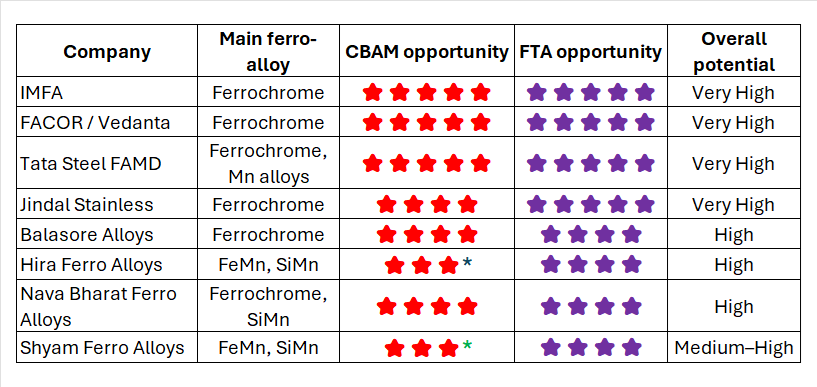 *CBAM advantage is more limited where the particular product is outside the EU CBAM scope.
22.1. IMFA — one of the strongest candidates
IMFA is probably one of the most strategically positioned Indian companies for the European market.
IMFA is India's largest producer of value-added ferrochrome and has an integrated model covering captive chrome ore mining and captive power generation. Its ferro-alloy production capacity is about 434,000 tonnes annually. (IMFA)
Why it matters:
• Ferrochrome is directly relevant to EU CBAM.
• Captive ore reduces raw-material dependence.
• Captive power gives greater control over carbon intensity.
• Value-added ferrochrome is attractive to stainless-steel producers.
• Existing international customer relationships make expansion into Europe easier.
CBAM + EU FTA potential: VERY HIGH.
22.2. FACOR / Vedanta
FACOR / Vedanta is another major candidate.
FACOR produces high-carbon ferrochrome/charge chrome at Bhadrak, Odisha, with captive chrome resources and a 100 MW power plant. Its ferrochrome capacity is reported at around 81.3 ktpa on Vedanta's site, while FACOR's own current site reports 145 KTPA charge chrome/ferrochrome capacity, so capacity figures should be checked against the specific reporting period. (Vedanta Resources)
Its advantages are:
Chrome ore + ferrochrome production + captive power + export capability + ESG focus.
That combination is particularly valuable as European customers increasingly ask suppliers for product carbon-footprint data.
22.3. Tata Steel – Ferro Alloys & Minerals Division
Tata Steel FAMD has a particularly strong CBAM positioning.
Tata produces ferrochrome and manganese alloys and has an integrated ore-to-alloy supply chain. Importantly, Tata says its ferrochrome operations have published an Environmental Product Declaration (EPD) and that direct emissions are being aligned with global benchmarks including EU CBAM requirements. (Tata Steel)
This is a major advantage because European buyers will increasingly want:
• Verified emissions data
• Product carbon footprint
• Traceability
• ESG documentation
• Reliable origin information
Tata therefore has one of the strongest "CBAM-ready" positions among Indian producers.
22.4. Jindal Stainless
Jindal Stainless is strategically important because it is both a major stainless-steel producer and a ferrochrome producer.
Indian government mineral-industry data identifies Jindal Stainless among India's major ferrochrome producers. (IBM Government India)
Its advantage is slightly different from a standalone ferrochrome producer:
Ferrochrome → stainless steel → export
This gives Jindal greater control over the downstream value chain.
22. 5. Balasore Alloys
Balasore Alloys is another significant Indian ferrochrome producer. Industry data places it among India's important ferrochrome manufacturers. (IMFA)
It could benefit from:
• Growing European demand for low-carbon ferrochrome
• EU CBAM carbon differentiation
• India-EU FTA tariff reductions
• Demand from European stainless-steel producers
However, its CBAM competitiveness will depend heavily on verified plant-level emissions and electricity mix.
22.6. Hira Ferro Alloys — particularly interesting for green ferro-alloys
Hira Ferro Alloys deserves special attention.
Hira produces ferro-manganese and silico-manganese and explicitly markets its products as "green ferro alloys." The company says approximately one-third of its ferro-alloy production is powered by green energy from solar, wind and biomass. It also serves customers in 20+ countries. (Hira Ferro Alloys)
This makes Hira particularly interesting from an EU sustainability/low-carbon procurement perspective.
However, there is an important distinction:
Silico-manganese itself is currently outside the EU CBAM tax scope. (GOV.UK)
So its benefit would come more from European buyers' decarbonisation requirements and FTA market access, rather than directly avoiding CBAM certificates.
The FTA opportunity is potentially bigger than CBAM
There are now several important trade opportunities for Indian ferro-alloy producers.
India–EU FTA
India and the EU concluded FTA negotiations on 27 January 2026, but the agreement is not yet in force. The European Commission proposed moving it toward signature on 11 September 2026. (Trade and Economic Security)
The agreement is expected to provide substantially improved market access, but ferro-alloy producers should not assume zero duty until the agreement's tariff schedule and entry-into-force provisions are confirmed.
For ferrochrome producers such as:
IMFA → FACOR → Tata → Jindal Stainless → Balasore
the EU opportunity could therefore become particularly significant.
India–UK FTA
The India–UK FTA entered into force on 15 July 2026. (Business Growth Service)
This is already operational.
India will transition out of the UK's Developing Countries Trading Scheme on 15 July 2028, with businesses able to use either DCTS preferences during the transition or the new FTA arrangements, subject to the applicable rules of origin. (GOV.UK)
This creates a near-term export opportunity for Indian ferro-alloy producers targeting the UK.
India–EFTA TEPA
India's TEPA with EFTA—Switzerland, Norway, Iceland and Liechtenstein—entered into force on 1 October 2025.
EFTA's offer covers 92.2% of tariff lines representing 99.6% of India's exports, including 100% of non-agricultural products. (Press Information Bureau)
This gives Indian ferro-alloy exporters another European market-access opportunity
23. SWOT Analysis – Indian Ferro Alloy Industry
Strengths
- Large domestic steel market
- ~5.15 Mt industry capacity
- Strong ferrochrome ecosystem
- Chrome and manganese resources
- Established exports
- Captive mining by major producers
- Growing steel consumption
Weaknesses
- High electricity intensity
- Carbon intensity at some facilities
- Specialty alloy technology gaps
- Fragmented industry
- Raw-material price volatility
- Limited noble alloy scale
- R&D requirements
Opportunities
- Indian steel growth
- EU market
- India–EU FTA
- Low-carbon alloys
- Noble ferro alloys
- EV/automotive steel
- Defence/aerospace
- Digital B2B trade
Threats
- Chinese overcapacity
- CBAM
- High power costs
- Global price competition
- Raw-material shortages
- Environmental regulations
- Geopolitical risk
- Freight volatility
24. SWOT Analysis – Indian Ferro Alloy Manufacturers
Strengths
Indian producers benefit from:
• Domestic steel demand
• Mineral availability
• Established manufacturing
• Skilled manpower
• Export relationships
• Captive resources
• Existing furnace infrastructure
Weaknesses
Many companies remain exposed to commodity cycles.
Margins can change rapidly with:
• Chrome ore prices
• Manganese ore prices
• Electricity
• Coal
• Steel prices
• Freight
• Currency movements
Opportunities
The major opportunity is to move:
Commodity → Speciality → Low-carbon → Customised
Threats
The largest threats are:
a) China
b) CBAM
c) Energy costs
d) Raw-material availability
e) Global oversupply
f) Environmental regulations
25. Usage of LOHAA Mobile Application of Android and iPhone / Portal for Commercial Transactions for Ferro Alloy Commercial Leads
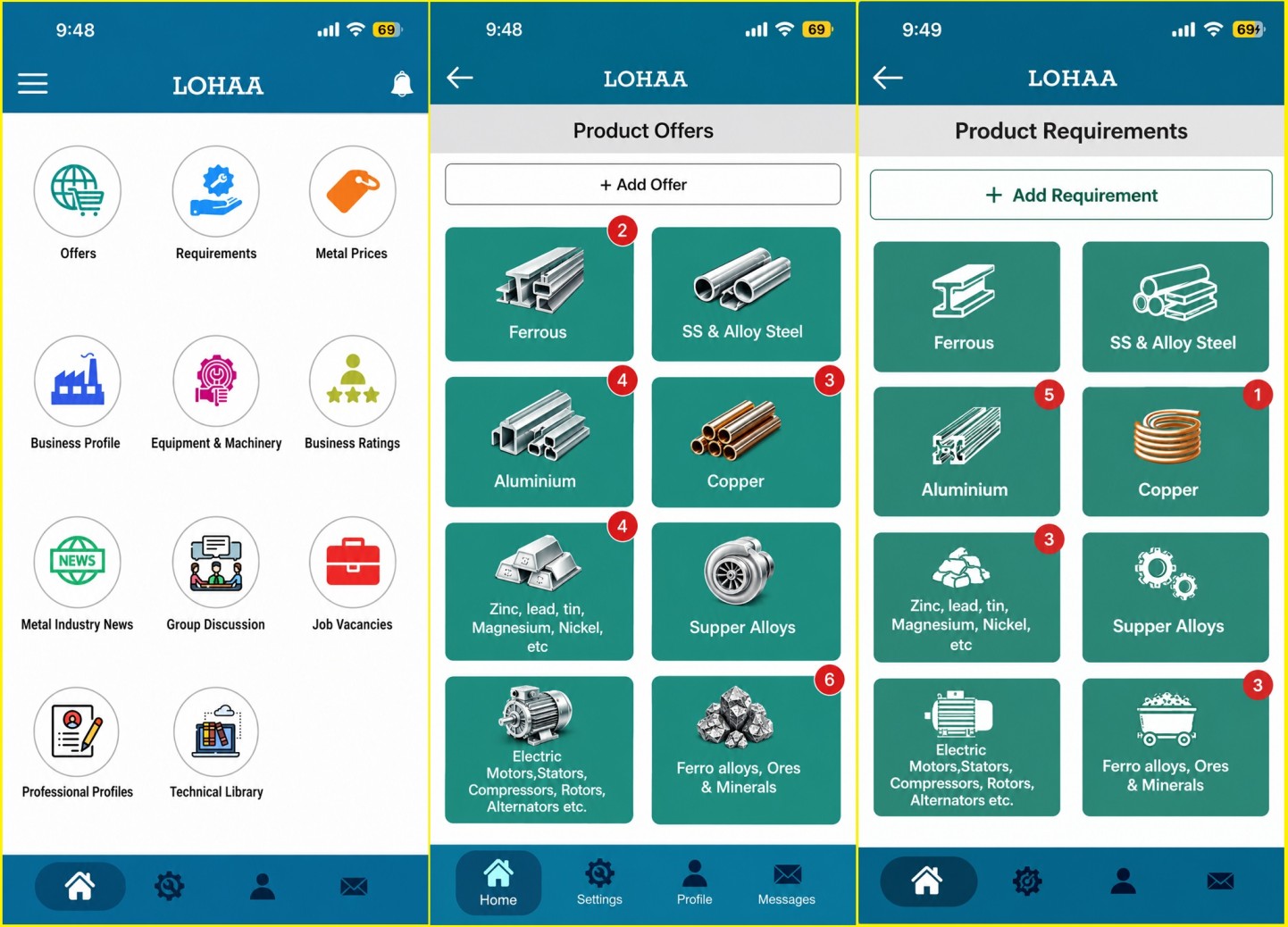
Digital B2B trading is becoming increasingly important in the metals industry.
LOHAA is a metal-industry B2B marketplace and business network designed to connect businesses across metals, alloys, scrap, ores, minerals and related industrial categories.
LOHAA's platform includes ferro alloy categories and supports business networking between manufacturers, traders, exporters, importers and buyers.
This creates a potentially valuable digital sales channel for ferro alloy companies.
26. How Ferro Alloy Manufacturers Can Use LOHAA
a) Publish sales offers: Generate buyer leads
b) Publish purchase requirements: Find suppliers
c) Publish export offers: Reach overseas buyers
d) Publish import requirements: Find international suppliers
e) Company profile: Increase visibility
f) Product listing: Showcase grades
g) Market information: Support negotiations
h) Industry news: Track market developments
i) Business discovery: Find new customers
j) Supplier discovery: Expand sourcing
k) Trading network: Build relationships
l) Digital communication: Speed up enquiries
No. LOHAA activity Commercial benefit
27. LOHAA for Importers, Exporters and Traders
LOHAA can support three important sides of the ferro alloy market.
Manufacturers
Can publish available production.
Traders
Can publish buying and selling requirements.
Importers/exporters
Can discover international business opportunities.
The digital approach can complement existing sales channels such as:
• Direct sales
• Agents
• Distributors
• Trading houses
• Email marketing
• Industry exhibitions
The objective is not to replace traditional relationships, but to increase commercial reach and lead generation.
28. Recommended Digital Commercial Strategy
Step 1 – Create a detailed company profile
Include:
• Manufacturing location
• Products
• Capacity
• Grades
• Certifications
• Export markets
• Contact details
Step 2 – Publish regular sales offers
Include:
• Product
• Grade
• Quantity
• Origin
• Location
• Delivery
• Packaging
• Commercial terms
Step 3 – Monitor purchase requirements
Search for:
• Steel mills
• Stainless steel manufacturers
• Foundries
• Traders
• Exporters
• Importers
Step 4 – Promote specialty products
Focus on higher-margin products.
Step 5 – Monitor prices and market information
Use market intelligence to support negotiation.
29. Strategic Priorities for Indian Manufacturers
a). Reduce electricity cost
Energy efficiency should be a board-level priority.
b) Increase renewable power
Solar, wind and hybrid power can improve carbon performance.
c) Improve furnace efficiency
Lower energy consumption improves both cost and carbon intensity.
d) Develop specialty alloys
Increase production of:
• Ferrovanadium
• Ferromolybdenum
• Ferroniobium
• Ferrotitanium
• Ferroboron
• Ferrotungsten
e) Develop low-carbon ferrochrome
Especially important for European customers.
f) Improve traceability
Digital batch and emissions records will become increasingly valuable.
g) Invest in R&D
New products can provide better margins.
h) Develop digital sales
Platforms such as LOHAA can increase customer discovery
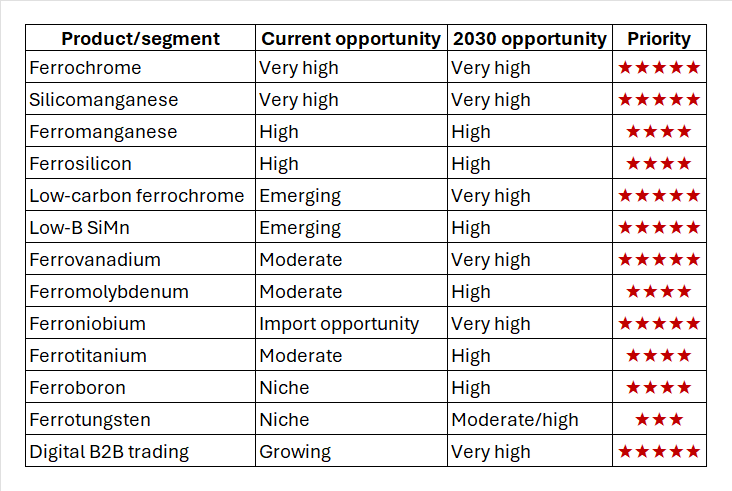
30. 2030 Opportunity Matrix
 31. Key Industry Takeaways
a) India has scale
Approximately 5.15 Mt of ferro alloy industry capacity provides a substantial manufacturing base.
b) Domestic steel is the fundamental demand driver
India produced 164.9 Mt crude steel in 2025. (World Steel Association)
c) China remains the largest competitor
China produced approximately 9.907 Mt ferrochrome in 2025, compared with India's 1.304 Mt. (ICD-ACR)
d) Ferrochrome is strategically important
India has a strong chrome ecosystem centred around Odisha.
e) CBAM must be analysed by product code
Ferrochrome and ferromanganese are covered, while several other ferroalloys are excluded from the relevant CBAM Annex II treatment. (Eur-Lex)
f) FTA improves tariff competitiveness
The EU says almost all iron and steel products receive zero tariffs under the agreement, with phase-in periods for some products. (Trade and Economic Security)
g) Low-carbon production will become more valuable
Renewable power and energy efficiency can become commercial advantages.
h) New-generation alloys offer higher value
The biggest long-term opportunity may be specialty rather than commodity ferro alloys.
i) Digital B2B trading can increase market reach
LOHAA can help manufacturers, traders, importers and exporters connect around ferro alloys and other metal products.
j) India's competitive strategy should change
The objective should move from:
"Produce more tonnes."
to:
"Produce higher-value, lower-carbon, technically superior tonnes and connect them efficiently with global buyers."
32. Conclusion
India's ferro alloy industry is entering a strategically important phase between 2026 and 2030. Its approximately 5.15-million-tonne industry capacity, mineral resources, expanding steel market and established export ecosystem provide a strong foundation for growth. Ferrochrome, ferromanganese, silicomanganese and ferrosilicon will remain the core products, while new-generation alloys such as ferrovanadium, ferromolybdenum, ferroniobium, ferrotitanium and ferroboron can provide higher-value opportunities.
CBAM will make carbon measurement and production efficiency increasingly important for covered exports to Europe, particularly ferrochrome and ferromanganese. At the same time, the India–EU FTA can improve tariff competitiveness and market access. Indian manufacturers that combine competitive power costs, captive raw materials, efficient furnaces, renewable energy, quality control and reliable documentation will be better positioned.
The next competitive advantage will come from low-carbon production, specialty grades, technical capability and digital commercial reach. LOHAA Mobile Application and Portal can complement traditional sales channels by connecting ferro alloy manufacturers, traders, importers, exporters and end users, helping generate commercial leads and discover new business opportunities.
33. References
1. Indian Ferro Alloy Producers' Association – Indian industry capacity, product categories and cost structure.
2. International Chromium Development Association – 2025 global ferrochrome production.
3. World Steel Association – 2025 global and Indian crude steel production.
4. IMFA – Ferrochrome production capacity, furnace capacity, mining and captive power.
5. Tata Steel – Ferro Alloys & Minerals Division.
6. Tata Steel – Gopalpur and Odisha ferro alloy plant capacities.
7. Balasore Alloys – Ferrochrome plants and 175,000 MTPA capacity.
8. FACOR – Ferrochrome capacity, mining and power.
9. FACOR environmental documentation – Current 145,000 tpa and proposed 445,000 tpa capacity.
10. VISA Steel – 150,000-tpa high-carbon ferrochrome facility.
11. Jai Balaji Industries – 166,000-tpa ferro alloy capacity and ferrochrome grades.
12. Sarda Energy & Minerals – FY2024–25 ferro alloy production and sales. (
13. Maithan Alloys – Annual reports and investor information.
14. European Commission – CBAM definitive regime from 1 January 2026.
15. EUR-Lex, EU Regulation 2023/956 – CBAM product exclusions and ferroalloy classifications.
16. EUR-Lex, Implementing Regulation 2023/1773 – Ferrochrome and ferromanganese emissions-monitoring requirements.
17. European Commission – EU–India Free Trade Agreement benefits for iron and steel.
18. LOHAA – Metal-industry B2B marketplace and business network. LOHAA Official Portal
FAQ
Q1. What are ferro alloys?
Ferro alloys are alloying materials containing iron and elements such as chromium, manganese, silicon, vanadium, molybdenum, titanium or niobium, used primarily in steelmaking.
Q2. What are the major ferro alloys produced in India?
India produces ferrochrome, ferromanganese, silicomanganese, ferrosilicon and several noble ferro alloys.
Q3. Which country produces the most ferrochrome?
China was the largest ferrochrome producer in 2025, with approximately 9.907 million tonnes.
Q4. What is India's ferro alloy capacity?
IFAPA reports approximately 5.15 million tonnes of ferro alloy industry capacity.
Q5. Does CBAM apply to all ferro alloys?
No. CBAM treatment depends on the exact CN code. Ferrochrome and ferromanganese are covered, while several other ferroalloys are excluded under the relevant CBAM provisions. (Eur-Lex)
Q6. How can Indian ferro alloy exporters benefit from the India–EU FTA?
The agreement provides preferential tariff treatment for covered products, including zero tariffs for almost all iron and steel products according to the European Commission's factsheet, subject to the agreed implementation schedules.
Q7. What are new-generation ferro alloys?
They include low-carbon and high-purity bulk alloys and specialty alloys such as ferrovanadium, ferromolybdenum, ferroniobium, ferrotitanium and ferroboron.
Q8. How can LOHAA help ferro alloy companies?
LOHAA can provide a digital B2B channel for manufacturers, traders, importers and exporters to showcase products, publish requirements and discover commercial opportunities.
Q9. Which Indian company has the largest reported ferro alloy capacity among the manufacturers discussed?
IMFA reports 434,000 tonnes of ferro alloy production capacity and 100,000 tonnes of upcoming capacity. (
Q10. What is the biggest opportunity for India's ferro alloy industry by 2030?
The strongest opportunity is expected to be the combination of specialty alloys, low-carbon production, renewable energy, advanced quality control and digital global sales.
By using digital trade platforms like LOHAA Mobile application, you can reach global buyers, source quality material, and strengthen long-term partnerships.
Download the Lohaa Metal Trading App for Android to access live scrap prices and real-time market updates anytime, anywhere.
Download the Lohaa Metal Trading App for iOS to access live scrap prices and real-time market updates anytime, anywhere.
(Notes: market and production volume estimates are synthesized from public market reports and industrial press; exact tonne figures for materials are not centrally published in a single comprehensive public dataset, therefore the numeric projection above is a conservative, documented estimate built from available intelligence and reasonable regional share assumptions.)


