
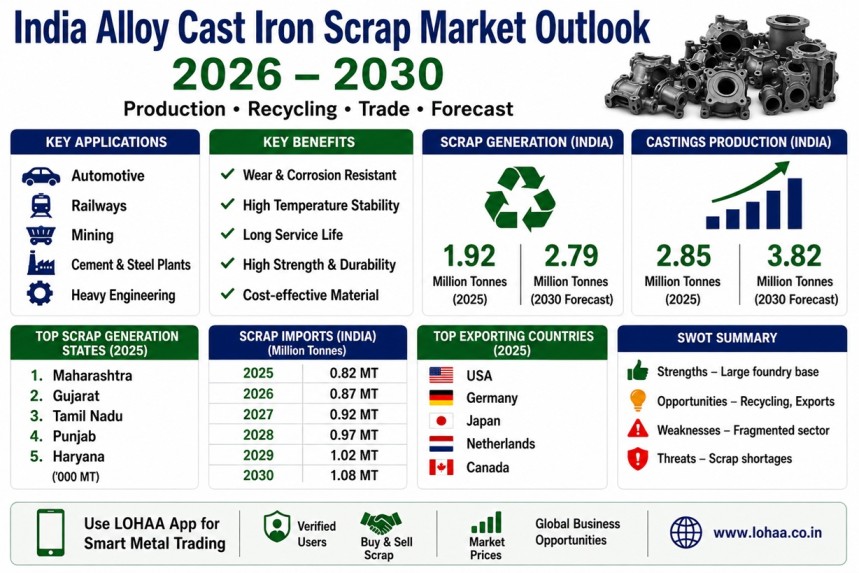
India Alloy Cast Iron Scrap Outlook 2026 to 2030
1. Introduction
Alloy cast iron plays an important role in modern engineering because of its excellent wear resistance, heat resistance, corrosion resistance, strength, and durability. Alloying elements such as chromium, nickel, molybdenum, manganese, vanadium, and silicon significantly improve the performance of conventional cast iron. Industries including automotive, mining, cement, power generation, steel plants, railway, defense, heavy engineering, and infrastructure depend on alloy cast iron components. As sustainability and circular economy initiatives gain momentum, alloy cast iron scrap has become a valuable secondary raw material. Recycling reduces energy consumption by nearly 60–70%, lowers greenhouse gas emissions, conserves natural resources, and supports India's growing foundry industry.
2. Importance of Alloy Cast Irons and Their Applications
Major alloy cast irons include:
- High Chromium Cast Iron: Mining equipment, crushers, cement plants
- Nickel Hard Cast Iron: Rolls, pumps, mining liners
- Ni-Resist Cast Iron: Marine, chemical industries
- Silicon Moly Cast Iron: Automotive exhaust manifolds
- Heat Resistant Cast Iron: Furnace parts
- Wear Resistant Cast Iron Earth moving equipment
- Corrosion Resistant Cast Iron: Chemical processing plants
- Austenitic Cast Iron: Oil & Gas industries
Key Benefits
• Excellent wear resistance
• High temperature stability
• Superior corrosion resistance
• Good machinability
• Long service life
• Low maintenance
• High compressive strength
• Cost-effective engineering material
Major application sectors include:
• Automotive
• Railway
• Cement
• Mining
• Steel Plants
• Power Plants
• Sugar Industry
• Marine
• Oil & Gas
• Construction Machinery
• Heavy Engineering
• Agriculture Equipment
3. Future Prospects of Alloy Cast Iron Requirements (2026–2030)
Global infrastructure expansion, mining investments, renewable energy, electric vehicles, defense manufacturing, and railway modernization will continue supporting demand.
- Automotive: High
- Railways: High
- Mining: Very High
- Cement: Moderate
- Steel Plants: High
- Defence: High
- Renewable Energy: Moderate
- Oil & Gas: Moderate
- Heavy Engineering: High
- Agriculture Equipment: Moderate
Estimated CAGR (2026–2030): 5–7%
Key demand drivers:
• Make in India
• PM Gati Shakti
• Smart Cities
• Defence Manufacturing
• Metro Rail Projects
• Mining expansion
• Export-oriented engineering manufacturing
4. Sources of Different Types of Alloy Cast Iron Scrap Generation
Major scrap originates from:
a) Foundry returns
b) Machining chips
c) Rejected castings
d) Production runners
e) Risers
f) Furnace skulls
g) Power plant maintenance
h) Mining equipment replacement
i) Cement plant shutdowns
j) Steel plant maintenance
k) Automobile replacement parts
l) Railway infrastructure renewal
m) Industrial machinery dismantling
n) Ship breaking
o) Demolition projects
5. Types of Alloy Cast Iron Scrap Generation
- High Chromium Scrap: Cement & Mining
- Ni-Hard Scrap: Crushers & Mills
- Ni-Resist Scrap: Marine Industry
- Heat Resistant Scrap: Furnace Components
- Silicon Moly Scrap: Automotive Exhaust
- Alloy Grey Iron Scrap: Engineering Industries
- Alloy Ductile Iron Scrap: Pipe Industry
- Mixed Alloy Returns: Foundries
- Machining Borings: Machine Shops
6. India's Alloy Cast Iron Castings Production (Estimated: Tonnes)
- 2025: 285000 Tonns
- 2026: 300000 Tonns
- 2027: 318000 Tonns
- 2028: 337000 Tonns
- 2029: 358000 Tonns
- 2030: 382000 Tonns
Forecast CAGR: 6.0%
Major growth sectors:
• Automotive
• Defence
• Railway
• Infrastructure
• Mining
• Export Engineering
7. State-wise Plain and Alloy Cast Iron Scrap Generation Forecast
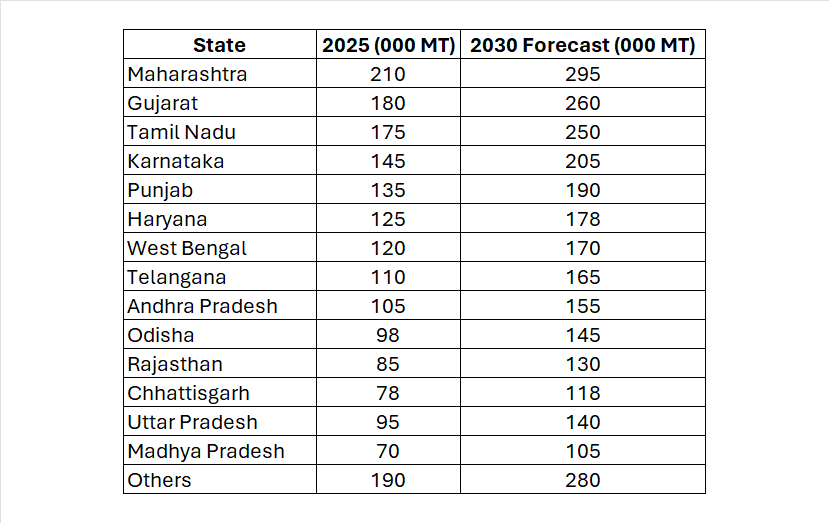 Estimated National Scrap Generation
- 2025: 1.92 Million Tonnes
- 2030: 2.79 Million Tonnes
8. Major Alloy Cast Iron Casting Manufacturers (Regional) Tons per year
- North India: Jindal Saw, Rico Auto, Escorts Kubota 350,000 tons
- Western India: Kirloskar Group, L&T Foundry 600,000 tons
- South India: Balu Foundry, Sanmar Engineering 700,000 tons
- East India: Electrosteel Castings,Tata Steel Foundry, Simplex Castings 300,000 tons
- Central India: Jayaswal Neco Industries 250,000 tons
Total organized capacity exceeds 2.2 million tonnes annually.
10. Top Ten plain and Alloy Cast Iron Scrap Recycling Countries
Rank Country Estimated Capacity (Million Tonnes)
- China: 4.2
- USA: 2.4
- India: 1.3
- Japan: 1.0
- Germany: 0.9
- South Korea: 0.7
- Italy: 0.6
- Turkey: 0.6
- Russia: 0.5
- Brazil: 0.5
11. Major Alloy Cast Iron Scrap Exporting Countries
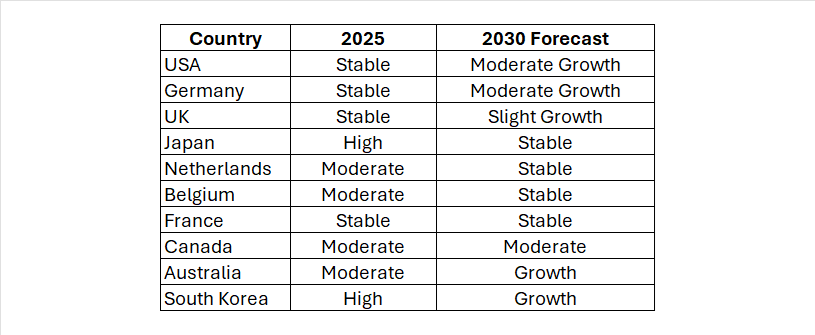 Global exports are expected to grow at 3–4% CAGR through 2030.
12. India Alloy Cast Iron Scrap Imports (2025–2030)
- 2025: 82000 Tonnes
- 2026: 87000 Tonnes
- 2027: 92000 Tonnes
- 2028: 97000 Tonnes
- 2029: 102000 Tonnes
- 2030: 108000 Tonnes
Imports will continue because domestic scrap availability is insufficient to meet demand from secondary foundries and engineering industries.
13. SWOT Analysis
Strengths
• Large foundry base
• Growing engineering sector
• Competitive labour cost
• Expanding automobile industry
• Strong recycling ecosystem
Weaknesses
• Fragmented scrap collection
• Large unorganized sector
• Inconsistent scrap quality
• Limited alloy segregation
• Technology gaps
Opportunities
• Green manufacturing
• Circular economy
• Digital scrap marketplaces
• AI-based scrap sorting
• Export growth
• Government infrastructure spending
Threats
• Global scrap shortages
• Import restrictions
• Environmental regulations
• Rising logistics costs
• Raw material price volatility
14. Usage of LOHAA Mobile Application of Android and iPhone / Portal for Commercial Transactions
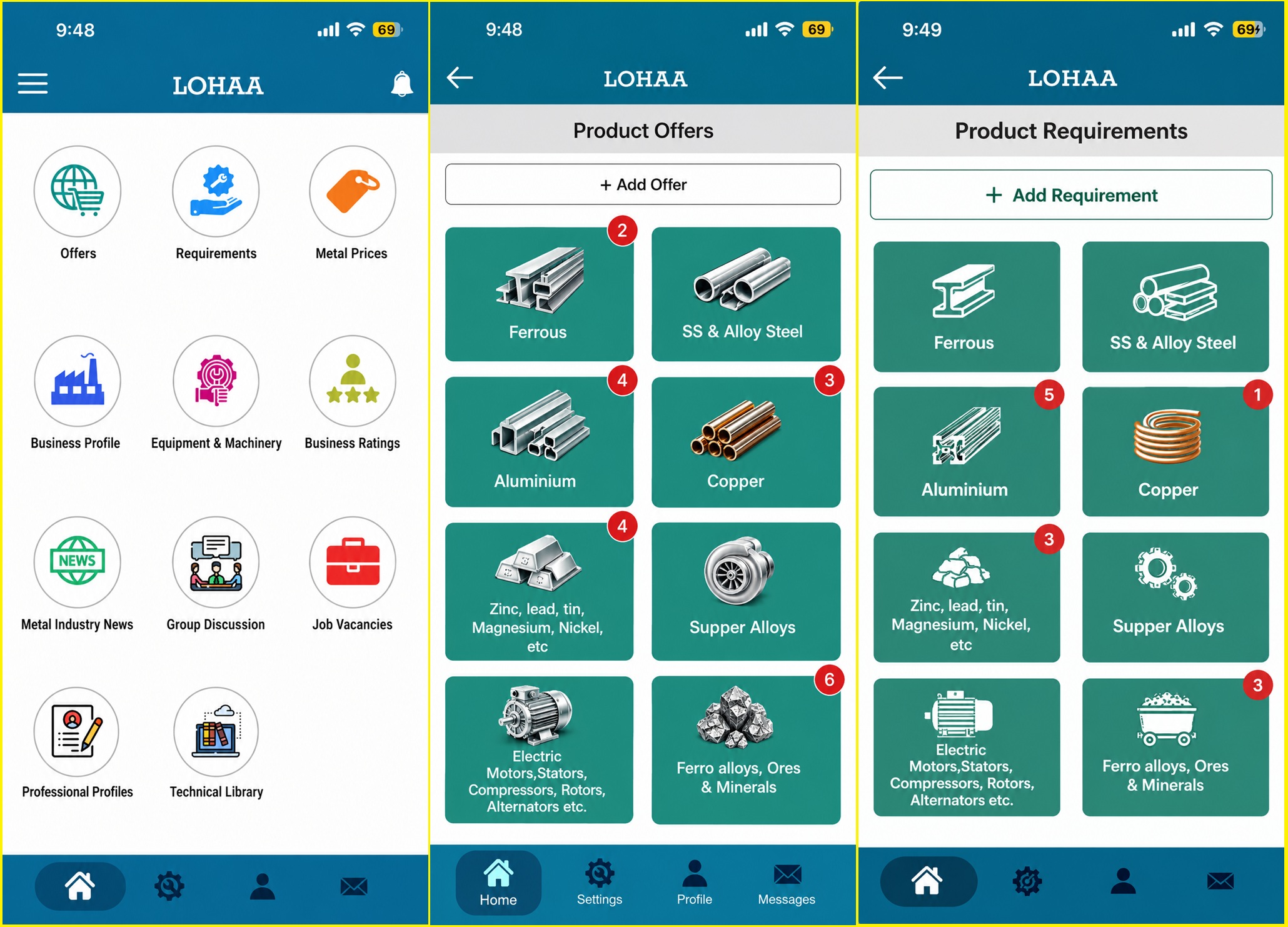
LOHAA Mobile Application is emerging as a specialized B2B digital platform for the metal, foundry, recycling, and scrap industries. It enables verified businesses to conduct secure commercial transactions efficiently.
Key features include:
• KYC-verified buyers and sellers
• Alloy cast iron scrap buying and selling
• Domestic and international trade opportunities
• Daily metal market prices
• Industry news and market intelligence
• Company profile verification
• Machinery and equipment listings
• Tender and procurement opportunities
• Scrap requirement publishing
• Offer publication for alloy cast iron scrap
• Direct communication between verified businesses
• Digital lead generation
• Export-import networking
• Faster procurement cycle
• Improved market transparency
The platform supports foundries, recyclers, engineering companies, traders, and manufacturers by reducing transaction time and expanding market reach.
15. Summary
India's Alloy Cast Iron Production Forecast
- 2025: 285000 Tonnes
- 2026: 300000 Tonnes
- 2027: 318000 Tonnes
- 2028: 337000 Tonnes
- 2029: 358000 Tonnes
- 2030: 382000 Tonnes
World wide Scrap Generation Forecast (Million Tonnes)
- 2025: 1.92
- 2026: 2.05
- 2027: 2.22
- 2028: 2.40
- 2029: 2.58
- 2030: 2.79
Imports Forecast Year Imports (000' Tonnes)
- 2025: 0.82
- 2026: 0.87
- 2027: 0.92
- 2028: 0.97
- 2029: 1.02
- 2030: 1.08
Market Growth (Indicator Value)
- Production CAGR: 6%
- Scrap CAGR: 7.5%
- Imports CAGR: 5.5%
- Global Demand CAGR: 5%
16. Conclusion
India's alloy cast iron industry is poised for sustained growth during 2026–2030, driven by increasing investments in infrastructure, automotive manufacturing, mining, railways, defense, power generation, and industrial engineering. Rising demand for wear-resistant and high-performance castings will significantly increase the generation and utilization of alloy cast iron scrap. Recycling will become an essential component of the circular economy, helping reduce energy consumption, greenhouse gas emissions, and dependence on virgin raw materials. Organized recycling facilities, improved scrap segregation technologies, and digital trading platforms will further strengthen supply chain efficiency. Although challenges such as fragmented scrap collection, inconsistent quality, and import dependence remain, technological advancements and supportive government policies are expected to improve competitiveness. Digital marketplaces such as LOHAA can play a crucial role by connecting verified buyers and sellers, enhancing market transparency, and accelerating commercial transactions. Overall, India's alloy cast iron sector presents strong long-term opportunities for manufacturers, recyclers, investors, traders, and policymakers.
17. References
1. Ministry of Steel, Government of India
2. Indian Bureau of Mines (IBM)
3. Directorate General of Commercial Intelligence and Statistics (DGCI&S)
4. World Foundry Organization (WFO)
5. World Steel Association
6. International Energy Agency (IEA)
7. Bureau of Indian Standards (BIS)
8. UN Comtrade Database
9. International Trade Centre (ITC)
10. CRISIL Industry Reports
11. NITI Aayog
12. Industry publications, foundry associations, and publicly available company annual reports (2024–2026).
By using digital trade platforms like LOHAA Mobile application, you can reach global buyers, source quality material, and strengthen long-term partnerships.
Download the Lohaa Metal Trading App for Android to access live scrap prices and real-time market updates anytime, anywhere.
Download the Lohaa Metal Trading App for iOS to access live scrap prices and real-time market updates anytime, anywhere.
(Notes: market and production volume estimates are synthesized from public market reports and industrial press; exact tonne figures for materials are not centrally published in a single comprehensive public dataset, therefore the numeric projection above is a conservative, documented estimate built from available intelligence and reasonable regional share assumptions.)


