
Gulf Crisis 2026: India’s Aluminum Scrap Import Outlook
Introduction
India has emerged as one of the world’s largest importers of aluminium scrap, driven by strong demand from secondary aluminium smelters, die-casting units, and recycling industries. The country relies heavily on imported scrap to meet the requirements of automotive, packaging, electrical, and construction sectors. Over the past decade, India’s aluminium scrap imports have nearly doubled, rising from around 0.88 million tonnes in 2015 to nearly 2 million tonnes by 2025. (alcircle)
This growth reflects the increasing role of recycling in the aluminium value chain. Recycling aluminium consumes about 95% less energy than primary production, making scrap an important raw material for cost efficiency and sustainability. (Reuters)
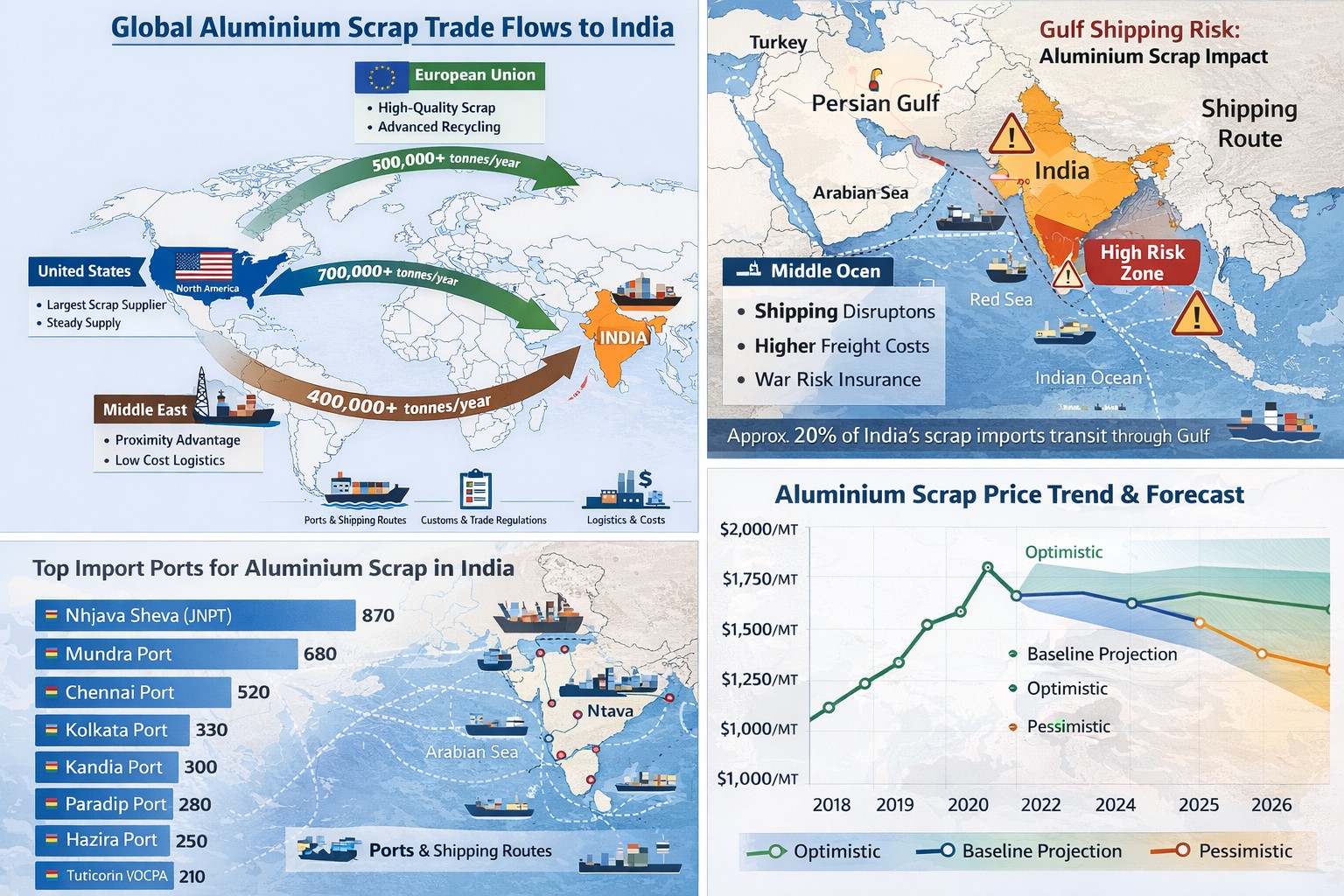
However, the geopolitical landscape has begun to reshape global scrap flows. The renewed tensions in the Gulf region and conflicts affecting Middle East trade routes have started to influence shipping costs, logistics security, and scrap availability for major importers like India. Since many scrap shipments to India pass through strategic maritime routes such as the Strait of Hormuz and Red Sea, any conflict in the Gulf region has immediate implications for freight rates, supply stability, and price volatility.
This article examines how Gulf war tensions affect India’s aluminium scrap imports, analyses import trends for 2024-2026, forecasts possible shortages by scrap type, and provides a regional SWOT analysis of supply chains over the next six months.
India’s Aluminium Scrap Import Market
India’s aluminium recycling industry has expanded rapidly due to rising industrial demand and environmental pressures to reduce primary metal production. Scrap imports are essential because domestic scrap generation is insufficient to meet demand.
India currently accounts for a significant share of global aluminium scrap imports, leading the world among major importers. (Volza)
The country imports scrap primarily from:
• United States
• United Arab Emirates
• Saudi Arabia
• United Kingdom
• European Union
• Southeast Asia
Trade flows are influenced by price arbitrage, policy changes, recycling capacity, and geopolitical factors affecting global logistics networks. (Tradeimex)
Aluminium Scrap Imports in India (2024-2026)
Below are indicative trends in India’s aluminium scrap imports based on trade statistics, industry reports, and market estimates.
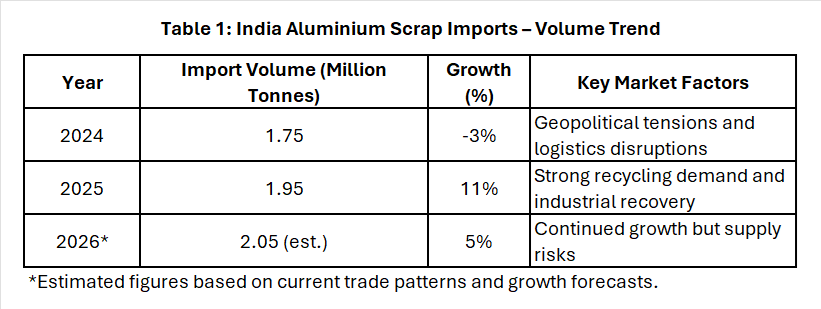 Imports in the period Nov 2024 – Oct 2025 reached about 1.97 million tonnes, showing a growth of over 12% compared with the previous year. (GTAIC)
Table 2: Value of Aluminium Scrap Imports (USD)
| Year | Import Value (USD Billions) |
| 2024 | 3.60 |
| 2025 | 4.30 |
| 2026* | 4.50 (Forecast) |
During the first half of 2025 alone, India imported aluminium scrap worth USD 1.96 billion, compared with USD 1.59 billion in the same period of 2024, representing more than 23% growth in value. (alcircle)
Table 3: Major Sources of Aluminium Scrap for India
| Region | Approx Share |
| North America | 35% |
| Middle East | 20% |
| Europe | 25% |
| SouthEast Asia | 15% |
| Other | 5% |
The Middle East has become an increasingly important supplier due to its proximity and strong recycling infrastructure.
How Gulf War Tensions Affect Aluminium Scrap Imports
1. Shipping Route Disruptions
One of the biggest risks from Gulf conflicts is disruption in maritime trade routes. A significant portion of scrap shipments to India pass through:
• Persian Gulf
• Strait of Hormuz
• Red Sea shipping lanes
Conflict escalation could lead to:
• Vessel diversions
• Higher insurance premiums
• Longer shipping routes
• Freight cost spikes
These factors can increase landed costs for scrap buyers in India.
2. Freight Rate Volatility
War or geopolitical instability usually leads to:
• Higher bunker fuel costs
• Increased war risk insurance
• Reduced shipping capacity
Freight costs can increase by 20-50% in conflict situations, directly impacting scrap prices.
3. Scrap Supply Diversion
Middle Eastern countries are both exporters and transit hubs for aluminium scrap. In a conflict scenario:
• Domestic consumption may increase
• Scrap exports could decline
• Regional supply chains may fragment
4. Insurance and Risk Premiums
Shipping companies impose war risk premiums on cargo traveling through conflict zones. These costs are passed on to scrap buyers.
Types of Aluminium Scrap Imported by India
India imports various grades of aluminium scrap depending on end-use industries.
Major Scrap Types
- Tense
- Taint Tabor
- Tread
- Twitch
- Zorba
- Wheels
- UBC
Secondary aluminium producers and die-casting companies rely heavily on these grades.
Anticipated Scrap Shortages in the Next Six Months
If geopolitical tensions escalate in the Gulf region, certain scrap types may experience shortages.
Table 4: Possible Scrap Shortages (Next 6 Months)
| Scrap Type | Risk level |
| Twitch | High |
| Taint Tabor | Medium |
| Tense | Medium |
| Wheels | High |
| Zorba | Medium |
Regional Supply Risk Analysis
1. Middle East
Strengths
• Proximity to India
• Growing recycling capacity
Weaknesses
• Political instability
• Export policy changes
Opportunities
• Long-term supply agreements
Threats
• Gulf war escalation affecting shipping routes
2. Europe
Strengths
• High-quality scrap supply
• Advanced recycling infrastructure
Weaknesses
• Rising domestic demand
Opportunities
• Export partnerships
Threats
• Possible export restrictions on aluminium scrap to retain supply for local industry. (Reuters)
3. North America
Strengths
• Largest global scrap availability
• Reliable supply chains
Weaknesses
• Longer shipping distance
Opportunities
• Stable supply during geopolitical crises
Threats
• Trade policy changes and tariffs
4. Southeast Asia
Strengths
• Emerging recycling hubs
• Competitive pricing
Weaknesses
• Limited high-grade scrap availability
Opportunities
• Growing regional scrap trade
Threats
• Environmental restrictions
SWOT Analysis of India’s Aluminium Scrap Supply Chain
Strengths
• Strong recycling industry
• Large secondary aluminium capacity
• Growing demand from automotive and construction sectors
Weaknesses
• Heavy dependence on imports
• Limited domestic scrap generation
• Vulnerability to freight fluctuations
Opportunities
• Domestic scrap collection improvements
• Circular economy policies
• Strategic scrap sourcing agreements
Threats
• Gulf conflict disrupting shipping routes
• Export restrictions from supplier countries
• Rising scrap prices globally
Market Outlook for the Next Six Months
Despite geopolitical tensions, India’s aluminium scrap demand is expected to remain strong due to:
• Expanding EV manufacturing
• Infrastructure growth
• Packaging demand
However, supply risks could lead to:
• Higher scrap prices
• Shift toward alternative suppliers
• Increased domestic scrap recycling
If Gulf tensions escalate significantly, India may diversify imports from:
• United States
• Latin America
• Africa
• Southeast Asia
These regions could compensate for disruptions in Middle East supply.
Strategic Recommendations for Indian Importers
1. Diversify supply sources to reduce dependence on Gulf trade routes.
2. Secure long-term supply contracts with multiple suppliers.
3. Invest in domestic scrap recycling infrastructure.
4. Adopt inventory buffering strategies to mitigate logistics disruptions.
5. Monitor geopolitical developments affecting shipping corridors.
Conclusion
The Gulf war and geopolitical tensions in the Middle East represent a significant risk factor for India’s aluminium scrap imports. While the country’s recycling industry continues to expand rapidly, its dependence on imported scrap exposes it to supply chain disruptions caused by conflicts, freight volatility, and export policy changes.
Import volumes have grown steadily from 2024 to 2025 and are expected to increase further in 2026. However, the coming months could see shortages in certain scrap categories, especially automotive-related grades such as twitch and wheels.
To ensure supply stability, India must diversify its import sources, strengthen domestic recycling capacity, and adopt proactive supply chain strategies. These measures will help mitigate geopolitical risks while supporting the country’s growing demand for recycled aluminium.
By using digital trade platforms like LOHAA Mobile application, you can reach global buyers, source quality material, and strengthen long-term partnerships.
Download the LOHAA Mobile application today and connect with verified scrap suppliers and manufacturers.
References
1. Aluminium scrap import growth data – (GTAIC)
2. Global aluminium scrap trade and market trends – (Tradeimex)
3. India aluminium scrap import statistics – (alcircle)
4. Aluminium scrap trade analysis – (alcircle)
5. Global scrap trade volume estimates – (alcircle)
6. EU scrap export policy discussions – (Reuters)
(Notes: market and production volume estimates are synthesized from public market reports and industrial press; exact tonne figures for aluminum are not centrally published in a single comprehensive public dataset, therefore the numeric projection above is a conservative, documented estimate built from available intelligence and reasonable regional share assumptions.)


