
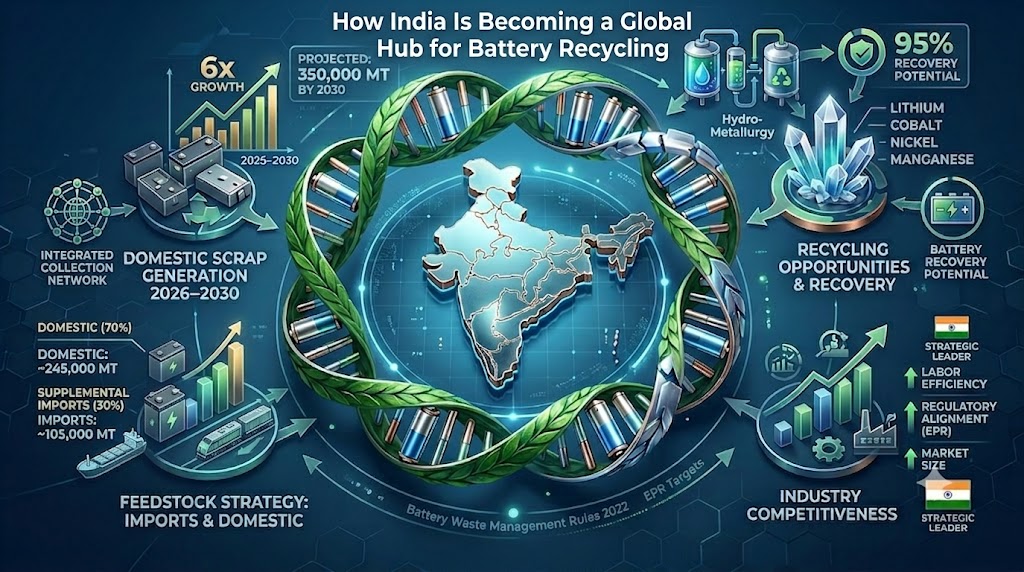
India EV Battery Recycling Industry Analysis 2026 to 2030
Introduction
Electric vehicles (EVs) are reshaping the global automotive industry and accelerating the transition toward cleaner transportation. Global EV sales have expanded rapidly over the past decade due to government incentives, advances in battery technology, and growing environmental awareness. While EV adoption reduces greenhouse gas emissions and dependence on fossil fuels, it also creates a new challenge: the management of end-of-life lithium-ion batteries.
EV batteries contain valuable metals such as lithium, cobalt, nickel, manganese, copper, aluminum, and graphite. Recovering these materials through recycling reduces dependence on mining, lowers carbon emissions, and improves resource security. As millions of EV batteries reach retirement after 2026, battery recycling is becoming a strategic industry worldwide.
India is one of the fastest-growing EV markets globally. Government initiatives including the Battery Waste Management Rules, Production Linked Incentive (PLI) schemes, and EV adoption programs are driving investments in battery manufacturing and recycling. Consequently, India is expected to emerge as a major regional hub for battery recycling and critical mineral recovery during 2026–2030.
Types of EV Batteries and Their Durability
The battery chemistry used in an EV significantly influences its performance, safety, cost, and recyclability.
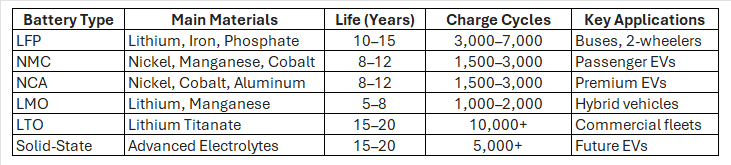 LFP batteries are becoming increasingly popular in India due to their lower cost and enhanced safety characteristics. NMC batteries continue to dominate passenger EV applications due to their higher energy density.
Top 10 EV Battery Scrap Generation Countries (2025–2030 Forecast)
Thousand Metric Tons (TMT)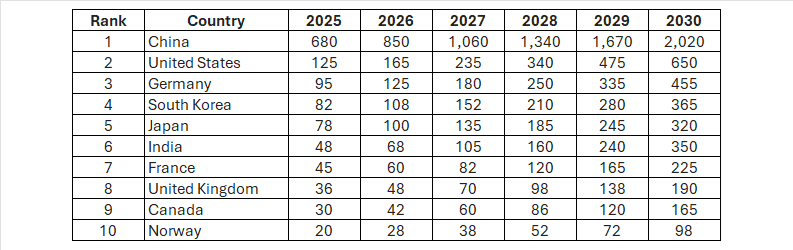 China will continue to dominate global battery scrap generation owing to its enormous EV manufacturing base. India is projected to become the sixth-largest battery scrap generator by 2030.
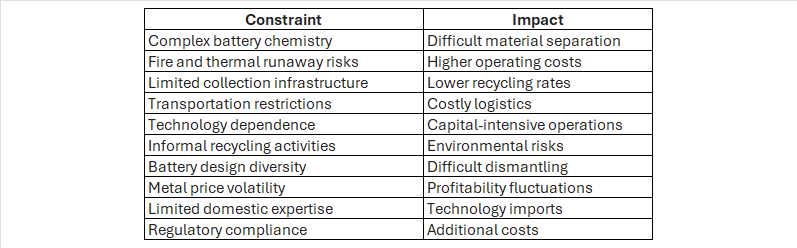
Constraints in Recycling EV Batteries
Despite significant growth opportunities, several challenges remain:
 Present Status of Indian EV Recycling
India's battery recycling sector remains in the early growth stage but is expanding rapidly.
Key developments include:
• Commercial lithium-ion battery recycling plants.
• Extended Producer Responsibility (EPR) implementation.
• Investments by recyclers and battery manufacturers.
• Expansion of hydrometallurgical recovery technologies.
• Growing interest from global investors.
• Development of domestic circular economy ecosystems.
Current installed recycling capacity is estimated to exceed 120,000 MT annually and could surpass 500,000 MT by 2030.
EV Battery Scrap Generation in India
Thousand Metric Tons (TMT)
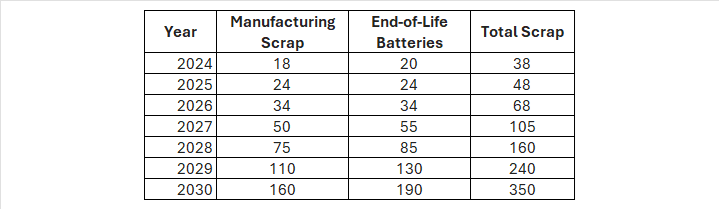
The rapid expansion after 2027 is primarily driven by battery retirements from early EV deployments and increasing manufacturing scrap from domestic gigafactories.
EV Battery Scrap Imports into India
Thousand Metric Tons (TMT)

Major Import Sources
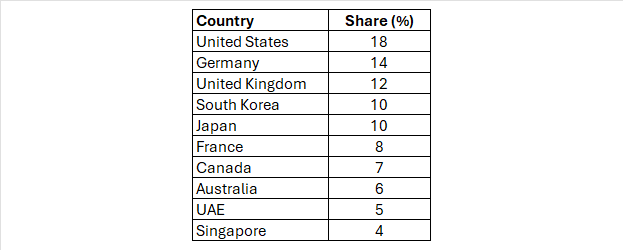
Battery scrap imports will remain important until domestic scrap availability becomes sufficient to meet recycling capacity utilization requirements.
SWOT Analysis of Indian EV Recycling
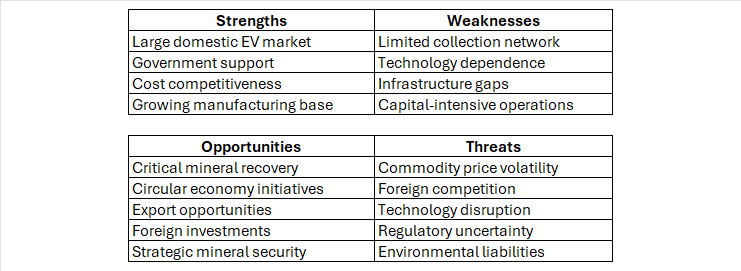 Top 10 EV Battery Scrap Generation States in India (2024–2030)
Thousand Metric Tons (TMT)
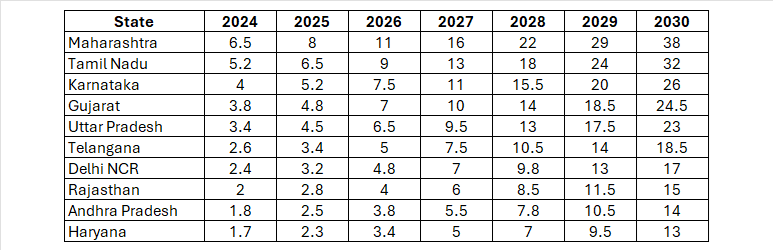
Competitiveness of Indian EV Battery Recycling Industry Compared with Other Asian Countries
Comparative Assessment (2026)
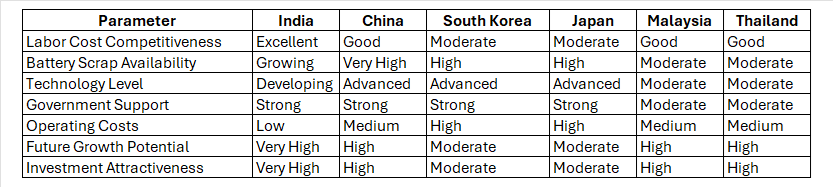 Why India Has an Advantage
1. Large domestic EV market.
2. Competitive labor and operating costs.
3. Growing battery manufacturing capacity.
4. Favorable government policies.
5. Strategic location for importing battery scrap from Europe, GCC and Asia.
6. Strong demand for recovered critical minerals.
Top 10 EV Battery Recycling Companies in India
Estimated Processing Capacity / Throughput (Thousand MT)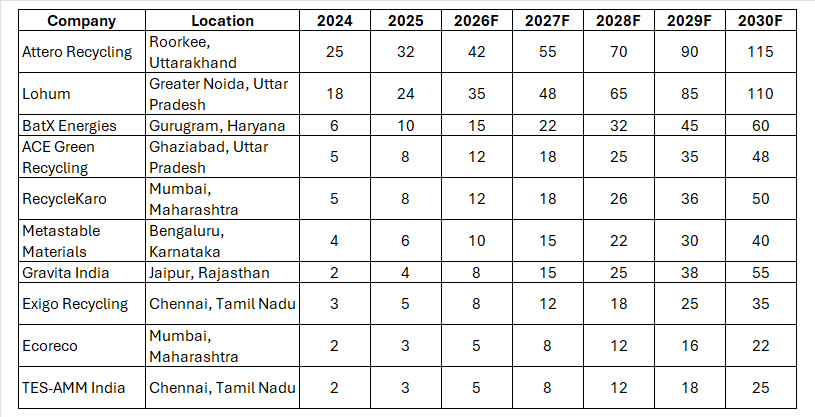 Future Outlook for India's Battery Recycling Industry
The industry is expected to witness rapid growth due to:
• Rising EV adoption.
• Battery gigafactory investments.
• Expansion of renewable energy storage systems.
• Increasing battery replacement volumes.
• Greater emphasis on domestic critical mineral security.
• Growing export opportunities for recycled battery materials.
By 2030, India could become one of the largest battery recycling markets in Asia outside China.
Conclusion
India's EV battery recycling industry is entering a transformative phase. Driven by rapid EV adoption, battery manufacturing expansion, supportive government policies, and increasing concerns over critical mineral security, the country is expected to become a major recycling hub by 2030. Battery scrap generation is projected to rise from approximately 68,000 MT in 2026 to around 350,000 MT by 2030, while imports will continue supplementing domestic feedstock availability. Compared with other Asian countries, India offers significant advantages in labor costs, market growth, and investment potential. With continued investment in collection systems, technology, and infrastructure, India can emerge as a global leader in sustainable battery recycling and circular economy development.
References
1. International Energy Agency (IEA) – Global EV Outlook.
2. Government of India Battery Waste Management Rules.
3. NITI Aayog EV Ecosystem Reports.
4. International Renewable Energy Agency (IRENA).
5. World Economic Forum Battery Circularity Reports.
6. International Council on Clean Transportation (ICCT).
7. United Nations Environment Programme (UNEP).
8. Industry reports on lithium-ion battery recycling and critical mineral recovery.
9. Public disclosures and capacity announcements by major recycling companies.
Disclaimer: Forecasts and company throughput estimates are indicative industry projections based on EV adoption trends, battery manufacturing growth, announced recycling capacities, and expected battery retirement rates through 2030.
By using digital trade platforms like LOHAA Mobile application, you can reach global buyers, source quality material, and strengthen long-term partnerships.
Download the Lohaa Metal Trading App for Android to access live scrap prices and real-time market updates anytime, anywhere.
Download the Lohaa Metal Trading App for iOS to access live scrap prices and real-time market updates anytime, anywhere.
(Notes: market and production volume estimates are synthesized from public market reports and industrial press; exact tonne figures for materials are not centrally published in a single comprehensive public dataset, therefore the numeric projection above is a conservative, documented estimate built from available intelligence and reasonable regional share assumptions.)


