
India Lead Scrap Market Report 2025 to 2030
1. Introduction
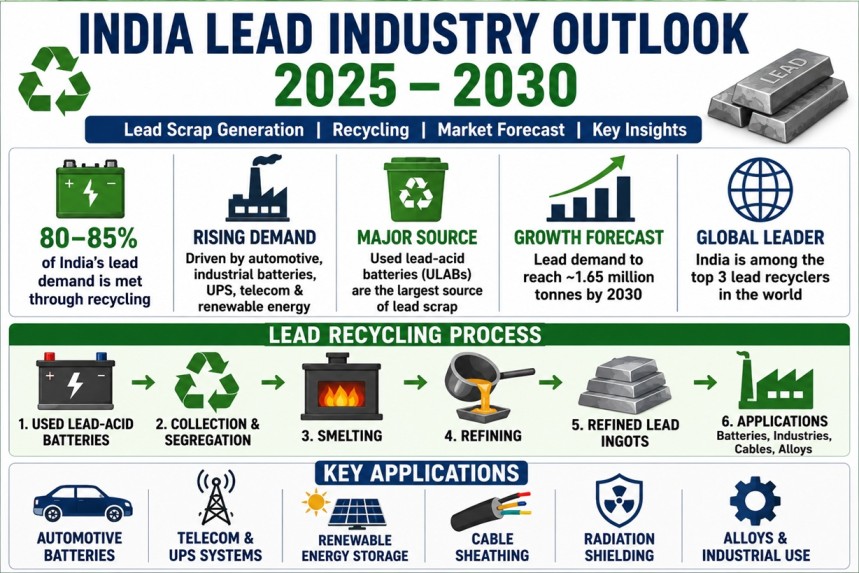
Lead is one of the world's most recycled and strategically important non-ferrous metals, primarily used in lead-acid batteries that power automobiles, industrial equipment, telecommunication systems, renewable energy storage, and uninterrupted power supply (UPS) systems. India has emerged as one of the fastest-growing lead markets due to increasing automobile production, rapid industrialization, expansion of renewable energy, and growth in backup power infrastructure. More than 80% of lead consumed in India is recovered through recycling, making the country a global leader in secondary lead production. Government initiatives promoting circular economy, battery recycling, and formalized scrap collection are expected to further strengthen the lead industry between 2026 and 2030.
2. Importance of Lead and Its Applications
Lead possesses excellent corrosion resistance, high density, low melting point, and superior electrochemical properties, making it indispensable across multiple industries.
Major Applications
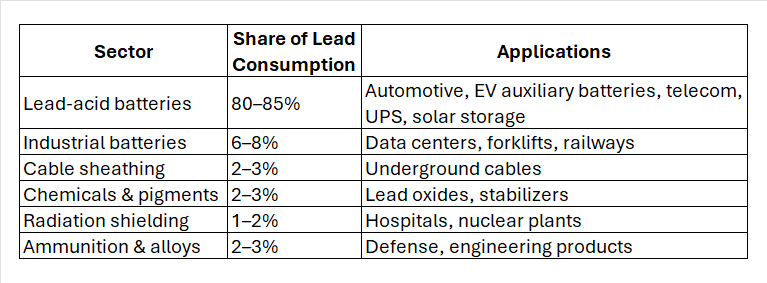 More than four-fifths of India's secondary lead demand is driven by lead-acid battery manufacturing, making battery recycling the backbone of the country's lead ecosystem.
Key Advantages
• Nearly 100% recyclable without significant quality loss.
• Lower production cost through recycling than primary smelting.
• Essential for energy storage and backup power.
• High scrap recovery value supports circular economy.
• Critical raw material for automotive and industrial batteries.
3. Future Prospects of Lead Demand (2026–2030)
India's lead demand is expected to remain robust despite the rapid adoption of lithium-ion batteries. Conventional internal combustion vehicles, commercial vehicles, tractors, telecom towers, UPS systems, railways, and renewable energy storage will continue to require lead-acid batteries.
Major Growth Drivers
Automobile Industry
India continues to be among the world's largest automobile manufacturers. Every passenger car, truck, bus, tractor, and two-wheeler requires at least one lead-acid battery.
Renewable Energy
Solar and wind projects increasingly utilize lead batteries for backup and hybrid energy storage, particularly in rural and off-grid installations.
Telecommunications
Expansion of 5G networks and telecom towers will sustain demand for industrial lead batteries.
Data Centres
Rapid growth in AI, cloud computing, and digital infrastructure is increasing demand for UPS systems powered by lead-acid batteries.
Industrial Infrastructure
Manufacturing expansion, warehousing, mining, and logistics continue to consume industrial batteries.
Lead Demand Forecast (Estimated Lead Demand (Million Tonnes)
- 2025 :1.25
- 2026 :1.31
- 2027 :1.38
- 2028 :1.46
- 2029 :1.55
- 2030 : 1.65
Industry studies project Indian lead demand to grow at approximately 5.5–6.5% CAGR, reaching around 1.6–1.7 million tonnes by 2030, supported by automotive growth, exports, and battery manufacturing.
4. Sources of Lead Scrap Generation
India generates lead scrap from numerous industrial and consumer sectors. Used lead-acid batteries (ULABs) remain the dominant source.
Major Sources
a). Automotive Batteries
• Cars
• Trucks
• Buses
• Motorcycles
• Tractors
Largest contributor to lead scrap generation.
b). Industrial Batteries
Generated from:
• Telecom towers
• UPS systems
• Data centers
• Railways
• Airports
• Hospitals
c). Renewable Energy Systems
• Solar battery banks
• Wind backup systems
• Rural electrification projects
Expected to become an increasingly important source by 2030.
d). Manufacturing Scrap
Generated during:
• Battery manufacturing
• Lead sheet production
• Cable manufacturing
• Alloy manufacturing
e). Construction & Demolition
Includes:
• Roofing materials
• Lead pipes
• Cable sheathing
• Radiation shielding materials
f). Electronic Waste
Recovered from:
• UPS units
• Emergency lighting
• Electronic equipment
• Communication systems
g). Defence & Engineering
Includes:
• Ammunition
• Counterweights
• Specialized industrial alloys
Lead scrap availability in India comes from used lead-acid batteries, industrial manufacturing residues, construction and demolition waste, electronic scrap, and miscellaneous consumer products containing lead.
5. Types of Lead Scrap and Their Sources
- Used Lead-Acid Batteries (ULABs) -- Automotive sector
- Battery Plates -- Battery manufacturers
- Battery Paste -- Battery recyclers
- Soft Lead Scrap -- Cable industries
- Hard Lead Scrap -- Alloy manufacturers
- Lead Ash -- Secondary smelters
- Lead Dross -- Smelting operations
- Lead Cable Scrap -- Power sector
- Lead Pipes -- Construction
- Radiation Lead Sheets -- Hospitals & Nuclear Industry
- Electronic Lead Scrap -- E-waste recyclers
- Lead Oxide Scrap -- Battery manufacturing
Used lead-acid batteries account for nearly 85–90% of recyclable lead feedstock in India, making efficient collection systems essential for sustainable secondary lead production.
6. India's Primary Lead Production Companies (2025) with Forecast (2026–2030)
India's primary lead production is dominated by integrated mining and smelting operations, with recycled lead accounting for the majority of overall supply.
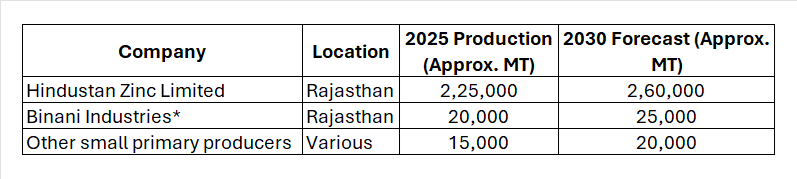
Hindustan Zinc remained India's leading primary lead producer in FY2025, increasing its domestic market share to approximately 74% while benefiting from continued growth in automotive and battery demand.
7. State-wise Lead Battery Scrap Generation (2025 & Forecast to 2030)
The estimates below are based on automobile population, industrial activity, telecom infrastructure, and battery replacement cycles.
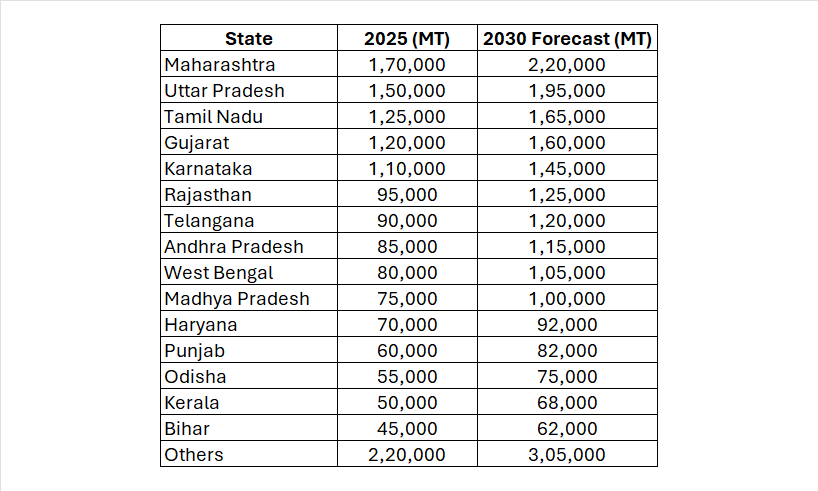 Estimated National Total (Lead Battery Scrap Generation in MT)
- 2025 -- 1.60 million tons
- 2030 -- 2.24 million tons
The increase is expected to be driven by growth in the vehicle fleet, industrial battery usage, telecom expansion, renewable energy installations, and improved collection under Battery Waste Management Rules. Industry outlooks also indicate sustained growth in India's lead-acid battery market through 2030. (Grand View Research)
8. Top 10 Indian States in Unorganized Lead Recycling with Estimated Quantities (2025)
India's unorganized lead recycling sector continues to play a significant role in recovering lead from used lead-acid batteries (ULABs), particularly through informal collection and small-scale smelting operations. However, these activities often lack pollution control systems and operate outside formal regulatory frameworks. The implementation of the Battery Waste Management Rules, 2022, and Extended Producer Responsibility (EPR) is expected to shift more recycling into the organized sector by 2030.
Table 8: Top 10 States in Unorganized Lead Recycling (Estimated 2025)
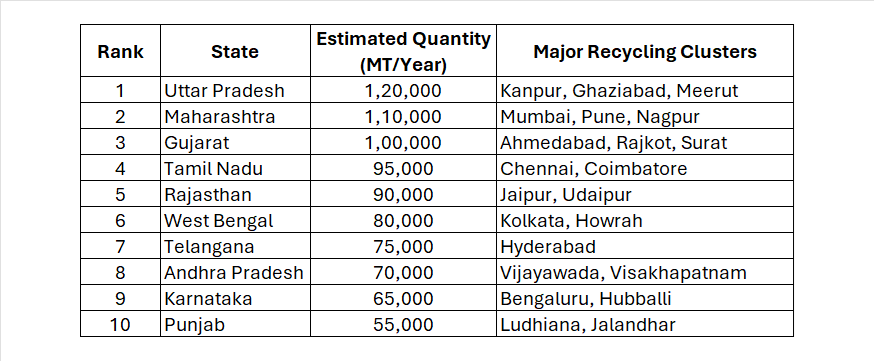
Estimated Total Unorganized Recycling: 860,000 MT/year
Forecast 2030: Expected to decline to 600,000–650,000 MT/year as more recyclers transition into the formal sector under stricter environmental regulations.
9. Regional Secondary Lead Producers in India with Plant Capacities
Secondary lead production contributes nearly 80–85% of India's total refined lead output. Most recyclers process used lead-acid batteries into refined lead ingots and lead alloys.
Table 9: Major Secondary Lead Producers
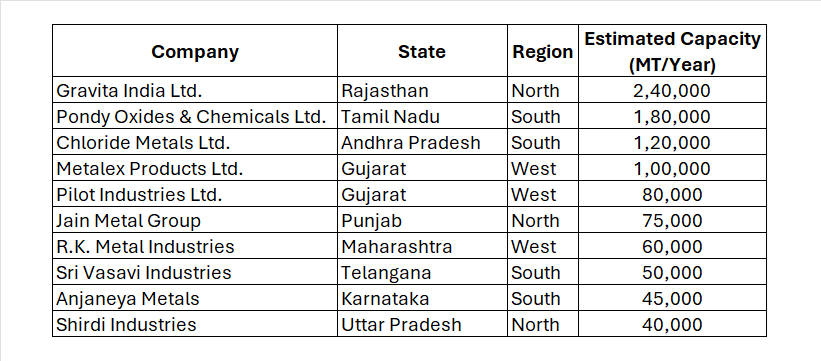 Regional Capacity (Mt/year)Distribution
- North India: 355,000
- West India: 240,000
- South India: 395,000
- East India: 60,000
Estimated National Secondary Capacity: 1.05–1.10 Million MT/Year
10. Top 20 Global Lead Recycling Countries with Recycling Capacities
Worldwide, approximately 60–65% of refined lead production comes from recycled lead.
Table 10: Global Lead Recycling Leaders (2025)
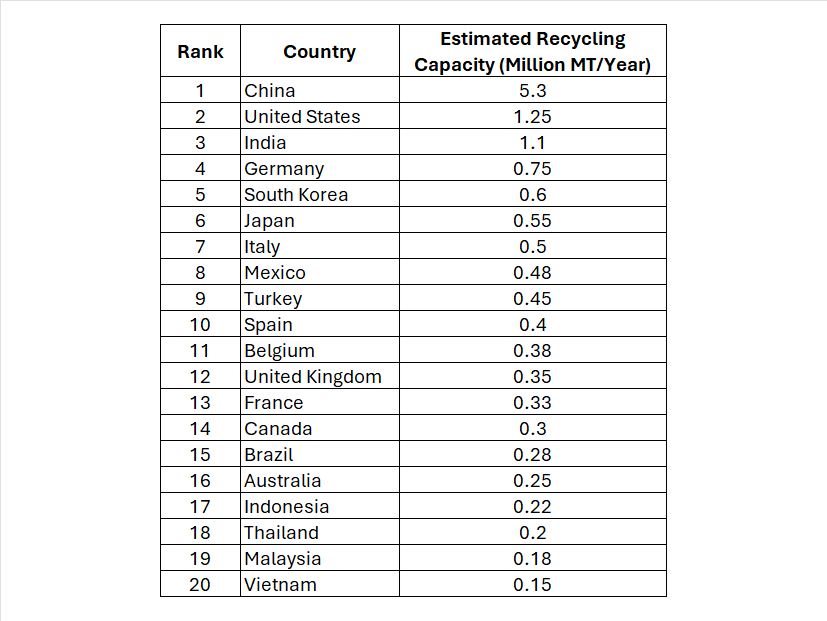
Global Recycling Capacity: Approximately 14–15 Million MT/year
11. Major Lead Scrap & Refined Lead Ingot Exporting Countries (2025 & Forecast 2030)
International trade in lead scrap and refined lead is driven by battery recycling, automotive demand, and secondary smelting industries.
Table 11: Major Exporters
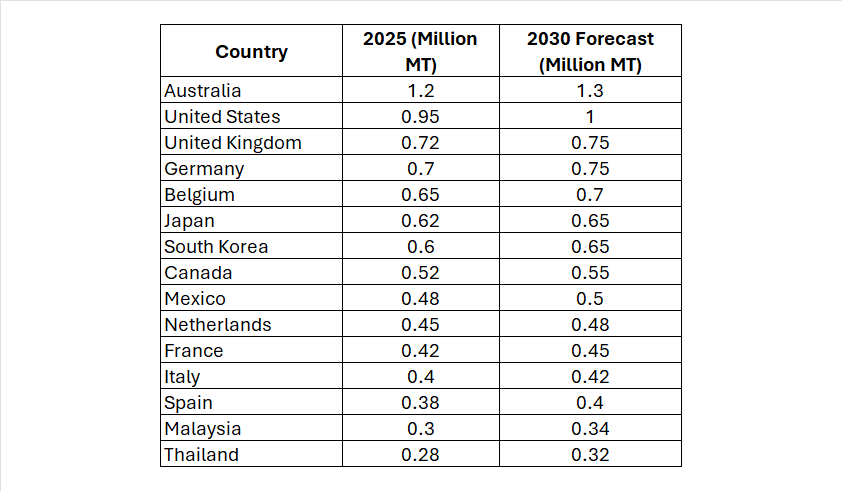
Key Trends (2026–2030)
• Battery recycling will dominate global lead trade.
• Asian demand is expected to remain the primary growth driver.
• Environmental regulations may reduce exports of untreated lead scrap.
• Higher exports of refined lead ingots are anticipated due to value addition.
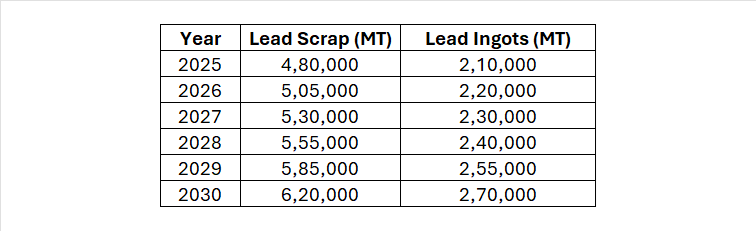
12. India's Lead Scrap & Lead Ingot Imports (2025 & Forecast 2030)
India imports both lead scrap and refined lead to meet growing demand from battery manufacturers and secondary smelters.
Table 12: Lead Imports
 Major Supplying Countries
• United Kingdom
• Australia
• United States
• Germany
• Belgium
• UAE
• Saudi Arabia
• Singapore
• Japan
• South Korea
13. SWOT Analysis of India's Lead Recycling Industry
Table 13: SWOT Analysis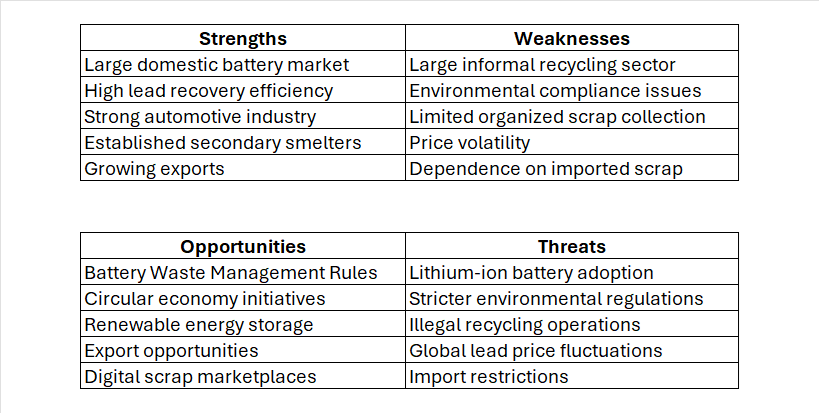 14. Usage of the LOHAA Mobile Application of Android and iPhone / Portal for Lead Commercial Transactions
The LOHAA Mobile Application is a specialized B2B digital marketplace that connects buyers and sellers across the metal recycling industry. For the lead sector, the platform provides a secure and transparent ecosystem for trading lead scrap, refined lead ingots, battery scrap, lead alloys, lead oxide, dross, and related products.
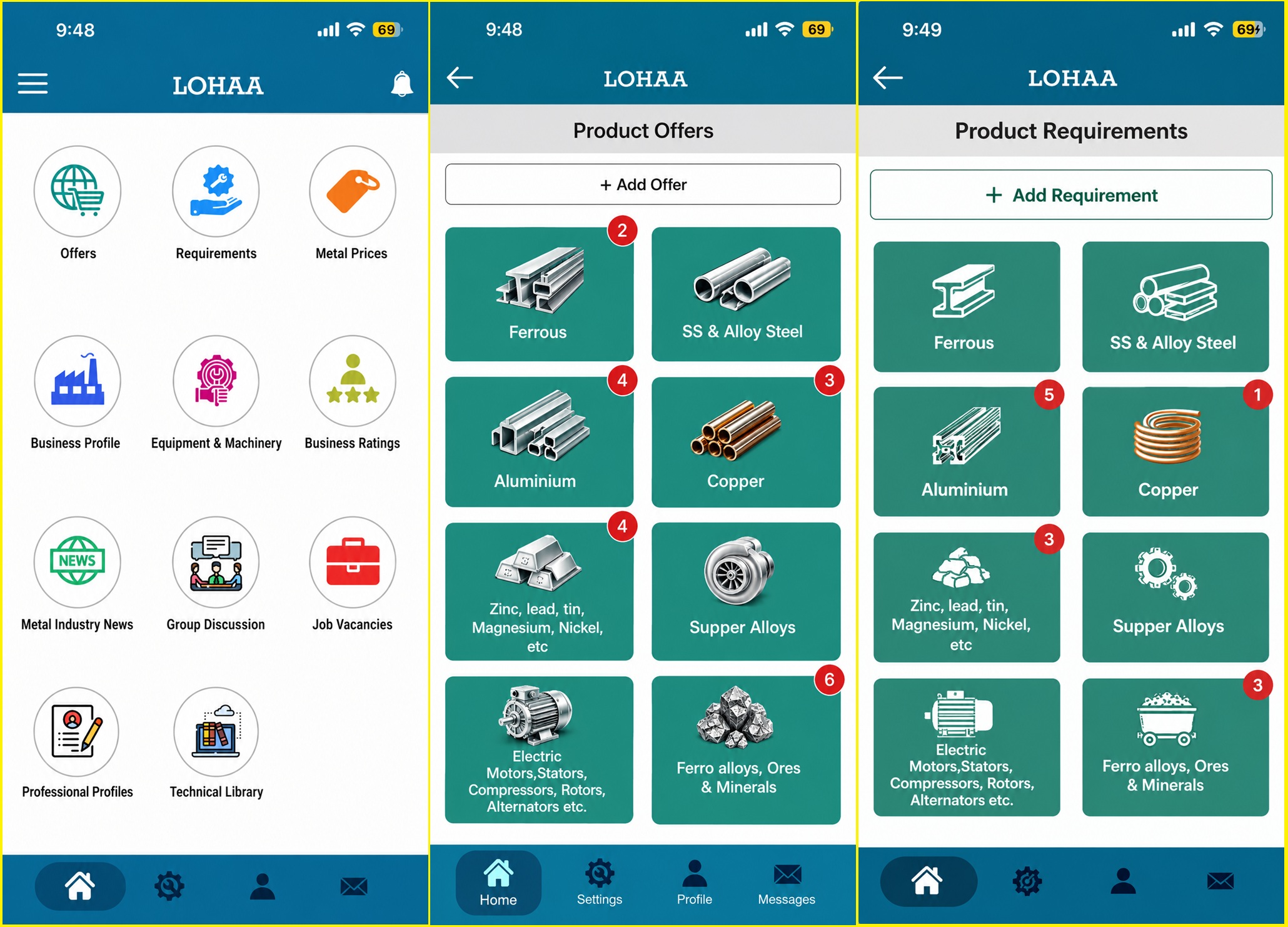
Key Benefits
• Publish buy and sell offers for lead scrap and lead ingots.
• Source verified suppliers and buyers across India and international markets.
• Access daily domestic and international lead price updates.
• Compare multiple quotations before finalizing purchases.
• Build long-term business relationships through KYC-verified company profiles.
• Post requirements for battery scrap, lead alloys, and recycled lead products.
• Discover import and export opportunities.
• Promote machinery and recycling equipment for lead processing.
• Receive industry news, market insights, and technical updates.
• Improve business visibility through company profiles and product listings.
Commercial Transactions Supported
Product Category Trading Through LOHAA
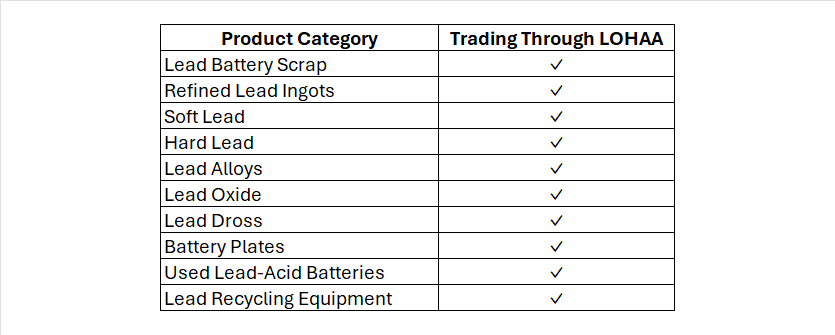 LOHAA enables recyclers, smelters, battery manufacturers, traders, importers, exporters, and industrial consumers to conduct commercial transactions efficiently while reducing procurement time and improving supply-chain transparency.
15. Additional Professional data
India's Lead Demand by Sector (2025)
- Automotive Batteries: 60%
- Industrial Batteries:20%
- Telecom & UPS:8%
- Renewable Energy:5%
- Chemicals & Others: 7%
Expected Growth Drivers (2026–2030)
- Vehicle Production :Very High
- Battery Replacement Market: Very High
- Renewable Energy: High
- Telecom Infrastructure :Moderate
- Data Canters :High
- Industrial Automation :Moderate
- Circular Economy Policies: High
Conclusion
India's lead industry is entering a transformative phase driven by rising battery demand, expanding automotive production, renewable energy growth, and stronger environmental regulations. While primary lead production remains relatively limited, secondary lead recycling will continue to dominate the supply chain, contributing more than 80% of the country's refined lead output. The implementation of the Battery Waste Management Rules and Extended Producer Responsibility (EPR) framework is expected to accelerate the transition from informal recycling to organized, environmentally compliant operations. Increased investments in modern recycling technologies, improved collection systems, and digital trading platforms will further strengthen the sector. India's dependence on imported lead scrap is likely to continue in the medium term, but domestic recycling efficiency is expected to improve significantly. Platforms such as the LOHAA Mobile Application will play an important role by connecting buyers, sellers, recyclers, importers, exporters, and manufacturers, improving price transparency, expanding market reach, and supporting sustainable commercial transactions across the lead recycling value chain.
References
The following authoritative sources were used and recommended for preparing the India Lead Industry Outlook 2025–2030 report.
Government Organizations
1. Central Pollution Control Board (CPCB). Battery Waste Management Rules, 2022 and Annual Reports.
2. Ministry of Environment, Forest & Climate Change (MoEFCC), Government of India.
3. Ministry of Mines, Government of India.
4. Indian Bureau of Mines (IBM). Indian Minerals Yearbook – Lead & Zinc.
5. Directorate General of Foreign Trade (DGFT), Government of India.
6. Ministry of Commerce & Industry, Government of India.
7. Department for Promotion of Industry and Internal Trade (DPIIT).
8. NITI Aayog Reports on Circular Economy and Resource Efficiency.
9. Ministry of Heavy Industries.
10. Central Electricity Authority (CEA).
International Organizations
11. International Lead and Zinc Study Group (ILZSG).
12. United States Geological Survey (USGS) – Mineral Commodity Summaries: Lead.
13. United Nations Comtrade Database.
14. World Bank Commodity Markets Outlook.
15. Organisation for Economic Co-operation and Development (OECD).
16. International Energy Agency (IEA).
17. International Trade Centre (ITC Trade Map).
18. World Customs Organization (WCO).
Industry Associations
19. International Lead Association (ILA).
20. Battery Council International (BCI).
21. India Lead Zinc Development Association (ILZDA).
22. Federation of Indian Mineral Industries (FIMI).
23. Metal Recycling Association of India (MRAI).
24. Confederation of Indian Industry (CII).
Company Annual Reports
25. Hindustan Zinc Limited.
26. Gravita India Limited.
27. Pondy Oxides & Chemicals Ltd.
28. Chloride Metals Ltd.
29. Amara Raja Energy & Mobility Ltd.
30. Exide Industries Ltd.
31. Luminous Power Technologies.
32. East Penn Manufacturing (USA).
33. Ecobat Technologies.
34. Johnson Controls (Historical Publications).
Market Intelligence & Research
35. CRU Group.
36. Fastmarkets.
37. Benchmark Mineral Intelligence.
38. S&P Global Commodity Insights.
39. Wood Mackenzie.
40. Grand View Research.
41. Fortune Business Insights.
42. MarketsandMarkets.
43. Mordor Intelligence.
44. Statista.
Trade & Customs Data
45. UN Comtrade Database.
46. ITC Trade Map.
47. Directorate General of Commercial Intelligence & Statistics (DGCIS).
48. Indian Customs Import-Export Statistics.
By using digital trade platforms like LOHAA Mobile application, you can reach global buyers, source quality material, and strengthen long-term partnerships.
Download the Lohaa Metal Trading App for Android to access live scrap prices and real-time market updates anytime, anywhere.
Download the Lohaa Metal Trading App for iOS to access live scrap prices and real-time market updates anytime, anywhere.
(Notes: market and production volume estimates are synthesized from public market reports and industrial press; exact tonne figures for materials are not centrally published in a single comprehensive public dataset, therefore the numeric projection above is a conservative, documented estimate built from available intelligence and reasonable regional share assumptions.)


