
India Lead Scrap Market 2025–2026 | Imports, Recycling, SWOT Analysis
Introduction
India’s metal recycling industry is undergoing a structural transformation, driven by sustainability goals, rising industrial demand, and cost optimization. Among all recyclable metals, lead holds a unique position due to its dominant usage in batteries—especially in automotive, telecom, and energy storage sectors.
India is one of the largest consumers of secondary (recycled) lead globally. The majority of lead production in the country is derived from recycled sources, primarily used lead-acid batteries (ULABs). With rapid urbanization, EV transition, and renewable energy expansion, the demand for recycled lead is expected to grow significantly.
This blog provides a detailed analysis of India’s lead scrap ecosystem, including generation patterns, regional sourcing, import dependency, recycling infrastructure, and future outlook.
India’s Lead Scrap Generation Overview
Lead scrap in India is primarily generated from:
• Used Lead Acid Batteries (ULABs) – ~85–90% of total scrap
• Industrial waste (cables, pipes, sheets)
• Telecom & inverter batteries
• Automotive sector (largest contributor)
India’s secondary lead production has steadily increased over the years. Demand for recycled lead rose from 0.98 million tonnes in FY2019 to 1.18 million tonnes in FY2024, reflecting sustained growth. (The Core)
Key Drivers of Lead Scrap Generation:
• Rapid vehicle ownership growth
• Expansion of solar and inverter battery systems
• Telecom infrastructure
• Industrial UPS systems
India’s lead battery industry itself is estimated at ?40,000 crore, further strengthening scrap availability and recycling demand. (ScienceDirect)
State-wise / Regional Lead Scrap Generation in India
Lead scrap generation in India is uneven and highly correlated with industrialization, vehicle density, and urbanization.
1. Northern India
Key states: Delhi, Haryana, Punjab, Uttar Pradesh
Characteristics:
• High automotive density
• Large informal recycling sector
• Strong battery replacement market
Major Scrap Sources:
• Automotive batteries
• Industrial UPS systems
• Telecom scrap
2. Western India
Key states: Maharashtra, Gujarat, Rajasthan
Highlights:
• Largest organized recycling hubs
• Ports facilitate scrap imports
• Presence of major recyclers
Major Centers:
• Gujarat (Alang, Mundra)
• Maharashtra (Mumbai, Pune industrial belt)
3. Southern India
Key states: Tamil Nadu, Karnataka, Telangana, Andhra Pradesh
Strengths:
• Strong manufacturing base
• Growing EV ecosystem
• High inverter battery usage
Key Drivers:
• Solar energy adoption
• Industrial clusters
4. Eastern India
Key states: West Bengal, Odisha, Jharkhand
Features:
• Emerging recycling ecosystem
• Proximity to mineral belts
• Growing industrial demand
Lead Scrap Recycling Ecosystem in India
India has both formal and informal recycling sectors:
1. Formal Sector
• Organized smelters with environmental compliance
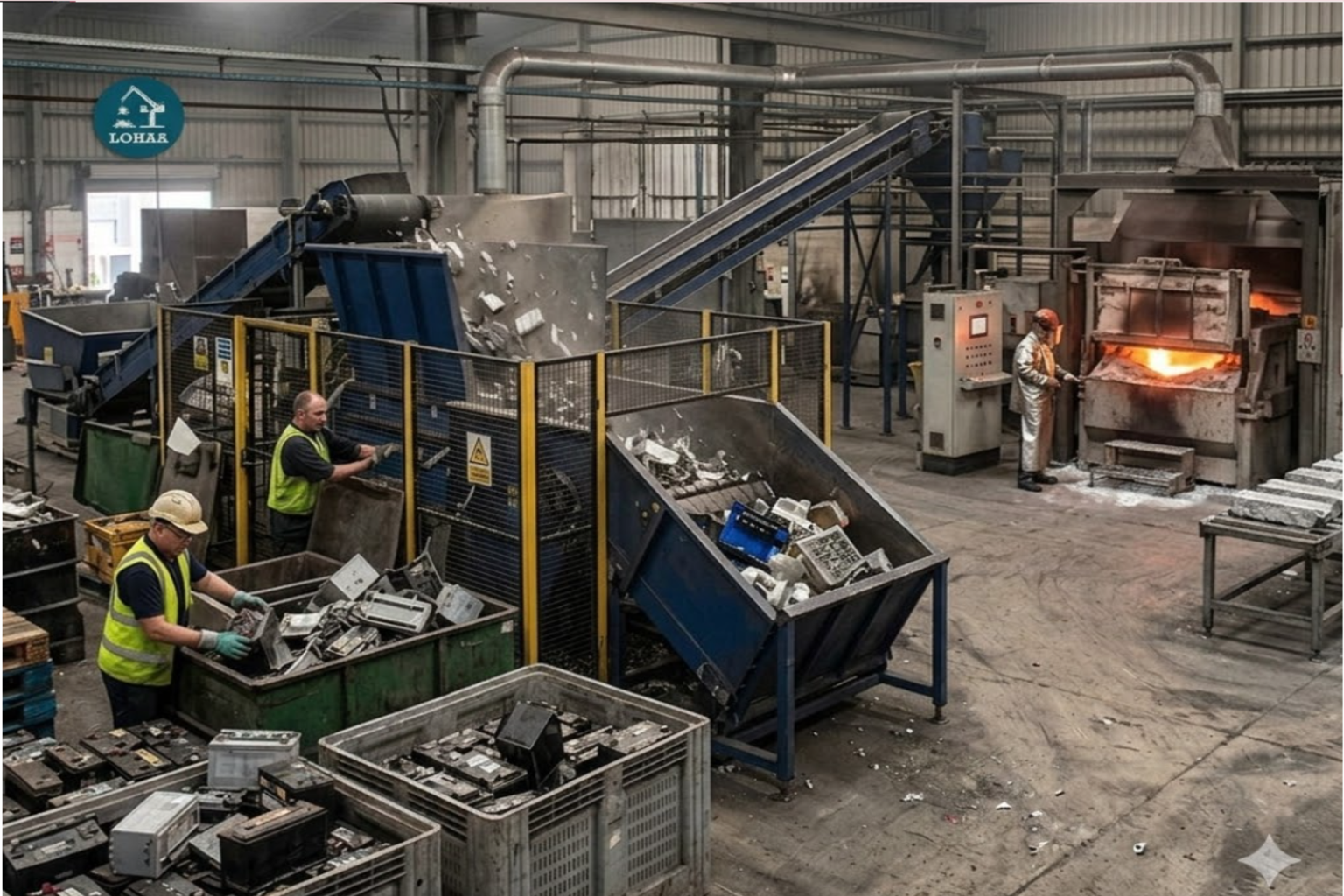
• Advanced technology (pyrometallurgical processes)
• High recovery rates (~95–98%)
2. Informal Sector
• Small-scale recyclers
• Environmental and safety concerns
• Significant share in total scrap processing
Recycling Process:
1. Collection of used batteries
2. Breaking and separation
3. Smelting and refining
4. Production of secondary lead
Lead Scrap Imports into India
Despite strong domestic scrap generation, India relies heavily on imports due to supply gaps.
Top Exporting Countries to India
• United States
• Australia
• United Kingdom
• Qatar
• UAE
These countries dominate India’s lead scrap supply chain.
In 2023, India imported lead scrap mainly from:
• USA ($63.5 million)
• Australia ($19.3 million)
• UK ($18.7 million) (OEC World)
In 2021, India imported 78,481 tonnes of lead scrap worth $168.8 million. (World Integrated Trade Solution)
The USA alone contributes ~77% of shipments in recent years. (Volza)
Import Supply Diversity:
India sources lead scrap from 100+ countries, ensuring supply stability and price competitiveness. (Volza)
Why India Imports Lead Scrap
• Domestic scrap shortage
• Increasing demand from battery industry
• Cost advantage of imported scrap
• Policy support (duty exemptions on critical minerals scrap) (Reuters)
Lead Scrap Demand Drivers in India
1. Automotive battery replacement
2. Renewable energy storage systems
3. Telecom infrastructure expansion
4. EV ecosystem (hybrid batteries)
5. Industrial backup systems
Future Prospects of Lead Scrap Market (2025–2026)
1. Growing Battery Demand
India’s transition toward renewable energy and EV adoption will boost demand for energy storage systems.
2. Circular Economy Push
Government initiatives promoting recycling and sustainability will strengthen the formal sector.
3. Import Dependency Continues
Domestic scrap generation will not meet demand, ensuring continued import growth.
4. Policy Support
Duty exemptions and recycling policies will improve availability of raw materials.
5. Technology Upgradation
Modern smelters and eco-friendly recycling technologies will increase efficiency.
SWOT Analysis of India’s Lead Scrap Industry
Strengths
• High recycling efficiency
• Strong battery market
• Established informal collection network
• Growing formal sector
Weaknesses
• Environmental concerns in informal recycling
• Supply inconsistency
• Dependence on imports
Opportunities
• EV and renewable energy growth
• Expansion of organized recycling
• Export potential of refined lead
• Digital scrap trading platforms (like LOHAA)
Threats
• Regulatory tightening
• Price volatility in global scrap markets
• Competition from alternative battery technologies
• Environmental compliance costs
Comparison of Lead with Other Scrap Metals
Table 1: Scrap Generation & Recycling Characteristics
| Metal | Major Sources | Recycling Rate | Demand Driver |
| Lead | Batteries | 95-98% | Automotive & Energy Storage |
| Steel | Cinstruction | 80-90% | Infracture |
| Aluminum | Packing & Auto | 90-95% | Transport &FMCG |
| Copper | Electical Wires | 85-90% | Power & Electronics |
| Zinc | galvanized Scrap | 60-70% | Steel protection |
Table 2: Import Dependency Comparison
| Metal | Import Dependency |
| Lead | High |
| Steel | Moderate |
| Aluminum | Moderate |
| Copper | Very High |
| Zinc | Moderate |
Table 3: Market Growth Outlook (2025–2030)
| Metal | Growth Outlook | Key Trend |
| Lead | Strong | Battery Demand Surge |
| Steel | Very Strong | Infracture Surge |
| Aluminum | Strong | Light weight Materials demand |
| Copper | Very strong | Electrification & EV |
| Zinc | Moderate | Construction & galvanisation |
Here is a curated list of Top Lead Recyclers / Secondary Lead (Ingot) Manufacturers in India with available capacity insights (latest industry-compiled data). This is highly useful for your LOHAA platform, sourcing, and trading intelligence.
Top 20 Lead Recyclers in India (with Capacity)
Large Organized Players (Tier-1)
1. Gravita India Ltd
• Headquarters: Jaipur, Rajasthan
• Capacity: ~278,000+ TPA (global, India major share)
• Presence: India + international recycling units
• Specialty: Integrated recycling (lead, aluminium, plastic)
2. Hindustan Zinc Ltd (Vedanta Group)
• Location: Rajasthan
• Capacity: ~185,000 TPA refined lead (primary + secondary)
• India’s largest lead producer
3. Pondy Oxides & Chemicals Ltd
• Location: Tamil Nadu
• Capacity: ~120,000+ TPA
• Strong export-oriented recycler
4. Amara Raja Energy & Mobility (Recycling Division)
• Location: Andhra Pradesh
• Capacity: ~100,000+ TPA (estimated)
• Integrated battery + recycling ecosystem
5. Exide Industries (Recycling Units)
• Locations: Maharashtra, Karnataka, West Bengal
• Capacity: ~90,000+ TPA (combined)
• Strong backward integration
Mid-Large Secondary Lead Producers (Tier-2)
6. Jain Metal Group
• Location: Chennai + Mundra
• Capacity: ~65,000+ TPA (Mundra unit)
7. Metal Recycling Industries (MRI)
• Location: Gujarat
• Capacity: ~60,000 TPA (estimated)
_
8. Gravita Group Subsidiaries (Multiple Units)
• Locations: Rajasthan, Gujarat
• Combined Capacity: Included in parent (multi-location)
9. Green Recycling Industries
• Location: Maharashtra
• Capacity: ~50,000 TPA (estimated)
_
10. Shivalik Alloys Pvt Ltd
• Location: Uttar Pradesh
• Capacity: ~45,000 TPA
Emerging & Regional Players (Tier-3)
11. Pondy Metal & Rolling Mills
• Tamil Nadu
• Capacity: ~40,000 TPA
12. Sagar Metal Industries
• Maharashtra
• Capacity: ~35,000 TPA
13. Bharat Battery Recycling Unit
• North India
• Capacity: ~30,000 TPA (estimated)
14. Haryana Lead Recycling Cluster (Multiple Units)
• Combined Capacity: ~50,000+ TPA (cluster)
15. Rajasthan Secondary Lead Cluster
• Combined Capacity: ~180,000+ TPA
• (Multiple small & mid-scale recyclers)
16. Karnataka Recycling Cluster
• Combined Capacity: ~100,000+ TPA
_
17. West Bengal Recycling Cluster
• Combined Capacity: ~90,000+ TPA
18. Andhra Pradesh Recycling Cluster
• Combined Capacity: ~80,000+ TPA
19. Gujarat Recycling Cluster (Mundra/Kandla belt)
• Combined Capacity: ~120,000+ TPA
20. Uttar Pradesh Recycling Cluster
• Combined Capacity: ~130,000+ TPA
Table: 4 State-wise Lead Scrap Processing
| States | No. Of Units |
| Rajasthan | 43 |
| Utter Pradesh | 22 |
| Maharashtra | 41 |
| Karnataka | 21 |
| West Bengal | 46 |
| Andhra Pradesh | 12 |
| Madhya Pradesh | 29 |
| Tamil Nadu | 13 |
| Haryana | 28 |
| Gujarat | 14 |
Table: 5 State-wise Lead Scrap Processing
| State | Production Type | Estmated Output share |
| Rajasthan | primary + Secondary | 20-25% |
| Gujarat | Secondary | 15-18% |
| Maharashtra | secondary | 12-15% |
| Utter Pradesh | secondary | 10-13% |
| karnataka | Secondary + export | 8-10% |
| Tamil Nadu | Secondary | 7-9% |
| Andhra Pradesh | Secondary 6-8% | 6-8% |
Role of Digital Platforms in Lead Scrap Trade
Digital marketplaces like LOHAA are transforming the scrap ecosystem by:
• Connecting global buyers and sellers
• Providing transparent pricing
• Ensuring verified transactions
• Enhancing supply chain efficiency
Challenges in India’s Lead Scrap Sector
• Informal recycling pollution
• Lack of structured collection systems
• Compliance costs
• Price fluctuations
Strategic Recommendations
1. Strengthen formal recycling infrastructure
2. Promote organized scrap collection networks
3. Increase domestic scrap recovery
4. Encourage international sourcing diversification
5. Adopt digital trading platforms
Conclusion
India’s lead scrap market is positioned for sustained growth, driven by the battery industry, renewable energy expansion, and circular economy initiatives. While domestic scrap generation is strong, it remains insufficient to meet rising demand, making imports a critical component of supply.
The transition toward organized recycling, coupled with policy support and digital transformation, will shape the future of the industry. By 2026 and beyond, India is expected to emerge as a global hub for lead recycling and secondary lead production.
By using digital trade platforms like LOHAA Mobile application, you can reach global buyers, source quality material, and strengthen long-term partnerships.
Download the LOHAA Mobile application today and connect with verified scrap suppliers and manufacturers.
References
1. Volza Lead Scrap Import Data (Volza)
2. OEC Trade Data – Lead Scrap Imports (OEC World)
3. The Core – Recycling Industry Growth (The Core)
4. ScienceDirect – Lead Recycling in India (ScienceDirect)
5. Reuters – India Scrap Policy (Reuters)
(Notes: market and production volume estimates are synthesized from public market reports and industrial press; exact tonne figures for scrap metal are not centrally published in a single comprehensive public dataset, therefore the numeric projection above is a conservative, documented estimate built from available intelligence and reasonable regional share assumptions.)


