
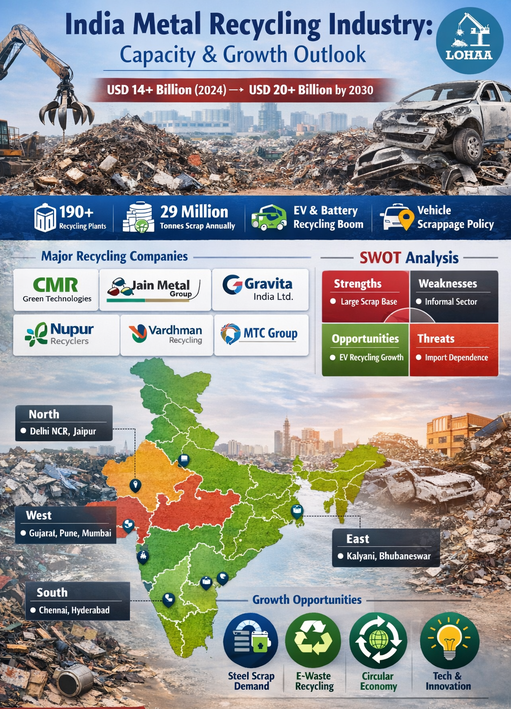
India Metal Recycling Industry Growth, Capacity & SWOT
Introduction: The Rise of Metal Recycling in India
India’s metal recycling sector is entering a transformative phase. Traditionally dominated by the informal sector, the industry is now evolving into a structured, technology-driven ecosystem backed by policy reforms, corporate investments, and sustainability goals.
The Indian metal recycling market was valued at over USD 11.4 billion in 2024 and is projected to reach nearly USD 18.87 billion by 2033, growing at a CAGR of over 5% (IMARC Group). Another estimate places the market at USD 14.1 billion in 2024, expected to exceed USD 21 billion by 2030 (Grand View Research).
India currently uses around 29 million tonnes of scrap annually, which constitutes only about 20% of steel production feedstock, indicating a massive untapped opportunity (S&P Global).
Types of Metals Recycled
Major scrap metals processed in Indian recycling plants:
• Steel scrap
• Aluminium scrap
• Copper scrap
• Lead scrap
• Zinc scrap
• Brass scrap
These metals are recycled and reused in industries such as steel production, automotive manufacturing, electrical equipment, and construction.
Existing Metal Recycling Facilities in India & Their Capacities
India has a mix of organized and unorganized recycling facilities. The organized segment includes large-scale industrial plants operated by major corporates, while the unorganized sector still handles a significant share of scrap collection and processing.
1. Large Organized Recycling Companies & Facilities
a) CMR Green Technologies
• India’s largest metal recycling company
• Focus: Aluminium and non-ferrous recycling
• Multi-location facilities across India
• Integrated recycling operations (collection → processing → alloys) (cmr.co.in)
b) Jain Metal Group
• Capacity: 200,000+ MT annually (copper recycling) (ensun)
• Products: Copper, aluminium, lead alloys
• Advanced cable recycling and metal recovery plants
c) Gravita India Ltd
• Focus: Lead, aluminium, and plastic recycling
• Global operations with multiple processing plants
• Strong presence in battery recycling
d) Tata Steel Recycling Facilities
• Scrap processing plant capacity: 500,000 tonnes/year (Global Recycling)
• New Electric Arc Furnace (EAF) plant (Ludhiana):
o Capacity: 0.75 million tonnes/year (The Economic Times)
• 100% scrap-based steel production
• Automobile Scrapping Facilities (Vehicle Recycling Units)
• India’s Registered Vehicle Scrapping Facilities (RVSF) are authorized dismantling centres under the Vehicle Scrappage Policy.
• Major Operational Locations
| Company / Facility | Location | State |
| Tata Motors Re.Wi.Re | Pune | Maharashtra |
| Tata Motors RVSF | Jaipur | Rajasthan |
| Tata Motors RVSF | Surat | Gujarat |
| Tata Motors RVSF | Chandigarh | Punjab |
| Tata Motors RVSF | Delhi NCR | Haryana |
| Tata Motors RVSF | Kalyani | West Bengal |
| Tata Motors RVSF | Bhubaneswar | Odisha |
| Tata Motors RVSF | Guwahati | Assma |
• The Kalyani (West Bengal) facility can scrap about 21,000 end-of-life vehicles annually. (The Times of India)
e) Ramky Enviro Engineers
• Integrated waste management including metal recovery
• Industrial waste recycling infrastructure
f) Nupur Recyclers
• Key players in scrap trading and export markets (metalbook.com)
g) Vardhman Recycling LLP
• Location: Delhi NCR
Specialization:
Recycling of aluminium, copper, zinc, and brass scrap. (ensun)
h) MTC Business Pvt Ltd.
• Head Office: Chennai
Activities:
Ferrous and non-ferrous metal scrap recycling and trading. (LinkedIn)
Other Government Approved Scrapping Units
Examples of authorized scrapping facilities:
| Facility | Location | State |
| Saral Auto Scraping India Pvt Ltd | Ghaziabad | Utter Pradesh |
| Gadar Kharda Pvt Ltd | Roorkee | Uttarakhand |
| Sega Tech Solution Pvt Ltd | Roorkee | Uttarakhand |
| MKP Kataria Vehicle Scrapping | Ahmedabad | Gujarat |
| Shree Ambica Automotive Pvt Ltd | Karmej | Gujarat |
2. Total Facility Landscape in India
• India has ~196 metal recycling plants listed in organized directories (ENF Metal)
• Thousands of informal scrap yards operate across cities
• E-waste recycling capacity remains underutilized (e.g., Tamil Nadu: 90,000 tonnes capacity but low formal processing) (The Times of India)
| Segment | Key Capacity Insights |
| Steel Scrap | Rapidly growing with EAF plants |
| Aluminium | High recycling rate due to cost benefits |
| Copper | ~200,000 MT+ capacity in organized sector |
| Lead (Battery) | Strong due to EV & battery demand |
| E-waste | Underdeveloped but high potential |
Challenges in Existing Infrastructure
Despite growth, India’s recycling ecosystem faces key bottlenecks:
• Fragmented supply chain dominated by informal players
• Lack of advanced shredding and sorting infrastructure
• High dependence on imported scrap
• Regulatory gaps and inconsistent enforcement
• Limited collection systems
Growth Opportunities for the Next Five Years (2026–2031)
India’s metal recycling sector is poised for strong growth due to structural shifts in manufacturing, policy, and sustainability.
1. Rising Steel Demand & Scrap Substitution
India aims to become a global steel manufacturing hub, increasing demand for scrap-based production. Electric Arc Furnace (EAF) technology will play a crucial role.
• Scrap usage expected to rise significantly
• Lower carbon emissions compared to traditional methods
3. Government Policies & Circular Economy Push
Key drivers:
• National Steel Scrap Recycling Policy
• Extended Producer Responsibility (EPR)
• Circular economy initiatives
These policies are encouraging formalization and investment.
4. EV & Battery Recycling Boom
• Lithium-ion battery recycling emerging as a major segment
• Growing EV adoption will create future scrap streams
• Investments in battery recycling facilities increasing
5. Urban Mining & E-Waste Recycling
India is the third-largest e-waste generator globally, yet less than half is formally recycled (arXiv)
Opportunities:
• Precious metal recovery (gold, copper, rare earths)
• Integration of informal sector
6. Digital Platforms & Supply Chain Integration
Platforms like LOHAA can:
• Connect buyers and sellers globally
• Improve price transparency
• Enable organized scrap sourcing
7. Foreign Investment & Technology Transfer
• Increasing FDI in recycling sector
• Adoption of:
o AI sorting
o Automated shredding
o Smart tracking systems
8. Export Potential
India is emerging as a global scrap trading hub:
• Growing exports of processed scrap
• Integration into global recycling value chains
9. SWOT Analysis – India Metal Recycling Industry
Strengths
• Large domestic scrap generation
• Growing industrial base
• Strong demand from steel and manufacturing
• Cost advantage vs primary metal production
Weaknesses
• Informal sector dominance
• Lack of advanced technology
• Supply chain inefficiencies
• Limited awareness and collection systems
Opportunities
• Circular economy adoption
• EV and battery recycling
• Export market expansion
• Digital transformation (LOHAA-like platforms)
Threats
• Import dependency
• Policy inconsistencies
• Environmental compliance challenges
• Global price volatility
Regional SWOT Analysis
a). North India (Punjab, Haryana, Delhi, UP)
Strengths
• Strong scrap trading ecosystem
• Presence of major recycling hubs (e.g., Ludhiana)
• Proximity to industrial clusters
Weaknesses
• Pollution concerns
• Regulatory challenges
Opportunities
• Expansion of EAF plants
• Organized scrap yards
Threats
• Environmental regulations tightening
b) West India (Gujarat, Maharashtra, Rajasthan)
Strengths
• Strong industrial base
• Major ports for scrap imports
• Leading recycling companies
Weaknesses
• High logistics costs inland
Opportunities
• Export-oriented recycling
• Advanced processing facilities
Threats
• Competition from global recyclers
c). South India (Tamil Nadu, Karnataka, Andhra Pradesh, Telangana)
Strengths
• Manufacturing hubs (auto, electronics)
• Growing e-waste generation
Weaknesses
• Low formal recycling penetration
• Informal dominance
Opportunities
• E-waste and battery recycling
• Industrial scrap generation
Threats
• Policy enforcement gaps
d) East India (Odisha, West Bengal, Jharkhand)
Strengths
• Mineral-rich region
• Steel production hubs
Weaknesses
• Limited recycling infrastructure
Opportunities
• Scrap-based steel plants
• Industrial waste recycling
Threats
• Infrastructure constraints
Future Outlook: India’s Recycling Industry by 2030
India’s recycling industry is expected to undergo a structural transformation:
• Shift from informal to organized sector
• Increased use of recycled metals in manufacturing
• Integration of digital platforms
• Emergence of “urban mining”
Major corporations like Tata, Vedanta, and Aditya Birla Group are already integrating recycling into their core strategies (The Core).
10. Role of LOHAA in Transforming Metal Recycling
LOHAA can play a pivotal role by:
• Digitizing scrap trading
• Connecting global buyers and sellers
• Ensuring transparency and traceability
• Supporting circular economy initiatives
With users across 18+ countries, LOHAA is positioned to become a key enabler of India’s recycling ecosystem.
Conclusion
India’s metal recycling industry stands at a critical juncture. With increasing industrial demand, supportive policies, and technological advancements, the sector is poised for exponential growth.
However, unlocking its full potential requires:
• Formalization of the informal sector
• Investment in infrastructure
• Digital transformation
• Strong regulatory frameworks
Over the next five years, India has the opportunity to emerge as a global leader in metal recycling, contributing significantly to sustainability, economic growth, and resource efficiency.
By using digital trade platforms like LOHAA Mobile application, you can reach global buyers, source quality material, and strengthen long-term partnerships.
Download the LOHAA Mobile application today and connect with verified scrap suppliers and manufacturers.
11. References
1. Grand View Research – India Metal Recycling Market (Grand View Research)
2. IMARC Group – India Metal Recycling Outlook (IMARC Group)
3. Tata Steel Scrap Facility News (The Economic Times)
4. Global Recycling – Scrap Processing Capacity (Global Recycling)
5. Jain Metal Group Capacity Data (ensun)
6. Recycling Industry Growth Insights (recyclingtoday.com)
7. Circular Economy Scrap Usage (S&P Global)
8. E-waste Research Paper (arXiv)
9. Industry Corporate Trends (The Core)
(Notes: market and production volume estimates are synthesized from public market reports and industrial press; exact tonne figures for scrap metal are not centrally published in a single comprehensive public dataset, therefore the numeric projection above is a conservative, documented estimate built from available intelligence and reasonable regional share assumptions.)


