
India Secondary Steel: Production & Cost Outlook
1. Introduction
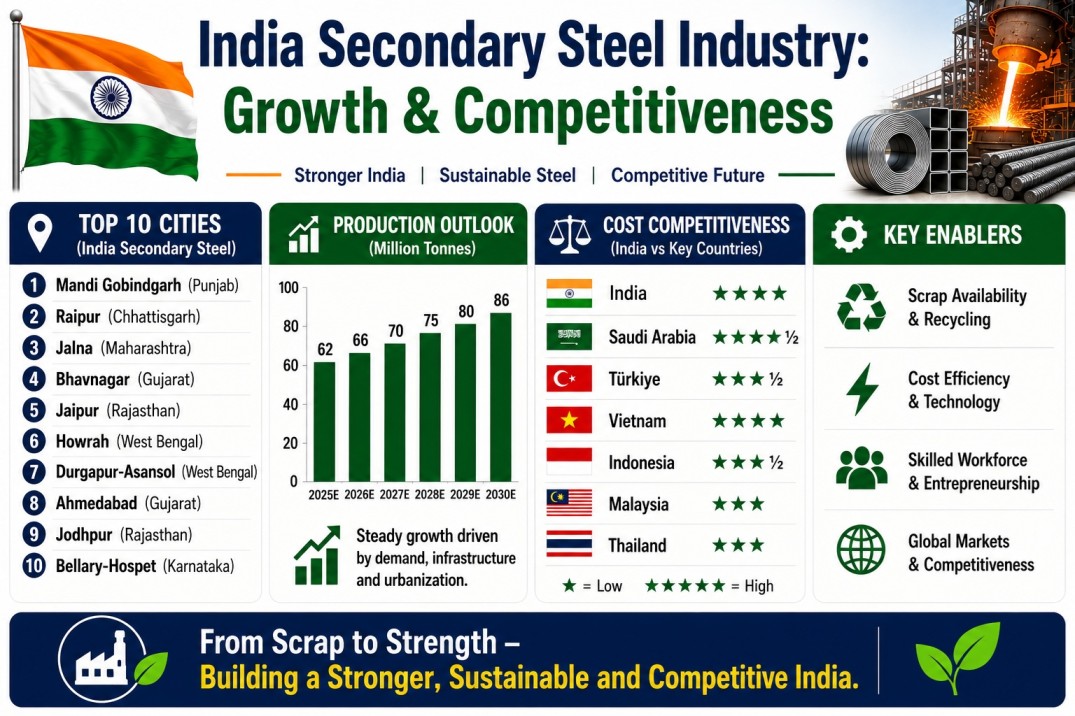
India’s secondary steel industry is entering a significant growth phase, supported by rising demand from infrastructure, housing, automobiles, railways, renewable energy and construction. The National Steel Policy 2017 targets 300 MT crude-steel capacity and 255 MT production by 2030–31. The secondary route is already important, with induction furnaces accounting for about 57 MT, or 38%, of FY2024–25 crude-steel production. DRI, scrap, induction furnaces and EAFs will remain central to future growth. However, fragmented production, volatile raw-material and ferroalloy prices, energy costs and working-capital pressures remain challenges. This report examines major secondary-steel cities, production, demand, scrap supply, costs, competitiveness and digital opportunities through LOHAA Mobile.
2. India's Top Ten Secondary-Steel Manufacturing Cities/Clusters
The most important clusters are identified by the concentration of induction furnaces, rolling mills, DRI/billet producers, scrap markets and downstream long-steel manufacturers.
The Bureau of Energy Efficiency officially identifies Mandi Gobindgarh-Ludhiana, Jaipur, Jalna and Raipur as steel-re-rolling clusters. Its cluster study also provides production and unit data for five major clusters.
a) Mandi Gobindgarh–Ludhiana (Punjab)
- Indicative Units: 275+
- 2025 Production Estimate: ~5.0 MT
- Main Products: Ingots, billets, TMT, rounds, sections
b) Raipur–Urla–Siltara (Chhattisgarh)
- Indicative Units:135+ in core cluster
- 2025 Production Estimate:~4.5–5.5 MT
- Main Products: DRI, billets, TMT, wire rods
c) Jalna (Maharashtra)
- Indicative Units:30+ core re-rolling units; wider cluster much larger
- 2025 Production Estimate:~3.5–4.0 MT
- Main Products: Billets, TMT, bars
d) Bhavnagar–Sihor (Gujarat)
- Indicative Units:70+ core re-rolling units
- 2025 Production Estimate:~1.8–2.5 MT
- Main Products: Billets, bars, TMT
e) Jaipur(Rajasthan)
- Indicative Units: 33+ core re-rolling units
- 2025 Production Estimate: ~1.2–1.8 MT
- Main Products: TMT, bars, sections
f) Howrah (West Bengal)
- Indicative Units:60–100
- 2025 Production Estimate:~1.5–2.0 MT
- Main Products: Long products, sections, engineering steel
g) Durgapur–Asansol (West Bengal)
- Indicative Units:60–100
- 2025 Production Estimate:~1.5–2.0 MT
- Main Products: Billets, TMT, wire rod
h) Ahmedabad–Mehsana (Gujarat)
- Indicative Units:50–90
- 2025 Production Estimate: ~1.2–1.7 MT
- Main Products: TMT, bars, billets
i) Jodhpur (Rajasthan)
- Indicative Units:40–70
- 2025 Production Estimate:~0.8–1.2 MT
- Main Products: TMT, rounds, structural steel
k) Bellary–Hospet (Karnataka)
- Indicative Units:40–70
- 2025 Production Estimate:~0.8–1.3 MT
- Main Products: DRI, billets, TMT
*Planning estimates. They should not be interpreted as official city-wise JPC statistics.
The BEE study gives a useful historical benchmark: Mandi Gobindgarh-Ludhiana was recorded at 275 units and 5 MT production, Raipur at 135 units and 3.3 MT, Jalna at 30 units and 3.9 MT, Bhavnagar at 70 units and 1.8 MT, and Jaipur at 33 units and 1.2 MT. (Bureau of Energy Efficiency)
The apparent difference between the number of units and wider industry estimates is because different studies use different cluster boundaries and definitions of "unit".
3. Why These Cities Developed as Secondary-Steel Manufacturing Centres
3.1 Mandi Gobindgarh–Ludhiana
Mandi Gobindgarh is traditionally known as India's "Loha Mandi". Its development was driven by:
- Long-established steel trading.
- Availability of scrap and billets.
- Large number of rolling mills.
- Experienced workforce.
- Strong engineering and fabrication ecosystem.
- Proximity to northern Indian markets.
- Established transport and warehousing infrastructure.
- Strong network of steel traders and distributors.
The BEE study recorded approximately 275 units in the cluster and about 5 MT production, while older industry descriptions have reported an even broader ecosystem containing rolling mills, induction furnaces, scrap-processing units, oxygen plants and other allied industries. (Bureau of Energy Efficiency)
Main challenge
The cluster's historical strength—many small independent producers—is also a weakness. Fragmentation reduces purchasing power, limits automation and makes technology upgrades difficult.
3.2 Raipur–Urla–Siltara
Raipur has arguably the strongest integrated secondary-steel ecosystem in India.
Its advantages include:
• Iron ore availability in the broader region.
• Large DRI industry.
• Coal availability.
• Captive power.
• Ferroalloy production.
• Billet manufacturing.
• Rolling mills.
• Railway connectivity.
• Established industrial land.
The Raipur cluster therefore has an advantage over pure scrap-based centres because producers can combine DRI, scrap and pig iron.
3.3 Jalna
Jalna developed as a major secondary-steel centre because of:
• Maharashtra's large construction market.
• Entrepreneurial steel businesses.
• Established TMT distribution.
• Availability of scrap and billets.
• Growing industrial activity.
• Road connectivity to western and central India.
BEE's historical data show that Jalna had 30 core units and approximately 3.9 MT production, with many units operating composite melting and rolling facilities. (Bureau of Energy Efficiency)
3.4 Bhavnagar–Sihor
Bhavnagar has a special advantage that few Indian steel clusters possess: its proximity to the Alang ship-recycling industry.
Ship recycling provides a large source of recovered steel, which can be processed into feedstock for re-rolling mills. This gives Bhavnagar an important circular-economy advantage.
3.5 Jaipur and Jodhpur
Rajasthan's steel clusters benefit from:
• Construction activity.
• Strong trading networks.
• Industrial development.
• Availability of land.
• Road connectivity.
• Growing renewable-energy infrastructure.
• Demand from northern and western India.
3.6 Howrah and Durgapur
Eastern India has a long history of iron, steel, foundry and engineering activity.
The region benefits from:
• Coal-producing areas.
• Iron ore availability.
• Railway infrastructure.
• Engineering industries.
• Large eastern Indian markets.
• Existing steel plants.
• Ports on the eastern coast.
BEE's current eligible-cluster programme also identifies Howrah as a major foundry cluster, reinforcing the depth of the region's metal-processing ecosystem.
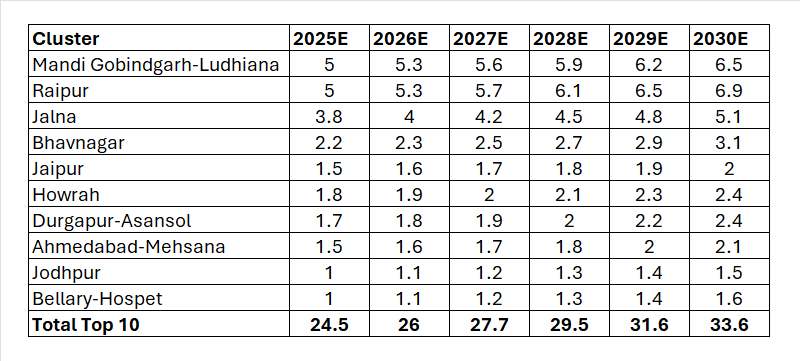
4. 2025 Production and 2026–2030 Production Forecast by City
A reasonable base-case model assumes that India's secondary-steel sector grows faster than mature global steel markets because Indian steel demand remains strong.
- Main Secondary/Downstream Products: DRI, billets, long products
- 2025 Production Status: Major integrated producer
- Main Secondary/Downstream Products: DRI, billets, TMT
- 2025 Production Status: 0.855 MT billets; 0.765 MT TMT in FY25
- Main Secondary/Downstream Products: DRI, billets, wire rods
- 2025 Production Status: Major integrated secondary-route producer
- Main Secondary/Downstream Products: DRI, billets, pig iron, TMT
- Major integrated producer
- Main Secondary/Downstream Products: DRI, billets, ferroalloys
- 2025 Production Status: Major producer
- Main Secondary/Downstream Products: DRI, billets, TMT
- 2025 Production Status: Major regional producer
- Main Secondary/Downstream Products: DRI, steel, ferroalloys
- 2025 Production Status: Regional producer
- Main Secondary/Downstream Products: DRI, billets, TMT
- 2025 Production Status: Major eastern producer
- Main Secondary/Downstream Products: TMT, billets
- 2025 Production Status: Major eastern long-steel producer
- Main Secondary/Downstream Products: Billets, TMT
- 2025 Production Status: Regional producer
- Main Secondary/Downstream Products: DRI, billets, TMT
- 2025 Production Status: Southern producer
- Main Secondary/Downstream Products: TMT
- 2025 Production Status: Distributed manufacturing network
- Main Secondary/Downstream Products: TMT, billets
- 2025 Production Status: Regional producer
6. India's Secondary Steel Demand Forecast: 2026–2030
India's total steel demand provides the fundamental support for secondary steel.
The OECD's 2026 Steel Outlook projects Indian steel demand at 174.72 MT in 2026 and 209.46 MT in 2030, representing a 2025-30 CAGR of approximately 5.1%. (OECD)
A secondary-steel demand scenario can therefore be modelled as follows (Estimated Secondary-Steel Demand)
- 2025: 60–62 MT
- 2026: 64 MT
- 2027: 68 MT
- 2028: 72 MT
- 2029: 77 MT
- 2030: 82 MT
Secondary steel should benefit particularly from demand for:
- TMT bars.
- Structural steel.
- Wire rods.
- Merchant bars.
- Rounds.
- Transmission towers.
- Solar structures.
- Railway infrastructure.
- Industrial buildings.
- Warehousing.
- Engineering products.
- Automotive components.
The National Steel Policy's 2030-31 target of 230 MT finished-steel demand/production establishes the broader structural opportunity. (Ministry of Steel)
7. India's Steel Scrap Generation
Scrap will become one of the most important strategic raw materials for India's steel industry.
The Economic Survey 2024-25 estimated domestic steel-scrap consumption at approximately 30 MT, of which around 5 MT was imported. It also noted that scrap recycling can reduce specific energy use, water consumption and greenhouse-gas emissions compared with primary steelmaking. (India Budget)
For planning purposes, domestic scrap generation can be modelled as (Estimated Domestic Steel Scrap Generation}
- 2024: ~35 MT
- 2025: ~37 MT
- 2026: ~39 MT
- 2027: ~41 MT
- 2028: ~43 MT
- 2029: ~46 MT
- 2030: ~49 MT
This is generation, not necessarily immediately recoverable steelmaking scrap.
The distinction is important because scrap can remain in buildings, vehicles, machinery, infrastructure and consumer products for many years before entering the recycling system.
8. Scrap Availability Through 2030
The government therefore faces two separate challenges:
Challenge 1: Increase scrap generation
This will occur naturally as India's industrial and vehicle stock ages.
Challenge 2: Increase scrap collection
This requires:
• Vehicle scrapping centres.
• Industrial scrap collection.
• Demolition-scrap processing.
• Construction-waste separation.
• Appliance recycling.
• Railway scrap recovery.
• Machinery dismantling.
• Scrap-processing centres.
• Digital scrap traceability.
The Steel Scrap Recycling Policy is specifically designed to improve systematic collection, processing and recycling. (Ministry of Steel)
9. Ferrous Scrap Imports: 2021–2025
HS 7204 is the principal customs heading for ferrous waste and scrap, including remelting scrap ingots.
World Bank/UN Comtrade data for HS 720449 show India's imports of this category at approximately 3.46 MT in 2021. (World Integrated Trade Solution)
For 2024, India imported approximately 7.61 MT of HS 720449 ferrous waste and scrap, worth about US$3.15 billion. Major suppliers included the United States, United Kingdom, Australia, Brazil and Poland. (World Integrated Trade Solution)
Trade values for the broader HS 7204 category show (Indicative Import Value)
- FY2020-21: ?21,340 crore
- FY2021-22: ?32,351 crore
- FY2022-23: ?54,206 crore
- FY2023-24: ?52,255 crore
- FY2024-25: Apr-Dec ?31,397 crore
These figures cover HS 7204 ferrous waste/scrap and remelting scrap ingots and should not be confused with the volume of all scrap categories. (NSE India Search Archives)
India was also the world's second-largest importer of ferrous waste and scrap by value in 2024 after Türkiye, according to DGCIS data. India's imports were valued at approximately US$5.05 billion in 2024 under HS 7204.
10. Types of Steel Scrap Imported by India
The principal categories include:
- HMS 1.
- HMS 1&2.
- Shredded scrap.
- P&S scrap.
- Plate and structural scrap.
- Busheling.
- Industrial manufacturing scrap.
- Turnings.
- Bundles.
- Heavy structural scrap.
- Stainless-steel scrap.
- Alloy-steel scrap.
- Machinery scrap.
- Automotive scrap.
- Ship-recycling scrap.
The economic importance differs by furnace technology.
For example:
• IF mills often use combinations of DRI, HMS and other ferrous scrap.
• EAF mills can use higher proportions of scrap.
• High-quality specialty steelmakers need cleaner and more chemically consistent scrap.
• Stainless producers require segregated stainless grades.
• Automotive-grade production requires tight control of residual elements.
11. Scrap Import Forecast: 2026–2030
A reasonable base-case scenario is (Forecast Ferrous Scrap Imports)
- 2026: 8.5 MT
- 2027: 9.0 MT
- 2028: 9.5 MT
- 2029: 10.0 MT
- 2030: 10.5–11.0 MT
The apparent contradiction between increasing domestic scrap generation and increasing imports can be explained by rapidly expanding steel production.
If domestic steel output rises faster than recoverable scrap supply, imports may increase even while domestic recycling improves.
12. Major Ports for Imported Steel Scrap
India's principal gateways (Ports) for imported ferrous scrap include:
- Nhava Sheva/JNPT: Maharashtra, MP, Gujarat, North India
- Mundra: Gujarat, Rajasthan, North India
- Kandla/Deendayal: Gujarat and Rajasthan
- Hazira: Gujarat
- Chennai: Tamil Nadu and southern India
- Kamarajar/Ennore: Tamil Nadu
- Krishnapatnam: Andhra Pradesh/Telangana
- Visakhapatnam: AP, Telangana, Odisha
- Kolkata/Haldia: Eastern India
- Cochin: Kerala and southern markets
The most economical port depends on vessel size, freight, customs clearance, inland transport, availability of stockyards and final plant location.
A Raipur producer, for example, may find eastern or western ports competitive depending on freight rates and scrap origin, whereas a Jalna producer may find western ports more attractive.
13. Secondary-Steel Manufacturing Cost in India's Top Ten Clusters
The most meaningful comparison is conversion cost, excluding the metallic charge because scrap, DRI and pig-iron prices change frequently.
Indicative 2025-26 conversion-cost range:
Cluster Estimated Conversion Cost INR/t Principal Advantage (Indicative 2025-26 conversion-cost range}:
- Raipur (DRI/power integration) 7,000–10,000
- Bhavnagar (Ship-scrap access) 8,000–11,000
- Jalna (Composite mills) 8,000–11,500
- Durgapur (Raw-material ecosystem) 8,000–11,000
- Mandi Gobindgarh (Market ecosystem) 9,000–12,000
- Howrah 9,000–12,000 Engineering base
- Ahmedabad (Engineering base) 9,000–12,000
- Jaipur (Northern market) 9,500–12,500
- Jodhpur (Market/land) 9,500–13,000
- Bellary-Hospet (Market/land) 8,000–11,000
14. Indicative Cost Structure
For an induction-furnace/rolling operation, a representative conversion-cost structure could be (Cost Component Indicative INR/ton)
- Electricity 3,000–5,500
- Electrodes 500–900
- Refractories 500–900
- Ferroalloys/additives 600–1,500
- Labour 400–800
- Oxygen/gases 250–500
- Maintenance 500–900
- Other consumables 300–600
- Finance/working capital 600–1,200
- Handling/internal logistics 300–700
- Total 7,000–13,000
The largest variables are:
• Electricity.
• Metallic yield.
• DRI price.
• Scrap price.
• Ferroalloy consumption.
• Furnace productivity.
• Refractory life.
• Capacity utilisation.
• Working-capital cost.
15. Why Power Cost Matters
The BEE study demonstrates substantial variation in the energy profile of Indian steel clusters.
For example, the historical BEE cluster dataset showed Jalna's electricity consumption was unusually important because many units used composite melting/rolling operations and direct rolling, whereas thermal energy was more important in several other clusters. (Bureau of Energy Efficiency)
This demonstrates an important lesson:
The lowest electricity tariff does not automatically create the lowest steel cost.
The complete equation is:
Power tariff × specific electricity consumption + demand charges + power quality + furnace efficiency + yield loss
A technologically efficient furnace paying a moderately higher tariff can sometimes outperform an inefficient furnace receiving cheaper electricity.
16. Cost Competitiveness of Indian Secondary Steel vs Asian Countries and Türkiye
India has a strong long-term advantage from its huge domestic market, DRI availability and relatively low labour costs. However, Saudi Arabia benefits from very competitive energy economics, Türkiye from its mature scrap-based EAF industry, and Vietnam/Indonesia from coastal logistics and growing industrial capacity. OECD also highlights continued capacity expansion across India, Southeast Asia and the Middle East, increasing competitive pressure.
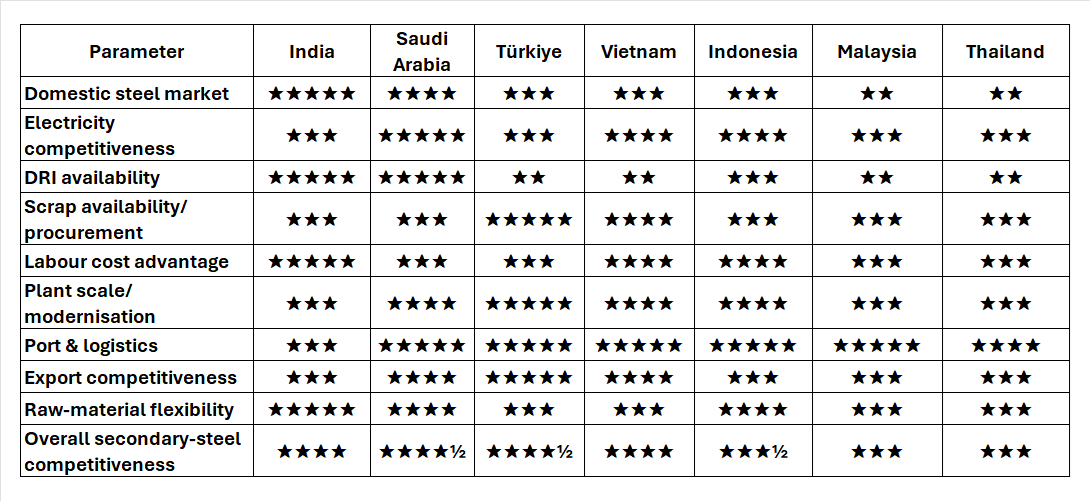 Key cost comparison
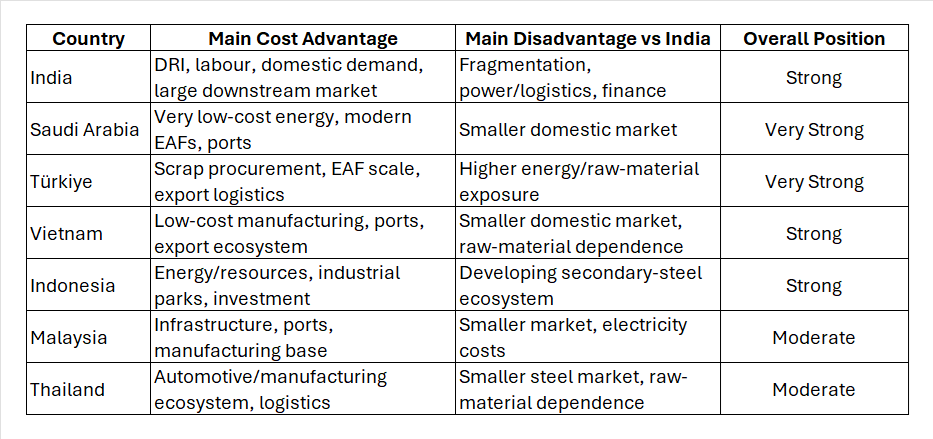 India remains highly competitive in secondary steel because of its large domestic market, DRI availability, low labour costs and extensive network of induction-furnace and rolling-mill producers. Saudi Arabia has a major advantage in low-cost energy and modern EAF facilities, while Türkiye is exceptionally strong in imported-scrap procurement, EAF scale and exports. Vietnam and Indonesia benefit from competitive manufacturing costs, ports and growing industrial capacity. Malaysia and Thailand have strong infrastructure but smaller steel markets. India's principal disadvantages are fragmented plant sizes, high working-capital costs, variable scrap quality, logistics and uneven energy efficiency. Improving technology, scrap processing, procurement, power efficiency and plant scale can significantly strengthen India's global competitiveness.
Turkey is the most relevant comparator because it has developed a highly competitive EAF-based steel industry using imported scrap.
India's advantage is that it combines:
• DRI.
• Scrap.
• Low-cost labour.
• Large domestic demand.
• Local engineering.
• Growing renewable power.
• Large industrial base.
Turkey's advantages include:
• Large EAF capacities.
• Efficient scrap procurement.
• Established international scrap-trading relationships.
• Strong export logistics.
• Proximity to European markets.
• More export-oriented production structures.
India's secondary steel producers therefore need to compete on total delivered cost and quality, rather than simply on furnace conversion cost.
17. Why Some Indian Secondary-Steel Units Perform Poorly
17.1 Fragmented production
Small plants have less bargaining power in purchasing and selling.
17.2 Inconsistent scrap quality
Mixed scrap creates:
• Lower yield.
• Higher slag.
• Higher electricity consumption.
• Residual-element problems.
• Greater alloy consumption.
17.3 High working capital
A steelmaker may need to finance:
• Scrap.
• DRI.
• Ferroalloys.
• Electrodes.
• Power.
• Finished inventory.
• Customer credit.
17.4 Technology gap
Older furnaces and rolling mills often have higher:
• kWh/t.
• Electrode consumption.
• Refractory consumption.
• Metal loss.
• Maintenance costs.
17.5 Weak procurement systems
Purchasing decisions based primarily on relationships rather than structured market intelligence can produce inconsistent raw-material costs.
17.6 Lack of product differentiation
Commodity TMT producers compete largely on price.
17.7 Logistics
A ?500/t cheaper scrap purchase can become more expensive if inland freight is ?800/t higher.
17.8 Limited financial strength
Large integrated companies can survive price cycles better than highly leveraged MSMEs.
17.9 Environmental investment
Pollution-control systems, energy efficiency and carbon reporting require additional capital.
17.10 Global competition
India is increasingly exposed to low-priced imports. The Economic Survey has already highlighted the importance of the gap between international and domestic steel prices in India's trade performance. (India Budget)
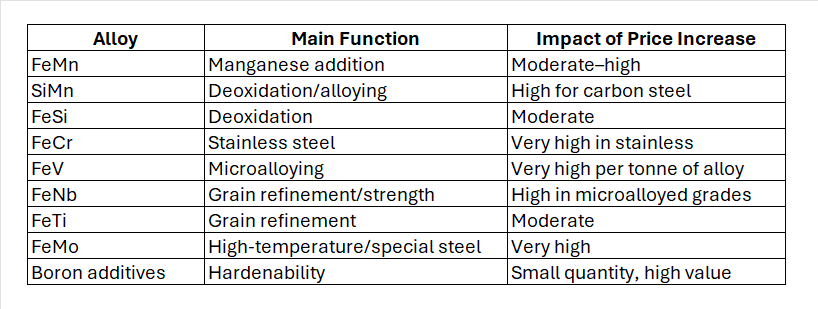
18. Effect of Ferroalloy Prices on Secondary-Steel Manufacturing Costs
Ferroalloys are often treated as a relatively small part of total steel cost, but they can have a disproportionately large effect on margin.
Major ferroalloys used in secondary steel include:
- Ferro manganese.
- Silicomanganese.
- Ferrosilicon.
- Ferrochrome.
- Ferrovanadium.
- Ferroniobium.
- Ferrotitanium.
- Ferromolybdenum.
- Boron additions.
- Aluminium and deoxidisers.
For a conventional carbon-steel TMT producer, manganese and silicon-bearing ferroalloys are particularly important.
A representative cost structure might look like (Indicative Share of Finished-Steel Cost)
- Metallic charge 75–85%
- Electricity/fuel 5–9%
- Ferroalloys/deoxidisers 1.5–4%
- Refractories/electrodes 1.5–3%
- Labour/maintenance 2–4%
- Finance/logistics/other 3–6%
- These percentages vary significantly according to the metallic mix and grade.
Why ferroalloys matter so much
Suppose a steelmaker consumes 12 kg of a particular alloying material per tonne of liquid steel.
- If the alloy price rises by INR20,000/t:
- Additional cost = 12 kg × INR20/kg = ?240/t steel
- If the producer operates at a 2,000-t/month margin-sensitive plant, the additional monthly cost becomes:
- INR240 × 2,000 = INR4.8 lakh/month
- For high-alloy or specialty steel, the impact can be much greater.
- Ferroalloy volatility affects pricing decisions
A steelmaker that buys ferroalloys when prices are low but sells steel on a fixed-price contract can protect margins.
A steelmaker buying alloys at spot prices while selling finished steel under delayed-price contracts can suffer margin compression.
Therefore, secondary steelmakers need a daily procurement dashboard covering:
- Ferroalloy prices.
- Scrap prices.
- DRI prices.
- Pig-iron prices.
- Billet pricesPower prices.
- Finished-steel prices.
- Freight.
- Currency.
- International benchmarks.
This is one area where a digital commercial platform can create significant value.
19. Ferroalloy Price Sensitivity
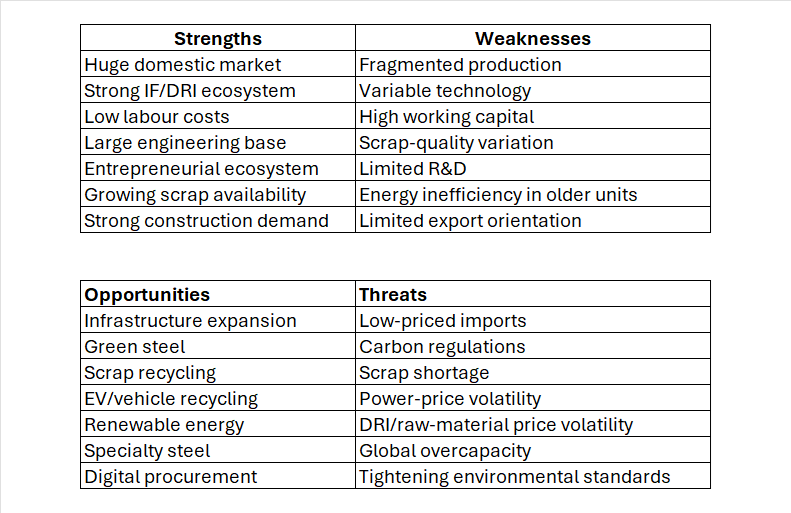
 20. SWOT Analysis of India's Secondary Steel Industry
 21. Developing the Top Ten Cities into World-Class Secondary-Steel Centres
The objective should not simply be to increase the number of induction furnaces.
Each cluster should become an integrated secondary-steel ecosystem.
Recommended infrastructure
- Common scrap-processing centres.
- Digital scrap marketplaces.
- Shared laboratories.
- Common testing facilities.
- Common oxygen plants.
- Renewable-power procurement.
- Waste-heat recovery.
- Energy-efficiency centres.
- Common logistics terminals.
- Skill-development centres.
- Metallurgical R&D centres.
- Carbon-accounting systems.
- Green-steel certification.
- Common warehousing.
- Digital transaction platforms.
The government's scrap-recycling policy provides the policy framework for improving collection and processing. (Ministry of Steel)
22. Suggested Specialisation by City
City Recommended 2030 Specialisation
- Mandi Gobindgarh: TMT, structural steel, merchant bars
- Raipur: DRI-integrated steel, billets, wire rod, TMT
- Jalna: TMT, construction steel, specialty long products
- Bhavnagar: Recycled steel and ship-scrap-based products
- Jaipur: TMT and structural products
- Howrah: Engineering steel and sections
- Durgapur: Wire rod, TMT and engineering products
- Ahmedabad: TMT, precision long products
- Jodhpur: Structural steel and fabrication
- Bellary-Hospet: DRI-integrated steel and long products
23. Usage of LOHAA Mobile Application of Android and iPhone / Portal for India’s secondary steel industry Commercial Transactions
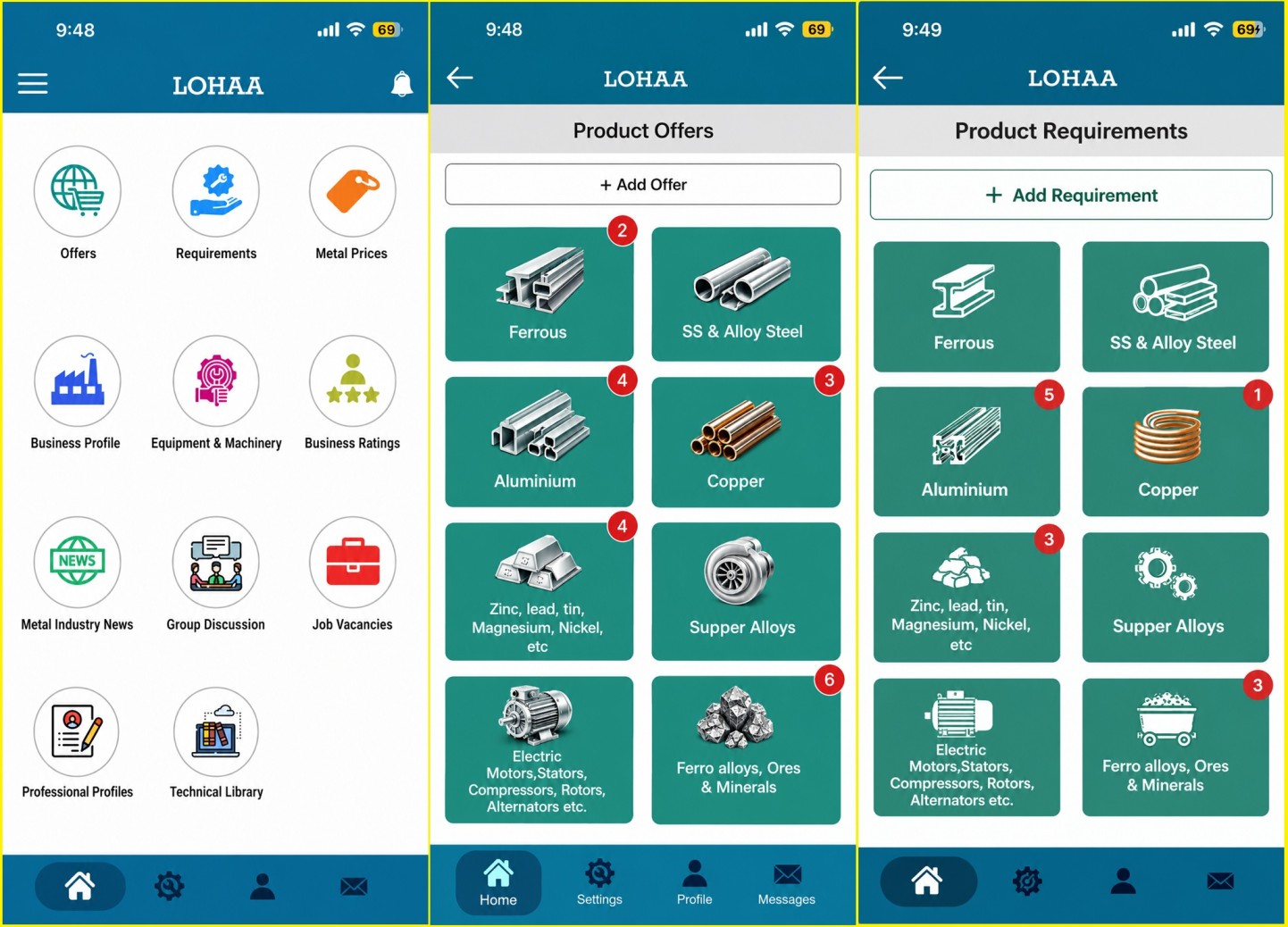 The fragmented nature of India's secondary-steel industry creates a strong case for specialised digital commercial platforms.
LOHAA Mobile app can potentially connect:
• Scrap sellers.
• Scrap buyers.
• Steel manufacturers.
• TMT manufacturers.
• Billet producers.
• DRI producers.
• Ferroalloy suppliers.
• Equipment suppliers.
• Traders and stockists.
• Importers/exporters.
• Recycling companies.
The platform's greatest value should be qualified commercial lead generation, rather than merely publishing advertisements.
23.1 Scrap Marketplace
A steelmaker could publish:
Requirement:
• HMS 1&2.
• Quantity.
• Delivery location.
• Required date.
• Payment terms.
• Quality specification.
Suppliers could respond with offers.
23.2 DRI and Pig-Iron Procurement
LOHAA can support requirements for:
• Sponge iron.
• DRI fines.
• Pig iron.
• Billets.
• Ingots.
This can improve price discovery between clusters.
23.3 Ferroalloy Marketplace
A dedicated ferroalloy section can include:
Product Information
- FeMn: Daily price/offers
- SiMn: Daily price/offers
- FeSi: Daily price/offers
- FeCr: Daily price/offers
- FeV: Price/offers
- FeNb: Price/offers
- FeTi: Price/offers
This becomes particularly valuable because ferroalloy prices can change the economics of secondary steel production.
23.4 Machinery Marketplace
Secondary steelmakers frequently need:
• Induction furnaces.
• Transformers.
• LRFs.
• Continuous casting machines.
• Rolling mills.
• Scrap shredders.
• Scrap balers.
• Oxygen plants.
• Pollution-control equipment.
• Used machinery.
• Electrical equipment.
A verified digital marketplace can reduce search time and improve supplier discovery.
24. LOHAA as a Secondary-Steel Commercial Intelligence Platform
A future Secondary Steel Hub could include:
- Scrap: Marketplace Buying/selling scrap
- DRI: Marketplace DRI offers and requirements
- Billet: Marketplace Billet transactions
- Ferroalloy: Market Daily prices
- TMT: Marketplace Sales leads
- Machinery: Marketplace Equipment transactions
- Daily Market Prices: Domestic/international prices
- Steel News: Market intelligence
- Company Profiles: Verified business information
- Ratings: Commercial credibility
- Requirements:L Board Procurement leads
- Jobs Skilled manpower
The platform can become especially useful in highly fragmented clusters where hundreds of companies need to communicate daily.
25. Strategic Roadmap: 2026–2030
2026–27: Improve efficiency
• Modernise furnaces.
• Improve scrap sorting.
• Reduce kWh/t.
• Improve metallic yield.
• Establish digital procurement.
• Improve inventory control.
2027–28: Build cluster infrastructure
• Common scrap yards.
• Testing laboratories.
• Shared logistics.
• Renewable-power procurement.
• Digital steel exchanges/marketplaces.
2028–29: Move into green steel
• Carbon-intensity measurement.
• Renewable electricity.
• Higher scrap ratios.
• Energy-efficient furnaces.
• Waste-heat recovery.
• Green-steel certification.
2029–30: Compete globally
• Export-quality TMT.
• Specialty long products.
• Microalloyed steel.
• Automated rolling.
• International certifications.
• Integrated digital procurement.
26. Consolidated India Secondary-Steel Forecast
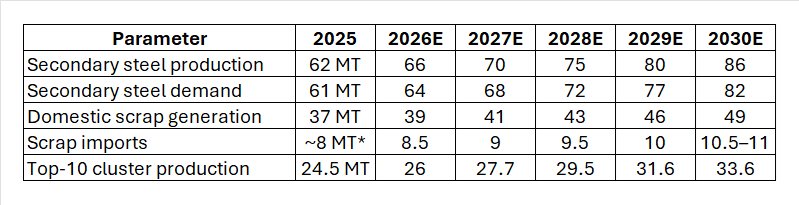 *Approximate planning figure; definitions and fiscal/calendar-year treatment vary between datasets.
27. Key Findings
Finding 1
India's secondary steel sector is already enormous. The IF route alone accounted for approximately 57 MT, or 38%, of crude-steel production in FY2024-25. (BigMint)
Finding 2
Mandi Gobindgarh, Raipur, Jalna, Bhavnagar and Jaipur remain strategically important secondary-steel clusters. (Bureau of Energy Efficiency)
Finding 3
India's total steel demand is expected to remain one of the world's fastest-growing. OECD projects demand at approximately 209.5 MT by 2030. (OECD)
Finding 4
Domestic scrap generation will rise, but it is unlikely to eliminate India's scrap-import requirement because steel production is expanding rapidly.
Finding 5
The major competitive weakness of smaller Indian producers is not necessarily labour cost. It is the combination of scale, financing, energy efficiency, procurement, scrap quality, technology and logistics.
Finding 6
Ferroalloy prices can have a significant effect on steel margins, particularly for high-alloy and specialty products.
Finding 7
The next generation of secondary-steel clusters must be integrated with scrap collection, digital procurement, renewable energy, testing laboratories and logistics.
Finding 8
Digital commercial platforms such as LOHAA Mobile can help improve price discovery, supplier discovery and qualified commercial leads.
28. CBAM Impact on Indian Secondary Steel Exports
The EU’s Carbon Border Adjustment Mechanism (CBAM), which entered its definitive phase in 2026, is increasing the cost and compliance burden for Indian steel exporters. Secondary-steel products such as billets, bars, wire rod and other covered iron-and-steel products can face additional CBAM costs based on their embedded carbon emissions. Indian induction-furnace producers using carbon-intensive electricity and DRI may therefore become less competitive in the EU unless they reduce emissions, improve scrap utilisation and establish reliable emissions data.
Among competing countries, Türkiye is particularly well positioned to benefit because of its large EAF-based, scrap-intensive steel industry, established EU export relationships and geographical proximity. Saudi Arabia also has an emerging advantage through gas-based DRI/HBI and EAF production with relatively low-cost energy. Consequently, Indian secondary-steel exporters may face stronger competition in European markets unless they accelerate renewable power, scrap-based production, energy efficiency, carbon measurement and green-steel certification.
29. Conclusion
India's secondary steel industry is positioned for substantial expansion through 2030, supported by strong domestic steel demand, infrastructure investment and the country's transition towards a circular steel economy. The sector already accounts for a major share of crude-steel production, with induction furnaces alone contributing approximately 38% in FY2024-25. The major clusters—Mandi Gobindgarh, Raipur, Jalna, Bhavnagar, Jaipur, Howrah and Durgapur—should be transformed into integrated manufacturing ecosystems rather than simply expanding furnace capacity. The biggest priorities are domestic scrap collection, high-quality scrap processing, lower energy consumption, modern furnaces, efficient rolling technology, working-capital support and better procurement systems. Ferroalloy-price volatility also needs stronger management because alloying costs can materially affect margins. India can compete successfully with Turkey and other Asian producers if it combines its large domestic market and DRI advantage with technology, scale and efficient logistics. Digital platforms such as LOHAA Mobile can further improve commercial connectivity and qualified lead generation across this fragmented industry.
References
- Ministry of Steel, Government of India – National Steel Policy 2017. (Ministry of Steel)
2. Ministry of Steel – Steel Scrap Recycling Policy. (Ministry of Steel)
3. Bureau of Energy Efficiency – Steel Re-rolling Sector Report. (Bureau of Energy Efficiency)
4. Bureau of Energy Efficiency – Eligible Cluster List. (Bee India)
5. BigMint – India's FY2025 route-wise steel production. (BigMint)
6. Economic Survey 2024-25 – Steel and scrap recycling. (India Budget)
7. OECD – Steel Outlook 2026. (OECD)
8. Ministry of Steel – Annual Report and JPC steel statistics. (Ministry of Steel)
9. World Bank/UN Comtrade – India's ferrous scrap imports. (World Integrated Trade Solution)
10. DGCIS – World ferrous scrap trade analysis. (DGCIS Kolhapur)
11. Gallantt Ispat – FY2025/FY2026 production disclosures. (NSE India Search Archives)
12. Ministry of Steel – Steel Import Management System. (Ministry of Steel)
13. Government of India – Steel production and consumption statistics. (Press Information Bureau)
14. SEBI/company filing – Ferrous scrap import trend data. (NSE India Search Archives)
By using digital trade platforms like LOHAA Mobile application, you can reach global buyers, source quality material, and strengthen long-term partnerships.
Download the Lohaa Metal Trading App for Android to access live scrap prices and real-time market updates anytime, anywhere.
Download the Lohaa Metal Trading App for iOS to access live scrap prices and real-time market updates anytime, anywhere.
(Notes: market and production volume estimates are synthesized from public market reports and industrial press; exact tonne figures for materials are not centrally published in a single comprehensive public dataset, therefore the numeric projection above is a conservative, documented estimate built from available intelligence and reasonable regional share assumptions.)


