
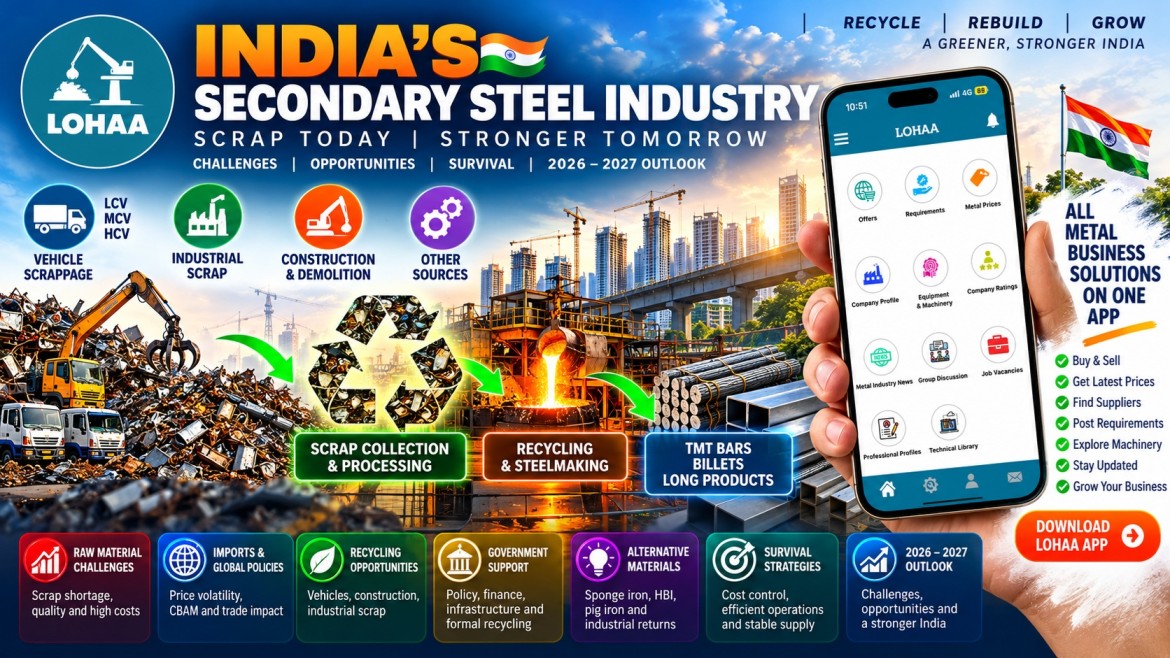
India Secondary Steel Outlook 2026–27 | Scrap & TMT
India Secondary Steel Outlook 2026–27: Scrap and Survival by considering the present market conditions
Updated: 18 October 2026 | Six-month outlook: October 2026–March 2027
1. Introduction: How Will India’s Secondary Steel Units Survive?
India’s secondary steel manufacturers face a demanding six months. Construction and infrastructure support steel consumption, but scrap availability, electricity costs and working-capital requirements will determine profitability.
Government provisional data show finished-steel consumption increased 7.5% year-on-year during April–September 2026. Meanwhile, the reported HMS-II scrap price increased 9.6% month-on-month in September. These figures indicate growing demand alongside raw-material pressure, although individual mills experience different prices and margins. www.pib.gov.in
The outlook is cautiously positive for efficient TMT, billet and long-product manufacturers. Units with reliable suppliers, flexible charge mixes and disciplined collections should remain competitive. Highly leveraged mills with inconsistent quality and delayed customer payments face greater risks.
2. Why Are Steel Raw Materials Becoming Scarce?
Scrap shortages reflect both availability and suitability.
a. Expanding consumption: steelmaking demand can increase faster than recoverable scrap supply.
b. Long product lives: steel remains locked in buildings, infrastructure and machinery for decades.
c. Fragmented collection: small suppliers aggregate material, but grading and documentation vary.
d. Quality limitations: copper contamination, mixed alloys, coatings and dirt restrict usable supply.
e. Transport costs: distant scrap becomes uneconomical when freight and handling rise.
f. International competition: greater electric-furnace production increases demand for suitable scrap.
Worldsteel explains that scrap availability depends on historical steel consumption, recovery infrastructure and product lifetimes. Steel products remain in use for approximately 40 years on average, with wide differences between applications. worldsteel.org
3. Commercial Trucks in India: Annual Position, 2010–2025
3.1 Registered Goods Vehicles Versus Active Trucks
The official series below measures registered goods vehicles, including light goods vehicles. It should not be presented as the number of trucks actually operating.
The below data indicates year 31st March and Registered goods vehicles, million
- 2010: 6.432
- 2011: 7.064
- 2012: 7.658
- 2013: 8.307
- 2014: 8.698
- 2015: 9.344
- 2016: 10.516
- 2017: 12.256
- 2018: 12.773
- 2019: 13.766
- 2020: 14.288
- 2021*: 14.792
- 2022*: 15.493
- 2023: Not verified
- 2024: Not verified
- 2025: Not verified
Provisional. Source: MoRTH Annual Report 2024–25. Registration totals can include vehicles no longer operating. morth.gov.in
A comparable annual LCV, MCV and HCV active-fleet breakdown for 2010–2025 was not verified. Sales, registrations and operating fleets measure different things and cannot be substituted for one another.
3.2 Vehicle Life and Scrap Recovery
There is no universal operating life for each truck segment. Retirement depends on maintenance, utilisation, fitness, repair economics and applicable local rules. Fifteen years is not an automatic nationwide scrapping age for every privately owned commercial vehicle. www.niti.gov.in
Scrap becomes available when vehicles are dismantled. Recovery should be calculated from unladen weight, excluding payload.
Segment example Illustrative ferrous recovery at 70%
- LCV: 1.4 tonnes
- MCV: 3.5 tonnes
- HCV: 7.0 tonnes
These are calculation examples, not verified segment averages. Actual recovery varies by model, body construction, reusable components and dismantling practice. Ferrous material includes steel and cast iron.
4. Other Scrap Sources and Global Comparisons
Important sources include automotive press-shop offcuts, engineering fabrication, demolition, machinery replacement, railway assets, ships, appliances, agricultural equipment and internal mill returns.
India’s infrastructure expansion keeps considerable steel in service. Mature industrial economies accumulated large steel stocks earlier, allowing more material to reach retirement today.
However, claiming India generates less scrap than every other top-ten steel-producing country would require comparable evidence. Production rankings do not establish scrap availability.
India’s collection networks recover valuable material, but collection activity alone does not prove superior recycling efficiency. A parliamentary review identified fragmented markets and the absence of a centralised scrap database. prsindia.org
5. State-Wise Units, Scrap Generation and Requirements
Verified, comparable state-wise totals for operating TMT/long-product units, 2025 scrap generation and 2026–2027 requirements were not established in the reviewed sources.
Required indicator - Reliable measurement approach
- Operating secondary steel units: Dated JPC plant register, separating melting and rolling
- State-wise scrap generation: Manufacturing, vehicle, demolition and other recovery records
- Scrap requirements: Actual output × route-specific scrap consumption
- Imported-scrap contribution: Imports traced to consuming plants, including interstate movement
Counting factories, furnaces and rolling mills together risks double-counting. A rolling-only mill purchases billets and may not consume melting scrap.
Likewise, scrap landed at a Gujarat or Maharashtra port can move to another state. Port arrivals cannot establish state-wise consumption.
6. How Much Are Scrap Imports Helping?
Imports bridge domestic shortages and provide grades that mills cannot consistently source locally.
The Economic Survey 2024–25 cited approximately 30 million tonnes of annual scrap consumption, including around 5 million tonnes imported. This historical national benchmark should not be labelled a verified calendar-2025 balance or a 2026–2027 forecast.
For individual plants, import viability depends on landed price, exchange rates, chemistry, recovery, inland freight and financing. Coastal access can help, while inland transport may reduce the advantage.
Reliable state-wise import dependence for 2025 and 2026 remains a verification gap.
7. Alternatives to Steel Scrap
i) DRI/sponge iron
- Potential benefit: Diversifies metallic supply
- Main limitation: Metallisation, gangue and energy demand
ii) HBI
- Potential benefit: Dense, transportable iron units
- Main limitation: Availability and landed cost
iii) Pig iron
- Potential benefit: Supports charge chemistry
- Main limitation: Carbon, impurities and emissions
iv) Hot metal
- Potential benefit: Useful in suitable integrated operations
- Main limitation: Infrastructure and logistics
Substitution must match furnace capability and product specifications. Mills should compare cost per tonne of acceptable liquid steel, including yield, electricity, slag, consumables and rejection losses.
Buying cheaper feedstock can increase total production cost if recovery or quality deteriorates.
8. CBAM, Overseas Policies and Steel Imports
EU CBAM entered its definitive regime on 1 January 2026. It covers selected iron and steel imports into the EU, creating emissions-data and carbon-cost implications for Indian suppliers serving that market. taxation-customs.ec.europa.eu
Its effect on steel entering India is indirect: material facing barriers overseas may seek alternative markets. That is a commercial risk, not proof that imports will necessarily rise.
Separately, most EU Waste Shipment Regulation export provisions apply from 21 May 2027, just beyond this outlook. Country authorisation and environmental requirements can affect future scrap access. environment.ec.europa.eu
Import-dependent countries also face pressure when European and North American mills compete for scrap domestically. Effects differ by country, grade and policy; there is no single North American scrap-export ban established here.
9. Support Required and Immediate Remedies
Secondary steel units need:
a) Affordable working capital and faster customer payments.
b) Reliable electricity and support for energy-efficiency upgrades.
c) Formal collection and processing infrastructure, including sorting and shredding.
d) Predictable import procedures and timely clearance of compliant cargo.
e) A national scrap database covering generation, trade and consumption.
f) Technical assistance for charge optimisation, quality and emissions measurement.
Immediate mill-level action should include supplier diversification, incoming-material inspection, realistic inventory limits and weekly contribution-margin reviews.
India’s recycling industry can reduce virgin-material demand. It cannot immediately supply all the additional metallics required by expanding steel production.
10. SWOT Analysis
a) Strengths: Domestic demand, flexible production and established trading networks
b) Weaknesses: Fragmentation, variable scrap quality, power costs and financing constraints
c) Opportunities: Vehicle recycling, formal processing, efficiency upgrades and lower-emission products
d) Threats Scrap: competition, import disruption, delayed collections and trade-policy changes
11. How LOHAA Helps Scrap Trading
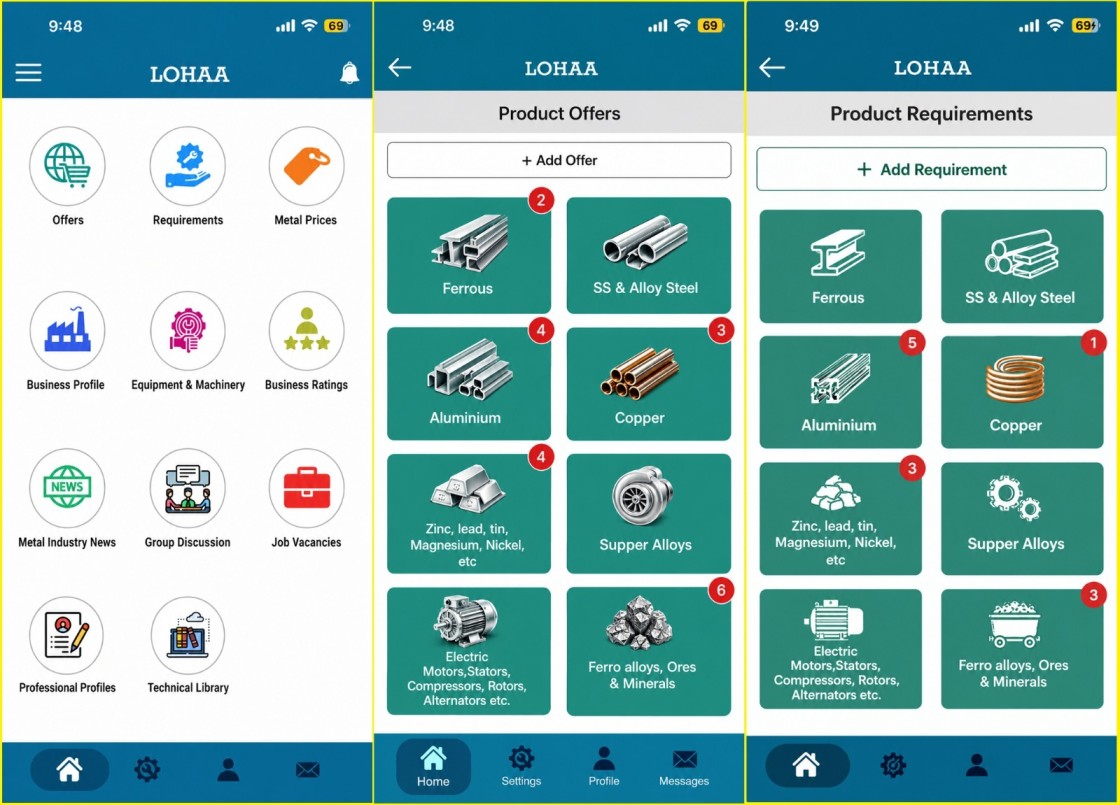
LOHAA Mobile Application of Android and iPhone / Portal can help manufacturers, recyclers, stockists and traders discover relevant buying and selling opportunities for Steel scrap, Ingots, Billets etc.,
Listings organised by material, grade, quantity, location and offer type make enquiries more focused. Market updates help users compare opportunities, while equipment listings can support processing-capacity expansion.
For effective transactions, sellers should disclose specifications, photographs, stock location, quantity and commercial terms. Buyers should verify chemistry, ownership, documentation and delivery arrangements.
LOHAA’s value lies in improving market visibility and connecting counterparties. Successful execution still depends on inspection, clear contracts and payment discipline.
 12. Ten Frequently Asked Questions
12.1 Will secondary steel demand grow?
Recent consumption data are supportive, but individual products and regions may perform differently.
12.2 Why is usable scrap scarce?
Collection, quality, geography and product-retirement cycles constrain supply.
12.3 Are truck registrations equal to trucks operating?
No. Registration totals can include inactive vehicles.
12.4 Must every commercial truck retire after 15 years?
No. Fitness requirements and applicable rules must be considered.
12.5 How much scrap does one truck generate?
Use model-specific unladen weight and measured recovery, excluding payload.
12.6 Can India immediately eliminate scrap imports?
The reviewed evidence does not support that conclusion.
12.7 Can sponge iron replace all scrap?
Replacement depends on furnace design, chemistry, energy and economics.
12.8 Does CBAM directly tax steel imported into India?
EU CBAM applies to covered goods entering the EU.
12.9 Are precise state-wise scrap forecasts available here?
No. Comparable verified figures remain a data gap.
12.10 How can LOHAA help?
It improves offer discovery, material visibility and buyer–seller connections.
13. Conclusion
India’s secondary steel outlook through March 2027 remains cautiously positive. Survival will depend on metallic yield, energy efficiency, reliable sourcing and cash collection. Stronger recycling infrastructure and credible data will improve the industry’s resilience.
14. References
1. Ministry of Steel/PIB: H1 FY2026–27 update, 6 October 2026.
2. MoRTH: Annual Report 2024–25.
3. Economic Survey: 2024–25, industry chapter.
4. Parliamentary committee review: Steel Scrap Recycling Policy, 4 August 2025.
5. NITI Aayog: End-of-life vehicle circular-economy report, 2026.
6. Worldsteel: Raw-material availability guidance.
7. European Commission: CBAM and waste-shipment guidance.
By using digital trade platforms like LOHAA Mobile application, you can reach global buyers, source quality material, and strengthen long-term partnerships.
Download the Lohaa Metal Trading App for Android to access live scrap prices and real-time market updates anytime, anywhere.
Download the Lohaa Metal Trading App for iOS to access live scrap prices and real-time market updates anytime, anywhere.
(Notes: market and production volume estimates are synthesized from public market reports and industrial press; exact tonne figures for materials are not centrally published in a single comprehensive public dataset, therefore the numeric projection above is a conservative, documented estimate built from available intelligence and reasonable regional share assumptions.)


