
India Steel Scrap: Recycling & Outlook
1. Introduction
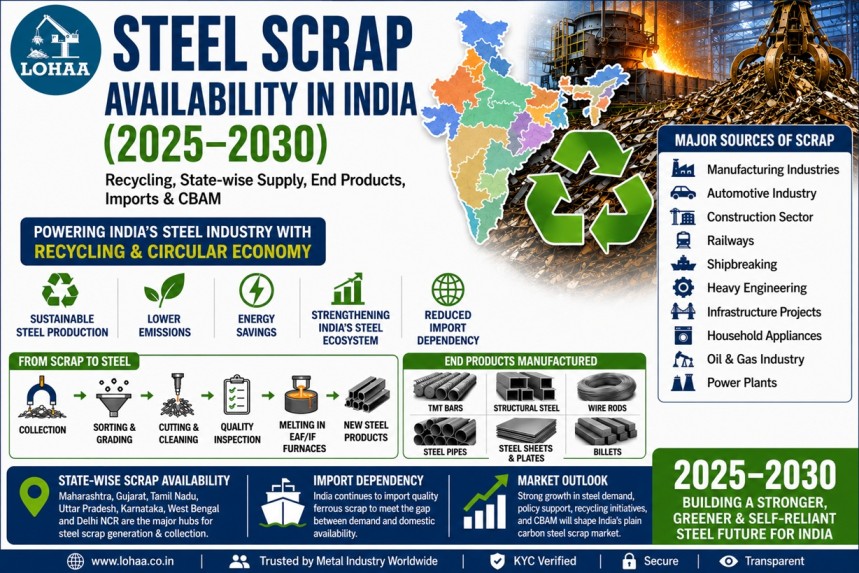
India is the world's second-largest crude steel producer, with demand driven by rapid urbanization, infrastructure development, manufacturing, and renewable energy projects. steel scrap has become a vital raw material for sustainable steel production through Electric Arc Furnaces (EAFs) and Induction Furnaces (IFs), reducing energy consumption, carbon emissions, and reliance on virgin iron ore. Although India generates significant quantities of steel scrap from industries, construction, automobiles, and shipbreaking, domestic supply remains insufficient to meet growing demand. Consequently, imports continue to supplement the market, while government recycling and vehicle scrappage policies aim to strengthen domestic scrap availability and promote a circular economy.
2. Overview of Steel Scrap
steel scrap refers to recyclable ferrous materials containing iron and carbon with minimal alloying elements. These materials originate from industrial manufacturing, obsolete products, demolition waste, automotive recycling, machinery replacement, railway infrastructure, shipbreaking, and fabrication activities.
After collection, scrap undergoes sorting, grading, cutting, cleaning, and quality inspection before being melted in electric furnaces to manufacture new steel products.
The recycling of carbon steel offers several economic and environmental benefits:
• Conservation of natural iron ore resources
• Reduction in energy consumption compared with primary steelmaking
• Lower greenhouse gas emissions
• Reduced industrial waste sent to landfills
• Faster steel production cycles
• Support for sustainable manufacturing
• Reduced dependence on imported raw materials
• Improved resource efficiency through circular economy practices
India's steel recycling industry consists of both organized recyclers equipped with advanced processing technologies and an extensive network of informal collectors who play a significant role in scrap recovery.
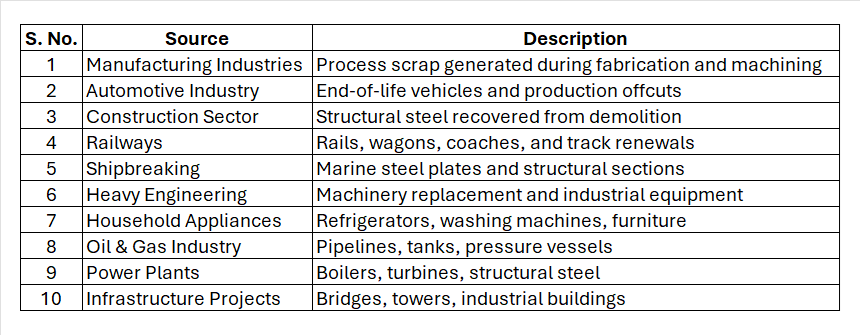
Table 1. Major Sources of Steel Scrap
3. Types of Steel Scrap
steel scrap is categorized according to thickness, density, cleanliness, residual elements, and intended steelmaking applications.
Table 2. Types of Steel Scrap and Their Applications
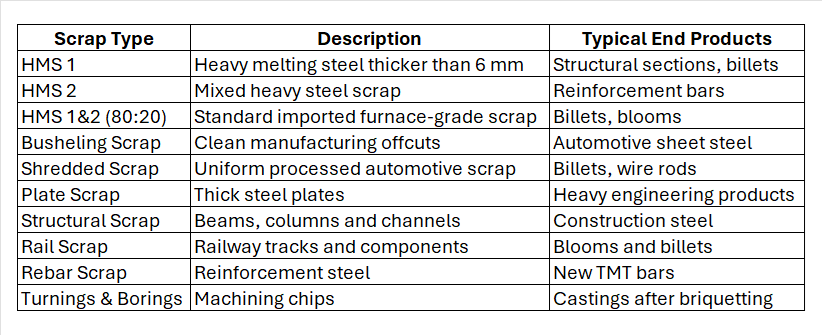 Among these grades, HMS 1&2, shredded scrap, and busheling scrap are the most widely traded internationally due to their consistent chemistry and suitability for high-quality steel production.
4. State-wise Availability of Steel Scrap in India
Steel scrap availability is closely linked to industrial development, manufacturing activity, urban infrastructure, automobile production, and port facilities. Western and southern India account for a substantial share of organized scrap generation due to their strong industrial base.
Table 3. State-wise Availability of Steel Scrap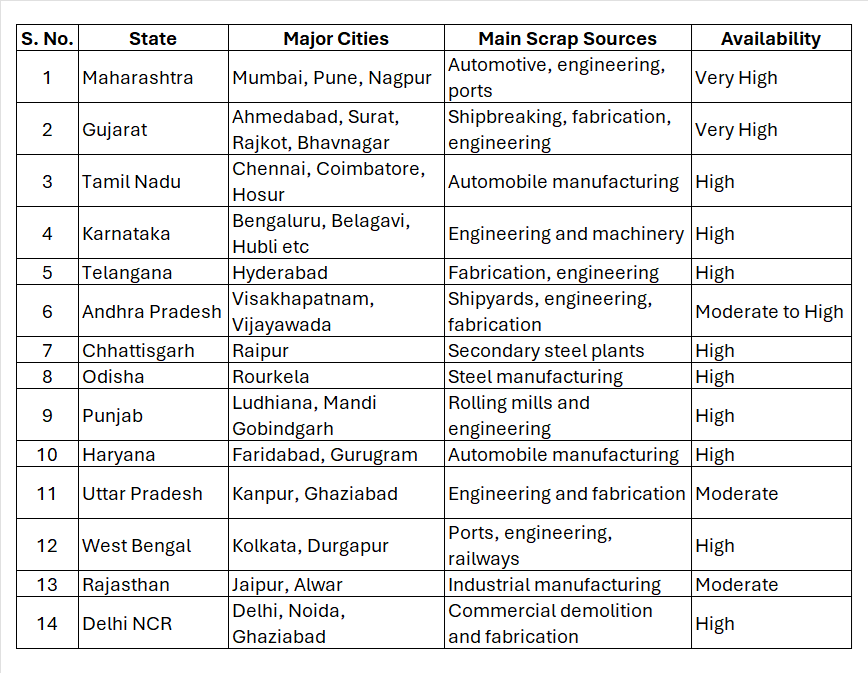 Major Scrap Recycling Hubs
Gujarat remains India's leading scrap-processing state due to the Alang shipbreaking yard, industrial clusters, and excellent port infrastructure.
Maharashtra generates substantial volumes of manufacturing and obsolete scrap through the automotive industry, engineering sector, and Mumbai Port.
Punjab, particularly Mandi Gobindgarh, is recognized as one of India's largest secondary steel clusters, consuming significant quantities of processed ferrous scrap.
Tamil Nadu benefits from automobile manufacturing hubs around Chennai and Hosur, producing high-quality industrial scrap.
Chhattisgarh, led by Raipur, has emerged as a major secondary steel manufacturing center with increasing demand for processed scrap.
5. Recycling Ecosystem and Scrap Collection Network
India's steel recycling system comprises a large informal collection network supported by an expanding organized recycling sector. Scrap flows through several stages before reaching steel manufacturers.
Generation → Collection → Aggregation → Processing → Quality Inspection → Distribution → Steel Manufacturing
Major Participants
Organized Sector
• Registered steel recyclers
• Automobile dismantling facilities
• Vehicle Scrapping Facilities (RVSFs)
• Shipbreaking companies
• Industrial recycling plants
• Integrated scrap processors
Unorganized Sector
• Local scrap dealers
• Kabadiwalas
• Small aggregators
• Demolition contractors
• Informal dismantlers
Despite its fragmented nature, the informal sector contributes significantly to India's overall scrap recovery and serves as the primary source of collection in many regions.
Processing Operations
Collected scrap undergoes several processing stages before being charged into furnaces:
• Manual sorting
• Magnetic separation
• Shearing
• Gas cutting
• Baling
• Shredding
• Cleaning and decontamination
• Radiation inspection
• Chemical grading
• Density classification
Table 4. Common Recycling Technologies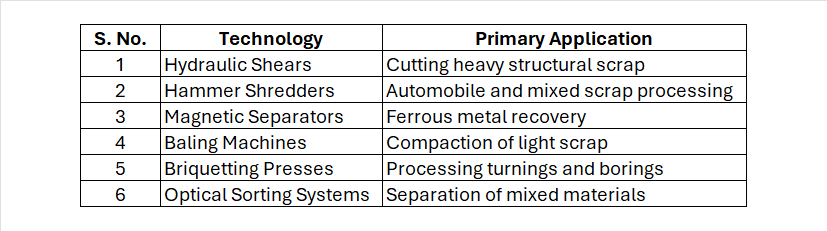
Key Challenges
Although India's recycling industry has expanded considerably, several constraints continue to affect scrap availability:
• Fragmented collection systems
• Limited organized processing infrastructure
• Quality inconsistency due to contamination
• High transportation and logistics costs
• Low awareness regarding scientific scrap recycling
• Limited penetration of modern shredding facilities
• Dependence on imported premium-grade scrap for high-quality steel production
Strengthening organized collection networks, increasing investments in modern recycling infrastructure, and promoting digital platforms that connect scrap generators with recyclers will be essential to improve domestic scrap availability and support India's long-term steel production goals.
6. End-Product Manufacturing and Production Analysis (2025–2026)
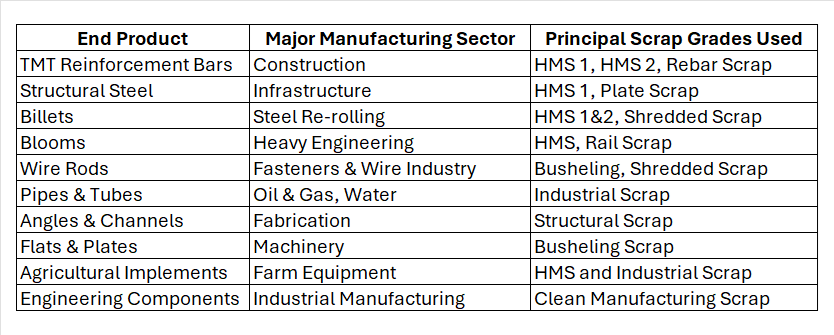
India's steel industry continues to expand due to increasing investments in infrastructure, urban housing, railways, renewable energy, automobiles, and engineering industries. The secondary steel sector, which primarily uses steel scrap through Electric Arc Furnaces (EAFs) and Induction Furnaces (IFs), contributes a significant share of long steel products such as TMT bars, structural sections, wire rods, billets, blooms, pipes, and engineering steels.
During 2025–2026, higher government expenditure on highways, metro rail, airports, industrial corridors, and renewable energy projects has strengthened domestic steel consumption. According to the Ministry of Steel, India's crude steel production exceeded 168 million tonnes during FY 2025–26, while finished steel consumption reached approximately 164 million tonnes, reflecting sustained industrial growth.
Table 5. Major End Products Manufactured Using Steel Scrap
 Major Manufacturing Sectors
The following industries are the largest consumers of scrap-based steel:
• Building and construction
• Infrastructure development
• Railways and metro projects
• Automotive manufacturing
• Agricultural equipment
• Capital goods
• Heavy engineering
• Oil and gas pipelines
• Renewable energy structures
• General fabrication
Table 6. Estimated Production of Scrap-Based Steel Products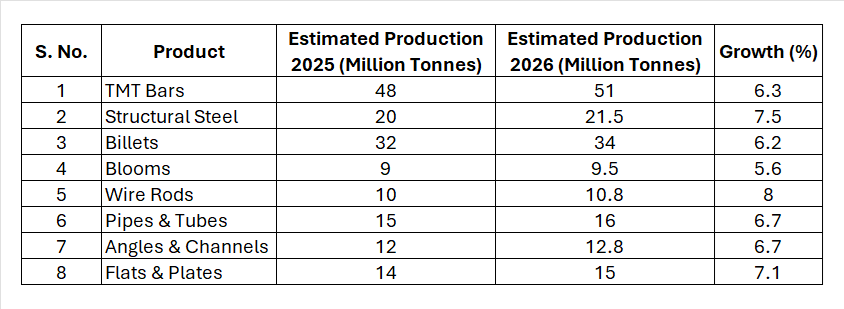 Overall growth is expected to remain supported by government infrastructure spending, private-sector manufacturing investments, and increasing adoption of scrap-based steelmaking technologies.
7. Production Forecast (2026–2030)
India aims to achieve 300 million tonnes of crude steel production capacity by 2030 under the National Steel Policy. This expansion will significantly increase the demand for high-quality steel scrap.
The increasing adoption of Electric Arc Furnace technology, combined with stricter environmental regulations, will make steel scrap one of the most strategic raw materials for India's steel industry.
Table 7. Forecast of Scrap-Based Steel Production (2026–2030)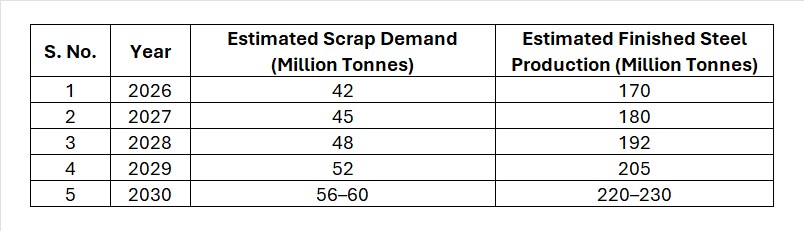
Key Growth Drivers
• National Infrastructure Pipeline (NIP)
• PM Gati Shakti Programme
• Affordable housing projects
• Renewable energy installations
• Railway modernization
• Automobile production growth
• Expansion of engineering industries
• Growth in Electric Arc Furnace capacity
• Organized vehicle scrappage ecosystem
Despite improvements in domestic recycling, demand for furnace-ready scrap is projected to outpace domestic supply unless collection and processing capacity expands significantly.
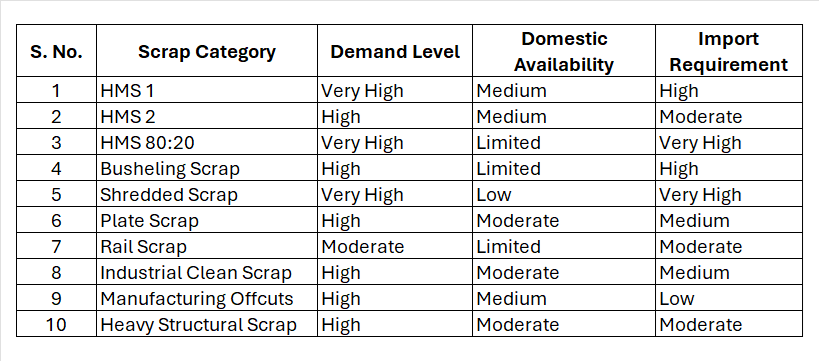
8. Types of Steel Scrap Shortages
Although India generates a large volume of ferrous scrap annually, shortages persist in several premium categories because domestic collection, segregation, and processing systems are still developing.
Table 8. Major Scrap Categories Facing Supply Shortages
 Reasons for Scrap Shortages
a). Limited End-of-Life Vehicle Recycling
India's vehicle scrappage system is still expanding, reducing the availability of automotive shredded scrap.
b). Fragmented Collection Network
A significant share of scrap remains dispersed across informal markets, affecting recovery efficiency and material quality.
c). Limited Shredding Capacity
Modern shredding facilities capable of producing furnace-ready scrap are insufficient relative to growing demand.
d). Export Restrictions Abroad
Several exporting countries are increasingly retaining high-quality scrap to support their own low-carbon steel industries, tightening global supply.
e). Rapid Growth in Domestic Steel Production
Expansion of EAF and induction furnace capacity has increased scrap demand faster than domestic supply.
f) . Major Steel Scrap Exporting Countries to India
India imports premium-quality steel scrap from several countries to bridge the gap between domestic supply and industrial demand.
Table 9. Major Exporting Countries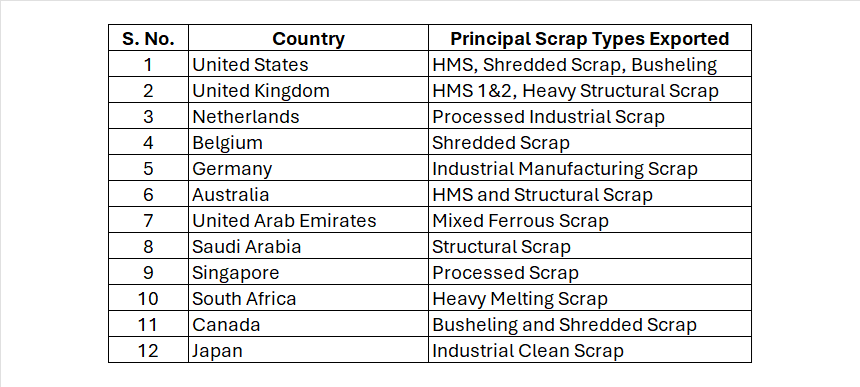 Why These Countries Are Major Suppliers
These exporters typically provide:
• Higher-quality processed scrap
• Lower contamination levels
• Consistent chemical composition
• Better furnace efficiency
• Reliable logistics through established ports
• Compliance with international quality specifications
Their advanced recycling infrastructure allows them to supply grades that are often difficult to source consistently within India.
10. Market Outlook
India's steel scrap market is expected to remain robust through 2030. Growth in infrastructure, manufacturing, transportation, renewable energy, and engineering sectors will continue to increase demand for recycled steel.
However, domestic scrap availability is unlikely to fully satisfy demand in the near term. Premium grades such as busheling and shredded scrap are expected to remain import-dependent unless India significantly expands organized scrap collection, vehicle recycling, and modern shredding facilities.
Developing a nationwide circular steel economy—with stronger recycling infrastructure, digital scrap marketplaces, and improved quality standards—will be essential for ensuring raw material security, reducing import dependence, and supporting the country's long-term objective of becoming one of the world's leading sustainable steel producers.
11. Long-Term Solutions to Minimise India's Dependence on Imported Steel Scrap
India's ambition to become a global steel manufacturing leader requires a secure and sustainable supply of high-quality steel scrap. While imports currently bridge the gap between domestic demand and supply, long-term dependence exposes the industry to global price volatility, freight costs, geopolitical risks, and changing international trade policies. Therefore, increasing domestic scrap availability is essential for the resilience and competitiveness of India's steel sector.
11.1 Strengthen the Organized Scrap Collection Network
A significant proportion of steel scrap is still collected through informal channels. Organizing this network by integrating local scrap dealers, aggregators, recyclers, and steel manufacturers can improve collection efficiency, traceability, and material quality.
Recommended Actions:
• Establish regional scrap collection centres.
• Register and train local scrap dealers.
• Introduce standardized grading systems.
• Promote digital trading platforms.
11.2 Expand Vehicle Scrappage Infrastructure
India has over 300 million registered vehicles, many of which will reach the end of their service life over the next decade. Accelerating the development of Registered Vehicle Scrapping Facilities (RVSFs) can substantially increase the availability of high-quality automotive steel scrap.
Benefits include:
• Increased supply of shredded scrap.
• Recovery of reusable automotive materials.
• Improved environmental compliance.
• Reduced dependence on imported shredded scrap.
11.3 Modernize Scrap Processing Facilities
Investment in advanced processing technologies can significantly improve scrap quality.
Key technologies include:
• Hammer shredders
• Hydraulic shears
• Automatic balers
• Eddy current separators
• Optical sorting systems
• Radiation detection systems
• AI-enabled quality inspection
These technologies reduce contamination and produce furnace-ready scrap that meets steelmakers' quality requirements.
11.4 Promote Circular Economy Practices
Industries generating manufacturing offcuts should adopt closed-loop recycling systems where process scrap is directly returned to steel producers.
Priority sectors include:
• Automotive manufacturing
• Construction
• Heavy engineering
• Shipbuilding
• Railways
• Consumer appliances
11.5 Encourage Electric Arc Furnace (EAF) Expansion
Electric Arc Furnaces consume significantly more recycled steel scrap than conventional blast furnaces while producing lower carbon emissions.
Increasing EAF capacity will:
• Improve energy efficiency.
• Lower greenhouse gas emissions.
• Support India's climate commitments.
• Increase domestic demand for recycled steel.
11.6 Strengthen Government Policies
Policy measures can accelerate domestic scrap availability through:
• Incentives for recycling plants.
• Tax benefits for organized recyclers.
• Simplified licensing procedures.
• Quality certification standards.
• Financial support for advanced recycling technologies.
Table 10. Strategic Roadmap for Reducing Import Dependency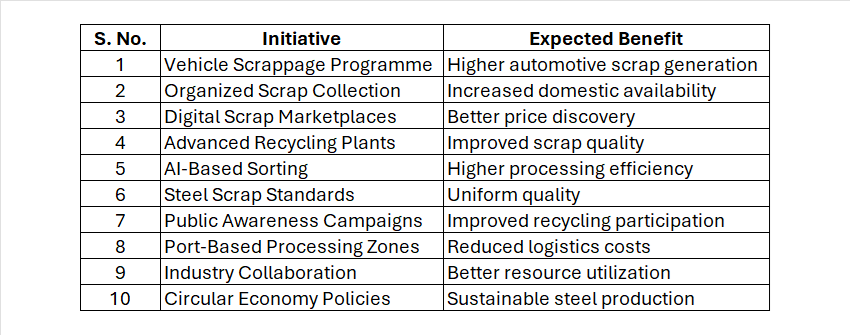 12. Effect of the European Union Carbon Border Adjustment Mechanism (CBAM) on Steel Scrap Imports
The European Union's Carbon Border Adjustment Mechanism (CBAM) is designed to place a carbon price on selected imported products, including iron and steel products, to reduce carbon leakage and encourage lower-emission production. While ferrous scrap itself is generally not a CBAM-covered imported product, CBAM is expected to influence the global scrap market indirectly because EU steelmakers have stronger incentives to use recycled scrap in lower-carbon production.
Potential Impacts on India
- Increased Competition for High-Quality Scrap
- European steel producers are expected to consume larger volumes of premium-quality scrap to reduce emissions, potentially reducing export availability.
- Higher International Scrap Prices
- As demand increases in Europe, international prices for HMS, shredded scrap, and busheling may rise.
- Reduced Export Availability
- Countries that traditionally export large quantities of processed scrap may retain more material for domestic use.
- Improved Demand for Low-Carbon Steel
Indian steel producers supplying European markets will face increasing pressure to reduce embedded carbon emissions, making greater use of recycled scrap strategically important.
Table 11. Expected Impact of CBAM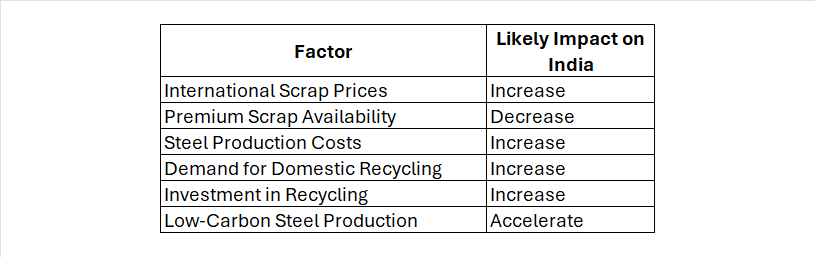 13. SWOT Analysis for Improving Steel Scrap Availability
Table 12. SWOT Analysis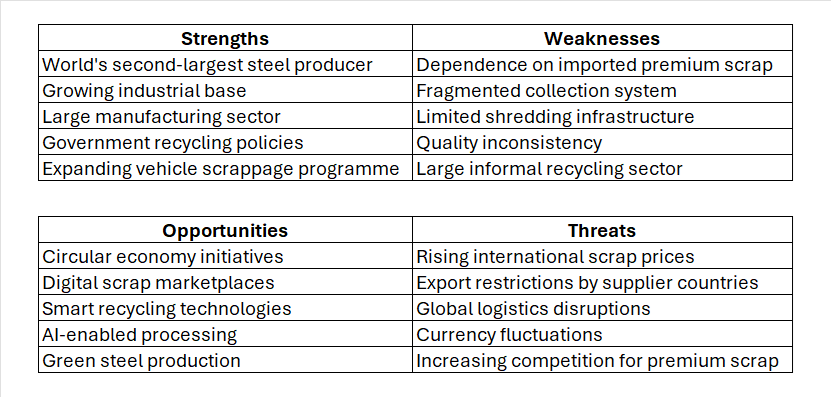
14. Role of the Lohaa Mobile Application/Portal
Digital platforms can transform India's fragmented scrap ecosystem by connecting scrap generators, collectors, recyclers, transporters, and steel manufacturers through a transparent marketplace.
The Lohaa Mobile Application of Android and iPhone / Portal can serve as an integrated digital ecosystem for buying, selling, tracking, and managing steel scrap across India.
Key Features
Digital Marketplace
• Buy and sell steel scrap.
• Connect directly with verified buyers and sellers.
• Real-time quotations.
Digital Payments
• Secure transactions.
• GST invoices.
Analytics Dashboard
• Price trends.
• Demand forecasting.
• Market intelligence.
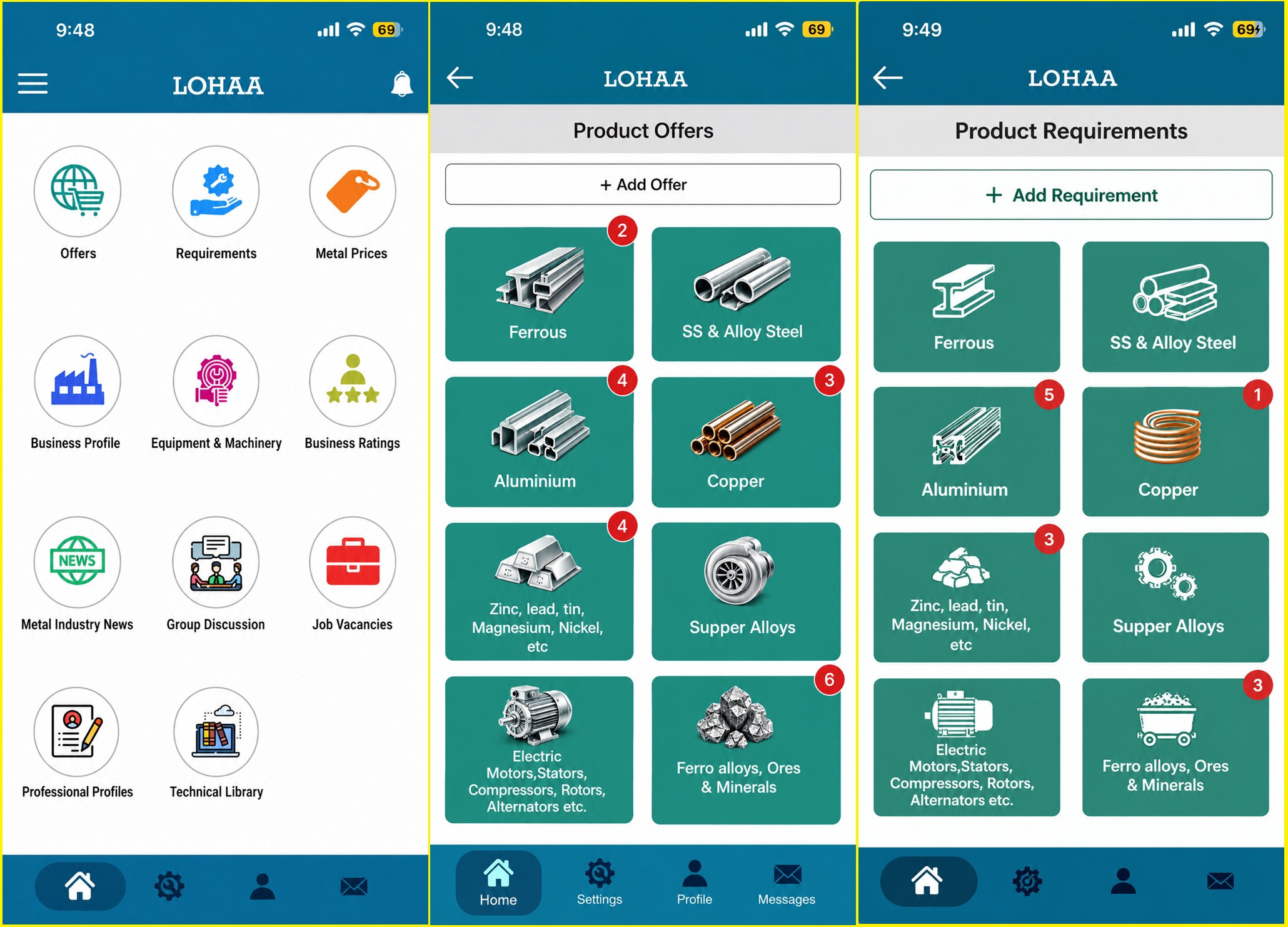
Table 13. Benefits of the Lohaa Platform
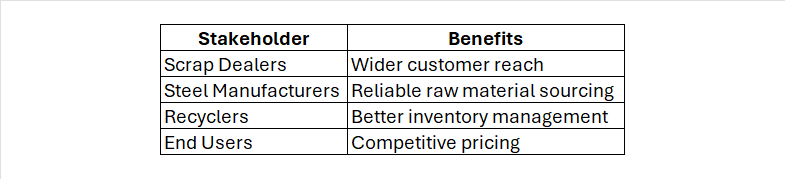 Strategic Advantages
The Lohaa platform can help:
• Increase organized scrap collection.
• Improve traceability.
• Reduce transaction costs.
• Enhance market transparency.
• Promote standardized quality.
• Improve recycling efficiency.
• Support circular economy initiatives.
• Reduce dependence on imported scrap.
15. Future Outlook
India's steel demand is projected to continue growing through 2030, driven by infrastructure development, industrial expansion, renewable energy investments, and manufacturing growth. This expansion will require a substantial increase in the availability of high-quality steel scrap.
A coordinated strategy involving government agencies, steel manufacturers, recyclers, technology providers, logistics companies, and digital platforms such as the Lohaa Mobile Application can significantly strengthen the domestic scrap ecosystem.
By investing in organized recycling infrastructure, advanced processing technologies, vehicle scrappage programs, and digital marketplaces, India can progressively reduce its reliance on imported steel scrap, improve resource efficiency, and advance toward a low-carbon, circular steel economy that supports long-term industrial growth.
16. Conclusion
The Indian steel industry is entering a transformative phase where sustainability, resource efficiency, and circular economy principles are becoming central to long-term growth. As the world's second-largest crude steel producer, India has set ambitious targets under the National Steel Policy 2017, aiming to achieve 300 million tonnes (MT) of crude steel production capacity by 2030. Achieving this objective will require not only investments in steelmaking capacity but also a reliable and sustainable supply of quality raw materials, particularly steel scrap.
steel scrap has become one of the most strategic raw materials for the secondary steel industry. Compared with primary steelmaking using iron ore and coking coal, scrap-based steel production consumes less energy, emits significantly lower greenhouse gases, reduces mining activities, and supports environmental sustainability. Electric Arc Furnaces (EAFs) and Induction Furnaces (IFs), which form an important part of India's steel manufacturing ecosystem, depend heavily on a continuous supply of high-quality ferrous scrap.
Although India generates substantial quantities of scrap from manufacturing industries, construction activities, automotive recycling, railway modernization, engineering industries, household appliances, and shipbreaking operations, domestic availability still falls short of the rapidly increasing demand. Premium grades such as Heavy Melting Scrap (HMS), shredded scrap, busheling scrap, and clean industrial scrap continue to be imported from countries including the United States, the United Kingdom, Germany, the Netherlands, Belgium, Australia, Canada, Japan, and the United Arab Emirates.
The article has demonstrated that scrap availability varies considerably across Indian states. Gujarat, Maharashtra, Tamil Nadu, Punjab, Chhattisgarh, Karnataka, Telangana, Odisha, Andhra Pradesh, Haryana, and West Bengal have emerged as major scrap generation and recycling hubs due to their industrial infrastructure, manufacturing base, ports, and organized recycling activities.
Despite this growth, several structural challenges remain:
• Fragmented scrap collection systems.
• Limited organized recycling infrastructure.
• Inconsistent scrap quality.
• Insufficient vehicle scrappage capacity.
• Shortage of modern shredding facilities.
• High logistics costs.
• Dependence on imported premium-grade scrap.
The implementation of the Steel Scrap Recycling Policy, expansion of Registered Vehicle Scrapping Facilities (RVSFs), and increasing adoption of digital technologies are expected to improve domestic scrap availability over the coming decade.
An equally important development is the global transition toward low-carbon steelmaking. Although the European Union's Carbon Border Adjustment Mechanism (CBAM) currently applies to selected iron and steel products rather than imported ferrous scrap itself, it is expected to indirectly reshape the global scrap market. As European producers increase their use of recycled scrap to lower embedded emissions, international demand for premium scrap may intensify, potentially increasing prices and reducing export availability for importing countries such as India.
Consequently, India must strengthen its domestic recycling ecosystem by:
• Expanding organized scrap collection.
• Modernizing processing infrastructure.
• Promoting scientific recycling practices.
• Increasing vehicle scrappage.
• Encouraging Electric Arc Furnace steelmaking.
• Supporting investments in shredding technologies.
• Developing digital marketplaces for transparent scrap trading.
Digital platforms such as the Lohaa Mobile Applicationof Android and iPhone / Portal can play a pivotal role in this transformation by connecting scrap generators, collectors, recyclers, transporters, and steel manufacturers through a single digital ecosystem. Such platforms can improve transparency, quality assurance, logistics, price discovery, and nationwide access to recyclable materials.
Looking ahead, India's steel scrap demand is expected to increase steadily between 2026 and 2030, driven by infrastructure development, urbanization, renewable energy projects, automotive manufacturing, railway modernization, engineering industries, and the growing adoption of sustainable steel production technologies. If supported by appropriate policies, technological innovation, and industry collaboration, India can substantially reduce its dependence on imported scrap while strengthening domestic recycling capacity.
Ultimately, a robust domestic scrap ecosystem will not only improve raw material security but also contribute to cleaner steel production, lower carbon emissions, enhanced industrial competitiveness, and the realization of India's long-term vision of becoming a global leader in sustainable steel manufacturing.
References
Government Publications
1. Ministry of Steel, Government of India. National Steel Policy 2017.
2. Ministry of Steel, Government of India. Steel Scrap Recycling Policy.
3. Ministry of Steel. Annual Report 2024–25.
4. Ministry of Road Transport and Highways. Vehicle Scrapping Policy.
5. NITI Aayog. Circular Economy Strategy for Metals.
6. Bureau of Indian Standards (BIS). Indian Standards for Ferrous Scrap and Steel Products.
International Organizations
7. World Steel Association. World Steel in Figures (Latest Edition).
8. Organisation for Economic Co-operation and Development (OECD). Steel Outlook.
9. International Energy Agency (IEA). Iron and Steel Technology Roadmap.
10. United Nations Environment Programme (UNEP). Resource Efficiency and Circular Economy Reports.
11. World Bank. Global Economic Prospects.
12. International Trade Centre (ITC). Trade Statistics for Ferrous Scrap.
Industry Associations
13. Indian Steel Association (ISA).
14. Material Recycling Association of India (MRAI).
15. Federation of Indian Chambers of Commerce & Industry (FICCI).
16. Confederation of Indian Industry (CII).
17. SteelMint Market Intelligence Reports.
18. BigMint Steel & Scrap Market Reports.
Technical References
19. European Commission. Carbon Border Adjustment Mechanism (CBAM) Guidance.
20. Eurofer. European Steel Market Reports.
21. American Iron and Steel Institute (AISI).
22. Bureau of International Recycling (BIR).
23. Institute of Scrap Recycling Industries (ISRI) Specifications.
24. International Organization for Standardization (ISO) – Environmental Management Standards.
25. Journal of Cleaner Production – Steel Recycling and Circular Economy Research.
By using digital trade platforms like LOHAA Mobile application, you can reach global buyers, source quality material, and strengthen long-term partnerships.
Download the Lohaa Metal Trading App for Android to access live scrap prices and real-time market updates anytime, anywhere.
Download the Lohaa Metal Trading App for iOS to access live scrap prices and real-time market updates anytime, anywhere.
(Notes: market and production volume estimates are synthesized from public market reports and industrial press; exact tonne figures for materials are not centrally published in a single comprehensive public dataset, therefore the numeric projection above is a conservative, documented estimate built from available intelligence and reasonable regional share assumptions.)


