
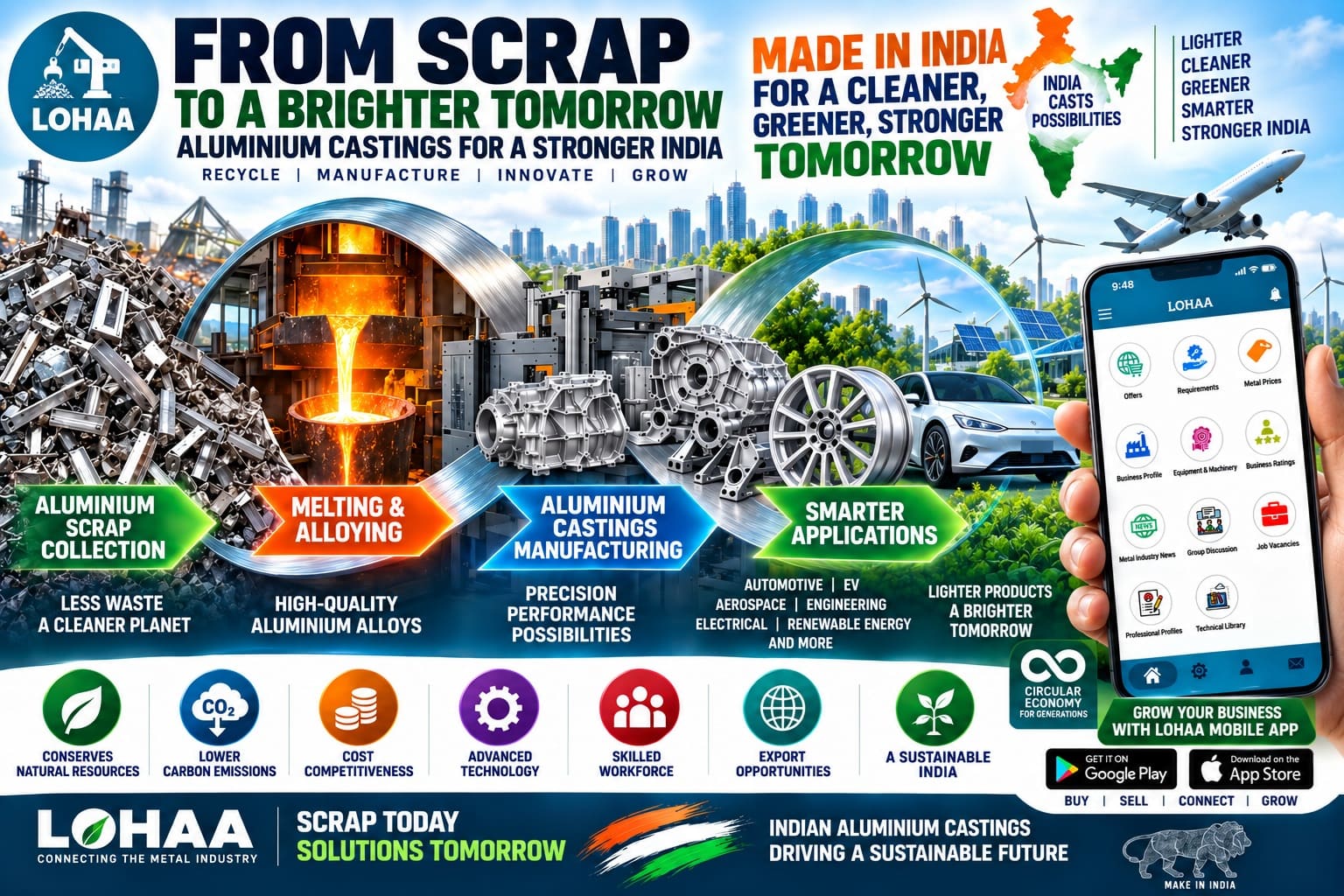
Indian Aluminium Alloy Castings: Production & Market Outlook
Indian Aluminium Alloy Castings Industry: Production, Technology, Recycling, Costs and Market Outlook 2024–2026
1. Introduction
Aluminium alloy castings are increasingly important in automotive, electric vehicles, engineering, electrical, aerospace, machinery and consumer industries because they combine low weight, corrosion resistance, good thermal conductivity and design flexibility. The choice of alloy and casting process determines component size, weight, strength, dimensional accuracy, surface finish, production volume and cost. India has developed strong capabilities in high-pressure, low-pressure and gravity die casting, sand casting and permanent-mould casting, particularly for automotive components. At the same time, recycled aluminium and imported scrap are becoming increasingly important feedstocks for Indian alloy producers and casting manufacturers. This report examines Indian production, major state clusters, casting technologies, recycling, imports, competitiveness and emerging applications during 2024–2026.
2. Aluminium Alloy Casting Processes, Applications and Maximum Practical Casting Weight
There is no universal maximum casting weight for a process. It depends on machine capacity, die dimensions, furnace capacity, alloy, component geometry, wall thickness and foundry design. The following ranges are therefore practical industry ranges rather than absolute technical limits.
i) Sand casting
- Typical alloy families: Al-Si, Al-Si-Mg, Al-Cu
- Typical component weight: 0.5–500 kg+
- Practical large-component capability*: 500 kg–several tonnes
- Major applications: Pumps, housings, machinery, industrial components
- Advantages: Flexible, low tooling cost, large components
- Limitations: Lower productivity, dimensional variation, machining required
ii) Gravity die casting
- Typical alloy families: Al-Si, Al-Si-Mg, Al-Si-Cu
- Typical component weight: 0.2–50 kg
- Practical large-component capability*: 50–100+ kg depending on equipment
- Major applications: Engine parts, housings, manifolds, wheels
- Advantages: Better quality than sand, reusable dies
- Limitations: Lower productivity than HPDC
iii) Low-pressure die casting (LPDC)
- Typical alloy families: Al-Si-Mg, Al-Si
- Typical component weight: 2–50 kg
- Practical large-component capability*: 50–100+ kg
- Major applications: Alloy wheels, cylinder heads, structural parts
- Advantages: Good filling, lower porosity, heat treatment possible
- Limitations: Slower than HPDC
iv) High-pressure die casting (HPDC)
- Typical alloy families: Al-Si-Cu, Al-Si-Mg, Al-Si
- Typical component weight: 0.05–25 kg
- Practical large-component capability*: 25–50+ kg on specialised systems
- Major applications: Gearboxes, motor housings, engine components, EV housings
- Advantages: Very high productivity, excellent repeatability
- Limitations: Porosity, die cost, alloy restrictions
v) Squeeze casting
- Typical alloy families: Al-Si-Mg, Al-Mg-Si
- Typical component weight: 1–50 kg
- Practical large-component capability*: 50–100+ kg
- Major applications: Suspension, brake and structural components
- Advantages:: High integrity and strength
- Limitations: Higher equipment/tooling cost
vi) Semi-solid/rheo casting
- Typical alloy families: Al-Si-Mg, Al-Mg
- Typical component weight: 0.5–30 kg
- Practical large-component capability*:Equipment dependent
- Major applications: EV structural parts, battery housings, automotive components
- Advantages: Lower porosity, good mechanical properties
- Limitations: Process control and feedstock requirements
vii) Investment casting
- Typical alloy families: Al alloys
- Typical component weight: grams–10 kg
- Practical large-component capability*: Generally smaller components
- Major applications: Aerospace, precision engineering
- Advantages: Complex geometry and high accuracy
- Limitations: Expensive and slower
viii) Giga/mega casting
- Typical alloy families: Special Al-Si structural alloys
- Typical component weight: 20–150+ kg/component
- Practical large-component capability*:100 kg+ possible
- Major applications: Vehicle front/rear structures, underbody, battery structures
- Advantages: Replaces multiple components with one casting
- Limitations: Very high capital expenditure and tooling requirements
*Indicative engineering ranges, not guaranteed process limits.
Indian manufacturers already demonstrate a broad capability. For example, Sundaram-Clayton reports PDC components from 0.25–25 kg, GDC components from 0.25–24 kg and LPDC components from 2.5–18 kg, with machines up to 3,200 tonnes locking force. (Sundaram Clayton)
Rockman reports HPDC, LPDC and GDC capabilities, including HPDC machines from 250–1,250 tonnes and expansion toward 1,650/1,800 tonnes. (Rockman)
3. Major Aluminium Alloy Families and Applications
i) Al-Si
- Typical applications: Engine blocks, housings, transmission parts
- Main advantages: Excellent castability and wear resistance
- Main limitations: Moderate ductility
ii) Al-Si-Cu
- Typical applications:: Gearboxes, engine components, compressor parts
- Main advantages: Strength, machinability
- Main limitations: Lower corrosion resistance
iii) Al-Si-Mg
- Typical applications:: Structural parts, suspension components
- Main advantages: Strength, heat treatability
- Main limitations: Higher process sensitivity
iv) Al-Mg
- Typical applications:: Marine, automotive, structural components
- Main advantages: Corrosion resistance and toughness
- Main limitations: More difficult casting
v) Al-Cu
- Typical applications: Aerospace and high-strength parts
- Main advantages: High strength
- Main limitations: Corrosion and castability challenges
vi) Al-Zn-Mg
- Typical applications: Structural/high-strength applications
- Main advantages: High strength
- Main limitations: More demanding metallurgy
vii) Al-Si-Mg-Fe
- Typical applications: Automotive secondary alloys
- Main advantages: Good recycled-scrap tolerance
- Main limitations: Excess Fe can reduce ductility
viii) Special giga-casting alloys
- Typical applications: EV structural parts
- Main advantages: High integrity and crash performance
- Main limitations: Expensive alloy/process development
4. Indian Aluminium Casting Industry – Major State Clusters
There is an important data limitation: India does not publish a comprehensive official annual state-by-state tonnage series specifically for aluminium alloy castings covering 2024, 2025 and 2026. Therefore, it would be misleading to present invented state production tonnages.
A better approach is to combine foundry concentration, automotive manufacturing, die-casting capacity, engineering clusters and known aluminium-casting facilities.
The Indian Foundry Association reports the broad geographical distribution of foundries as Gujarat/MP/Chhattisgarh 18%, Maharashtra 15%, Tamil Nadu/Kerala 15%, West Bengal/Jharkhand/Odisha 13%, Karnataka 12%, UP/Uttarakhand 8%, Haryana 4%, Punjab 5% and Andhra Pradesh/Telangana 7%. (The Institute of Indian Foundrymen)
4.1 Top 10 states/regions relevant to aluminium castings
i) Maharashtra
- Major clusters: Pune, Chhatrapati Sambhajinagar, Nashik, Mumbai
- Main casting demand: Automotive, EV, engineering
- 2024: High
- 2025: Higher
- 2026 outlook: Strong
ii) Tamil Nadu
- Major clusters: Chennai, Coimbatore, Hosur, Sriperumbudur
- Main casting demand: Automotive, EV, pumps, engineering
- 2024: High
- 2025:Higher
- 2026 outlook: Strong
iii) Gujarat
- Major clusters: Ahmedabad, Rajkot, Sanand, Vadodara
- Main casting demand: Automotive, engineering, industrial
- 2024: High
- 2025:Higher
- 2026 outlook: Strong
iv) Karnataka
- Major clusters: Bengaluru, Belagavi, Mysuru, Tumakuru
- Main casting demand: Automotive, aerospace, engineering
- 2024: High
- 2025: Higher
- 2026 outlook: Strong
v) Haryana
- Major clusters: Gurugram, Manesar, Bawal
- Main casting demand: Automotive and Tier-1 suppliers
- 2024:High
- 2025:Higher
- 2026 outlook: Strong
vi) Telangana
- Major clusters: Hyderabad, Medak, Zaheerabad
- Main casting demand: Automotive, electrical, engineering
- 2024: Medium
- 2025: Higher
- 2026 outlook: Strong
vii) Andhra Pradesh
- Major clusters: Sri City, Tirupati, Nellore
- Main casting demand: Automotive, EV, industrial
- 2024: Medium
- 2025: Higher
- 2026 outlook: Strong
viii) Punjab
- Major clusters: Ludhiana, Jalandhar
- Main casting demand: Auto components, machinery
- 2024: Medium
- 2025: Stable/Higher
- 2026 outlook: Moderate–strong
ix) Uttar Pradesh
- Major clusters: Noida, Greater Noida, Ghaziabad, Kanpur
- Main casting demand: Auto, electrical, engineering
- 2024:Medium
- 2025: Higher
- 2026 outlook: Strong
x) West Bengal
- Major clusters: Kolkata, Howrah, Durgapur
- Main casting demand: Engineering, machinery, industrial
- 2024: Medium
- 2025: Stable/Higher
- 2026 outlook: Moderate
Interpretation: These are industry-activity assessments, not official state production tonnages. The strongest growth areas are associated with automotive localisation, EV manufacturing, integrated die casting and engineering demand.
5. Indian Aluminium Casting Production: 2024, 2025 and 2026
Instead of presenting unsupported state tonnage estimates, the available market indicators give a useful picture.
The Indian aluminium casting market was estimated at approximately US$3.61 billion in 2025, with an estimated US$3.67 billion for 2026 and a projected 4.8% CAGR through 2033. Die casting was the largest process segment. (Grand View Research)
For automotive aluminium die casting, another industry estimate places the 2025 Indian market at approximately US$1.71 billion, with an estimated US$2.44 billion by 2030, implying approximately 7.37% CAGR. HPDC represented about 69% of the market in 2024. (NSE Archives)
A separate estimate puts the wider Indian aluminium die-casting market at US$2.6 billion in 2025. Differences between these figures reflect different market definitions and methodologies. (IMARC Group)
Production trend
i) Year: 2024
- Market/industry direction: Growth
- Main drivers: Automotive, 2/3-wheelers, industrial equipment, exports
ii) Year: 2025
- Market/industry direction: Stronger growth
- Main drivers: EVs, localisation, HPDC, automation, OEM sourcing
iii) 2026
- Market/industry direction: Continued expansion expected
- Main drivers: EV structural castings, giga casting, battery housings, recycling
India's overall aluminium market also expanded strongly: an ICRA-linked industry report estimates FY2025 aluminium consumption at 5.31 million tonnes, up from 4.805 million tonnes in FY2024. (CMR)
6. Technology Comparison: India, China, Japan, South Korea and Europe
i) Conventional HPDC
- India: Advanced
- China: Advanced
- Japan: Advanced
- South Korea: Advanced
- Europe: Advanced
ii) LPDC/GDC
- India: Strong
- China: Strong
- Japan: Strong
- South Korea: Strong
- Europe: Strong
iii) Automation
- India: Increasing rapidly
- China: Very high
- Japan: Very high
- South Korea: Very high
- Europe: Very high
iv) Casting simulation
- India: Widely adopted by leading firms
- China:: Very advanced
- Japan: Very advanced
- South Korea: Very advanced
- Europe: Very advanced
v) 3,000–6,000T HPDC
- India: Developing
- China:: Large installed base
- Japan: Selective
- South Korea: Advanced
- Europe: Advanced
vi) Giga casting
- India: Emerging rapidly
- China:: Advanced
- Japan: Developing
- South Korea: Advanced
- Europe: Advanced
vii) EV structural casting
- India: Developing
- China:: Very strong
- Japan: Strong
- South Korea: Strong
- Europe: Strong
viii) Recycled alloy development
- India: Strong secondary industry
- China:: Very large
- Japan: Advanced Advanced
- South Korea:Advanced
- Europe: Highly advanced
ix) Labour cost
- India: Competitive
- China:: Competitive
- Japan: High
- South Korea: High
- Advanced High
x) Energy cost
- India: Generally advantageous vs Europe, but variable
- China: Variable
- Japan: High
- South Korea: High
- Advanced High
xi) Tooling cost
- India: Competitive
- China: Competitive
- Japan: High
- South Korea: High
- Advanced High
xii) Production flexibility
- India: Strong
- China: Very strong
- Japan: Strong
- South Korea: Strong
- Advanced Strong
xiii) Overall cost competitiveness
- India: Strong
- China: Strong
- Japan: Higher-cost
- South Korea: Higher-cost
- Advanced Higher-cost
The important point is that India is not technologically behind across the entire aluminium casting sector. Leading Indian companies use simulation, automated production, CNC machining, X-ray/CT inspection, heat treatment and sophisticated HPDC systems.
For example, Endurance describes in-house FEA/casting simulation, tooling, laboratories and alloy-development capabilities. (Endurance)
Rockman operates HPDC, LPDC and GDC processes and has extensive machining and quality-control infrastructure. (Rockman)
The remaining technology gap is concentrated particularly in very large integrated structural castings, advanced alloy development, process automation, real-time data control and high-volume giga-casting experience.
8. Example: Bharat Forge's 4,200-Tonne Giga-Press
A useful Indian example is Bharat Forge's Centre for Light Weighting Technology in Andhra Pradesh.
The company reports a 4,200-tonne giga press and applications including automotive and industrial components, EV battery housings, EV motor components, engine/transmission/chassis components and wheel battery packs. (Bharat Forge)
This demonstrates the movement of Indian aluminium casting from conventional small and medium automotive components toward large integrated structural components.
The significance is substantial: instead of manufacturing many separate stamped, forged or cast components and assembling them, an integrated casting can potentially consolidate several parts into one component. The global research literature identifies vehicle giga casting as a major development for lightweight, large, complex thin-wall structures. (ScienceDirect)
9. SWOT Analysis of Indian Aluminium Casting Manufacturers
Strengths
- Competitive manufacturing cost
- Strong automotive ecosystem
- Large domestic market
- Strong secondary aluminium industry
- Skilled engineering workforce
- Growing EV manufacturing
- Strong export potential
- Growing automation
Weaknesses
- Energy costs vary considerably
- Advanced machinery often imported
- Fragmented SME foundry sector
- Scrap chemistry can be inconsistent
- Limited very-large giga-casting experience
- High capital requirements for mega machines
- Logistics can increase delivered cost
- Dependence on imported specialised technology
Opportunities
- EV battery housings
- Giga casting
- Structural automotive castings
- Lightweight engineering
- Aerospace
- Renewable-energy equipment
- Export to ASEAN/Europe
- Closed-loop recycling
Threats
- China remains highly competitive
- Rapid technological change
- Volatile aluminium prices
- Scrap shortages
- Higher environmental requirements
- European carbon-related trade measures
- Global OEM price pressure
- Higher quality requirements for recycled alloys
10. Aluminium Scrap Generated in India
India generates aluminium scrap from both industrial production and post-consumer sources.
a) Aluminium extrusion scrap
- Major source: Windows, doors, profiles
- Typical recycling route: Sorting → melting → alloying
- Typical alloy/output: 6xxx/wrought-related alloys
b) Aluminium casting scrap
- Major source: Automotive and engineering castings
- Typical recycling route: Sorting → melting → refining
- Typical alloy/output: Al-Si casting alloys
c) Aluminium wheels
- Major source: End-of-life vehicles
- Typical recycling route: Dismantling → melting
- Typical alloy/output: Al-Si-Mg wheel alloys
d) Aluminium engine scrap
- Major source: Vehicles
- Typical recycling route: Sorting → remelting
- Typical alloy/output: Al-Si-Cu alloys
e) Aluminium beverage cans
- Major source: Packaging
- Typical recycling route: Shredding/sorting → melting
- Typical alloy/output: Can-sheet/wrought alloys
f) Aluminium foil
- Major source: Packaging
- Typical recycling route: Sorting → melting
- Typical alloy/output: Secondary aluminium
g) Aluminium cables
- Major source: Electrical sector
- Typical recycling route: Stripping/separation → melting
- Typical alloy/output: Electrical/secondary alloys
h) Aluminium sheet scrap
- Major source: Fabrication/stamping
- Typical recycling route: Baling → melting
- Typical alloy/output: Wrought/casting alloys
i) Aluminium turnings
- Major source: Machining
- Typical recycling route: Briquetting → melting
- Typical alloy/output: Casting alloys
j) Mixed aluminium scrap
- Major source: Scrap yards/ELVs
- Typical recycling route: Sorting → shredding → separation
- Typical alloy/output: Secondary casting alloys
k) Zorba
- Major source: Shredded mixed non-ferrous scrap
- Typical recycling route: Eddy-current separation
- Typical alloy/output: Secondary aluminium
l) Taint/Tabor
- Major source: Used beverage/painted aluminium
- Typical recycling route: Sorting and remelting
- Typical alloy/output: Secondary alloys
11. How Recycled Aluminium Is Used in Alloy Production
The major challenge is scrap chemistry.
A casting manufacturer cannot simply melt every aluminium scrap grade together and obtain a specified alloy. Elements such as Si, Cu, Mg, Fe, Mn and Zn must be controlled.
Typical flow
Scrap collection → sorting → shredding → magnetic/eddy-current separation → decoating where required → melting → fluxing/degassing → filtration → alloy adjustment → spectrometer analysis → holding → casting of ingots → remelting by casting manufacturer
High Fe levels are particularly important because they can create brittle intermetallic phases. Research into high-shear processing has demonstrated methods for improving the quality of contaminated aluminium scrap for casting applications. (CORDIS)
12. How Much Recycled Aluminium Is Used?
India is a major secondary-aluminium market.
Reuters reported in April 2026 that India produces nearly half of its approximately 4.2 million tonnes of aluminium through recycled scrap, although the figure refers to aluminium production broadly rather than aluminium alloy castings alone. Automotive applications consume around 60% of India's secondary aluminium according to the same report. (Reuters)
Therefore, recycled aluminium has a very significant role in Indian aluminium alloy casting, especially for automotive components.
However, there is no reliable public national statistic showing precisely:
"X% of every aluminium casting produced in India contains Y% recycled aluminium."
The percentage varies substantially by:
• alloy;
• OEM specification;
• casting process;
• component safety requirements;
• scrap source;
• chemistry;
• recycled-content target;
• primary aluminium dilution.
13. India's Aluminium Scrap Imports and the Deficit
India supplements domestic scrap generation with imports.
World Bank/UN Comtrade data show that India imported approximately 2.023 million tonnes of aluminium waste and scrap in 2025, valued at approximately USD 4.452 billion. (World Integrated Trade Solution)
The major 2024 suppliers included:
- USA: 423,215 tonnes
- UK 166,472 tonnes
- Saudi Arabia 160,537 tonnes
- UAE 119,880 tonnes
- Australia 86,234 tonnes
- Netherlands 79,381 tonnes
(World Integrated Trade Solution)
During H1 2025, India imported about 875,466 tonnes of aluminium scrap worth approximately US$1.96 billion, according to UN Comtrade-based reporting. (MySteel)
13.1 Deficit by scrap category
a) Clean extrusion scrap
- Domestic availability: Moderate/high
- Import requirement: Moderate
- Main reason: Need for specific chemistry
b) Cast aluminium scrap
- Domestic availability: High
- Import requirement: Moderate
- Main reason: Automotive demand
c) Wheels
- Domestic availability: Increasing
- Import requirement: Moderate
- Main reason: Alloy quality requirements
d) Zorba
- Domestic availability: Moderate
- Import requirement: High
- Main reason: Large recycling demand
e) Taint/Tabor
- Domestic availability: Moderate
- Import requirement: High
- Main reason: Packaging and mixed scrap
f) High-quality alloy scrap
- Domestic availability: Limited
- Import requirement: High
- Main reason: Precise alloy chemistry
g) Mixed post-consumer scrap
- Domestic availability: High
- Import requirement: High
- Main reason: Sorting/recovery limitations
h) Clean manufacturing scrap
- Domestic availability: Relatively strong
- Import requirement: Lower
- Main reason: Local industrial recycling
Thus, imports are not simply replacing a single "tonnage deficit." They also solve a quality and alloy-chemistry deficit.
14. Year 2026 Scrap-Supply Risk
India's dependence on imported aluminium scrap became particularly visible in 2026.
Reuters reported that Middle East disruption constrained scrap imports and pushed scrap prices sharply higher, with some secondary aluminium producers operating at substantially reduced utilisation. (Reuters)
This highlights an important strategic issue:
India has significant recycling capacity, but recycling capacity does not automatically guarantee sufficient availability of the right scrap chemistry.
The 2025 End-of-Life Vehicles Rules are likely to improve formal collection and recovery over time. The rules came into force on 1 April 2025 and introduce producer EPR obligations for end-of-life vehicles. (Press Information Bureau)
NITI Aayog's 2026 report also identifies the development of a stronger circular economy for end-of-life vehicles as an important policy direction. (NITI Aayog)
15. Recent Developments in Aluminium Alloy Casting Technology
15.1 Giga casting
Giga casting is moving from experimental technology toward industrial deployment.
Applications include:
• EV rear underbody;
• front underbody;
• battery structures;
• shock-tower structures;
• motor housings;
• large chassis structures.
Research identifies lightweight Al alloys, large machines, mould development, structural optimisation and process control as central areas of giga-casting development. (ScienceDirect)
15.2 Real-time shot control
Modern HPDC machines increasingly use:
• shot-speed monitoring;
• pressure monitoring;
• cavity sensors;
• automated lubrication;
• closed-loop process control.
15.3 Casting simulation
Simulation is increasingly used before die manufacturing to predict:
• filling;
• turbulence;
• air entrapment;
• shrinkage;
• porosity;
• solidification;
• thermal balance.
15.4 X-ray and CT inspection
High-integrity automotive and EV castings increasingly require internal inspection rather than relying solely on surface inspection.
15.5 Heat treatment
T6 and related treatments allow selected alloys/processes to achieve higher strength and improved performance.
15.6 Semi-solid and rheocasting
Semi-solid processes are receiving increased attention for EV structural and battery applications because of their potential for high integrity and reduced porosity.
15.7 More recycled aluminium
Manufacturers are increasingly investigating higher recycled content while maintaining specified chemistry and mechanical properties. The direction is consistent with the broader automotive circular-economy trend identified in recent research. (DOI)
16. Applications in Engineering Industries
- Industry: Aluminium casting applications
- Passenger vehicles: Engine, transmission, chassis, structural components
- Two-wheelers: Crankcases, cylinder heads, wheels, housings
- EVs: Battery housings, motor housings, structural castings
- Commercial vehicles Gear housings, engine components, transmission parts
- Aerospace: Structural and non-structural precision components
- Electrical: Motor housings, electrical enclosures
- Renewable energy: Motor housings, inverter components
- Pumps: Pump bodies, impellers and housings
- Compressors: Compressor housings and covers
- Industrial machinery: Housings, brackets, structural components
- Railways: Lightweight structural and mechanical components
- Consumer products: Appliance and equipment components
17. Aluminium Castings and EVs
The shift toward EVs is changing the casting product mix.
Traditional ICE vehicles require large numbers of:
• engine components;
• cylinder heads;
• crankcases;
• transmission components.
EVs create demand for:
• battery housings;
• motor housings;
• inverter housings;
• e-axle housings;
• structural castings;
• cooling components;
• charging-system housings.
This does not mean all traditional aluminium casting demand disappears. Instead, the alloy and component mix is changing.
18. LOHAA Mobile Application of Android and iPhone / Portal Mobile Application for Aluminium Casting Manufacturers for Commercial Transactions /Leads
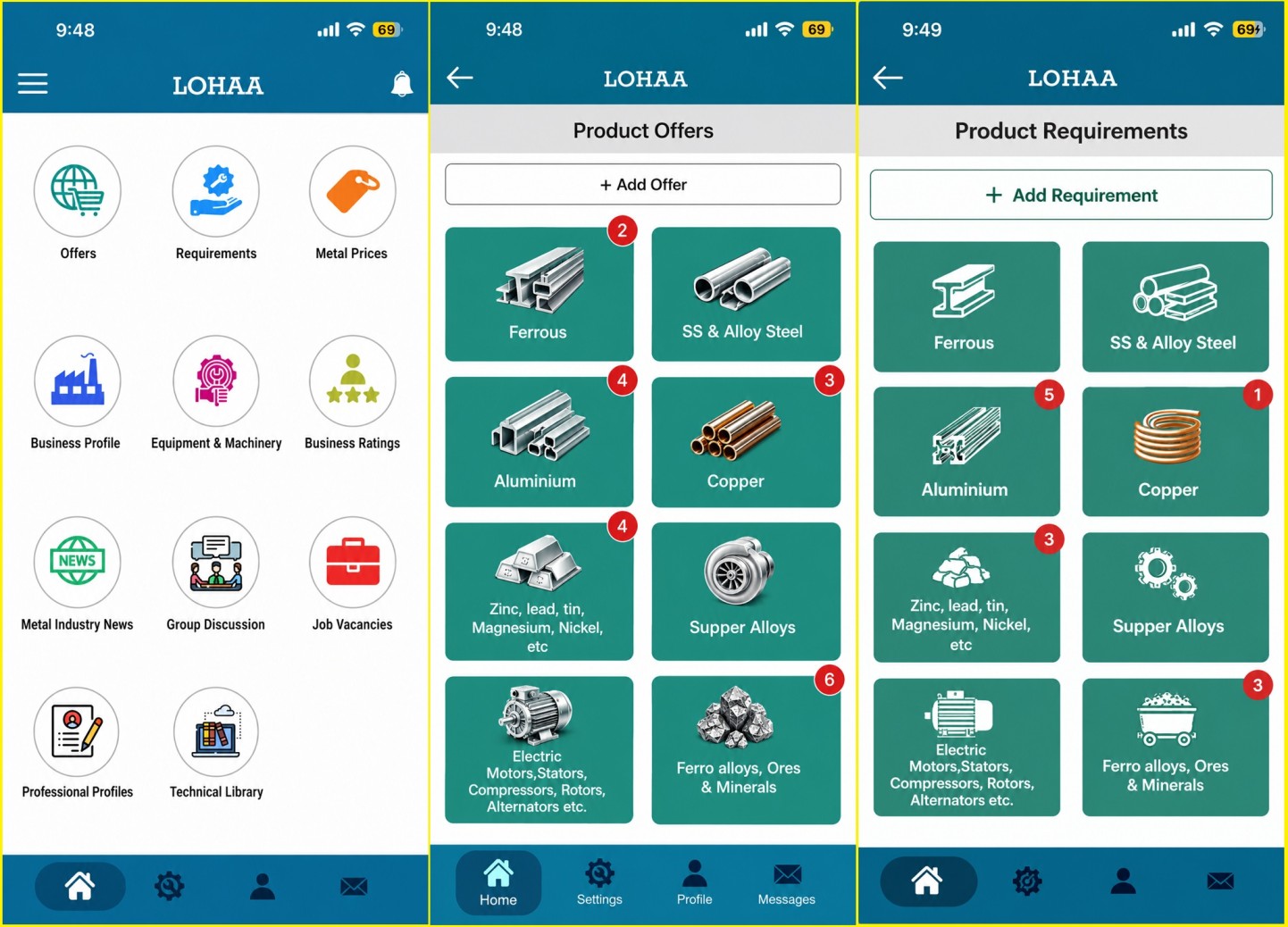 LOHAA Mobile can provide a digital commercial channel for aluminium alloy casting manufacturers, alloy producers, scrap suppliers, traders, stockists and engineering companies.
- Publish offers: Sell aluminium alloy castings
- Publish requirements: Purchase aluminium castings/components
- Scrap requirements: Source aluminium scrap
- Alloy ingot: offers Buy/sell secondary aluminium alloy ingots
- Company profiles: Identify manufacturers and suppliers
- KYC verification: Improve counterparty confidence
- Ratings: Evaluate trading relationships
- Machinery marketplace: Buy/sell casting machinery
- Market prices: Monitor aluminium and scrap prices
- Industry news: Follow aluminium and automotive developments
- Commercial enquiries: Generate B2B leads
- Industry channel: Share daily market developments
For a casting manufacturer, the value proposition is particularly relevant when the business needs to source scrap, alloy ingots, machinery, buyers or industrial customers rather than relying only on traditional sales networks.
19. Commercial Example – Aluminium Casting Manufacturer
Consider an Indian manufacturer producing an Al-Si alloy gearbox housing.
Conventional model
Scrap/ingot supplier → aluminium melting → alloy adjustment → HPDC → machining → testing → OEM
The major commercial risks are:
• aluminium price;
• scrap quality;
• alloy chemistry;
• rejection;
• energy;
• tooling;
• customer concentration.
Digitally supported model
LOHAA requirement → KYC-verified suppliers → scrap/ingot offers → commercial negotiation → production → customer offer → OEM/Tier-1 buyer
A digital B2B marketplace can therefore complement—not replace—the manufacturer's existing procurement and sales network.
20. Key Challenges for Indian Aluminium Casting Manufacturers
a) Volatile aluminium and scrap prices.
b) Availability of consistent alloy scrap.
c) High capital expenditure for large HPDC machines.
d) Tooling costs.
e) Energy consumption.
f) Porosity control.
g) Requirement for increasingly thin-wall components.
h) OEM price pressure.
i) Shorter product-development cycles.
j) Need for digital process monitoring.
k) Increasing environmental compliance.
l) Need to increase recycled content without compromising performance.
21. 21. Key Opportunities Through 2030 (Opportunity and Expected importance)
- EV battery housings: Very significant
- Giga casting: Rapidly developing
- Structural automotive castings: High
- Aluminium recycling: Very high
- ELV aluminium recovery: Increasing
- Export of cast components: High
- Aerospace castings: Selective/high-value
- Renewable-energy: components Growing
- Automated HPDC: Increasing
- Digital B2B sourcing: Increasing
- Low-carbon recycled alloys: Strategic
22. Conclusion
India's aluminium alloy casting industry has developed from a largely conventional automotive and engineering supply base into a more sophisticated manufacturing sector using HPDC, LPDC, GDC, simulation, automation, CNC machining, X-ray/CT inspection and advanced alloy control. The strongest growth opportunities through 2026 and beyond are in EV battery housings, motor and e-axle components, structural castings and giga-casting.
India's principal competitive advantages remain manufacturing cost, engineering skills, a large automotive market, a developed secondary-aluminium ecosystem and growing OEM localisation. The principal challenges are scrap-quality consistency, energy costs, capital requirements and the need to accelerate advanced large-casting technology. Recycling will become increasingly important as domestic demand grows. India's 1.74 million tonnes of aluminium scrap imports in 2024 demonstrate the scale of this requirement. The formalisation of end-of-life vehicle recycling should gradually improve domestic scrap availability. Digital B2B platforms such as LOHAA Mobile can complement this ecosystem by connecting verified buyers and sellers of castings, alloy ingots, scrap and equipment.
23. References
1. Indian Foundry Association – Indian foundry clusters and industry structure.
2. World Bank/UN Comtrade – India's aluminium waste and scrap imports, 2024.
3. Reuters – India's secondary aluminium industry and scrap supply disruption, 2026.
4. Ministry of Environment, Forest and Climate Change – End-of-Life Vehicles Rules, 2025.
5. NITI Aayog – Enhancing Circular Economy of End-of-Life Vehicles in India, 2026.
6. ScienceDirect – Vehicle giga-casting Al alloys technologies, applications, and beyond.
7. ScienceDirect – Recycling aluminum alloys for the automotive industry.
8. European Commission CORDIS – RecycAl high-shear recycling project.
9. Sundaram-Clayton – aluminium die-casting capabilities.
10. Endurance Technologies – aluminium die-casting capabilities.
11. Rockman Industries – aluminium HPDC/LPDC/GDC capabilities.
12. Bharat Forge – Centre for Light Weighting Technology and 4,200-tonne giga press.
13. ICRA/industry data – Indian aluminium market development.
14. Grand View Research – Indian aluminium casting market estimates.
Ten Frequently Asked Questions – Indian Aluminium Alloy Castings
1. What are aluminium alloy castings?
Aluminium alloy castings are components produced by melting aluminium alloys and pouring or injecting the molten metal into a mould. They are widely used in automotive, EVs, aerospace, electrical, machinery, pumps and engineering industries.
2. Which aluminium casting processes are commonly used in India?
The main processes are:
- High-Pressure Die Casting (HPDC)
- Low-Pressure Die Casting (LPDC)
- Gravity Die Casting (GDC)
- Sand Casting
- Permanent Mould Casting
- Squeeze Casting
- Investment Casting
- Giga Casting
3. Which aluminium alloys are commonly used for castings?
Common families include Al-Si, Al-Si-Mg, Al-Si-Cu, Al-Mg and Al-Cu alloys. Al-Si alloys are particularly popular because of their good castability, strength and wear characteristics.
4. What are the major applications of aluminium castings?
Aluminium castings are used for engine and transmission components, motor housings, battery housings, wheels, pump bodies, compressor parts, electrical housings, structural automotive components and industrial machinery.
5. How much aluminium scrap is used to manufacture aluminium alloy castings?
The percentage varies according to the alloy, component specification and customer requirements. Automotive secondary alloys can contain substantial recycled material, while critical applications may require tighter control of recycled content and chemistry.
6. What types of aluminium scrap are used?
Major types include extrusion scrap, casting scrap, aluminium wheels, engine scrap, sheet scrap, cable scrap, beverage cans, machining turnings, Zorba and mixed aluminium scrap.
7. Why does India import aluminium scrap?
India imports scrap because domestic collection does not always provide sufficient quantity, quality or specific alloy chemistry. Imported scrap supplements domestic supply for secondary aluminium producers and casting manufacturers.
8. Is India competitive in aluminium casting compared with China, Asia and Europe?
India has important advantages in manufacturing cost, engineering skills, automotive demand, supplier networks and secondary aluminium. Leading Indian companies also use advanced automation, simulation, machining and quality-control technologies. However, China and some East Asian and European manufacturers have greater experience in certain areas such as very-large giga casting, advanced automation and specialised process technologies.
9. What is the future of aluminium castings in India?
Major growth areas include EV battery housings, motor and e-axle housings, lightweight structural components, giga casting, renewable-energy equipment, aerospace and export-oriented engineering components.
10. How can LOHAA Mobile help aluminium casting manufacturers?
LOHAA Mobile can connect aluminium casting manufacturers with the metal-industry ecosystem through Offers, Requirements, Metal Prices, Business Profiles, Equipment & Machinery, Business Ratings, Metal Industry News, Group Discussion, Professional Profiles and Technical Library. It can help manufacturers discover potential suppliers and buyers and support B2B commercial networking.
Quick takeaway
Aluminium scrap → Sorting → Melting & Alloying → Casting → Machining → Automotive/EV/Engineering Applications → Recycling
LOHAA Mobile → Buy | Sell | Requirements | Offers | Metal Prices | Suppliers | Machinery | Industry News → Connect & Grow
By using digital trade platforms like LOHAA Mobile application, you can reach global buyers, source quality material, and strengthen long-term partnerships.
Download the Lohaa Metal Trading App for Android to access live scrap prices and real-time market updates anytime, anywhere.
Download the Lohaa Metal Trading App for iOS to access live scrap prices and real-time market updates anytime, anywhere.
(Notes: market and production volume estimates are synthesized from public market reports and industrial press; exact tonne figures for materials are not centrally published in a single comprehensive public dataset, therefore the numeric projection above is a conservative, documented estimate built from available intelligence and reasonable regional share assumptions.)


