
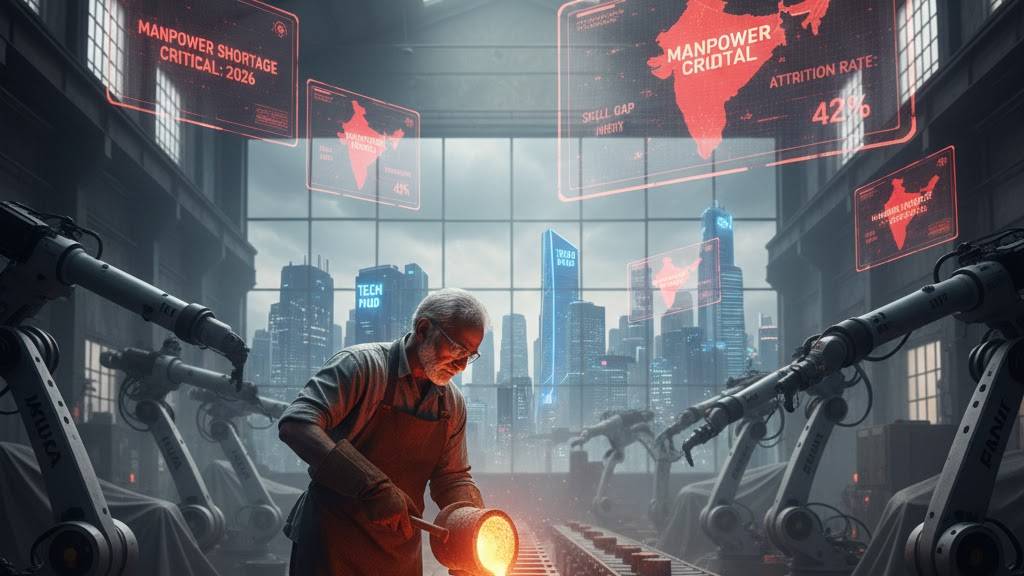
Indian foundries manpower shortage regional SWOT and solutions
India’s foundry sector is an industrial backbone: supplying castings to automotive, railways, infrastructure, pumps, valves, agriculture equipment and more. With more than 5,000 foundry units and an installed capacity measured in millions of tonnes per annum, foundries are poised for growth — but they face a critical bottleneck: a shortage of skilled technical staff and shop-floor manpower. This shortage is already constraining capacity utilization, slowing adoption of newer processes, and risking the timely fulfilment of orders from high-growth sectors. (Sidhiee Bee India)
Below, LOHAA presents a detailed, regionalized diagnosis of the manpower challenge, tables that estimate manpower availability vs. shortfall by region, a SWOT analysis (North, East, West, South), and practical recommendations to stabilize and scale foundry manpower for the decade ahead.
Quick snapshot — the problem in three lines
a) Employers across India report growing difficulty finding skilled talent; India’s 2025 Global Talent Shortage survey shows nearly 4 in 5 employers struggling to hire skilled workers. (ManpowerGroup)
b) The foundry sector is aging and largely small-scale; many clusters rely on traditional craft knowledge that is not being replaced by younger workers skilled in automation or metallurgy. (Indian Foundry Association)
c) Regional imbalances (migrant flows, cluster concentration, and local education/training gaps) mean some regions face more acute shortages than others — requiring cluster-level solutions, not only national policy fixes. (The Times of India)
Why this matters to LOHAA users and the scrap ecosystem
LOHAA connects buyers and sellers across multiple countries. Foundries are major consumers of ferrous and non-ferrous scrap and need predictable, skilled operations to convert scrap into castings reliably. A manpower crisis in foundries affects scrap demand patterns, procurement planning, and lead times for raw material purchases. If foundries cannot staff technical roles (melt shop operators, patternmakers, coremakers, fettlers, heat-treat technicians, quality engineers), they will either slow production or invest in automation — both of which reshape scrap demand composition (e.g., more demand for higher-quality feedstock).
The national picture: scale and structural drivers
i) India has over 5,000 foundry units, mostly small and medium enterprises (SMEs), concentrated in established clusters (Howrah, Rajkot, Coimbatore, Jalandhar/Batala, Kolhapur, etc.). These clusters historically developed a pipeline from local worker pools and apprenticeship systems, but those pipelines are weakening. (Indian Foundry Association)
ii) Demand for castings is rising (automotive electrification, infrastructure, pumps, agricultural machinery), which increases the need for both quantity and higher technical competence (metallurgy, process control, automated moulding). Market research projects strong growth in the Indian foundry market through 2028–2031. (Research and Markets)
iii) Structural causes of the manpower shortage include aging workforce, declining migration of labour to urban hubs, limited modern vocational training aligned to foundry processes, limited attractiveness of shop-floor careers to younger cohorts, and a skills mismatch for modern foundry technology. (Govind Steel)
Regional breakdown: manpower availability & shortfall (North, East, West, South)
Method note exact, up-to-the-personnel counts are not publicly available for every cluster. The tables below combine: (a) published cluster counts and industrial concentration; (b) industry reports on skill shortages and employer surveys (e.g., ManpowerGroup India 2025 findings); and (c) ground-level reporting on labour migration and localized shortages. Use the numbers as evidence-based estimates for planning; adjust with your own cluster HR data where available.
Table 1 — Summary estimates: foundry units, rough workforce size and estimated shortfall by region
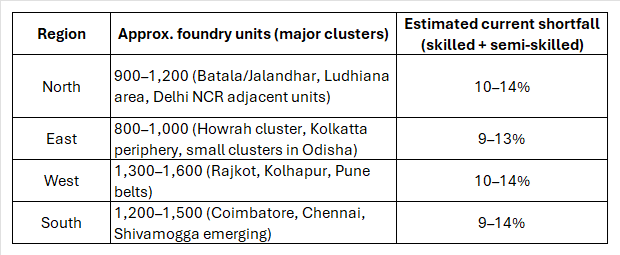
Sources & rationale: national foundry unit count and cluster locations from IFA / industry profiles; national talent shortage indicators from ManpowerGroup’s 2025 India report; local reporting on labor issues (Ludhiana) and cluster expansion (Shivamogga). These give a conservative, evidence-based shortfall range. (Indian Foundry Association)
Deeper regional profiles & SWOTs
Below we present an actionable SWOT analysis for each region (Strengths, Weaknesses, Opportunities, Threats) focused specifically on manpower and technical staffing for foundries.
NORTH REGION — profile & SWOT
Profile: The North hosts mature foundry clusters around Batala/Jalandhar, Ludhiana, parts of Haryana and Punjab, and small units near Delhi/NCR. Historically these clusters depended on migrant labour from Bihar and UP; recent declines in migration and competition for labour from other industries have squeezed availability. (The Times of India)
Strengths
i) Established apprenticeship traditions and experienced older workforce.
ii) Strong connectivity to large OEMs in automotive, tractors, and engineering.
iii) Existing vocational institutes and polytechnics that could be mobilized.
Weaknesses
i) High reliance on migrant labour vulnerable to changing migration patterns.
ii) Aging skilled workforce; slow re-entry of youth into foundry trades.
iii) Safety and social infrastructure (labour hostels, transport) often inadequate — making worker attraction hard. (The Times of India)
Opportunities
i) Cluster-level transport/hostel programs (village-to-industry buses) to secure labour flows. Local government interest exists. (The Times of India)
ii) Upskilling programs with local polytechnics to convert semi-skilled workers into technical operators.
iii) Automation combined with targeted skilling to reduce reliance on low-skilled labour while increasing demand for technicians.
Threats
1) Rising wage pressures and competition from other manufacturing sectors (textiles, food processing).
ii) Delays in modernization if technical staff shortages persist, reducing competitiveness for OEM contracts.
EAST REGION — profile & SWOT
Profile: The Eastern region (notably Howrah cluster, parts of Odisha) has long foundry traditions, especially in medium-duty castings. Many units are small, family-run, and craft-based. (Indian Foundry Association)
Strengths
i) Deep craft knowledge (pattern making, moulding) preserved in longstanding clusters.
ii) Proximity to raw material sources and port connectivity in some subregions.
Weaknesses
i) Younger workers often migrate out for urban jobs, fewer join shop floor trades
ii) Limited exposure to modern process controls and metallurgy training.
iii) Environmental compliance costs can force smaller units to delay investments that would attract technical talent.
Opportunities
i) Cluster upgradation grants and targeted skill centres to transition older artisans into certified technicians.
ii) Linkages with engineering colleges and applied research labs for metallurgy internships.
Threats
i) Cluster fragmentation — small units may not individually afford training or retention packages.
ii) Environmental regulations without transition support could depress hiring.
WEST REGION — profile & SWOT
Profile: Western India (Gujarat, Maharashtra) includes some of the largest foundry clusters — Rajkot, Kolhapur, Pune belts — and has significant output for automotive and industrial equipment. It is among the most growth-oriented regions. Rajkot is a notable hub. (Scribd)
Strengths
i) Large established clusters with scale that can absorb investments in training.
ii) Better access to formal vocational training and engineering institutions.
iii) More visible migration inflows from nearby rural areas compared to some other regions.
Weaknesses
i) Rapid modernization has created a skills gap — demand for automation-literate technicians exceeds supply.
ii) Wage inflation in some clusters makes it hard for smaller foundries to retain staff.
Opportunities
i) Industry-led training academies and hiring pipelines with technical institutes.
ii) Public-private partnerships for upskilling, funded through MSME cluster development initiatives.
Threats
i) If larger players poach trained staff from SMEs, small foundries will remain under-resourced.
ii) Global OEMs’ quality requirements will penalize foundries that cannot secure competent QA/Metallurgy engineers.
SOUTH REGION — profile & SWOT
Profile: The South, with strong clusters near Coimbatore and an emerging cluster in Shivamogga (Karnataka), combines traditional foundry skills with some high-end engineering castings. Government scheme support for clusters is visible, e.g., new cluster announcements. (The Times of India)
Strengths
i) Good technical education infrastructure (polytechnics, engineering colleges).
ii) Progressive cluster development initiatives and some public investment.
iii) Strong MSME support frameworks in states like Tamil Nadu and Karnataka.
Weaknesses
i) Even where technical institutions exist, curricula are often disconnected from foundry shop realities.
ii) Some clusters have limited scale per unit, reducing their ability to run continuous in-house training.
Opportunities
i) Clusters can co-fund training centres and collaborate with OEMs for internships and apprenticeships.
ii) Investment in automation paired with technician training can make South clusters leaders in higher-end castings.
Threats
i) Outmigration to IT/Service sectors for younger talent; manufacturing careers perceived as less desirable.
ii) Competition for talent from other advanced manufacturing hubs (electronics, auto components).
Role of modernization & automation — not a replacement, but a force multiplier
Foundries are considering automation to reduce dependence on scarce low-skill manpower. But automation raises the bar: it reduces some manual roles while increasing demand for technicians who can operate, maintain and program equipment, as well as metallurgists and quality engineers. This transition exacerbates the skills gap unless accompanied by intensive reskilling and targeted recruitment pipelines.
Industry reports and cluster studies repeatedly note that the foundry sector is facing both “shortage of hands” and a “shortage of skills” — not the same thing. The ManpowerGroup survey showed India’s overall skilled talent shortage is acute; translated to foundries, that means both shop-floor operators and higher technical staff are hard to find. (ManpowerGroup)
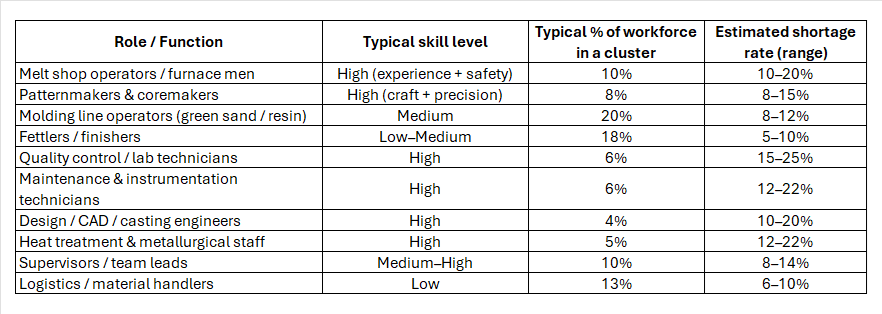
Interpretation: QC, maintenance, and melting roles show the highest relative shortages because they require a combination of experience, safety discipline and formal technical knowledge — the hardest to replace quickly.
Where the shortages show up first (consequences)
a) Quality misses (higher rejection rates) when labs and metallurgical controls are understaffed — OEM contracts can be at risk. (GMK)
b) Longer lead times & missed deliveries as shifts run understaffed, reducing capacity utilization.
c) Slower technology adoption because foundries cannot staff the technicians needed to run automated equipment.
d) Wage inflation & poaching: when a trained technician appears, larger firms hire them away from SMEs.
e) Safety incidents increase if less experienced personnel operate hazardous equipment.
Practical recommendations — what foundries, clusters and policymakers can do
Below are actionable steps framed by actor — quick to medium term.
For foundry owners & cluster associations
a) Set up shared training & apprenticeship centres at the cluster level (funded by cluster members and local government). Shared infrastructure lowers per-unit cost and creates a certified pipeline. (NER Promotion)
b) Apprenticeship tie-ups with local polytechnics: co-created syllabi, internships, guaranteed interviews for graduates.
c) Retention packages for critical technical staff: modest pay + training + safety & health benefits to reduce churn.
d) Cross-company rotations for trainees so they get broad exposure (pattern, moulding, melt, QA).
e) Micro-automation: target the most labour-intensive repetitive tasks for affordable automation (e.g., robotic fettling, mechanized sand handling), paired with technician training.
For policymakers & state governments
i) Incentivize cluster training centres under MSME/Skill India programs — matching grants for equipment and trainer salaries.
ii) Transport & housing measures for migrant labour (bus services, subsidized hostels) to stabilize labour supply — a practical measure advocated by industry in places like Ludhiana. (The Times of India)
iii) Quality certification subsidies so smaller foundries can afford to certify labs and thus attract QC staff.
For training institutes & academia
i) Update curricula to include practical modules on foundry safety, metallurgy, furnace operations and automation interfaces.
ii) Offer short, stackable credentials (6–12 weeks) that certify a worker as “foundry melt-operator level 1” or “foundry QA technician level 1”.
For LOHAA and platform players
i) Run hiring boards and skills marketplaces: LOHAA can connect trained candidates with clusters (a verified talent pool for the platform).
ii) Host cluster skill bootcamps and sponsor scholarships for candidates (promotes ecosystem trust and brand).
iii) Market intelligence on workforce trends: provide buyers and sellers with staffing outlooks so procurement timelines account for workforce constraints.
Quick wins (30–90 days) vs medium/long term
i) 0–90 days (quick wins): partner with a local polytechnic to start a 6-week “foundry essentials” bootcamp; subsidize return transport for workers; create a retention bonus for critical staff. (NER Promotion)
ii) 3–12 months (medium): establish a cluster training academy; pilot micro-automation in a willing SME; run a recruitment drive with local villages.
iii) 12+ months (long term): sustained curriculum reform at vocational institutes; full modernization programs tied to export/OEM quality standards; regional employment exchanges specialized for foundries.
Case snippet — Ludhiana & the village-to-industry bus idea
Ludhiana’s manufacturing leaders have publicly urged village-to-industry bus services and hostels to solve immediate labour shortages — an idea with clear applicability to foundry clusters that rely on migrant labour. This is a practical, low-technology intervention that can alleviate short-term supply gaps while training pipelines are created. (The Times of India)
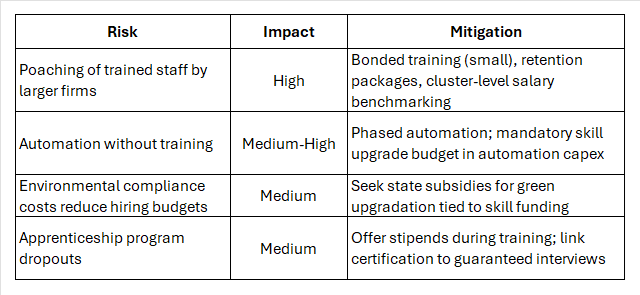
Risk & mitigation matrix
Performance KPIs to monitor (recommended for clusters / foundries)
i) Number of certified technicians produced per quarter (target per 100 foundries: 20–40).
ii) Vacancy rate for critical roles (melt, QA, maintenance) — aim to reduce by 50% in 12 months.
iii) Staff churn rate for trained technicians — aim <15% annually.
iv) % of workforce with formal (certified) foundry training — aim to double in 2 years.
Concluding summary (what LOHAA readers should remember)
India’s foundry sector is at an inflection point. Demand growth is real, and the opportunity to supply domestic and export markets is substantial — but human capital limitations risk leaving capacity on the table.
The solution is neither pure automation nor waiting for the labour market to “fix itself”; it requires coordinated cluster-level action: shared training centers, public funding levers, practical transport/housing solutions to secure labour flows, and a focused strategy to convert experienced craft workers into certified technicians. LOHAA’s role as a connective marketplace can be leveraged to coordinate hiring and reduce friction between foundries and sources of trained manpower.
By using digital trade platforms like LOHAA Mobile application, you can reach global buyers, source quality material, and strengthen long-term partnerships.
Download the LOHAA Mobile application today and connect with verified scrap suppliers and manufacturers.
References & sources
i) Indian Foundry Association — IFA profile & cluster overview. (Indian Foundry Association)
ii) ManpowerGroup India — 2025 Global Talent Shortage Survey (India findings). (ManpowerGroup)
iii) Government / BEE foundry sector overview (sector detail). (Sidhiee Bee India)
iv) Local reporting on cluster manpower & transport solutions — Ludhiana manufacturing labour shortage (The Times of India)
v) Cluster expansion / state initiatives — foundry cluster in Shivamogga announcement. (The Times of India)
vi) Industry analysis & market outlook — ResearchAndMarkets / Mordor / IMARC summaries on India foundry and metal casting market growth. (Research and Markets)
vii) Foundry production and personnel challenges (industry commentary). (GMR)
viii) Cluster development / MSME foundry study (North-east promotion PDF). (NER Promotion)


