
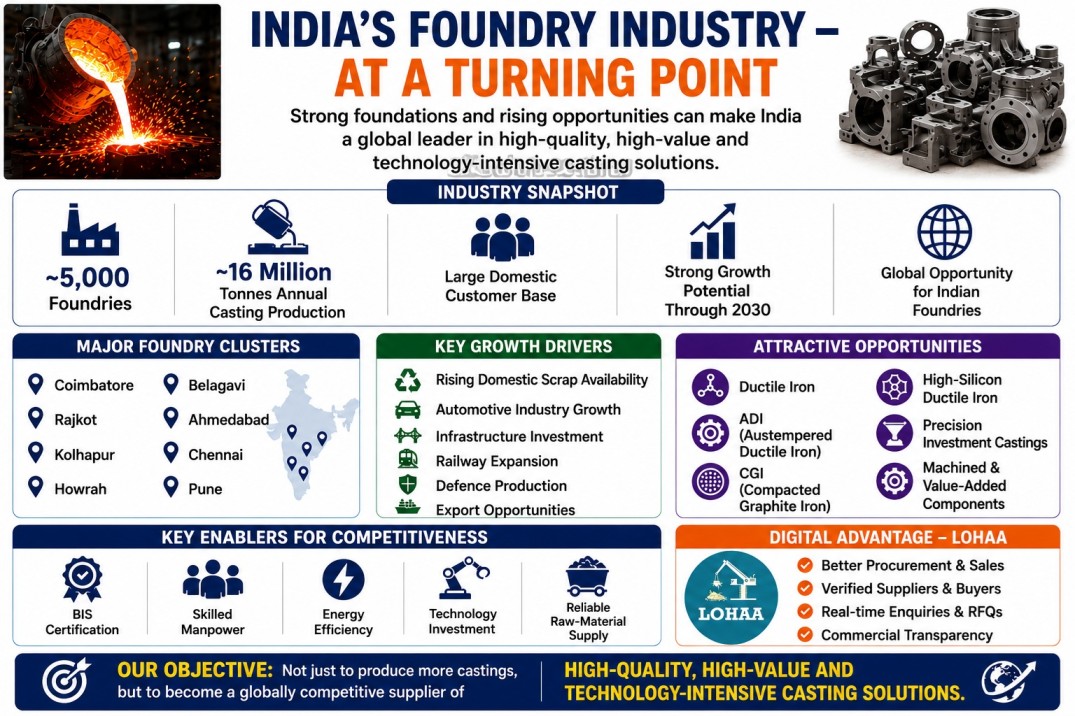
India’s Foundry Revolution: From Castings to Global Leadership
India’s Cast Iron Foundry Industry 2025–2030: Major Foundry Cities, Production, Raw Materials, Scrap, Technology and Global Competitiveness
1. Introduction
India has one of the world's largest and most diversified foundry industries. The sector supplies grey iron, ductile iron, malleable iron, alloy iron, steel and non-ferrous castings to automotive, tractors, agricultural machinery, pumps, valves, compressors, railways, construction equipment, power, mining, defence and general engineering industries.
According to the Indian Institute of Foundrymen (IIF) Foundry Informatics Centre, India produced approximately 15.16 million tonnes of castings in FY2023–24, making India the world's second-largest casting producer after China. The industry comprises approximately 5,000 foundry units, employs around 2 million people directly and indirectly, generates approximately US$21 billion revenue, and exported around US$4.11 billion of castings in FY2023–24. Automotive applications account for the largest end-use segment. (foundryinfo-india.org)
Industry estimates indicate that casting production increased further to approximately 15.8–15.9 million tonnes in FY2024–25. However, city-level production statistics are not published comprehensively by government agencies. Therefore, the city production figures used in this report should be regarded as industry estimates/modelled estimates, based on known cluster size, historical production, installed capacities and company disclosures—not as audited city-level census figures. (ET Edge Insights -)
The Indian foundry industry is entering a transition period. Traditional grey iron castings continue to provide large volumes, but demand is increasingly shifting towards ductile iron, compacted graphite iron, ADI, high-silicon ductile iron, alloy castings, thin-wall automotive castings, precision castings and machined/value-added components.
The opportunity is substantial, but Indian foundries face serious challenges relating to energy costs, skilled manpower, technology adoption, environmental compliance, quality certification, scrap availability, working capital, inconsistent raw-material quality and international competition.
2. India’s Top Ten Foundry Cities / Clusters
India's foundry industry is highly clustered. Major clusters have developed around automobile manufacturers, agricultural machinery, textile machinery, pumps, valves, railways, engineering industries and ports.
a) Coimbatore
- Estimated foundry units: 535–600 Grey iron,
- Major casting products: SG iron, pump, motor and engineering castings
- Estimated 2025 iron/steel casting production: ~0.65 MT
b) Rajkot
- Estimated foundry units: 700–800 Grey iron,
- Major casting products: SG iron, auto, diesel-engine, pump castings
- Estimated 2025 iron/steel casting production: ~0.55 MT
c) Kolhapur
- Estimated foundry units: 250–300
- Major casting products: Automotive, tractor, engineering, SG iron
- Estimated 2025 iron/steel casting production: ~0.55 MT
d) Howrah–Kolkata
- Estimated foundry units: 300–400
- Major casting products: Sanitary, pipes, manhole covers, engineering and steel castings
- Estimated 2025 iron/steel casting production: ~0.45 MT
e) Belagavi
- Estimated foundry units: ~100
- Major casting products: Automotive, tractor, pump and precision castings
- Estimated 2025 iron/steel casting production: ~0.25 MT
f) Ahmedabad
- Estimated foundry units: 200–300
- Major casting products: Automotive, engineering, pump and industrial castings
- Estimated 2025 iron/steel casting production: ~0.25 MT
g) Batala–Jalandhar
- Estimated foundry units: 250–350
- Major casting products: Agricultural machinery, grey iron, machine components
- Estimated 2025 iron/steel casting production: ~0.22 MT
h) Chennai–Sriperumbudur–Hosur
- Estimated foundry units: 150–200
- Major casting products: Automotive, ductile iron and precision castings
- Estimated 2025 iron/steel casting production: ~0.22 MT
i) Pune–Chakan–Aurangabad
- Estimated foundry units: 150–200
- Major casting products: Automotive, commercial vehicles, tractors and engineering
- Estimated 2025 iron/steel casting production: ~0.20 MT
j) Agra
- Estimated foundry units: 150–200
- Major casting products: Grey iron, agricultural and engineering castings
- Estimated 2025 iron/steel casting production: ~0.15 MT
These figures should be used as a market-sizing estimate rather than an official census. IIF identifies Coimbatore, Kolhapur, Belagavi and Rajkot among the country's important clusters, while the Bureau of Energy Efficiency's foundry-cluster programme identifies Ahmedabad, Belagavi, Howrah and Coimbatore as major clusters. (Indian Foundry Association)
Coimbatore is particularly important. BEE's cluster assessment identifies approximately 535 foundries, producing around 2,000 tonnes per day, or approximately 0.6 million tonnes annually. The cluster employs about 10,000 direct and 25,000 indirect workers according to the BEE assessment.
Kolhapur is another exceptionally important centre. A BEE/TERI cluster study estimated approximately 300 MSME foundries producing around 600,000 tonnes of mainly ferrous castings annually, demonstrating the concentration of India's automotive foundry capability in the region. (Sameeeksha)
Rajkot is particularly important for diesel-engine, pump, valve and automotive castings. Historical industrial surveys have identified around 800 engineering units in the wider cluster, including more than 175 investment-casting foundries.
3. City-wise Production Outlook: 2025–2030
The following is an indicative projection for iron and steel castings from the major clusters.
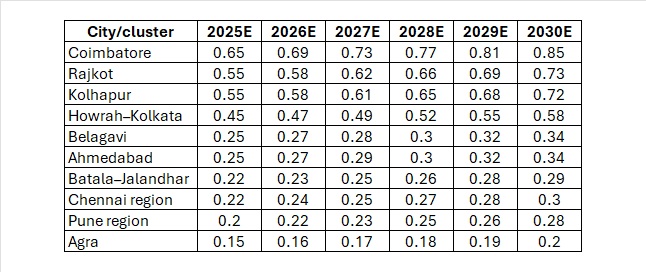 Million tonnes; E = estimate.
The combined output of these ten clusters could therefore rise from approximately 3.44 million tonnes in 2025 to around 4.63 million tonnes by 2030, assuming investment in automation, automotive demand, infrastructure, exports and higher-value castings continues.
4. Why Some Foundry Cities Are Developing Faster
The strongest clusters have several common advantages.
4.1 Proximity to customers
Coimbatore developed around textile machinery, pumps and motors. Kolhapur and Belagavi developed around automotive and engineering industries. Rajkot developed around diesel engines, pumps, agricultural equipment and engineering.
4.2 Supplier ecosystem
A mature cluster provides:
• Pattern makers
• Tool rooms
• Foundry machinery suppliers
• Furnace manufacturers
• Refractory suppliers
• Sand suppliers
• Ferro-alloy dealers
• Heat-treatment companies
• Machining companies
• Testing laboratories
• Scrap dealers
• Transporters
• Exporters
This lowers development costs and improves delivery speed.
4.3 Availability of skilled labour
Foundry knowledge is often transferred between generations. Cities with a long foundry tradition therefore have a stronger pool of moulders, furnace operators, metallurgists, pattern makers, fettling workers and quality personnel.
4.4 Automotive ecosystem
Automotive OEMs and Tier-1 companies create long-term demand for high-volume, repeatable castings. This encourages investment in automatic moulding, robotic pouring, online inspection and machining.
4.5 Port connectivity
Chennai, Mundra, Nhava Sheva/JNPT, Kandla and Kolkata/Haldia provide advantages for importing scrap, alloys and equipment and exporting castings.
5. Segregation of Indian Foundries by Manufacturing Process
Indian foundries use a wide range of processes.
a) Green sand machine moulding
- Typical products: Grey/SG iron, automotive
- Major advantage: High productivity
- Typical users: Automotive, tractors
b) DISA moulding
- Typical products: High-volume precision iron castings
- Major advantage: Automation and dimensional consistency
- Typical users: Automotive
c) High-pressure moulding
- Typical products: Automotive components
- Major advantage: High productivity
- Typical users: OEM suppliers
d) Shell moulding
- Typical products: Small/medium precision parts
- Major advantage: Good surface finish
- Typical users: Auto, pumps
e) No-bake moulding
- Typical products: Large and complex castings
- Major advantage: Flexible mould size
- Typical users: Heavy engineering
f) CO2/sodium silicate
- Typical products: Medium/large castings
- Major advantage: Simple tooling
- Typical users: Engineering
g) Investment casting
- Typical products: Complex, thin-wall parts
- Major advantage: High dimensional accuracy
- Typical users: Aerospace, defence, valves
h) Lost-foam casting
- Typical products: Complex shapes
- Major advantage: Reduced tooling complexity
- Typical users: Automotive/engineering
i) Gravity die casting
- Typical products: Aluminium/non-ferrous
- Major advantage: Repeatability
- Typical users: Automotive
j) Pressure die casting
- Typical products: Aluminium/zinc
- Major advantage: Very high production
- Typical users: Automotive
k) Centrifugal casting
- Typical products: Pipes, sleeves
- Major advantage: Dense structure
- Typical users: Pipes, engineering
l) Sand hand moulding
- Typical products: Low-volume castings
- Major advantage: Low tooling cost
- Typical users: MSMEs
m) 3D sand printing
- Typical products: Complex prototypes
- Major advantage: Tool-less mould production
- Typical users: Advanced engineering
India's transition should increasingly move from labour-intensive hand moulding towards automated moulding, digitally controlled melting, simulation, robotic pouring, automatic fettling, online inspection and digitally traceable production.
BIS itself maintains standards covering foundry materials, practices and steel castings, including organic no-bake binders, mould washes, iron oxide powder, bentonite, exothermic feeding aids and steel casting inspection.
6. Major Raw Materials and Ferro-Alloy Requirements
The principal metallic charge materials for iron foundries are:
a) Pig iron
b) Steel scrap
c) Foundry returns
d) Cast iron scrap
e) Ductile iron returns
f) Sponge iron/DRI in selected applications
g) Ferro-silicon
h) Ferro-manganese
i) Ferro-chrome
j) Ferro-molybdenum
k) Ferro-vanadium
l) Ferro-niobium
m) Ferro-titanium
n) Silicon carbide
o) Graphite/carbon raisers
p) Copper
q) Tin
r) Nickel
s) Magnesium alloys/nodulants
t) Rare-earth inoculants
BEE identifies pig iron, steel, borings, scrap and foundry returns as important base materials and ferro-silicon, ferro-manganese, iron sulphide and silicon carbide as major alloying materials. Copper and tin are used for special grades and SG iron applications.
Major domestic sources
Material Important Indian sources
- Pig iron: Odisha, Chhattisgarh, Jharkhand, Karnataka, West Bengal
- Steel scrap: Automotive hubs, fabrication, demolition, industrial scrap yards
- Foundry returns: Within individual foundry clusters
- Ferro-silicon: Gujarat, Chhattisgarh, Himachal Pradesh and other alloy clusters
- Ferro-manganese: Odisha, Karnataka, Maharashtra and other ferro-alloy centres
- Silicon carbide: Gujarat and imported supply
- Graphite/carbon raiser: Domestic processors plus imports
- Manganese alloys: Chatisgarh, West Bengal, Odisha and Karnataka
- Chromium alloys: Odisha and other ferro-alloy regions
- Nickel/copper/tin: Domestic distributors plus imports
A major advantage of India's foundry clusters is the ability to source most routine materials domestically. However, high-purity speciality alloys and certain inoculants remain dependent on international supply.
7. Imported Foundry Consumables, Scrap and Alloys
India imports several materials because domestic production is either insufficient, inconsistent in quality or unavailable in the required grade.
Imported materials include:
• High-quality shredded scrap
• Heavy melting scrap
• Stainless steel scrap
• Special alloy steel scrap
• Nickel
• High-purity copper
• Tin
• Cobalt
• Molybdenum
• Niobium
• Vanadium
• Titanium
• Special ferro-alloys
• Rare-earth inoculants
• Magnesium treatment alloys
• High-quality carbon raisers
• Special refractory products
• Resin and catalyst systems
• High-performance ceramic filters
• Special coating materials
• Foundry binders
• High-end refractory bricks
The importance of imported ferrous scrap has fluctuated considerably. India imported approximately 11.76 million tonnes of ferrous scrap in calendar 2023, according to S&P Global, while FY2023–24 imports were around 10.09 million tonnes according to BigMint data. FY2024–25 imports were estimated at approximately 8.45 million tonnes. (S&P Global)
8. India's Iron/Ferrous Scrap Generation: 2024–2030
India's domestic ferrous scrap generation is expected to increase as the country's steel stock grows, vehicle population expands and end-of-life vehicles, construction materials and industrial equipment enter the recycling stream.
SteelMint-related estimates have indicated that India's ferrous scrap generation could reach approximately 45 million tonnes by 2030, up substantially from around 27 million tonnes in the earlier base period. (Mysteel)
An indicative projection is (Year Estimated domestic ferrous scrap generation)
- 2024: ~29 MT
- 2025: ~32 MT
- 2026: ~34 MT
- 2027: ~36 MT
- 2028: ~39 MT
- 2029: ~42 MT
- 2030: ~45 MT
The Ministry of Steel's roadmap also highlights the need for a major expansion of scrap collection and processing infrastructure. At a future crude-steel production level of 250 MTPA, India may require 70–80 MTPA of scrap, supported by around 700 large scrap-processing centres and 2,800–3,000 collection/dismantling centres. (Ministry of Steel)
This represents a major opportunity for foundries and metal recyclers.
9. Ferrous Scrap Imports: 2021–2030
Historical numbers differ according to calendar year versus financial year and depending on whether all HS 7204 categories or selected ferrous scrap categories are included. The following table therefore provides a practical market view
- 2021 ~5.0 MT Actual/industry estimate
- 2022 ~8.4 MT Actual/industry estimate
- 2023 11.76 MT Actual
- 2024 ~10.0 MT Actual/industry estimate
- FY2024–25 ~8.45 MT Industry estimate
- 2026 ~8.5 MT Forecast
- 2027 ~9.0 MT Forecast
- 2028 ~9.5 MT Forecast
- 2029 ~10.0 MT Forecast
- 2030 ~10.5 MT Forecast
India's 2021–22 imported scrap consumption was approximately 3.35 million tonnes, compared with 4.20 million tonnes in FY2020–21 in SteelMint's consumption series. Later imports rose sharply, reaching 11.76 million tonnes in calendar 2023. (SteelMint)
The future trajectory will depend on domestic scrap availability, steel production, international scrap prices, freight, currency movements and environmental regulations in exporting countries.
10. Major Destination Ports for Imported Scrap
Important Indian ports for ferrous scrap include:
• Nhava Sheva/JNPT
• Mundra
• Kandla/Deendayal Port
• Hazira
• Chennai
• Kattupalli
• Krishnapatnam
• Visakhapatnam
• Kolkata/Haldia
• Cochin
• Tuticorin
• Ennore
South India has recently increased bulk scrap arrivals. Industry data indicated that Chennai and Visakhapatnam together saw bulk arrivals increase from approximately 21,000 tonnes in FY2023–24 to around 150,000 tonnes in FY2024–25.
For foundries located in Coimbatore, Chennai, Bengaluru, Belagavi and parts of Andhra Pradesh, southern ports can become increasingly important because they reduce inland freight compared with western ports.
11. Top Large Indian Foundry Units/Groups
There is no single public database providing audited 2025 production for every Indian foundry. The following list therefore combines publicly disclosed production/capacity data with 2025 estimated output, and should be treated as a market-ranking reference.
i) Brakes India
- Main Casting Type: Grey Iron / SG Iron
- Approx. MT/month: 12,500+
- Major Location(s): Tamil Nadu, AP, Gujarat
ii) Kirloskar Ferrous Industries (KFIL)
- Main Casting Type: CI / SG Iron
- Approx. MT/month: 12,400
- Major Location(s): Karnataka / Maharashtra
iii) Mahabal Metals / Mahabal Group
- Main Casting Type: CI / SG Iron
- Approx. MT/month: 11,600*
- Major Location(s): Maharashtra
iv) G.P. Iron & Steel / GPI
- Main Casting Type: Grey Iron / SG Iron
- Approx.MT/month: 10,000
- Major Location(s): Kolhapur
v) Nelcast Ltd.
- Main Casting Type: Ductile / Grey Iron
- Approx. MT/month: 9,830
- Major Location(s): AP / Tamil Nadu
vi) Jayaswal Neco Industries – Foundry Division
- Main Casting Type: Iron & Steel Castings
- Approx. MT/month: 11,700
- Major Location(s): Nagpur / Chhattisgarh
vii) Ashok Iron Works
- Main Casting Type: CI / SG Iron
- Approx. MT/month: 12,000
- Major Location(s): Belagavi, Karnataka
viii) Ashok Leyland / Hinduja Foundries operations
- Main Casting Type: Grey Iron / SG Iron
- Approx. MT/month: 6,000+
- Major Location(s): Tamil Nadu
ix) DCM Engineering Products
- Main Casting Type: Grey Iron
- Approx. MT/month: 6,000
- Major Location(s): Rupnagar, Punjab
12. Cost Competitiveness: India vs China, Malaysia, Thailand, Vietnam and Turkey
India remains globally competitive in casting because of relatively low labour costs, a large domestic market, engineering capability and a broad supplier ecosystem. However, the cost advantage is not uniform.
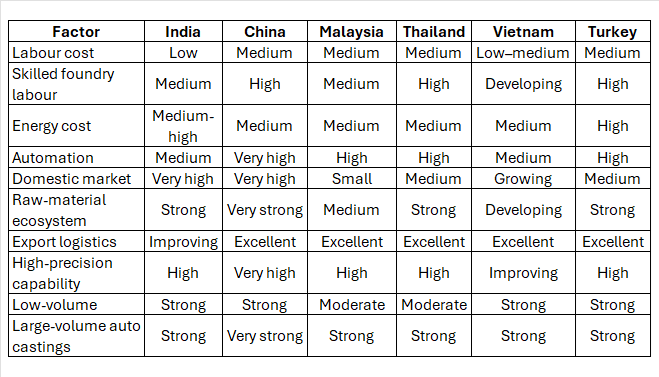
India’s main advantages
• Large domestic automotive market
• Low-to-moderate labour cost
• Established engineering clusters
• Availability of domestic scrap
• Growing automation
• Strong technical manpower
• Competitive machining
• Increasing export orientation
India's disadvantages
• High power costs in some states
• Fragmented MSME structure
• Higher financing costs
• Inconsistent scrap quality
• Lower automation among small units
• Logistics inefficiency
• Environmental compliance costs
• Slow technology adoption
• Skilled-worker shortage
China remains the strongest benchmark for automation, tooling, scale and supply-chain integration. Vietnam is becoming increasingly important for labour-intensive manufacturing and export-oriented supply chains. Thailand has a mature automotive ecosystem. Turkey benefits from geographical proximity to Europe and a strong automotive/engineering base. Malaysia is competitive in selected precision and electronics-related manufacturing.
India's strategic opportunity is to compete not only on casting price but on casting + machining + engineering + quality + delivery + digital traceability.
13. Reasons Behind the Poor Performance of Some Indian Foundries
Despite India's enormous potential, many foundries remain below international productivity standards.
13.1 Fragmentation
A large proportion of foundries are MSMEs. IIF estimates approximately 5,000 units nationally, while the industry remains dominated by smaller companies. (foundryinfo-india.org)
13.2 Outdated technology
Many smaller foundries continue to depend on:
• Manual moulding
• Manual pouring
• Old cupolas
• Low-efficiency induction furnaces
• Manual fettling
• Limited process automation
13.3 Energy costs
Melting is the most energy-intensive operation. Poor furnace efficiency, power-quality issues, transformer losses and inadequate process control can significantly increase conversion costs.
13.4 Working capital
Foundries must finance:
• Scrap
• Pig iron
• Ferro-alloys
• Sand
• Binders
• Refractories
• Patterns
• Tooling
• WIP
• Finished inventory
Delayed customer payments can therefore create severe liquidity pressure.
13.5 Rejection rates
Poor control over charge chemistry, sand properties, temperature, inoculation, nodularisation and mould parameters increases rejection.
13.6 Lack of product development
Many MSMEs operate primarily as jobbing foundries and depend on customer drawings rather than developing proprietary casting solutions.
14. Availability of Manpower
Manpower is becoming one of the most serious constraints.
IIF estimates approximately 2 million direct and indirect employment opportunities in India's foundry industry, including approximately 500,000 direct workers. (foundryinfo-india.org)
The problem is not simply a shortage of workers. The major problem is the shortage of trained foundry workers.
Critical skill shortages include:
• Metallurgists
• Foundry process engineers
• Pattern designers
• CAD/CAM engineers
• Moulding-machine operators
• Furnace operators
• Quality inspectors
• Spectrometer operators
• CNC programmers
• Maintenance engineers
• Simulation engineers
• Automation engineers
The next generation of foundries will therefore require fewer unskilled workers and more technically trained personnel capable of operating automated systems.
15. Importance of BIS Certification and Constraints
BIS certification is increasingly important for castings used in regulated or safety-critical applications.
The Cast Iron Products (Quality Control) Order, 2024 requires specified cast iron products to conform to relevant Indian Standards and carry the BIS Standard Mark under the applicable conformity-assessment scheme. The order covers products including cast iron manhole covers and frames, drainage pipes and fittings and other specified cast iron products. (Bureau of Indian Standards)
For example, BIS has standards covering grey cast iron, foundry materials and steel castings. BIS also highlights IS 210 for grey cast iron castings and provides testing guidance covering tensile strength, hardness and microstructure. (YouTube)
Major certification constraints
a) Cost of testing
b) Laboratory infrastructure
c) Documentation
d) Process control requirements
e) Traceability
f) Calibration
g) Periodic inspection
h) Product-specific testing
i) Skilled quality personnel
j) Small-unit compliance burden
For small foundries, the cost is not necessarily the only obstacle. The bigger challenge is creating a repeatable manufacturing process capable of consistently meeting the standard.
16. Constraints to Developing New-Generation Alloy Castings
Future growth will depend on moving from conventional grey iron towards:
• ADI
• High-Si ductile iron
• CGI
• Ni-resist iron
• Alloyed ductile iron
• Heat-resistant cast iron
• Wear-resistant cast iron
• High-chrome cast iron
• Lightweight alloy castings
• Aluminium-silicon alloys
• Magnesium alloys
• Nickel-based cast alloys
• Superalloys
• Special stainless-steel castings
Major constraints
- Technology: Advanced alloys require accurate chemistry and thermal control.
- Equipment: Heat treatment, vacuum systems, advanced furnaces and sophisticated testing equipment increase capital expenditure.
- Raw materials: High-purity alloying elements can be expensive and import-dependent.
- Market size: Customers may not initially accept the higher price of advanced grades.
- Testing: Advanced alloys require metallography, spectroscopy, mechanical testing, fatigue testing and sometimes non-destructive testing.
- Manpower: Metallurgical expertise is more difficult to recruit than conventional foundry labour.
17. SWOT Analysis – Indian Foundry Industry
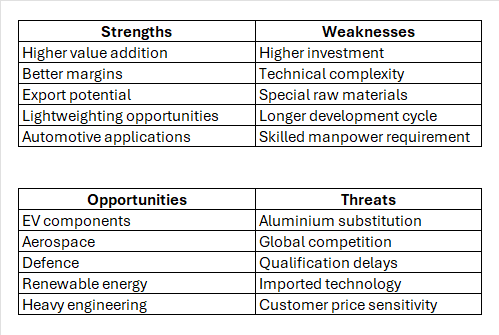
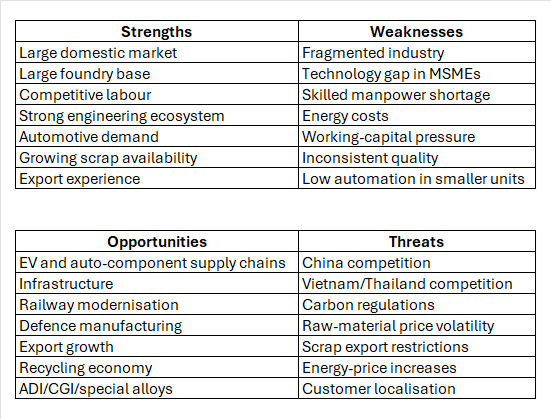 18. SWOT Analysis – New-Generation Alloy Castings
 19. Usage of LOHAA Mobile Application of Android and iPhone / Portal for Minor ferro alloys Commercial Transactions
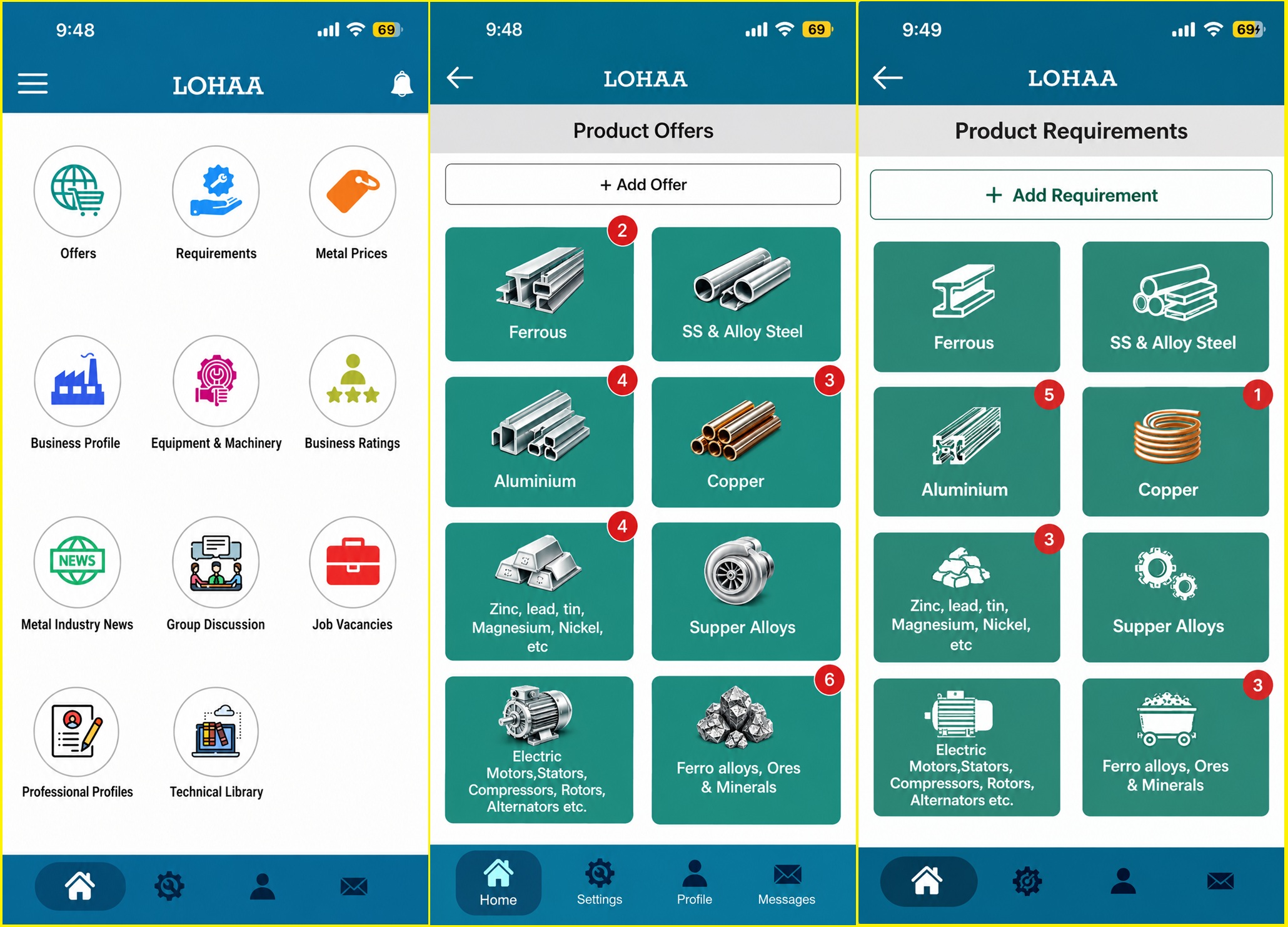 The Indian foundry industry remains highly fragmented. One of its major commercial challenges is discovering reliable suppliers and customers for scrap, pig iron, ferro-alloys, machinery, consumables and finished castings.
This creates a strong opportunity for LOHAA Mobile, a KYC-verified B2B digital trading platform for the metal industry.
LOHAA can support foundries in several areas:
Buying
Foundries can publish requirements for:
• Cast iron scrap
• Steel scrap
• Pig iron
• Ferro-silicon
• Ferro-manganese
• Ferro-chrome
• Silicon carbide
• Graphite
• Copper
• Tin
• Nickel
• Refractories
• Foundry consumables
Selling
Foundries can publish offers for:
• Grey iron castings
• Ductile iron castings
• SG iron components
• Alloy castings
• Machine-moulded castings
• Investment castings
• Foundry returns
• Excess raw materials
• Scrap
• Used machinery
Machinery trading
LOHAA can also connect foundries with buyers and sellers of:
• Induction furnaces
• Transformers
• Moulding machines
• DISA lines
• Shot-blasting machines
• Core-making machines
• Sand reclamation systems
• CNC machines
• Fettling equipment
• Testing equipment
The KYC-based structure is particularly valuable because foundry transactions often involve large quantities and significant credit exposure.
A digital platform can reduce the time required to identify suppliers, compare commercial offers, discover new customers and expand beyond local clusters.
20. Recommended Strategy for Developing Indian Foundry Cities
India should consider developing specialised Foundry Manufacturing Zones around existing clusters.
i) Coimbatore: Focus on pump, valve, textile machinery, automotive and precision castings.
ii) Rajkot: Focus on diesel engines, agricultural equipment, pumps, valves and investment castings.
iii) Kolhapur: Focus on automotive, tractor, construction-equipment and ADI castings.
iv) Belagavi: Focus on automotive, precision engineering and export castings.
v) Howrah: Modernise traditional foundries and move towards automated moulding and higher-value castings.
vi) Ahmedabad: Develop automotive, engineering and specialised alloy casting capability.
vii) Chennai region: Develop export-oriented automotive and high-precision ductile iron casting capacity.
viii) Pune region: Develop automotive, EV, commercial-vehicle and heavy-engineering castings.
The cluster-development model should include a common testing laboratory, sand reclamation plant, scrap-processing centre, common effluent treatment facility, training centre, pattern/tooling centre, logistics hub and digital marketplace.
21. Strategic Priorities for 2026–2030
Indian foundries should concentrate on ten priorities:
• Automation of moulding and pouring
• Energy-efficient induction furnaces
• Digital furnace control
• Sand reclamation
• Simulation-led casting design
• Robotic fettling
• Advanced metallurgical laboratories
• Development of ADI/CGI/high-Si ductile iron
• Export-oriented quality certification
• Digital B2B procurement and sales
The most important transformation will be from a traditional "melting and casting" business into an engineering-led casting solutions business.
22. Key Market Indicators (2023–24 / Current reference)
Indian Foundry Industry – Key Indicators
Indicator 2023–24 / Current reference
- Casting production: ~15.16 MT
- Estimated 2024–25 production ~15.8–15.9 MT
- Foundry units ~5,000
- Direct + indirect employment ~2 million
- Direct employment ~0.5 million
- Revenue ~US$21 billion
- Casting exports ~US$4.11 billion
- Global ranking No. 2
- Largest customer segment Automotive
- Major casting types Grey, ductile, steel, malleable, non-ferrous
Sources: IIF Foundry Informatics Centre and industry reports. (foundryinfo-india.org)
Indicative Growth Areas (2026–30 outlook)
- Grey iron: Moderate
- Ductile iron: High
- ADI: Very high
- CGI: High
- Automotive castings: High
- EV-related castings: High but selective
- Pumps/valves: High
- Railways: High
- Defence: High
- Aerospace: Very high
- Investment casting: Very high
Traditional low-value castings Low/moderate
23. Conclusion
India's foundry industry is at an important turning point. The country already has approximately 5,000 foundries, annual casting production of nearly 16 million tonnes and a large domestic customer base. The major clusters of Coimbatore, Rajkot, Kolhapur, Howrah, Belagavi, Ahmedabad, Chennai and Pune provide an excellent foundation for future growth. However, the industry must move away from low-value, labour-intensive production towards automated, digitally controlled and engineering-driven manufacturing.
Rising domestic scrap availability, automotive growth, infrastructure investment, railway expansion, defence production and export opportunities can support strong growth through 2030. The most attractive opportunities are ductile iron, ADI, CGI, high-silicon ductile iron, precision investment castings and machined value-added components. BIS certification, skilled manpower, energy efficiency, technology investment and reliable raw-material supply will determine competitiveness. Digital platforms such as LOHAA Mobile can further improve procurement, sales, supplier discovery and commercial transparency. India's objective should be not merely to produce more castings, but to become a globally competitive supplier of high-quality, high-value and technology-intensive casting solutions.
References
1. Indian Institute of Foundrymen – Foundry Informatics Centre, Profile of Indian Foundry Industry. (foundryinfo-india.org)
2. Bureau of Energy Efficiency – Indian Foundry Cluster Studies.
3. Bureau of Indian Standards – Cast Iron Products (Quality Control) Order, 2024. (Bureau of Indian Standards)
4. Bureau of Indian Standards – Foundry and Steel Castings Sectional Committee. (Bureau of Indian Standards)
5. Ministry of Steel – Greening the Steel Sector in India: Roadmap and Action Plan. (Ministry of Steel)
6. S&P Global Commodity Insights – India's Circular Economy Goals: Spotlight on Ferrous Scrap. (S&P Global)
7. BigMint/SteelMint – Indian ferrous scrap market and import studies. (SteelMint)
8. Brakes India – Metal Castings Business Unit. (Brakes India)
9. Nelcast – Manufacturing facilities and casting capabilities. (Nelcast)
10. Kirloskar Ferrous Industries – Investor/management disclosures. (Kirloskar Ferrous)
11. Texmaco Rail & Engineering – Steel Foundry Business. (Texmaco)
12. Foundry cluster and technology studies published by BEE/TERI and other industry institutions. (Sameeeksha)
By using digital trade platforms like LOHAA Mobile application, you can reach global buyers, source quality material, and strengthen long-term partnerships.
Download the Lohaa Metal Trading App for Android to access live scrap prices and real-time market updates anytime, anywhere.
Download the Lohaa Metal Trading App for iOS to access live scrap prices and real-time market updates anytime, anywhere.
(Notes: market and production volume estimates are synthesized from public market reports and industrial press; exact tonne figures for materials are not centrally published in a single comprehensive public dataset, therefore the numeric projection above is a conservative, documented estimate built from available intelligence and reasonable regional share assumptions.)


