
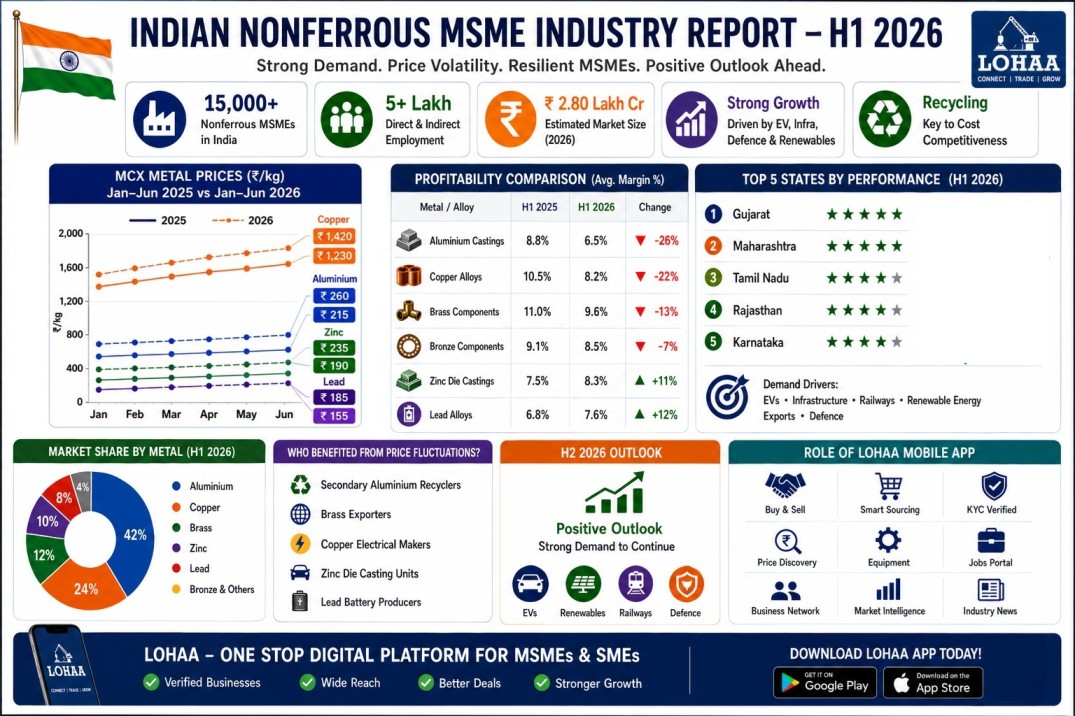
H1 2026 Indian Nonferrous MSME Analysis
1. Executive Summary
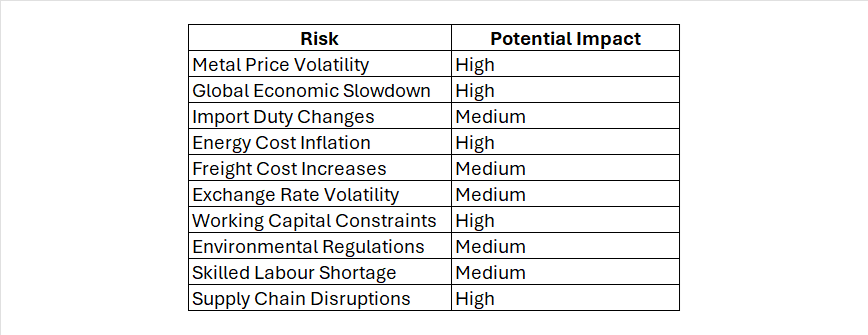
India's nonferrous MSME sector remained resilient during the first half of 2026 despite one of the most volatile commodity markets in recent years. Sharp fluctuations in aluminium, copper, zinc and lead prices created significant procurement challenges for manufacturers. Rising energy costs, elevated freight charges, higher working capital requirements and geopolitical uncertainties also affected profitability.
Nevertheless, robust domestic demand from infrastructure, renewable energy, defence, railways, automobiles and electric vehicles (EVs) supported production activity. Companies engaged in secondary aluminium recycling, brass exports, copper electrical components and value-added engineering products generally outperformed commodity-based manufacturers.
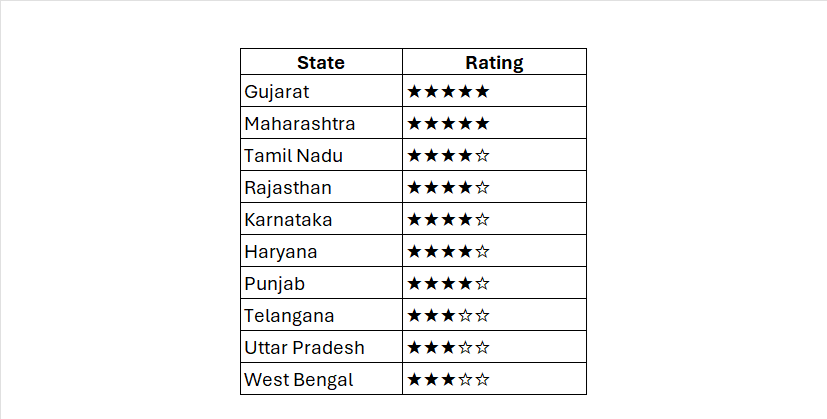
Regional performance varied considerably. Gujarat continued to lead due to its strong export ecosystem and brass manufacturing cluster, while Maharashtra, Tamil Nadu, Karnataka and Rajasthan benefited from diversified industrial bases. MSMEs adopting digital procurement platforms, inventory optimization, automation and recycling were better positioned to manage price volatility.
The outlook for H2 2026 remains cautiously optimistic, supported by government infrastructure spending, industrial growth and increasing emphasis on circular economy initiatives.
2. Introduction
The Indian nonferrous metal industry is one of the country's most dynamic manufacturing sectors, supplying essential materials to automotive, electrical equipment, renewable energy, aerospace, defence, construction, railways and consumer goods industries.
Thousands of Micro, Small and Medium Enterprises (MSMEs) form the backbone of this ecosystem by producing aluminium castings, copper and brass components, zinc die-cast products, lead alloys, bronze bearings, extrusions and recycled metals.
During the first half of 2026, the industry operated in a complex environment characterized by volatile global metal prices, changing trade policies, currency fluctuations and evolving customer demand. Unlike integrated primary metal producers, most MSMEs depend heavily on imported scrap, recycled metals and secondary raw materials.
Consequently, fluctuations in the London Metal Exchange (LME) and domestic markets directly influenced their manufacturing costs and profitability.
Despite these challenges, India's strong domestic demand, government-led infrastructure investments, expansion of electric vehicle manufacturing, defence modernization and renewable energy projects created new opportunities. This report examines how Indian nonferrous MSMEs performed during H1 2026 compared with H1 2025, identifies the sectors that benefited from price movements, and evaluates future growth prospects.
3. Indian Nonferrous MSME Industry Overview
India has more than 15,000 nonferrous MSMEs engaged in manufacturing and recycling activities. The sector contributes significantly to employment, exports and domestic manufacturing.
Major Product Categories
• Aluminium Castings
• Pressure Die Castings
• Gravity Die Castings
• Aluminium Extrusions
• Copper Components
• Brass Components
• Bronze Bearings
• Zinc Die Castings
• Lead Alloys
• Secondary Aluminium
• Nonferrous Scrap Recycling
Key End-Use Industries
• Automobile
• Electric Vehicles
• Electrical Equipment
• Railways
• Defence
• Renewable Energy
• Infrastructure
• Construction
• Consumer Durables
• Aerospace
Industry Highlights

4. H1 2026 Industry Survey
The first half of 2026 witnessed mixed performance across India's nonferrous MSME landscape.
Positive Developments
• Strong infrastructure spending by the Government of India.
• Rising demand from EV and battery manufacturers.
• Growth in railway modernization projects.
• Expansion in renewable energy installations.
• Increasing exports of engineering products.
Major Challenges
• Volatile aluminium and copper prices.
• Higher imported scrap costs.
• Rising electricity tariffs.
• Working capital constraints.
• Fluctuating freight charges.
• Intense price competition.
Industry Sentiment Overall, manufacturers with efficient procurement systems, recycling operations and value-added product portfolios demonstrated greater resilience.
5. H1 2025 vs H1 2026 Profitability Comparison
Metal price volatility directly affected profitability across different alloy segments.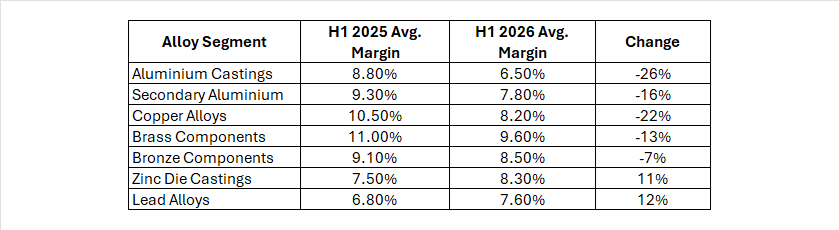 Key Findings
• Aluminium foundries experienced the largest decline in profitability due to volatile raw material prices and energy costs.
• Copper alloy manufacturers faced higher working capital requirements because of elevated copper prices.
• Brass exporters remained relatively profitable due to strong international demand.
• Zinc and lead alloy manufacturers benefited from stable domestic demand in automotive hardware and battery sectors.
6. Aluminium Industry Analysis
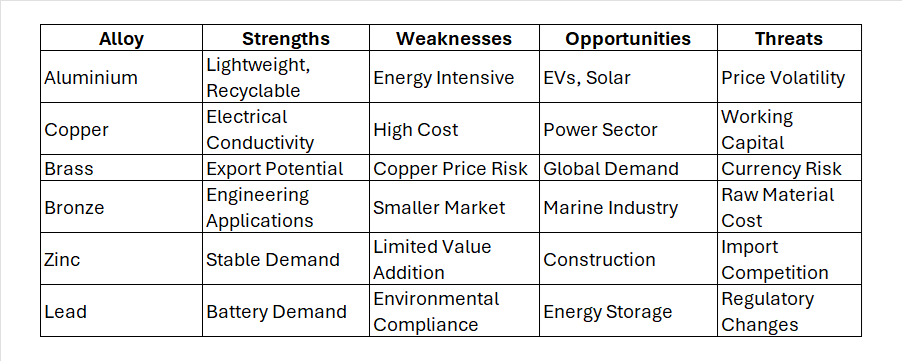
Aluminium remained one of the most important nonferrous metals for Indian MSMEs, serving sectors such as automotive, transportation, construction, electrical equipment, packaging and renewable energy.
Strengths
• High recyclability.
• Lightweight properties.
• Growing EV applications.
• Expanding railway projects.
• Strong demand from solar and infrastructure sectors.
Major Challenges
• Sharp fluctuations in aluminium prices.
• Higher electricity consumption during melting.
• Imported scrap availability issues.
• Rising logistics costs.
• Margin pressure in commodity-grade castings.
Opportunities
• Electric vehicle manufacturing.
• Battery enclosures.
• Renewable energy infrastructure.
• Aerospace components.
• Circular economy through aluminium recycling.
Overall Assessment
Although primary aluminium price volatility compressed margins, manufacturers producing precision castings, automotive components and recycled aluminium products continued to perform relatively well due to sustained customer demand.
7. Copper Industry Analysis
Copper remained a strategic metal because of increasing investments in power transmission, renewable energy, electric vehicles and electronics manufacturing.
Positive Factors
• Strong demand for transformers and switchgear.
• Rapid growth in renewable energy projects.
• Expansion of EV charging infrastructure.
• Government investment in power transmission.
Challenges
• Historically high copper prices.
• Increased financing requirements.
• Working capital pressure.
• Reduced flexibility in long-term contracts.
Profitability Outlook
Copper component manufacturers supplying electrical equipment and infrastructure projects generally maintained healthy order books despite compressed margins caused by higher raw material costs.
8. Zinc Industry Analysis
Zinc-based MSMEs benefited from relatively stable demand throughout H1 2026.
Key Applications
• Die-cast automotive components.
• Hardware.
• Electrical accessories.
• Construction fittings.
• Consumer appliances.
Market Trends
Compared with aluminium and copper, zinc prices were comparatively stable, allowing manufacturers to maintain better pricing discipline. The automotive recovery and infrastructure investments supported demand for zinc die-cast products.
9. Lead Industry Analysis
Lead alloy manufacturers experienced improving business conditions due to sustained battery demand.
Demand Drivers
• Automotive batteries.
• UPS systems.
• Telecom backup power.
• Industrial batteries.
• Energy storage systems.
Industry Challenges
• Environmental compliance.
• Volatility in lead prices.
• Recycling regulations.
• Higher compliance costs.
Market Outlook
Lead alloy manufacturers supplying battery producers generally recorded improved profitability during H1 2026, supported by consistent replacement demand and growth in industrial energy storage applications
10. Brass & Bronze Industry Analysis
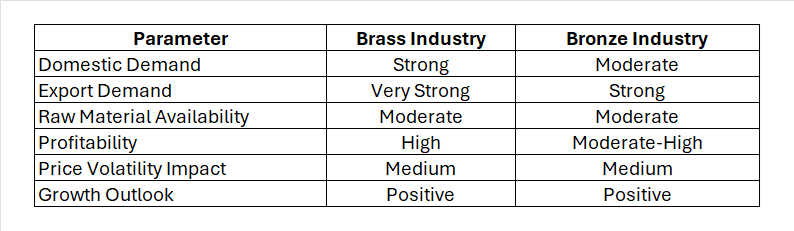
Brass and bronze MSMEs remained among the most resilient segments of India's nonferrous industry during H1 2026. Unlike primary metal producers, many manufacturers in these sectors operate with higher value-added products, including precision-engineered components, plumbing fittings, electrical accessories, bearings, marine components, decorative hardware and export-oriented engineering goods. Their ability to pass a portion of raw material cost increases to customers helped preserve margins despite volatile copper prices.
India continues to be one of the world's leading exporters of brass components, with the Jamnagar cluster in Gujarat serving as the country's principal manufacturing hub. Strong export demand from Europe, North America and the Middle East supported production, while domestic demand from electrical, plumbing and industrial machinery sectors remained stable.
Industry Performance – H1 2026
 Major Growth Drivers
• Export demand for precision brass components
• Electrical and electronics manufacturing
• Smart city infrastructure projects
• Plumbing and sanitary hardware
• Renewable energy equipment
• Marine engineering applications
Major Challenges
• Copper price volatility
• Higher working capital requirements
• Imported scrap availability
• Energy costs
• Skilled labour shortage
Overall Assessment
Brass manufacturers achieved relatively stronger profitability than aluminium foundries because of higher value addition, export orientation and better pricing power. Bronze manufacturers supplying bearings, pumps and marine industries also maintained healthy order books.
11. Regional Analysis (10 Major States)
The performance of India's nonferrous MSMEs varied significantly across regions depending on industrial infrastructure, access to raw materials, export capability, logistics and customer industries. Gujarat
• India's largest brass manufacturing cluster.
• Strong export infrastructure.
• Better logistics.
• High profitability.
Maharashtra
• Large automotive ecosystem.
• Strong aluminium and die-casting industries.
• Stable domestic demand.
Tamil Nadu
• EV manufacturing growth.
• Auto component expansion.
• Precision casting investments.
Karnataka
• Aerospace and defence demand.
• High-value engineering products.
Rajasthan
• Copper and zinc ecosystem.
• Mining proximity.
• Lower transportation costs.
Uttar Pradesh
• Large number of MSMEs.
• Labour availability.
• Higher competition reduced margins.
Punjab
• Strong electrical equipment manufacturing.
• Healthy export opportunities.
Haryana
• Automotive manufacturing cluster.
• Strong OEM demand.
Telangana
• Growing engineering industries.
• Emerging aluminium casting hub.
West Bengal
• Secondary lead and copper recycling.
• Logistics challenges affected profitability.
12. Regional SWOT Analysis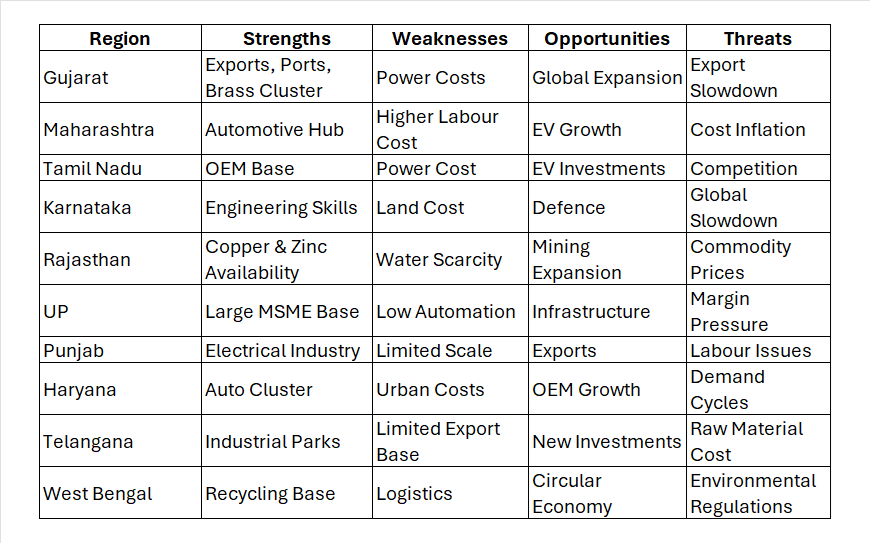 13. Alloy-wise SWOT Analysis
 14. Who Benefited from Price Fluctuations?
Price volatility created both winners and losers across the nonferrous MSME ecosystem.
Major Beneficiaries
a). Secondary Aluminium Recyclers
• Purchased scrap strategically.
• Better inventory management.
• Lower dependence on primary aluminium.
b). Brass Exporters
• Benefited from higher export prices.
• Better currency realization.
c). Copper Electrical Component Manufacturers
• Long-term contracts.
• Infrastructure demand remained strong.
d). Zinc Die Casting Units
• Stable zinc prices.
• Automotive recovery.
e). Lead Alloy Manufacturers
• Rising battery demand.
• Industrial backup power systems.
f). Precision Engineering MSMEs
• Higher value-added products.
• Better pricing flexibility.
g). Renewable Energy Suppliers
• Increased aluminium and copper consumption.
h). Railway Component Manufacturers
• Government infrastructure spending.
i). Defence Component Suppliers
• Rising indigenous procurement.
j). Digital Procurement Companies
• Improved sourcing efficiency reduced procurement costs.
15. Top 10 Profitable MSME Segments (H1 2026)
Note: Public financial data for most Indian MSMEs is not available. Therefore, the following ranking represents industry segments rather than individual companies.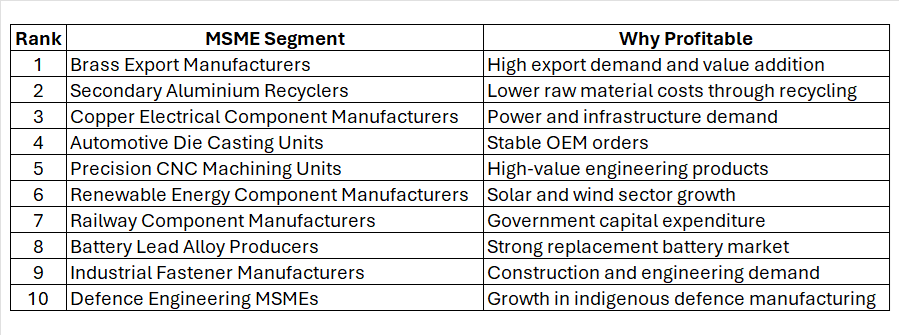 Key Reasons Behind Higher Profitability
• Greater value addition instead of commodity manufacturing.
• Export-oriented product mix.
• Adoption of automation and CNC machining.
• Strong customer diversification.
• Long-term supply contracts with OEMs.
• Better inventory and risk management.
• Increased use of recycled raw materials.
• Higher operational efficiency and quality standards.
• Faster digital procurement and sourcing.
• Ability to pass on part of raw material cost increases to customers.
Key Takeaways
• Brass and bronze manufacturers remained among the strongest-performing nonferrous MSME segments due to export demand and higher value addition.
• Gujarat, Maharashtra, Tamil Nadu and Rajasthan led regional performance because of established industrial ecosystems and export infrastructure.
• Recycling, precision engineering and export-oriented businesses were the primary beneficiaries of metal price volatility.
• MSMEs that invested in automation, diversified sourcing and efficient inventory management generally outperformed those focused on commodity-grade products.
16. Role of the LOHAA Mobile Application for MSMEs & SMEs
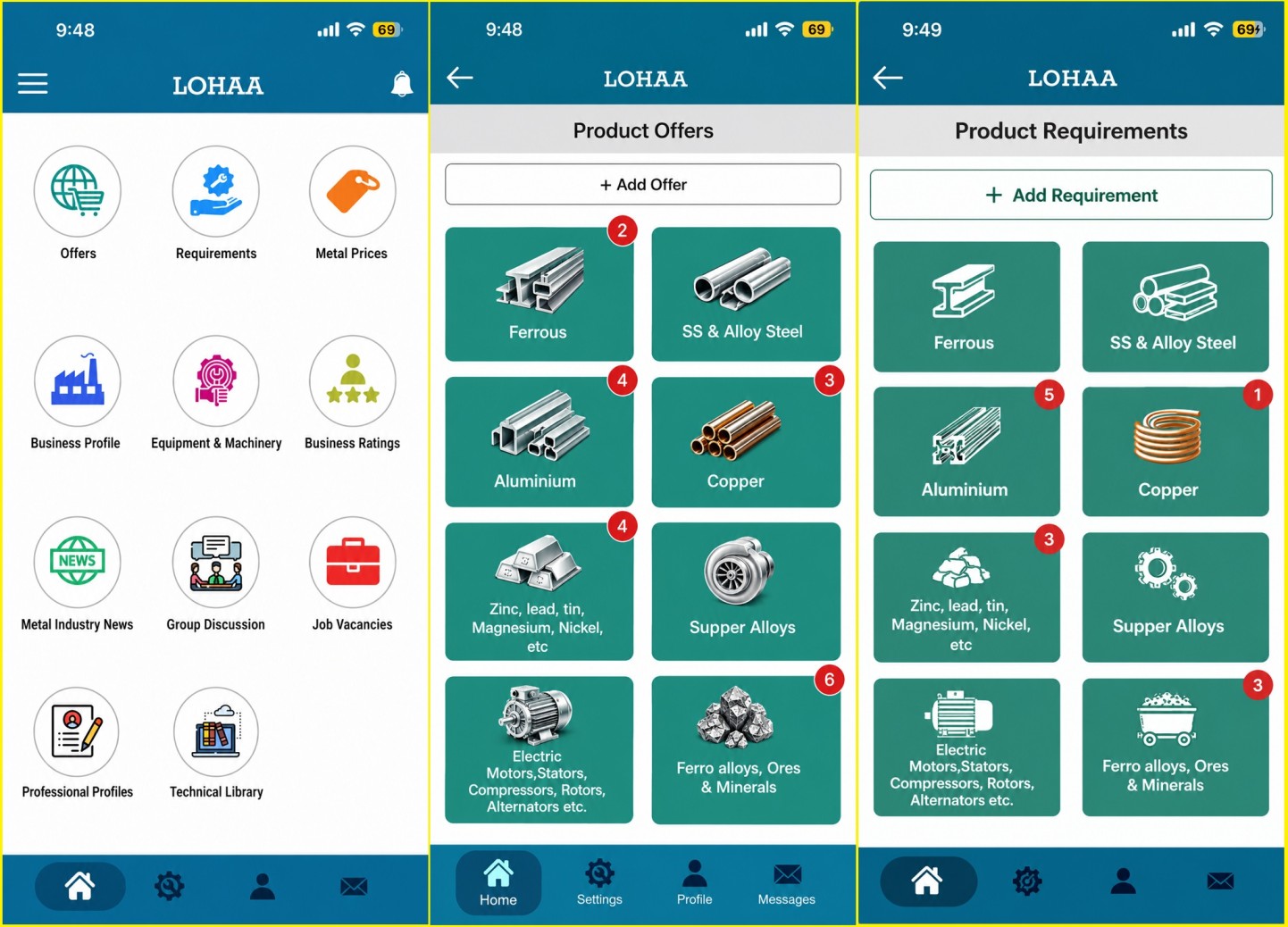
Digital transformation is becoming an essential driver of competitiveness for India's nonferrous MSMEs. Many enterprises continue to face challenges in sourcing quality raw materials, identifying reliable buyers, comparing market prices, finding machinery, recruiting skilled manpower and accessing timely industry information. The LOHAA Mobile Application of Android and iPhone addresses these challenges by bringing buyers, sellers, recyclers, manufacturers, importers and exporters onto a single digital platform.
How LOHAA Supports MSMEs & SMEs
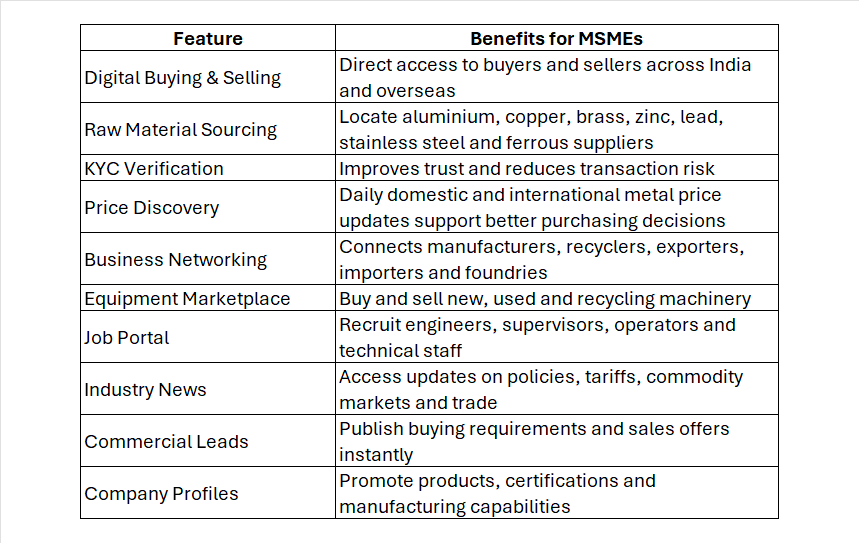
Benefits to Nonferrous MSMEs
- • Lower procurement costs through wider supplier access.
• Faster sourcing of metal scrap and alloys.
• Improved customer acquisition through verified business listings.
• Greater transparency in pricing and market trends.
• Reduced dependence on intermediaries.
• Enhanced visibility in domestic and export markets.
• Easier access to recycling equipment and industrial machinery.
• Improved business credibility through KYC verification.
LOHAA supports the Government of India's Digital India, Make in India, and MSME competitiveness initiatives by enabling secure digital commerce and industry networking.
17. Professional Tables
a) Estimated Market Size by Metal (H1 2026)
- Aluminium: 42%
- Copper: 24%
- Brass: 12%
- Zinc: 10%
- Lead: 8%
- Bronze & Others: 4%
b) Regional Performance
State Rating
 c) Major End-User Industries
Industry Demand Trend
- Automobile: Strong
- Electric Vehicles: Very Strong
- Railways: Strong
- Infrastructure: Strong
- Renewable Energy Very Strong
- Electrical Equipment Strong
- Construction Moderate
- Defence Very Strong
d) Major Cost Drivers
Cost Component Impact
- Raw Materials Very High
- Power High
- Freight High
- Labour Medium
- Finance Cost Medium
- Compliance Medium
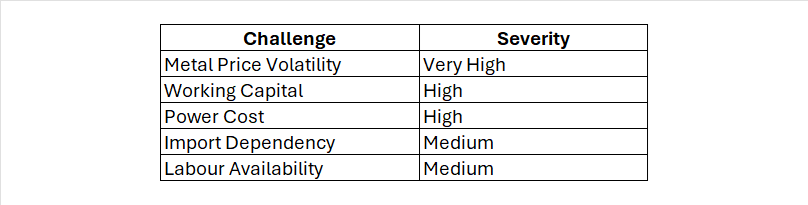
e). Manufacturing Challenges
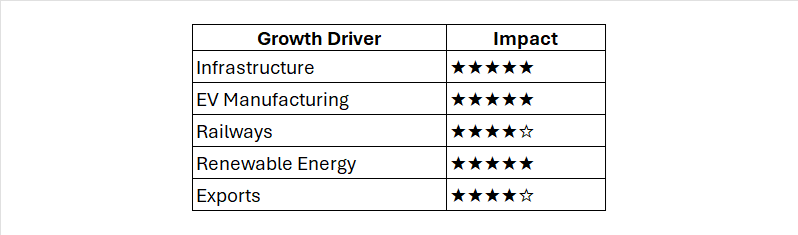
f). H1 2026 Growth Drivers
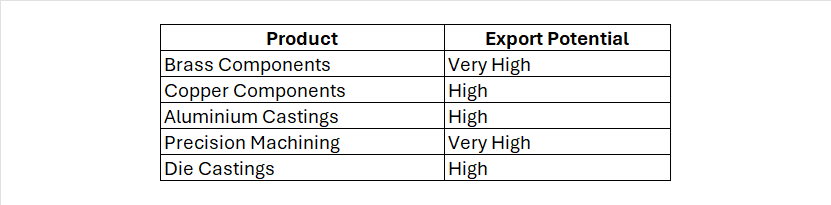
 g): Export-Oriented Segments
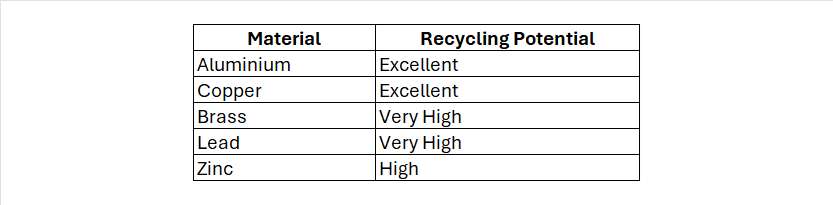
 h) Recycling Opportunities
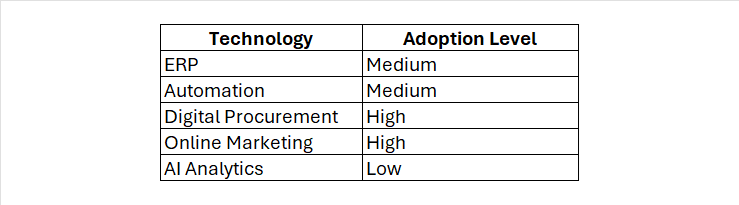
 h): Digital Adoption
i): H2 2026 Outlook

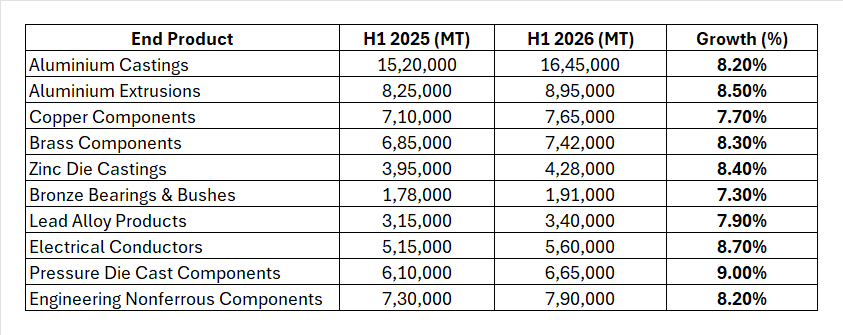
j). Production by Major Nonferrous End Products (H1 2025 vs H1 2026)
 19. H2 2026 Forecast
The second half of 2026 is expected to remain favorable for India's nonferrous MSME sector, although commodity price volatility and geopolitical developments will continue to influence costs.
Expected Market Outlook
Segment Forecast
- Domestic Demand: Strong
- Exports: Improving
- Infrastructure: Strong
- EV Manufacturing: Very Strong
- Renewable Energy: Strong
- Profitability: Moderately Positive
Industry Expectations
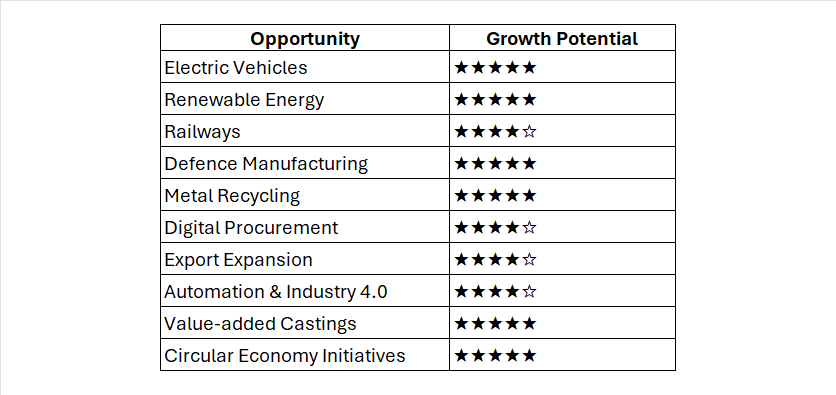
• Continued growth in EV production will increase demand for aluminium and copper components.
• Renewable energy installations will support aluminium extrusions, copper conductors and fabricated products.
• Railway modernization and defence procurement are expected to generate sustained orders.
• Recycling is likely to gain further importance as manufacturers seek to reduce raw material costs.
• Digital procurement and supply-chain platforms will improve sourcing efficiency and market access.
20. Key Opportunities
 21. Major Risks
 22. Conclusion
The Indian nonferrous MSME industry demonstrated resilience during H1 2026 despite significant raw material price volatility and rising operating costs. Strong demand from automobiles, electric vehicles, renewable energy, railways, defence and infrastructure supported production, while export-oriented segments such as brass components and precision engineering products maintained healthy performance.
Regional clusters in Gujarat, Maharashtra, Tamil Nadu and Rajasthan continued to lead due to strong industrial ecosystems, export infrastructure and diversified manufacturing capabilities. MSMEs that adopted recycling, automation, value-added manufacturing and digital procurement strategies generally achieved better profitability than businesses focused on commodity-grade products.
Digital platforms such as the LOHAA Mobile Application can further strengthen the sector by enabling verified sourcing, business networking, market intelligence, equipment trading and wider market access. As India advances its manufacturing and sustainability goals, digitally connected and technologically upgraded MSMEs are well positioned to capture opportunities in both domestic and global markets.
23. References
1. Ministry of Micro, Small and Medium Enterprises (MSME), Government of India.
2. Ministry of Commerce & Industry, Government of India.
3. Ministry of Mines, Government of India.
4. Ministry of Heavy Industries, Government of India.
5. Directorate General of Commercial Intelligence and Statistics (DGCIS).
6. Bureau of Indian Standards (BIS).
7. World Bureau of Metal Statistics (WBMS).
8. International Aluminium Institute (IAI).
9. International Copper Study Group (ICSG).
10. International Lead and Zinc Study Group (ILZSG).
11. World Steel Association (industry context).
12. London Metal Exchange (LME).
13. Multi Commodity Exchange of India (MCX).
14. Reserve Bank of India (RBI).
15. Office of the Economic Adviser, Department for Promotion of Industry and Internal Trade (DPIIT) – Wholesale Price Index (WPI).
By using digital trade platforms like LOHAA Mobile application, you can reach global buyers, source quality material, and strengthen long-term partnerships.
Download the Lohaa Metal Trading App for Android to access live scrap prices and real-time market updates anytime, anywhere.
Download the Lohaa Metal Trading App for iOS to access live scrap prices and real-time market updates anytime, anywhere.
(Notes: market and production volume estimates are synthesized from public market reports and industrial press; exact tonne figures for materials are not centrally published in a single comprehensive public dataset, therefore the numeric projection above is a conservative, documented estimate built from available intelligence and reasonable regional share assumptions.)


