
India Secondary Aluminium Six month outlook from October 2026
India’s Secondary Aluminium Ingot Six-month outlook: October 2026–April 2027
1. Introduction
India’s secondary aluminium ingot industry has opportunities in automotive components, engineering castings, appliances and industrial equipment. However, manufacturers face a central challenge: securing suitable scrap at prices that leave a sustainable conversion margin.
The next six months will favour manufacturers with reliable suppliers, controlled metal recovery, consistent alloy chemistry and disciplined working capital. Expanding furnace capacity without securing feedstock and customers could increase financial pressure.
This article focuses on aluminium; the steel references in the requested outline have been interpreted accordingly.
2. Six-Month Outlook: How Will Manufacturers Survive?
The following scenarios are an analytical outlook, not a numerical market forecast.
a. Base case
- Operating conditions: Demand continues; scrap remains competitive
- Likely implication: Selective production and frequent repricing
b. Upside
- Operating conditions: Better scrap availability and customer orders
- Likely implication: Higher utilisation and improved margins
c. Downside
- Operating conditions: Freight disruption, expensive scrap or delayed collections
- Likely implication: Working-capital stress and production cuts
Manufacturers should monitor the scrap-to-ingot conversion margin, rather than aluminium prices alone. Rising ingot prices provide limited relief when scrap, fuel and financing costs rise faster.
3. Why Is Aluminium Scrap in Short Supply?
India’s growing aluminium consumption does not immediately create equivalent scrap availability. Metal installed in vehicles, buildings and electrical infrastructure remains in service for years.
Other constraints include dispersed collection, mixed alloys, contamination, inconsistent documentation and competition for clean manufacturing returns.
i) Calendar year: 2024
- Aluminium scrap imports: HS 760200: 1.741 million tonnes
- Domestic generation by grade: Verified national breakdown unavailable
ii) Calendar year: 2025
- Aluminium scrap imports: HS 760200: 2.024 million tonnes
- Domestic generation by grade: Verified national breakdown unavailable
iii) Calendar year: 2026
- Aluminium scrap imports: HS 760200: Full-year actual unavailable
- Domestic generation by grade: Reliable grade-wise forecast unavailable
Imports increased approximately 16.2% in 2025. These are calendar-year imports, not domestic scrap generation or ingot output. wits.worldbank.org
Import dependence also exposes recyclers to exchange rates, shipping schedules and changes in supplier-country policies.
4. How Aluminium Scrap Is Generated in India
Aluminium scrap falls into two broad streams: new scrap from manufacturing and old scrap from products reaching retirement.
i) Foundries
- Typical materials: Rejected castings, runners, risers
- Processing consideration: Known chemistry supports controlled blending
ii) Machining units
- Typical materials: Chips and turnings
- Processing consideration: Oil, moisture and oxidation affect recovery
iii) Automobiles
- Typical materials: Engines, gearboxes, wheels, housings
- Processing consideration: Separate castings from wrought components
iv) Construction
- Typical materials: Windows, doors, extrusion offcuts
- Processing consideration: Remove steel attachments and coatings
v) Electrical sector
- Typical materials: Conductors, cables, equipment parts
- Processing consideration: Separate insulation and other metals
vi) Packaging and households
- Typical materials: Cans, foil, utensils
- Processing consideration: Thin material needs suitable preparation
vii) Appliances and machinery
- Typical materials: Sheet, castings, heat exchangers
- Processing consideration: Dismantling determines usable quality
Which Scrap Dominated in 2024–2026?
The sources reviewed do not establish a verified national ranking by aluminium scrap grade for these years. Cast scrap, manufacturing returns and wrought scrap are important feedstocks, but precise tonnages should not be invented.
For 2026 planning, buyers should forecast their own available tonnage by supplier and grade, using actual collections, purchase records and recovery trials.
5. How Much Aluminium Scrap Comes From Each Car?
Cars contain aluminium in engines, cylinder heads, transmission housings, wheels, heat exchangers and selected structural components. Electric vehicles have different component combinations.
There is no single verified recovery figure applicable to every Indian car. Vehicle age, model, powertrain, reusable parts and dismantling methods change the result.
An illustrative calculation:
100 kg aluminium content × 90% collection × 90% melting yield = 81 kg recovered metal.
This is a planning example, not an Indian industry average. Separate cast and wrought streams wherever practical; mixed recovery can restrict higher-value recycling. european-aluminium.eu
Why High Automobile Sales Do Not Solve Today’s Shortage
SIAM reported 4.3 million domestic passenger-vehicle sales in FY2024–25. These sales create manufacturing returns now, but most vehicle metal becomes end-of-life scrap much later. www.siam.in
Repair, resale and component reuse extend that delay. NITI Aayog’s January 2026 vehicle-recycling report highlights the need for stronger organised collection and processing. www.niti.gov.in
6. Recycling Capacity and Ten-State Procurement Map
India has advanced recyclers alongside smaller businesses with varying sorting, melting and pollution-control capabilities.
For a documented benchmark, CMR’s prospectus reported 461,000 tonnes/year of aluminium-alloy capacity as of 30 June 2025. Its larger 605,850-tonne overall capacity included zinc alloys and other metals; that total should not be presented as aluminium-only capacity. cmr.co.in
A verified national census ranking the top ten states by operating secondary aluminium ingot units was not established. The following is an indicative sourcing map, not a statistical ranking; unit counts and statewide capacities remain unverified.
i) Maharashtra
- Relevant scrap streams: Castings, wheels, machining returns
- Commercial rationale: Automotive and engineering customers
ii) Gujarat
- Relevant scrap streams: Castings, extrusions, imported scrap
- Commercial rationale: Industrial clusters and ports
iii) Tamil Nadu
- Relevant scrap streams: Automotive returns, chips, castings
- Commercial rationale: Vehicle-component manufacturing
iv) Haryana
- Relevant scrap streams: Engines, wheels, casting returns
- Commercial rationale: NCR automotive supply chains
v) Rajasthan
- Relevant scrap streams: Castings and industrial returns
- Commercial rationale: Northern manufacturing markets
vi) Uttar Pradesh
- Relevant scrap streams: Utensils, electrical scrap, castings
- Commercial rationale: Diverse manufacturing base
vii) Karnataka
- Relevant scrap streams: Engineering returns and castings
- Commercial rationale: Automotive and machinery activity
viii) Telangana
- Relevant scrap streams: Machining returns and castings
- Commercial rationale: Engineering-component production
ix) Andhra Pradesh
- Relevant scrap streams: Industrial and electrical scrap
- Commercial rationale: Manufacturing and coastal access
x) West Bengal
- Relevant scrap streams: Machinery and mixed cast scrap
- Commercial rationale: Engineering and collection networks
State Relevant scrap streams Commercial rationale:
MaThese streams indicate procurement opportunities, not mandatory state-specific requirements. The customer’s alloy specification determines the actual charge mix.
7. Why Domestic Scrap Trails Mature Economies
India’s historically lower aluminium consumption means a smaller accumulated stock is reaching retirement today. Long product lives and fragmented collection further limit available scrap. www.seaisi.org
A meaningful comparison with ten leading nations must distinguish:
• Scrap generated from scrap collected.
• Domestic scrap from imported material.
• Installed recycling capacity from actual output.
• Old scrap from manufacturing returns.
A comparable ten-country dataset was not established in this research. Recycling can reduce primary-metal demand, but cannot immediately supply all growth because availability depends on past consumption.
8. BIS Certification: Why Quality Matters
IS 617:2024 covers aluminium and aluminium-alloy ingots for remelting and castings for general engineering purposes. Consistent chemistry and traceable testing help manufacturers gain customer confidence and reduce rejection disputes. www.services.bis.gov.in
BIS certification is generally voluntary unless a government Quality Control Order makes it compulsory for the specified product. Applicability therefore requires checking the current product scope, implementation dates and exemptions. Bureau of Indian Standards
Operational priorities include calibrated spectrometers, heat-wise identification, representative samples and certificates matching the agreed alloy specification.
9. CBAM, Trade Rules and Alternative Scrap Sources
CBAM affects covered goods imported into the European Union. Its definitive regime began on 1 January 2026. Indian suppliers of covered aluminium products need appropriate emissions information; CBAM is not a tax on EU scrap exports. taxation-customs.ec.europa.eu
Separately, most new EU waste-export rules apply from 21 May 2027, just beyond this outlook. The Commission’s September 2026 draft country-authorisation process creates procurement uncertainty that buyers should address before signing forward contracts. European Commission
US finished-product tariffs must also be distinguished from scrap-export restrictions. This article does not establish a blanket US aluminium-scrap export ban.
Supply region and its ptential Potential benefits and Essential checks are as below.
a) Africa
- Potential benefit: Additional collection sources
- Essential checks: Export legality, inspection and contamination
b) Australia
- Potential benefit: Supply diversification
- Essential checks: Freight, available grades and competition
c) Other Asian countries
- Potential benefit: Alternative suppliers and routes
- Essential checks: Local restrictions, origin and recovery
India already sources scrap from numerous countries in these regions. Nevertheless, geography alone does not guarantee quality or competitive recovered-metal costs. wits.worldbank.org
Other import-dependent countries can face similar pressures when suppliers retain scrap domestically: fewer available cargoes, stronger bidding and longer sourcing distances.
10. Support Required and SWOT Analysis
Priority support includes affordable working capital, modern sorting equipment, shared testing facilities, formal collection networks and predictable import procedures.
Strengths: Established casting markets; lower energy needs than primary production
Weaknesses: Import exposure; inconsistent feedstock and recovery
Opportunities: Vehicle recycling, traceable alloys and manufacturing-return contracts
Threats: Trade restrictions, freight disruption and margin compression
Recycling aluminium requires approximately 5% of primary-production energy, although actual plant performance varies. european-aluminium.eu
Manufacturers should compare purchases by cost per kilogram of recovered metal, improve chip preparation and dross control, and match customer commitments with secured feedstock.
11. How LOHAA Helps Secondary Aluminium Businesses
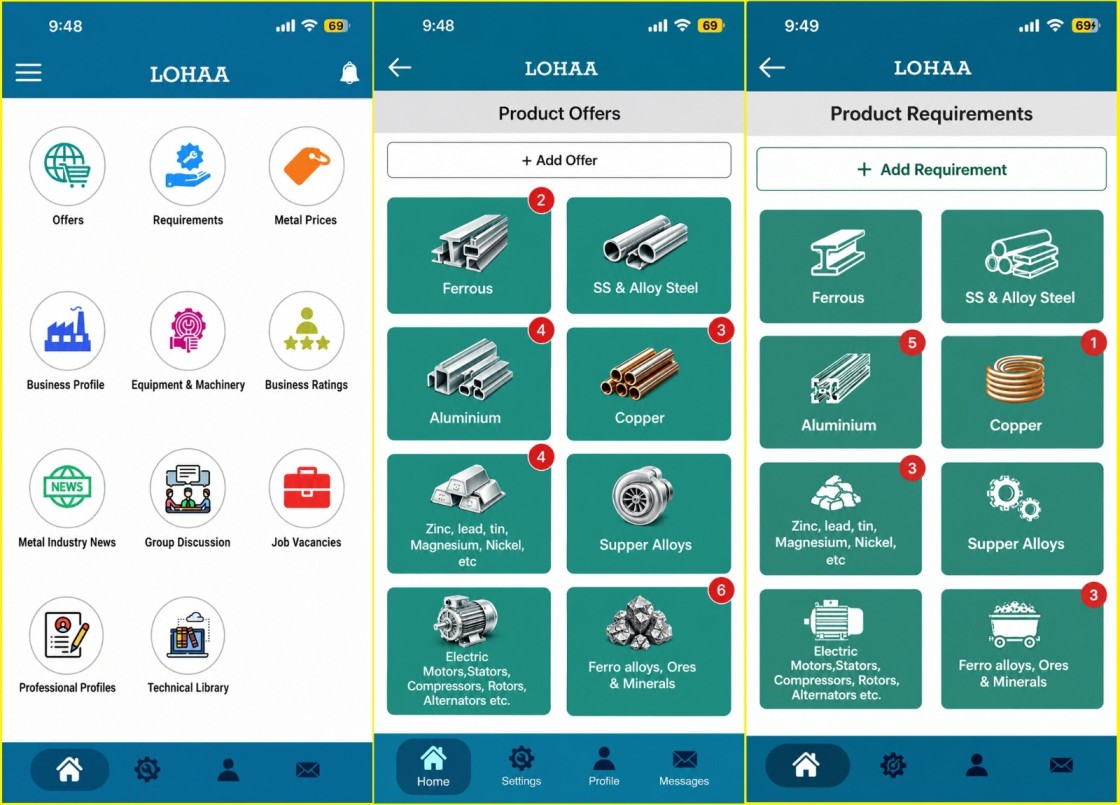
Based on LOHAA’s described metals-market workflow, LOHAA Mobile Application of Android and iPhone / Portal can help recyclers, stockists and traders discover relevant buying and selling opportunities for different types of Aluminium scraps, Aluminium ingots etc.,
a) Publish scrap requirements by grade, quantity and location.
b) Identify sellers and compare available material.
c) Advertise secondary ingots to relevant buyers.
d) Follow market updates and equipment opportunities.
e) Broaden sourcing beyond existing local contacts.
Detailed listings should include photographs, alloy information, contamination limits, delivery terms and payment conditions.
LOHAA can support supplier discovery and commercial communication. Buyers still need to verify identity, inspect material, test chemistry and agree recovery-related claims before purchasing.
12. Conclusion
India’s secondary aluminium ingot manufacturers can strengthen their position through reliable sourcing, consistent quality and controlled conversion costs. Over the next six months, secured scrap and disciplined cash flow will matter as much as furnace capacity.
13. Ten Frequently Asked Questions
13.1. What is the outlook for India’s secondary aluminium ingot industry over the next six months?
The industry has opportunities in automotive and engineering applications. Profitability will depend on scrap availability, recovery efficiency, energy costs and customer payment cycles.
13.2. Why do Indian aluminium ingot manufacturers depend on imported scrap?
Domestic scrap collection does not consistently meet manufacturers’ volume and quality requirements. Aluminium also remains in vehicles, buildings and infrastructure for years before becoming available for recycling.
13.3. Which aluminium scrap is suitable for manufacturing secondary ingots?
Common feedstocks include engine and gearbox castings, alloy wheels, rejected castings, extrusion offcuts and machining scrap. The right combination depends on the required alloy chemistry and contamination limits.
13.4. How much aluminium can be recovered from one scrapped car?
Recovery varies by vehicle model, age, components and processing method. Aluminium content should not be confused with recovered metal: dismantling losses, reusable parts and melting losses reduce the final quantity.
13.5. Why does growing automobile production not immediately increase end-of-life scrap?
New vehicles remain in service for many years. Manufacturing generates prompt scrap, while end-of-life recovery depends on older vehicles entering the dismantling system.
13.6. Can recycled aluminium meet all of India’s growing aluminium demand?
Recycling can meet part of demand, but scrap availability depends on historical consumption, collection and product lifetimes. Primary aluminium remains necessary to support growth and certain quality requirements.
13.7. Why are BIS standards important for secondary aluminium ingots?
Standards help define product quality, testing and chemical composition. Manufacturers should check the applicable standard and current Quality Control Order to determine whether certification is mandatory for their product.
13.8. How do CBAM and overseas scrap-export rules affect Indian manufacturers?
CBAM concerns covered products imported into the EU and their embedded emissions. Scrap-export rules are separate measures that can affect feedstock availability, documentation, delivery schedules and procurement costs.
13.9. How can secondary aluminium ingot units improve profitability?
Buy scrap against verified recovery and chemistry, reduce contamination and melting losses, control energy consumption, and align selling prices with replacement costs. Reliable suppliers and timely customer collections also protect margins.
13. 10. How can the LOHAA mobile application help aluminium recyclers?
LOHAA helps businesses publish scrap requirements, discover suppliers, advertise ingots and follow metals-market information. Buyers should still verify suppliers, inspect material and agree quality, delivery and payment terms.
14. References
• World Bank WITS: 2024 aluminium scrap imports
• World Bank WITS: 2025 aluminium scrap imports
• CMR prospectus: August 2025
• European Commission: Waste shipments
By using digital trade platforms like LOHAA Mobile application, you can reach global buyers, source quality material, and strengthen long-term partnerships.
Download the Lohaa Metal Trading App for Android to access live scrap prices and real-time market updates anytime, anywhere.
Download the Lohaa Metal Trading App for iOS to access live scrap prices and real-time market updates anytime, anywhere.
(Notes: market and production volume estimates are synthesized from public market reports and industrial press; exact tonne figures for materials are not centrally published in a single comprehensive public dataset, therefore the numeric projection above is a conservative, documented estimate built from available intelligence and reasonable regional share assumptions.)


