
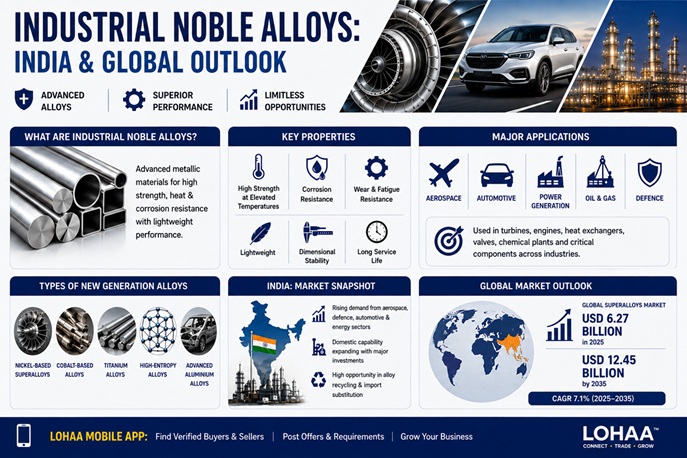
Industrial Noble Alloys: India & Global Outlook 2026–35
Industrial Noble Alloys: India & Global Market Outlook, Applications, New-Generation Materials and Opportunities
1. Introduction
Industrial Noble alloys are advanced metallic materials engineered to deliver properties beyond those of conventional steels, stainless steels and standard non-ferrous alloys. They combine carefully controlled compositions and advanced manufacturing processes to achieve high strength, heat resistance, corrosion resistance, wear resistance, fatigue performance and dimensional stability. Major categories include nickel-based superalloys, cobalt-based alloys, titanium alloys, advanced stainless steels, precipitation-hardened alloys, high-entropy alloys and specialised aluminium and magnesium alloys.
The importance of these materials is increasing as automotive, aerospace, defence, power generation, energy, chemical processing and precision engineering industries demand lighter, stronger and longer-lasting components. India is also moving towards domestic production of strategic materials. MIDHANI already manufactures a broad range of nickel-based superalloys, while PTC Industries has established a large titanium and superalloy manufacturing facility.
2. Industrial Noble Alloys and Their Importance
Noble alloys are designed by controlling the percentage of principal and minor alloying elements and by applying sophisticated melting, refining, casting, forging, heat treatment and machining technologies.
Typical alloying elements include:
• Nickel (Ni)
• Chromium (Cr)
• Cobalt (Co)
• Molybdenum (Mo)
• Tungsten (W)
• Titanium (Ti)
• Aluminium (Al)
• Niobium (Nb)
• Tantalum (Ta)
• Rhenium (Re)
• Vanadium (V)
• Hafnium (Hf)
• Zirconium (Zr)
• Boron (B)
• Carbon (C)
The selection of alloying elements determines the final microstructure and service performance.
For example, nickel-based superalloys are particularly important where components must maintain strength at elevated temperatures. MIDHANI's portfolio includes Superni 600, 601, 617, 625, 690, 706 and 718, corresponding to internationally recognised nickel-alloy grades such as Inconel 600, 625 and 718.
Noble alloys are important because conventional materials increasingly reach their performance limits in high-temperature, high-pressure, corrosive and high-cycle applications.
Major industrial applications
- Automobile: Exhaust valves, turbochargers, fuel systems, high-temperature fasteners
- Aerospace: Turbine blades, discs, combustor components, engine parts
- Defence: Missiles, aircraft engines, armour and high-temperature components
- Power generation: Gas turbines, steam turbines, heat exchangers
- Oil & gas: Valves, pipes, pumps and corrosion-resistant components
- Chemical: Reactors, heat exchangers and process equipment
- Nuclear: Reactor components and heat-resistant materials
- Marine: Propulsion, pumps and corrosion-resistant components
- Medical: Implants and specialised surgical equipment
- Additive manufacturing: Complex high-strength components and prototypes
3. New-Generation Industrial Noble Alloys
The next generation of industrial alloys is focused on achieving higher performance with lower weight, lower material consumption, longer component life and improved environmental performance.
Important emerging categories include:
3.1 Advanced nickel-based superalloys
Nickel-based superalloys remain among the most important high-temperature engineering materials. Inconel 718, for example, is strengthened principally through precipitation phases involving niobium, aluminium and titanium.
Newer generations seek:
• Higher creep strength
• Better oxidation resistance
• Lower density
• Improved fatigue resistance
• Better additive-manufacturing capability
• Reduced dependence on critical elements
Research is also moving toward alloys with optimised combinations of γ, γ' and γ'' phases. (arXiv)
3.2 Cobalt-based superalloys
Cobalt alloys provide high-temperature strength, wear resistance and corrosion resistance. They are particularly useful for turbine components, hard-facing applications and specialised industrial components.
3.3 Titanium alloys
Titanium alloys offer an attractive strength-to-weight ratio and excellent corrosion resistance. Their importance is increasing in aerospace, defence, medical and high-performance automotive applications.
3.4 High-entropy alloys
High-entropy alloys use several principal elements rather than relying on one dominant base element. Systems based on combinations such as Fe-Ni-Co-Cr-Mn are being researched for high strength, corrosion resistance and high-temperature performance.
3.5 Advanced aluminium alloys
High-strength aluminium alloys remain critical for lightweight vehicles. Developments include improved 6xxx and 7xxx series alloys, heat-treatable casting alloys and alloys designed for giga-casting and structural applications.
3.6 Additive-manufacturing alloys
Powder-bed fusion, directed-energy deposition and related technologies are opening opportunities for manufacturing complex components from nickel, titanium and cobalt alloys. However, composition, solidification behaviour and cracking remain important technical challenges. (arXiv)
4. Importance in the Present Automobile Industry
The automobile industry is undergoing two simultaneous transformations: electrification and increasing efficiency of internal-combustion and hybrid powertrains.
Although EVs reduce the number of conventional engine components, advanced alloys remain important for:
• Electric motor shafts
• Bearings
• Transmission components
• High-strength fasteners
• Battery-system components
• Thermal-management systems
• Lightweight structural components
• Charging-system components
For ICE and hybrid vehicles, high-temperature alloys continue to be important for exhaust valves, turbochargers and other engine components.
Nickel-based superalloys have been used in automotive exhaust valves because they can maintain strength and corrosion resistance at high temperatures. SAE research, for example, documented the development of nickel-base alloys for motorcycle exhaust valves and iron-base alternatives for diesel-engine exhaust valves. (SAE Mobilus)
The future automotive opportunity is therefore not limited to one alloy family. It is likely to involve a combination of lightweight aluminium and magnesium alloys, high-strength steels, nickel alloys, titanium alloys and specialised coatings.
5. Importance and Specifications of Industrial Noble Alloys
Alloy specifications must be defined by chemical composition, mechanical properties, heat treatment, manufacturing process and applicable standards.
Selected advanced alloy compositions
- Major characteristics: Corrosion and heat resistance
- Applications: Chemical, heat treatment
- Major characteristics: Corrosion, fatigue and high-temperature strength
- Applications: Aerospace, marine, chemical
- Major characteristics: High strength and fatigue resistance
- Applications: Aerospace, power, high-performance engineering
- Major characteristics:High-temperature strength
- Applications: Gas turbines, high-temperature equipment
- Major characteristics: High-temperature creep strength
- Applications: Engines and exhaust systems
- Major characteristics: Wear and heat resistance
- Applications: Turbines, medical, hard-facing
- Major characteristics: High strength-to-weight ratio
- Applications: Aerospace, defence, medical
- Major characteristics: High-temperature capability
- Applications: Space propulsion
- Major characteristics: High strength and potential thermal stability
- Applications: Emerging applications
Actual chemical limits must always be taken from the applicable ASTM, AMS, UNS, EN, DIN, BIS or customer specification rather than from a general market description.
MIDHANI's published portfolio demonstrates the breadth of international specifications used in India, including ASTM, AMS, British, German and French standards for nickel-based alloys.
6. India's Production and Consumption
India is becoming an increasingly important market for advanced engineering materials because of rapid growth in aerospace, defence, automotive, power generation, oil and gas, chemicals and precision engineering.
However, India still depends significantly on imported high-value nickel alloy products. World Bank WITS/UN Comtrade data show that in 2024 India imported approximately 5.85 million kg of nickel-alloy bars, rods and profiles, worth about US$185.8 million. India also imported approximately 4.48 million kg of nickel-alloy plates, sheets, strips and foils, valued at about US$138.7 million. Nickel-alloy tube and pipe imports were about 3.08 million kg, worth approximately US$96.0 million. (World Integrated Trade Solution)
These figures do not represent total superalloy consumption because the HS classifications include several nickel-alloy products and do not isolate every superalloy grade. Nevertheless, they demonstrate the scale of India's dependence on imported high-value nickel materials.
Major Indian supply-side developments
India is building domestic capability through organisations and companies including:
• MIDHANI
• PTC Industries / Aerolloy Technologies
• HAL-linked aerospace manufacturing ecosystem
• DRDO laboratories
• ISRO-linked material-development programmes
• Private aerospace and defence manufacturers
• Specialty steel and alloy producers
PTC Industries' Strategic Materials Technology Complex in Lucknow represents a major step toward domestic titanium and superalloy production. The facility has been described as having production capacity of more than 6,000 tonnes per year for aviation-grade titanium and superalloys. (The Times of India)
In July 2026, Raghu Vamsi Aerospace Group also announced an investment of more than ?600 crore in an integrated nickel-based superalloy manufacturing facility in Telangana, highlighting continuing private-sector investment. (The Times of India)
7. Types of New-Generation Industrial Noble Alloys
a) Nickel superalloys (Ni-Cr-Mo-Nb-Ti-Al)
- Main advantage: High-temperature strength
- Major industries: Aerospace and power
b) Cobalt superalloys (Co-Cr-W-Mo-Ni)
- Main advantage: Heat/wear resistance
- Major industries: Aerospace and medical
c) Titanium alloys (Ti-Al-V & Ti-Nb)
- Main advantage: Lightweight/high strength
- Major industries: Aerospace and defence
d) High-entropy alloys (Fe-Ni-Co-Cr-Mn etc.)
- Main advantage: Multi-property performance
- Major industries: Emerging engineering
e) Advanced aluminium (Al-Mg-Si, Al-Zn-Mg-Cu)
- Main advantage: Lightweight
- Major industries: Automotive and aerospace
f) Advanced magnesium (Mg-Al-Zn/rare-earth systems)
- Main advantage: Very low density
- Major industries: Automotive
g) Maraging steels (Fe-Ni-Co-Mo-Ti)
- Main advantage: Ultra-high strength
- Major industries: Aerospace, tooling
h) Precipitation-hardening steels (Fe-Cr-Ni-Cu-Nb etc.)
- Main advantage: Strength/corrosion resistance
- Major industries: Engineering
i) Nb-based alloys (Nb-Hf-Ti)
- Main advantage: Extreme-temperature capability
- Major industries: Space
j) ODS alloys (Ni/Fe/Cr + oxide dispersions)
- Main advantage: Creep resistance
- Major industries: Energy, nuclear
8. Leading Countries Producing New-Generation Industrial Alloys
The global advanced-alloy industry is highly concentrated in countries possessing aerospace, defence, turbine, automotive and specialty-metallurgy capabilities.
The United States, China, Japan, Germany, France, the United Kingdom, Russia, India, South Korea and Italy represent important manufacturing and technology centres.
However, a critical qualification is required: there is no single internationally reported database providing comparable annual production capacity for “Noble alloys” by country. Companies report capacity by individual alloy, product form or facility, while market studies normally report revenue rather than tonnes. Therefore, presenting precise country-by-country tonnage would create a false impression of accuracy.
Top 10 country capability assessment
a) USA
- Global position: Very high
- Principal strengths: Aerospace, superalloys, turbine materials
- Public capacity information: Large, company-specific
b) China
- Global position: Very high and expanding
- Principal strengths: Specialty metals, aerospace, automotive
- Public capacity information: Large, fragmented
c) Japan
- Global position: Very high
- Principal strengths: Automotive, turbine and specialty alloys
- Public capacity information: Company-specific
d) Germany
- Global position: Very high
- Principal strengths: Automotive, industrial and specialty materials
- Public capacity information: Company-specific
e) France
- Global position: Very high
- Principal strengths: Aerospace and turbine alloys
- Public capacity information: Company-specific
f) UK
- Global position: Very high
- Principal strengths: Aerospace, turbine and advanced materials
- Public capacity information: Company-specific
g) Russia
- Global position: High
- Principal strengths: Aerospace, defence, titanium and nickel alloys
- Public capacity information: Strategic/company-specific
h) India
- Global position: Rapidly developing
- Principal strengths: Defence, aerospace, space and engineering
- Public capacity information: Expanding
i) South Korea
- Global position: High
- Principal strengths: Automotive, shipbuilding and advanced manufacturing
- Public capacity information: Company-specific
j) Italy
- Global position: High
- Principal strengths: Aerospace, automotive and specialty engineering
- Public capacity information: Company-specific
Market research indicates strong growth prospects for superalloys, with China and India among the faster-growing markets. One 2026 market assessment projects the global superalloy market to rise from approximately US$6.27 billion in 2025 to US$12.45 billion by 2035. (Fundamental Insights Consulting)
9. India's Opportunity
India's opportunity is particularly strong because the country has a large engineering base but continues to import significant quantities of high-value nickel alloy products.
Three areas deserve priority:
9.1 Domestic raw materials and recycling
Recovery of nickel, cobalt, chromium, molybdenum, tungsten and other strategic elements from industrial scrap can reduce import dependence.
9.2 Advanced melting technology
Vacuum induction melting (VIM), vacuum arc remelting (VAR), electroslag remelting (ESR), electron-beam melting and controlled atmosphere processing are important for premium-grade alloys.
9.3 Aerospace and defence localisation
Aerospace and defence provide an anchor market because performance requirements justify higher-value materials and long-term qualification programmes.
India's broader specialty-steel policy is also designed to encourage value-added steel manufacturing and reduce import dependence.
10. Constraints to Developing New-Generation Industrial Alloys
10.1 High capital investment
VIM, VAR, ESR, precision forging, vacuum casting and advanced heat treatment require substantial investment.
10.2 High raw-material cost
Nickel, cobalt, molybdenum, tungsten, tantalum and rhenium can significantly increase alloy cost.
10.3 Technology barriers
Producing an alloy is not sufficient. Aerospace-grade products require strict control of inclusions, segregation, grain structure, porosity and heat treatment.
10.4 Qualification time
Automotive, aerospace and defence customers require extensive validation before accepting a new material.
10.5 Limited recycling infrastructure
High-value alloy scrap is often mixed with other metallic materials, making identification and segregation difficult.
10.6 Lack of scale
Domestic manufacturers may have insufficient volume to compete with established international producers.
10.7 Skilled manpower
Advanced metallurgy requires specialists in alloy design, melting, thermodynamics, casting, forging, heat treatment and failure analysis.
10.8 Intellectual property
Next-generation alloy compositions, processing routes and manufacturing parameters can be protected by patents and proprietary know-how.
11. SWOT Analysis
Strengths
- Growing Indian engineering sector
- Strong aerospace and defence demand
- Availability of engineering talent
- Existing MIDHANI capability
- Emerging private-sector investment
Weaknesses
- High dependence on imports
- Limited domestic scale
- High technology investment
- Qualification barriers
- Limited recycling ecosystem
Opportunities
- Aerospace localisation
- EV and hybrid vehicles
- Defence indigenisation
- Gas turbines and power generation
- Additive manufacturing
- High-value alloy recycling
Threats
- Global raw-material price volatility
- Chinese manufacturing competition
- Export controls
- Critical-mineral shortages
- Long customer qualification cycles
- Substitution by ceramics/composites
12. Commercial Opportunities for India
The strongest opportunity is not necessarily to compete immediately with the world's largest alloy producers across every grade. Indian manufacturers can instead focus on selected high-value niches.
Potential areas include:
• Nickel-based superalloy bars and forgings
• Aerospace-grade titanium
• High-temperature exhaust alloys
• Precision investment castings
• Turbine components
• Defence components
• High-temperature fasteners
• Heat-resistant automotive components
• Special alloy scrap recycling
• Additive-manufacturing powders
• Special alloy master alloys
• Remelt-grade alloy scrap
The market can also benefit from stronger connections between alloy producers, scrap processors, foundries, forging companies, OEMs and exporters.
13. Usage of LOHAA Mobile Application of Android and iPhone / Portal for Industrial Noble Alloys Commercial Transactions
LOHAA Mobile / Portal can support the commercial development of the advanced-alloy ecosystem by connecting verified companies involved in buying and selling metals, alloys, scrap, equipment and related products.
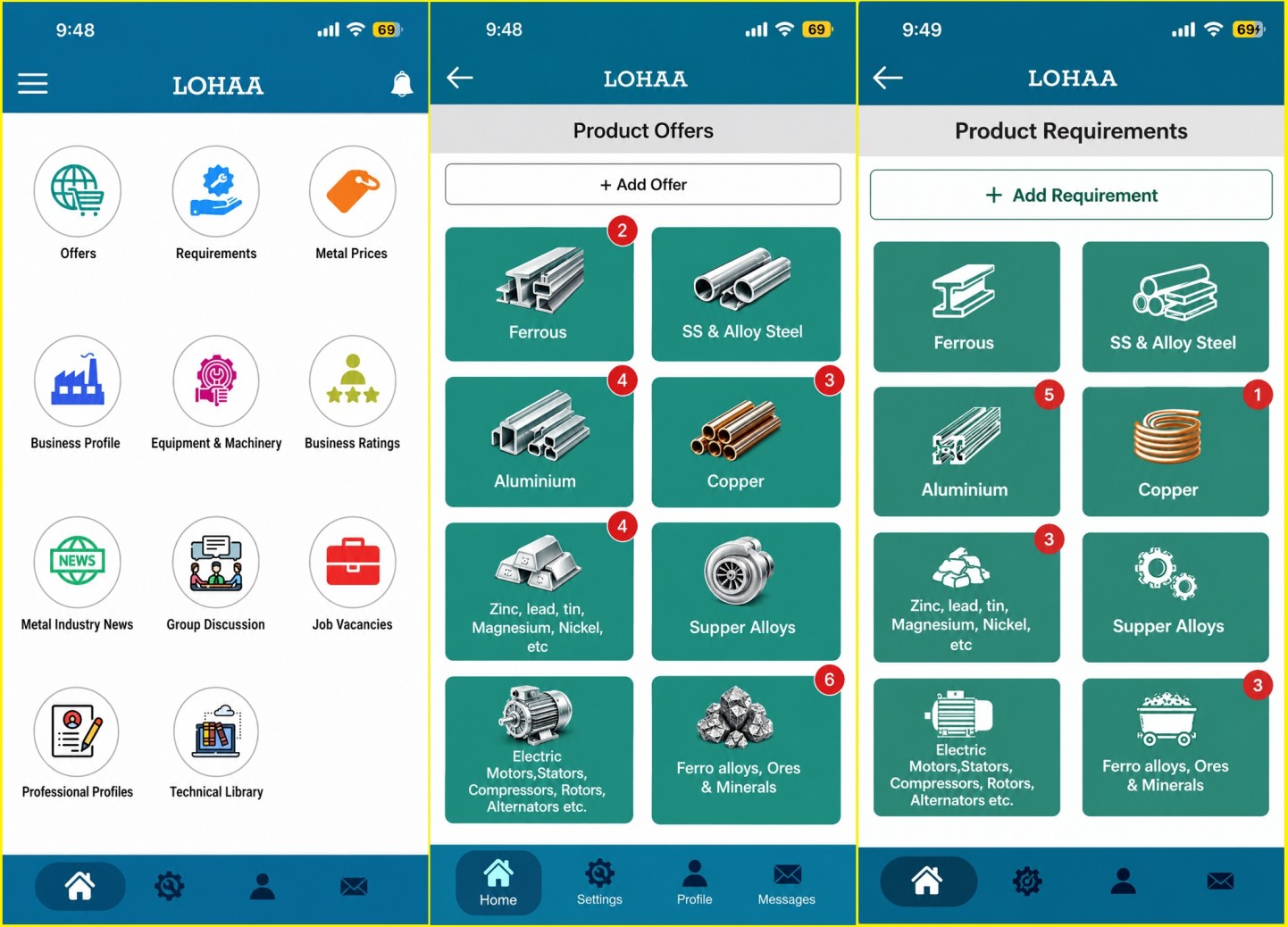
For this segment, LOHAA can be used for:
A. Publishing alloy offers
Manufacturers, traders, exoprters & Importers and stockists can publish offers for:
• Nickel alloys
• Superalloys
• Titanium alloys
• Cobalt alloys
• Stainless steel
• Special alloy scrap
• Master alloys
• Alloy ingots
• Bars, rods, sheets and plates
B. Publishing requirements
Industrial buyers can publish requirements specifying:
• Alloy grade
• Quantity
• Chemical composition
• Product form
• Size
• Standard
• Origin
• Delivery location
• Payment terms
C. Lead generation
A buyer searching for Inconel 718, Inconel 625, titanium alloy or other specialty materials can identify relevant suppliers and initiate commercial discussions.
D. Scrap and recycling opportunities
Advanced-alloy scrap has significant intrinsic value because it contains nickel, cobalt, chromium, molybdenum and other strategic elements. LOHAA can help connect scrap generators with recycling companies and alloy manufacturers.
E. Equipment transactions
Advanced alloy manufacturing requires specialised equipment. LOHAA's equipment marketplace can facilitate buying and selling of:
• Vacuum melting equipment
• Induction furnaces
• VIM/VAR equipment
• Heat-treatment furnaces
• Forging equipment
• Casting equipment
• Testing equipment
• Recycling equipment
F. KYC and business credibility
A major advantage for B2B transactions is the use of verified business profiles. For high-value alloy transactions, buyer and seller verification is particularly important because material specifications, quality certificates and payment reliability are critical commercial issues.
LOHAA's industry-news, market-price, company-profile and commercial-listing functions can therefore serve as a digital lead-generation layer for the advanced-alloy industry.
14. Key Market Trends
The next five to ten years are expected to be shaped by several major trends.
Lightweighting
Automotive and aerospace manufacturers will continue replacing heavier materials with higher-strength alloys and composites.
a) Electrification
EVs will reduce some traditional engine-alloy demand but increase demand for specialised materials used in electric motors, batteries and thermal-management systems.
b) Aerospace growth
Aircraft production and defence programmes will remain important drivers for nickel and titanium alloys.
c) Additive manufacturing
3D printing will create demand for specialised alloy powders and alloys designed specifically for additive manufacturing.
d) Recycling
Recycling will become increasingly important as nickel, cobalt and other critical alloying elements become strategically important.
e) Localisation
Countries including India are increasingly seeking domestic supply chains for critical engineering materials.
The global superalloy market's expected growth supports the long-term opportunity for manufacturers able to combine metallurgy, quality control and cost competitiveness. (Fundamental Insights Consulting)
15. Important Tables – Market Summary
Advanced-alloy application matrix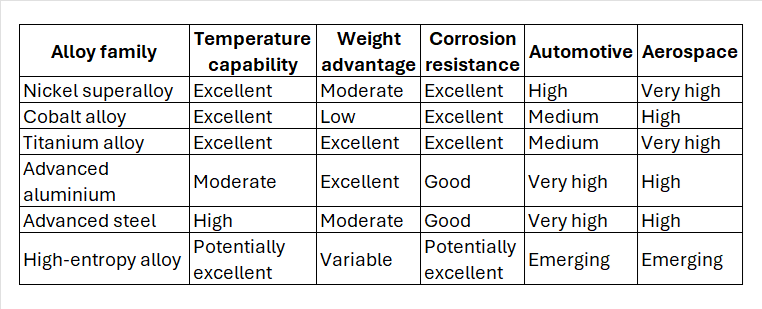
India's market opportunity
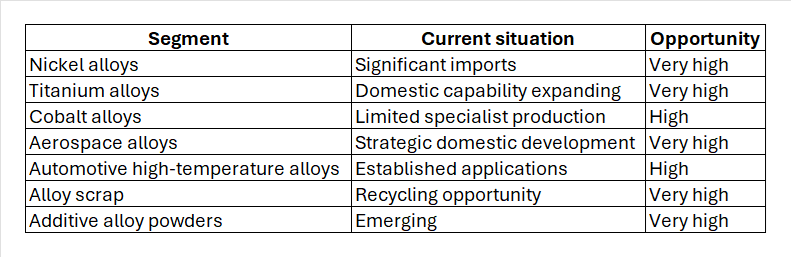
16. Conclusion
Industrial Noble alloys are becoming strategic materials for India's next phase of manufacturing. Their importance extends beyond conventional steel and aluminium because they enable components to operate under higher temperatures, pressures, stresses and corrosive conditions while improving reliability and service life.
The automobile sector will remain an important consumer of specialised alloys, particularly in high-temperature engine, exhaust, turbocharger, transmission, bearing and lightweight structural applications. At the same time, aerospace, defence, space, power generation, oil and gas and chemical industries are likely to generate even stronger demand for nickel, cobalt, titanium and other advanced alloys.
India has made significant progress through MIDHANI, PTC Industries and the wider aerospace-defence ecosystem. The establishment of large titanium and superalloy facilities demonstrates that domestic capability is moving from research and development toward commercial-scale production.
The principal challenge is not simply alloy production but achieving globally competitive quality, consistency, qualification, cost and scale. Investment in VIM, VAR, ESR, precision casting, forging, heat treatment, testing and recycling will therefore be essential.
For India, the greatest opportunity lies in combining domestic alloy development with critical-mineral recycling, advanced manufacturing, defence localisation and export-oriented production. Digital B2B platforms such as LOHAA can complement this industrial development by connecting verified manufacturers, buyers, traders, recyclers and equipment suppliers.
Overall, new-generation industrial alloys are likely to become an increasingly important strategic-material segment for India's automotive, engineering, aerospace and defence industries during the coming decade.
17. References
1. Ministry of Steel, Government of India – Indian steel-sector policy and production information.
2. Joint Plant Committee, Ministry of Steel – Indian steel production and consumption statistics.
3. MIDHANI – Nickel-based superalloy product portfolio and international specifications.
4. World Bank WITS / UN Comtrade – India's nickel-alloy imports by product category.
5. SAE International – Development and automotive application of nickel- and iron-based superalloys.
6. PTC Industries / Aerolloy Technologies – Strategic Materials Technology Complex developments.
7. World Platinum Investment Council – Global advanced-material/PGM automotive and industrial trends.
8. Fundamental Business Insights – Global superalloys market outlook.
9. Academic research on next-generation nickel superalloy design and additive manufacturing.
By using digital trade platforms like LOHAA Mobile application, you can reach global buyers, source quality material, and strengthen long-term partnerships.
Download the Lohaa Metal Trading App for Android to access live scrap prices and real-time market updates anytime, anywhere.
Download the Lohaa Metal Trading App for iOS to access live scrap prices and real-time market updates anytime, anywhere.
(Notes: market and production volume estimates are synthesized from public market reports and industrial press; exact tonne figures for materials are not centrally published in a single comprehensive public dataset, therefore the numeric projection above is a conservative, documented estimate built from available intelligence and reasonable regional share assumptions.)


