
Jamnagar Brass Industry: Outlook 2026 to 2030
1. Introduction
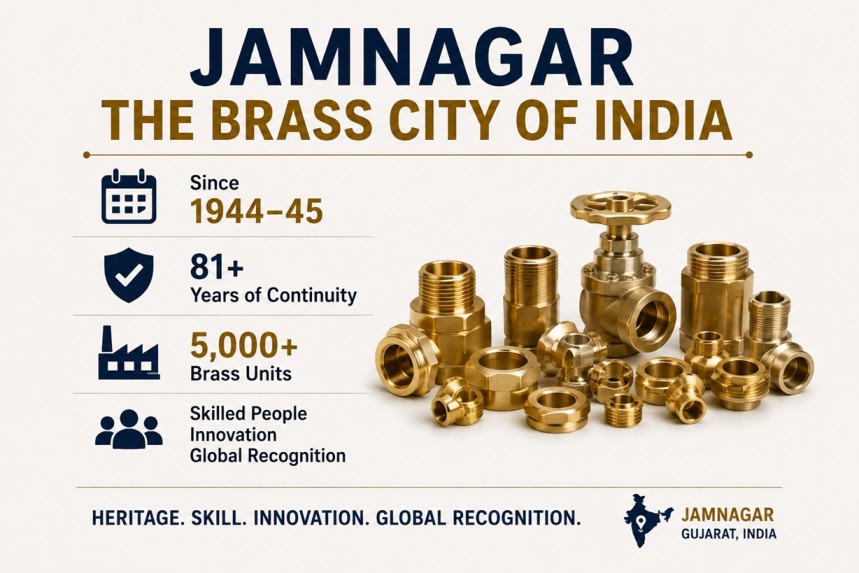
Jamnagar, Gujarat, is India’s leading brass manufacturing hub, supported by a large network of MSMEs, skilled manpower, recycling facilities, machining units and exporters. The cluster produces a wide range of brass and bronze components for electrical, automotive, plumbing, sanitary, gas, HVAC and engineering applications. Its proximity to major Gujarat ports and access to domestic and imported copper-alloy scrap have strengthened its global competitiveness. With rising demand for precision components, lead-free alloys, EVs, renewable energy and recycling, Jamnagar has significant growth opportunities through 2030. However, automation, quality standards, environmental compliance, raw-material volatility and international competition will remain key challenges.
2. When did Jamnagar’s brass industry actually start?
The strongest evidence places the beginning of the modern brass-parts industry in 1944–45, during the late colonial period and before Indian independence.
The Jamnagar Area Development Authority (JADA) states that Jamnagar became known as the “Brass City” because of its extensive brass-parts development and records that the industry is understood to have started around 1944–45, when brass-button manufacturing declined.
The Jamnagar Factory Owners’ Association (JFOA) gives a similar history. Its historical account says the brass industry started around 1944–45 and developed significantly during 1956–57. It also identifies 1948 as the establishment year of the association (Jamnagar Factory Association)
Therefore, for a 2026 market report, it is reasonable to state:
Jamnagar’s modern brass-parts industry has a history of approximately 80–82 years, dating from around 1944–45 to 2026.
3. Why did the brass industry start in Jamnagar?
3.1 The transition from brass buttons to brass components
This is probably the most important historical reason.
According to a study of the Jamnagar brass cluster, the industry initially consisted of small brass-button manufacturing units in the early 1940s. The emergence of plastic/nylon buttons reduced demand for traditional brass buttons.
Instead of disappearing, the entrepreneurs modified their existing machines and skills to manufacture brass components.
The study records that the decline of the button industry in the late 1940s encouraged manufacturers to diversify into brass parts. Existing machinery was modified, while local capabilities in machine manufacturing and brass casting also developed.
3.2 This created an important industrial chain:
Brass buttons → modified machinery → brass components → local machine building → casting → machining → specialised components
This is one of the key reasons Jamnagar's industry survived rather than becoming obsolete.
3.3 Local craftsmen and technical skills played a major role
The JFOA historical account specifically credits the Suthar community with an important role in developing the industry.
It records that Hirji Mistry developed hand-operated and electrically operated machines of different capacities. These machines were relatively affordable, allowing ordinary entrepreneurs to establish small manufacturing units.
The industry initially developed around four basic activities:
• Casting
• Turning
• Drilling
• Slotting
This is significant because the industry did not depend entirely on large external engineering companies. Local people developed the machines, operated them and trained the next generation. (Fi Gujarat)
That created a powerful local skill ecosystem.
3.4 The industry grew through a self-reinforcing cluster
The Government of India's Foundation for MSME Clusters study provides particularly strong evidence.
It states that a few pioneering entrepreneurs initially manufactured items such as:
• screws
• pins
• bulb holders
3.5 As their businesses expanded, other entrepreneurs followed them.
Number of Tier-1 industries around Jamnagar in 2026
There is an important statistical limitation here.
“Tier-1 industry” is not a statutory MSME classification.
India officially classifies enterprises primarily according to investment and turnover under the MSME framework. A “Tier-1 supplier” generally means a company supplying directly to an OEM or major manufacturer.
Therefore, there is no authoritative Government database stating “X Tier-1 brass industries in Jamnagar.”
The Government's Jamnagar District Industrial Profile provides a list of medium and large enterprises but does not classify them as Tier-1 brass suppliers. (DCMSME)
Practical 2026 estimate
For market-research purposes, I would classify approximately 20–30 companies in and around the Jamnagar industrial region as potential Tier-1/large direct industrial suppliers, but this should be treated as a research estimate, not an official count.
A stronger definition would be:
Companies supplying directly to large OEMs in automotive, electrical, energy, sanitary, industrial equipment, valves, instrumentation and engineering sectors.
3.6 MSMEs in Jamnagar
The Government's Udyam Registration system is the appropriate primary source for current registered MSMEs. Its search database allows filtering by state, district and activity, but it does not provide a single public headline number specifically labelled “all Jamnagar brass MSMEs 2026.”
The older Government district profile provides a detailed inventory of micro and small enterprises by industry and identifies engineering, metal-based and other manufacturing units.
For the brass ecosystem specifically, credible Government/cluster sources provide:
• approximately 3,500 brass units in one BEE cluster study;
• 4,500+ brass-related units in another Government-supported cluster study;
• current industry sources commonly cite 5,000+ units.
Recommended report figure
2026 Jamnagar brass-related MSME ecosystem: approximately 4,500–5,000+ units.
Do not present this as an official Udyam count.
3.7 SMEs and cottage industries
“SME” and “cottage industry” overlap with the broader MSME ecosystem and therefore should not be simply added to the MSME figure.
A useful segmentation for market research is (Category 2026 indicative estimate)
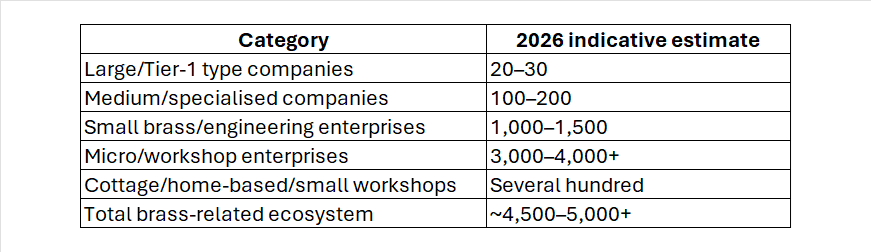 These are analytical estimates, not Government census figures.
This is very strong evidence that the industry was not simply a collection of isolated factories. A genuine industrial cluster developed.
3.6 Ready domestic market helped Jamnagar grow
During the early years, Jamnagar manufacturers supplied components to industrial centres such as Mumbai, Kolkata, Delhi and Ludhiana.
Products included electrical components, bicycle tube valves, hardware and other small engineering components.
The Government of India's cluster study specifically notes the existence of a ready domestic market, which encouraged manufacturers to expand production.
3.7 This created a cycle:
More orders → more small factories → more specialised skills → more suppliers → lower cost → more orders
That is one of the classic characteristics of a successful industrial cluster.
3.8 Bicycle-valve manufacturing was a major turning point
The bicycle industry played an important role in Jamnagar's expansion.
In the early 1960s, Indian bicycle manufacturers began procuring components domestically instead of importing them. This created substantial demand for bicycle tube valves.
The Government of India's cluster study says this helped increase the number of Jamnagar manufacturers to approximately 700 units by 1967–68.
Later, when Germany, Italy, the USA and Japan shifted their production away from bicycle tube valves toward precision components, Jamnagar manufacturers began exporting valves and subsequently moved into higher-value precision components.
This ability to change products according to market requirements is another major reason for the industry's longevity.
3.9 Jamnagar developed its own supporting machinery industry
This is an especially important reason why the cluster sustained itself.
The industry didn't just manufacture brass components. It gradually developed local suppliers for:
- lathes and machines
- dies
- tools
- jigs
- fixtures
- casting equipment
- machining
- electroplating
- finishing
The Government of India's cluster study specifically identifies the gradual development of machines, tools, jigs, fixtures and dies as a contributor to the cluster's growth.
Consequently, Jamnagar evolved from a simple manufacturing location into an integrated brass ecosystem.
3.10 GIDC and infrastructure accelerated the second phase of growth
The industry initially developed organically. Later, industrial infrastructure provided another major boost.
The Government of India's cluster study states that the establishment of GIDC industrial estates, infrastructure and port connectivity provided further impetus to the industry.
This was important because manufacturers could operate close to:
- suppliers
- subcontractors
- foundries
- machining units
- finishing units
- transport facilities
- ports
This further strengthened the cluster effect.
3.11 Why has it survived for more than 80 years?
The interesting point is that Jamnagar is not particularly famous because it has abundant copper or zinc deposits.
In fact, an academic study specifically observes that raw material availability alone cannot explain the concentration because a large proportion of brass scrap is imported. The study concludes that the major explanation is the entrepreneurial character of the people, accumulated knowledge and local skills built over decades.
The Jamnagar Brass Cluster Sustainability Model
a. Skilled workforce
↓
b. Family-based transfer of manufacturing knowledge
↓
c. Local machine/tool manufacturers
↓
d. Foundries and raw-material suppliers
↓
e. Large network of subcontractors
↓
f. Low-cost, flexible production
↓
g. Large domestic customer base
↓
h. Export markets
↓
i. Product diversification
↓
k. Continuous technology upgrading
This ecosystem makes it difficult for another location to replicate Jamnagar quickly.
4. Why Is Brass Consumption Much Higher Than Bronze?
Brass is a copper-zinc alloy, while bronze is a broader family of copper alloys, commonly containing tin, aluminium, silicon or other alloying elements.
Brass generally has a larger consumption base because:
- Lower relative cost – Zinc is generally less expensive than tin and several specialty bronze alloying elements.
- Excellent machinability – Free-cutting brass grades are particularly suitable for automatic screw machines and CNC production.
- Good corrosion resistance – Brass performs well in plumbing, sanitary, electrical and industrial environments.
- Good electrical conductivity – It is widely used for terminals, connectors, switchgear and electrical hardware.
- Excellent formability – Brass can be extruded, forged, cast, drawn and machined.
- Wide grade availability – Different brass grades can be selected for electrical, plumbing, automotive and engineering applications.
- High scrap recoverability – Brass scrap can be segregated, remelted and converted into billets, rods and components.
- Large component market – Plumbing, sanitary, electrical, automotive, construction and hardware applications consume large quantities.
- Better suitability for mass production – Brass is particularly attractive for millions of small components.
- Strong Jamnagar manufacturing base – The concentration of brass processing equipment and labour further increases brass consumption.
Bronze remains highly valuable where wear resistance, corrosion resistance, strength at elevated temperatures, bearing performance or marine performance are important. Consequently, bronze is more specialised, while brass is a much broader-volume engineering material.
The key advantage: machinability
Jamnagar specialises heavily in turned, threaded, drilled, milled and precision-machined components.
Brass is particularly attractive for these applications because several free-machining brass grades can be produced efficiently on automatic and CNC machines.
That is why brass is widely used for:
• screws
• nuts
• inserts
• cable glands
• terminals
• connectors
• valves
• fittings
• electrical parts
• sanitary components
• automobile components
• instrumentation components
Bronze, on the other hand, has important advantages in wear resistance, corrosion resistance, bearing applications and marine applications, but it generally does not have the same breadth of low-cost precision-component applications as brass.
Therefore:
Brass wins on volume because it combines reasonable cost + machinability + corrosion resistance + conductivity + appearance + recyclability + broad application.
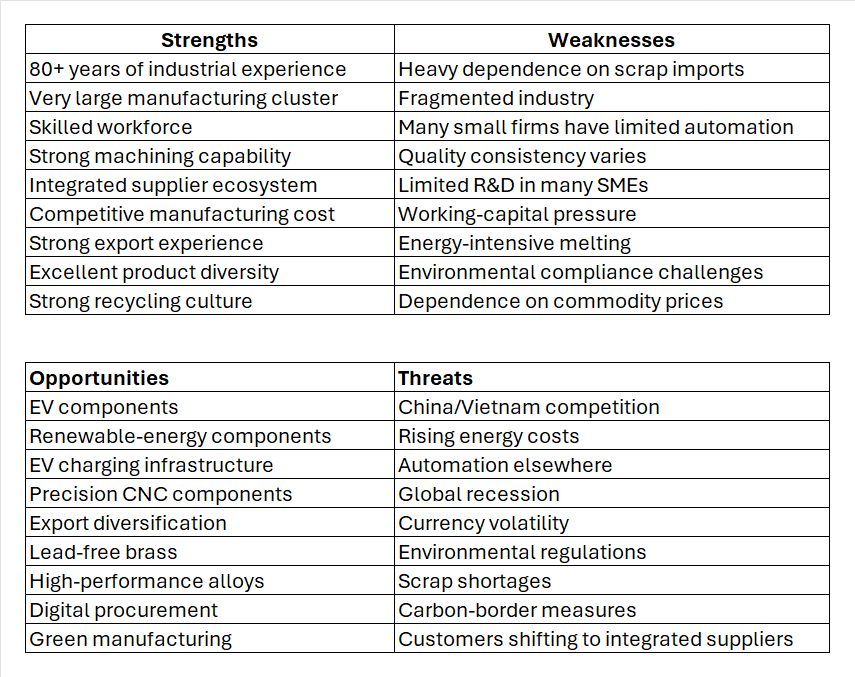
5. SWOT analysis of Jamnagar brass industry
6. Copper and copper-alloy scrap recycling in Gujarat
There is no single Government statistic for “copper and copper-alloy scrap recycled in Gujarat in 2025.”
However, Jamnagar is one of India's largest brass recycling centres.
Historical cluster research estimated approximately 280–300 tonnes of brass scrap recycled per day in the Jamnagar cluster. That corresponds to approximately 102,000–110,000 tonnes annually at that historical operating rate. (studylib.net)
Given the expansion of the cluster, inflation-adjusted production and greater use of imported scrap, I recommend using the following as a market model rather than an official statistic:
Gujarat copper/brass/bronze scrap recycling Estimated tonnes
- 2025: 0.40–0.50 million tons
- 2026: 0.42–0.53 million tons
- 2027: 0.44–0.56 million tons
- 2028: 0.47–0.59 million tons
- 2029: 0.49–0.62 million tons
- 2030: 0.52–0.65 million tons
This assumes approximately 5–6% annual growth in recyclable feedstock and processing capacity.
7. India copper and copper-alloy scrap recycling
India is structurally dependent on imported copper scrap.
For HS 7404—waste and scrap of copper or copper alloy—India imported approximately 329,074 tonnes in 2024, worth approximately US$2.04 billion according to World Bank/UN Comtrade data. (World Integrated Trade Solution)
Government trade data for FY2024–25 puts India's copper scrap imports at approximately US$2.23 billion, up about 33.5% year-on-year.
Estimated Indian recycling throughput (Year Estimated copper & copper-alloy scrap processed)
- 2025: 1.40–1.60 Mt
- 2026: 1.48–1.69 Mt
- 2027: 1.56–1.79 Mt
- 2028: 1.64–1.90 Mt
- 2029: 1.72–2.01 Mt
- 2030: 1.82–2.13 Mt
This includes domestically generated scrap plus imported scrap entering Indian recycling/secondary manufacturing streams. It is a market estimate, not an official Government tonnage.
8. Global copper recycling outlook
The International Energy Agency estimates that available copper scrap could rise from approximately 16 million tonnes currently to 19 million tonnes by 2030, before reaching approximately 27 Mt by 2050 in its stated scenario. (IEA)
This is an important long-term positive for Jamnagar.
Global copper scrap availability (Year Global estimated available scrap )
- 2025 ~16.0 Mt
- 2026 ~16.5 Mt
- 2027 ~17.0 Mt
- 2028 ~17.6 Mt
- 2029 ~18.3 Mt
- 2030 ~19.0 Mt
The International Copper Study Group independently maintains annual recycling surveys covering copper scrap use, secondary refined production and direct-melt copper-alloy scrap. (ICSG)
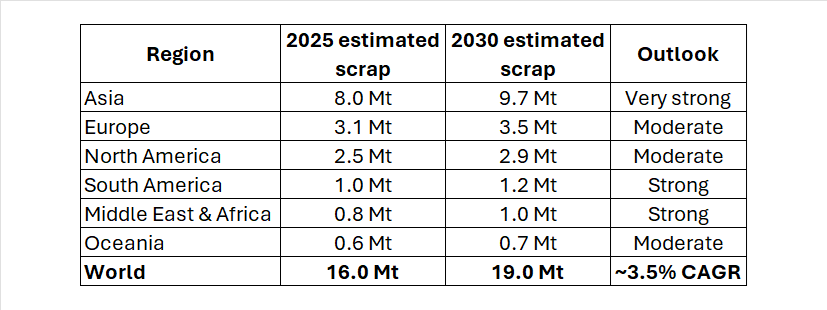
9. Continental distribution of copper scrap recycling
The following is a modelled market estimate, rather than an official continental recycling census.
 10. Top countries involved in copper/brass/bronze scrap recycling and trade
Using international trade and recycling infrastructure as the basis, the leading countries/markets include:
- China
- Germany
- United States
- Japan
- South Korea
- India
- Italy
- Netherlands
- Belgium
- United Kingdom
China alone imported approximately 2.25 million tonnes of copper/copper-alloy scrap in 2024, according to World Bank/UN Comtrade data, making it by far the world's largest importer in that dataset. (World Integrated Trade Solution)
India ranked among the world's largest importers at approximately 329,000 tonnes in 2024. (World Integrated Trade Solution)
11. Major countries exporting copper scrap to India
FY2024–25 Government data identifies the following major sources:
Rank Country 2024–25 value
- Saudi Arabia:US$414.84m
- USA: US$287.23m
- Germany: US$182.57m
- UK: US$179.73m
- UAE: US$121.44m
- Belgium: US$77.30m
- Colombia: US$76.18m
- Kuwait: US$70.40m
- Brazil: US$67.59m
- Netherlands: US$55.90m
Total reported FY2024–25 value was approximately US$2.234 billion.
This confirms that India's copper recycling industry depends substantially on an international scrap-supply network.
12. Gujarat imports of copper/brass/bronze scrap
A crucial limitation is that Indian customs data is generally reported by port and importer, while a shipment may be cleared through Mundra, Kandla, Pipavav, Nhava Sheva or another port and subsequently transported to Jamnagar.
Therefore, “Gujarat imports” cannot safely be equated with “Jamnagar consumption.”
For Jamnagar manufacturers, the principal practical sourcing channels include:
• Mundra
• Kandla/Deendayal
• Pipavav
• Nhava Sheva/JNPT
• other Indian ports
The large international supply base makes Gujarat particularly important for secondary copper/brass manufacturing.
13 Types of imported brass and bronze scrap
The Jamnagar industry uses a wide range of copper-alloy scrap, including:
Brass scrap
• Honey
• Honey brass
• Brass turnings
• Brass borings
• Brass solids
• Brass rods
• Brass extrusion scrap
• Brass casting scrap
• Yellow brass
• Red brass
• Brass radiators
• Brass valves
• Brass fittings
• Mixed brass scrap
Copper scrap
• Berry
• Birch
• Candy
• Barley
• Millberry
• No. 1 copper
• No. 2 copper
• Copper wire
• Copper tube
• Copper turnings
Bronze
• Bronze castings
• Bronze turnings
• Phosphor bronze
• Aluminium bronze
• Silicon bronze
• Gunmetal scrap
Trade records show Indian buyers importing material specifically described as Brass Honey, Brass Label and Brass Honey Hairwire, demonstrating the importance of ISRI-style scrap grades in the Indian market. (Volza)
14. Brass and bronze components produced around Jamnagar
Major product categories
Component Main application
- Brass cable glands: Electrical/cable industry
- Brass terminals: Electrical/electronics
- Brass connectors: Electrical
- Neutral links: Switchgear
- Brass inserts: Plastic injection moulding
- Brass fasteners: Engineering
- Brass screws/nuts: Engineering
- Brass valves: Plumbing/industrial
- Sanitary fittings: Construction
- LPG/CNG fittings: Automotive/energy
- Auto components: Automotive
- Battery terminals: Automotive
- Precision turned: components Engineering
- Brass rods: Further manufacturing
- Brass extrusion sections: Electrical/engineering
- Brass bushings: Machinery
- Brass gears: Engineering
- Brass nozzles: Industrial
- Brass pins: Electrical/mechanical
- Bronze bushes: Machinery
- Bronze bearings: Heavy engineering
- Bronze valves: Marine/industrial
- Aluminium-bronze components: Marine/heavy engineering
Government cluster studies identify building hardware, rods, sections, sanitary/bathroom fittings and electrical products among Jamnagar's major product groups.
15. Applications of Jamnagar components
Jamnagar's products serve:
• electrical
• electronics
• automotive
• construction
• plumbing
• sanitary
• telecommunications
• renewable energy
• industrial automation
• instrumentation
• HVAC
• LPG/CNG
• water treatment
• machinery
• marine
• aerospace/precision engineering
The historical cluster study also records exports of bicycle tube valves, automobile valves, battery terminals, cable glands, builder hardware and precision components. (studylib.net)
16. Exports of finished brass and bronze components
There is no reliable official public dataset assigning all exports of HS 74 products specifically to Jamnagar district.
India's Ministry of Commerce TRADESTAT database does provide commodity/country/HS-level national trade data, with data available through 2025–26, but it does not directly publish a complete “Jamnagar brass exports” series. (Tradestat)
Therefore, a Jamnagar-specific export forecast should be treated as a market estimate.
Indicative market model
Year Estimated Jamnagar brass/bronze component exports
- 2025 US$0.65–0.80 bn
- 2026 US$0.70–0.86 bn
- 2027 US$0.75–0.92 bn
- 2028 US$0.81–0.99 bn
- 2029 US$0.87–1.07 bn
- 2030 US$0.94–1.16 bn
This should be validated against DGCI&S/ICEGATE shipment-level data before publication as a definitive statistic.
Individual Jamnagar exporters report shipments to Europe, the United States, Middle East, Southeast Asia, Australia and numerous other markets. (Brass Parts Jamnagar)
17. Competitors to Jamnagar in India
Indian competitors
Major competing manufacturing clusters include:
• Rajkot
• Ahmedabad
• Vadodara
• Mumbai
• Pune
• Delhi-NCR
• Howrah/Kolkata
• Ludhiana
• Moradabad
• Aligarh
• Coimbatore
• Bengaluru
However, most do not replicate Jamnagar's complete brass ecosystem at the same concentration.
Jamnagar's strongest competitive advantage is not simply manufacturing cost—it is cluster density.
18. International competitors
Important international competitors include:
China
• huge production scale
• integrated supply chains
• advanced CNC manufacturing
• enormous domestic market
Taiwan
• precision machining
• high-quality components
• sophisticated export network
Vietnam
• rapidly developing manufacturing base
• competitive labour costs
• growing export infrastructure
Italy
• high-end brass fittings
• premium sanitary products
• design and engineering
Germany
• high precision
• industrial automation
• premium engineering
Turkey
• strong brass fittings and sanitary industry
• proximity to Europe
Mexico
• proximity to North American OEMs
• automotive manufacturing
19. What must Jamnagar do to sustain its market?
The biggest future risk is that low-cost manufacturing alone will no longer be sufficient.
Jamnagar should move progressively from:
Commodity brass components → engineered components → precision components → OEM-qualified components
Priority actions
- Increase CNC automation.
- Introduce Industry 4.0.
- Improve dimensional inspection.
- Invest in spectrometers.
- Develop lead-free brass grades.
- Reduce melting losses.
- Improve furnace efficiency.
- Introduce renewable energy.
- Develop traceability.
- Obtain ISO/IATF/sector-specific certifications.
- Increase direct OEM relationships.
- Reduce dependence on intermediaries.
- Develop export brands.
- Improve environmental compliance.
- Establish professional management systems.
20. Manpower requirements
Jamnagar's future workforce will require both traditional metallurgical knowledge and modern engineering skills.
- Foundry operators: High
- Furnace operators: High
- CNC operators: Very high
- CNC programmers: High
- Tool & die makers: Very high
- Metallurgists: High
- Quality engineers: Very high
- Spectrometer operators: High
- Maintenance engineers: High
- Automation engineers: Increasing
- PLC programmers: Increasing
- Production planners: High
- Export executives: High
- ESG/environment officers: Increasing
- Procurement professionals: High
- Digital marketing staff: Increasing
- Data/ERP specialists: Increasing
Recommendation
Jamnagar should establish stronger collaboration between:
• ITIs
• polytechnics
• engineering colleges
• industry associations
• individual manufacturers
• machine manufacturers
The objective should be to create a Jamnagar Brass Skill Development Programme covering foundry, CNC, metallurgy, quality and export management.
20. Usage of LOHAA Mobile Application of Android and iPhone / Portal for Jamnagar Brass Indistry Commercial Transactions
For an industry as fragmented as Jamnagar brass, a B2B digital platform can substantially improve procurement and sales efficiency.
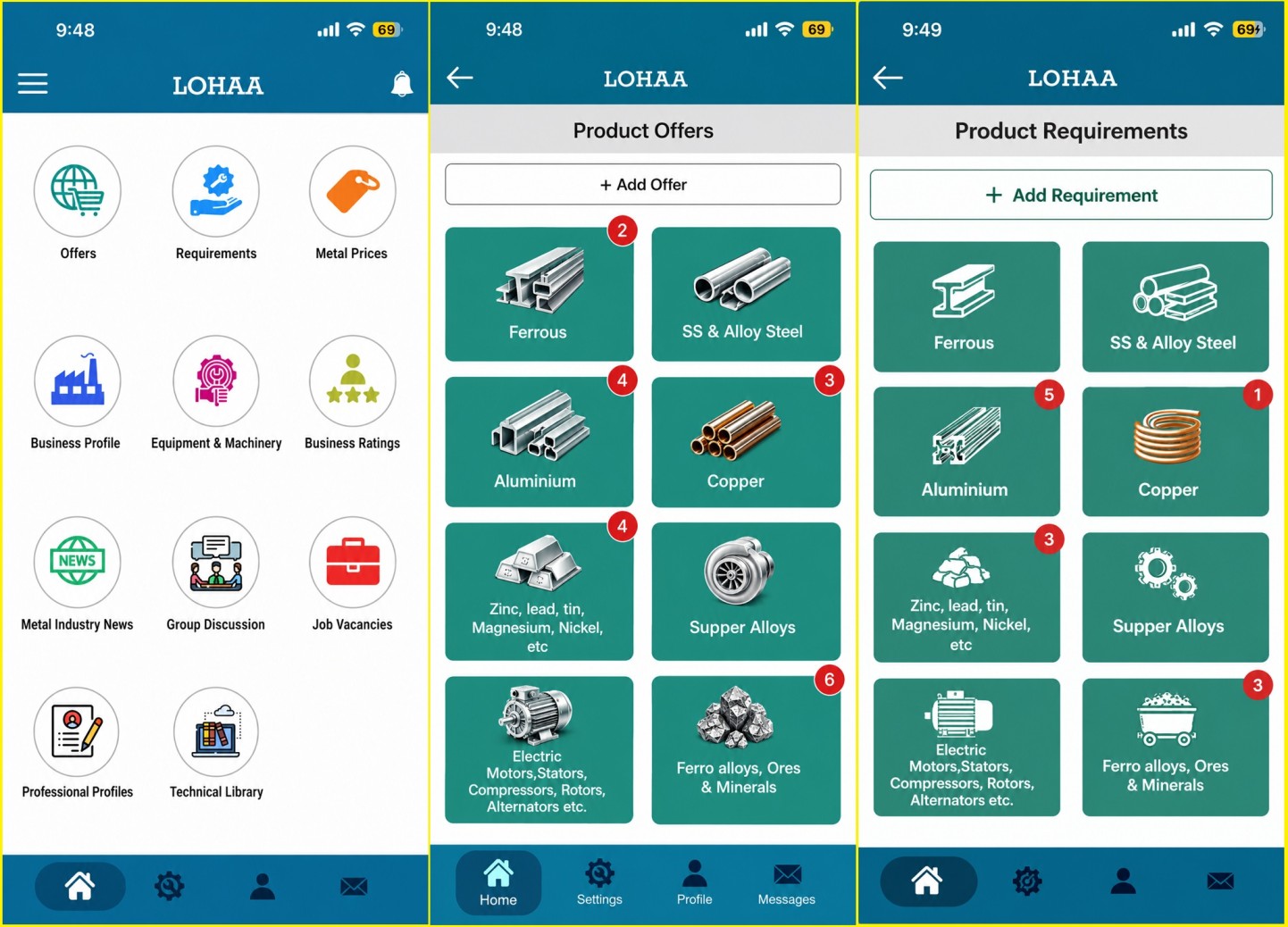
The LOHAA Mobile application can be positioned as a digital commercial marketplace connecting:
Scrap suppliers
• Copper scrap
• Brass scrap
• Bronze scrap
• Brass Honey
• Copper Berry
• Birch
• Millberry
• Brass turnings
• Bronze scrap
Manufacturers
• Brass rods
• Brass billets
• Brass components
• Precision turned components
• Valves
• Electrical components
• Fittings
Buyers
• Foundries
• Brass manufacturers
• Electrical manufacturers
• Automotive companies
• Exporters
• Traders/stockists
• Recycling companies
The major advantage is that commercial transactions can move from telephone/WhatsApp-based fragmented sourcing toward structured B2B transactions.
For Jamnagar, a particularly useful LOHAA workflow would be:
Buyer requirement → KYC-verified supplier → material specification → quantity → price → location → delivery terms → negotiation → commercial confirmation
This can be especially valuable because the Jamnagar cluster has thousands of fragmented enterprises.
21. Recommended digital trading categories for Jamnagar
“Jamnagar Brass & Copper Marketplace”
Scrap
• Brass Honey
• Brass Turnings
• Brass Solids
• Copper Berry
• Copper Birch
• Millberry
• Bronze Scrap
• Mixed Copper Alloy Scrap
Raw materials
• Brass billets
• Brass rods
• Copper rods
• Zinc
• Tin
• Lead
• Master alloys
Finished products
• Brass fittings
• Electrical components
• Cable glands
• Valves
• Sanitary fittings
• Precision components
Machinery
• CNC machines
• Automatic lathes
• Brass extrusion machines
• Foundry equipment
• Induction furnaces
• Plating equipment
• Scrap-processing machinery
This would allow LOHAA to become not merely a news/pricing platform but a commercial sourcing and sales channel for the Jamnagar ecosystem.
22. Forecast for 2026–2030
Overall market direction outlook fr 2026 - 30
- Brass components: Strong
- Precision turned components: Very strong
- Electrical brass: Very strong
- Automotive brass: Strong
- Sanitary fittings: Moderate–strong
- Bronze components: Moderate
- Copper scrap recycling: Strong
- Imported brass scrap: Strong
- CNC machining: Very strong
- Lead-free brass: Very strong
- Export-oriented manufacturing: Strong
- Low-end commodity components: Moderate/under pressure
The strongest opportunity is expected to be in high-precision, high-value, specification-driven components, rather than commodity parts.
23. Key risks for 2026–2030
The industry should closely monitor:
• Copper price volatility
• Zinc price volatility
• Scrap availability
• Freight rates
• Exchange rates
• Chinese competition
• Vietnam's manufacturing expansion
• European environmental regulations
• Lead restrictions
• Carbon regulations
• Energy costs
• Labour shortages
• Automation costs
• Quality requirements
• Customer consolidation
• Working-capital requirements
Copper recycling will become strategically more important because global electrification is increasing demand for copper while secondary material provides a lower-energy source of metal. The IEA expects scrap availability to rise substantially through 2030. (IEA)
24. Conclusion
Jamnagar's brass industry is one of India's most established and geographically concentrated non-ferrous manufacturing clusters. Its modern industrial history can be traced to approximately 1944–45, giving the industry around 81 years of continuity by 2026. Its success was driven not by proximity to copper or zinc mines, but by entrepreneurship, skilled craftsmen, machinery development, family-based knowledge transfer, subcontracting and the gradual creation of an integrated manufacturing ecosystem. The cluster expanded from a handful of units in the 1950s to thousands of enterprises today. Government and cluster studies identify approximately 3,500–4,500+ brass-related units, while contemporary industry sources commonly cite 5,000+ units. (JADA)
The next phase must be based on precision manufacturing, automation, quality certification, lead-free alloys, energy efficiency, recycling, digital procurement and export diversification. Rising copper demand and increasing global scrap availability create significant opportunities. For Jamnagar, the strategic objective should be to evolve from a low-cost brass manufacturing cluster into a globally recognised precision copper-alloy engineering cluster. Digital B2B platforms such as LOHAA can further strengthen this transition by connecting verified scrap suppliers, manufacturers, traders, exporters and industrial buyers in a structured commercial ecosystem.
25. References
1. Jamnagar Area Development Authority (JADA) – historical background and economic activities of Jamnagar. (JADA)
2. Government of India, DC-MSME – District Industrial Profile, Jamnagar – industrial units, medium enterprises and major industries. (DCMSME)
3. Bureau of Energy Efficiency / SAMEEEKSHA – Jamnagar Brass Cluster profile and approximately 3,500-unit structure. (Bee India)
4. Government-supported MSME cluster study – 4,500+ brass-related units and manufacturing process.
5. Government of India / Indian Trade Journal, DGCI&S – India's copper waste and scrap imports and major source countries for FY2024–25. (DGCIS Kolhapur)
6. World Bank WITS / UN Comtrade – India's 2024 copper/copper-alloy scrap import quantities and values. (World Integrated Trade Solution)
7. World Bank WITS / UN Comtrade – global copper-scrap importing countries. (World Integrated Trade Solution)
8. International Copper Study Group (ICSG) – global copper recycling methodology and secondary copper statistics. (ICSG)
9. International Energy Agency (IEA) – copper scrap availability outlook to 2030 and 2050. (IEA)
10. Government of India TRADESTAT – official India commodity and country trade database through FY2025–26. (Tradestat)
11. Jamnagar brass industry historical performance study – historical unit growth, scrap recycling and product/export structure. (studylib.net)
12. Udyam Registration Portal, Ministry of MSME – registered MSME search database. (Udyam Registration)
By using digital trade platforms like LOHAA Mobile application, you can reach global buyers, source quality material, and strengthen long-term partnerships.
Download the Lohaa Metal Trading App for Android to access live scrap prices and real-time market updates anytime, anywhere.
Download the Lohaa Metal Trading App for iOS to access live scrap prices and real-time market updates anytime, anywhere.
(Notes: market and production volume estimates are synthesized from public market reports and industrial press; exact tonne figures for materials are not centrally published in a single comprehensive public dataset, therefore the numeric projection above is a conservative, documented estimate built from available intelligence and reasonable regional share assumptions.)


