
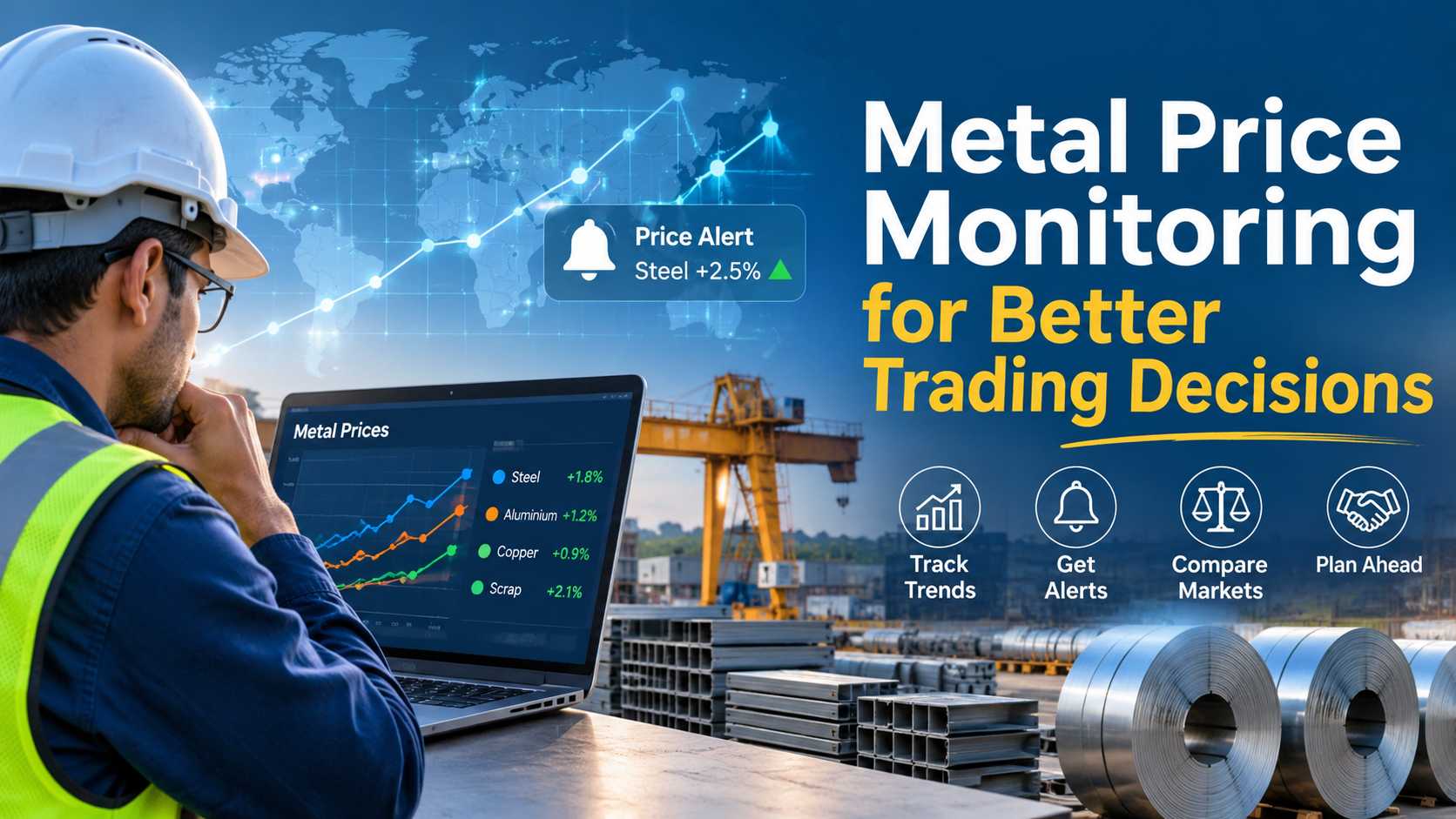
Metal Price Monitoring: Alerts, Trends & AI for Traders
Metal prices rarely remain constant for long. Changes in international commodity markets, currency movements, regional demand, transportation costs and material availability can directly influence the buying and selling decisions of metal traders.
For scrap dealers, manufacturers, recyclers and procurement teams, checking daily metal prices is important. However, simply knowing the latest market rate is not always enough. Businesses also need to understand how prices are changing, where differences exist between markets and when a change could affect their purchasing or selling decisions.
This is where structured metal price monitoring becomes valuable.
What Is Metal Price Monitoring?
Metal price monitoring is the process of regularly tracking, recording and analysing metal prices across different materials, grades, locations and market sources.
Rather than relying on occasional price checks, businesses can maintain a continuous view of relevant market information.
A well-organised monitoring process can track:
-
Daily prices of ferrous and non-ferrous metals.
-
Different grades of steel, aluminium, copper and other materials.
-
Scrap prices across different cities and trading locations.
-
International commodity benchmarks and domestic market movements.
-
Supplier quotations and buyer offers.
-
Historical price changes and market differences.
The objective is not just to collect prices but to make the information useful for everyday business decisions.
1. Monitor Multiple Markets Instead of a Single Price
One of the challenges in metal trading is that the same material can have different prices across markets.
For example, the price of aluminium scrap in Mumbai may differ from the rate available in Hyderabad or Ahmedabad. Transportation expenses, local demand, availability and material quality can all contribute to these differences.
Businesses should therefore monitor prices based on:
-
Metal category and grade.
-
Material condition and quality.
-
Market location.
-
Quantity and trading volume.
-
Applicable delivery and commercial terms.
Comparing similar materials across multiple locations gives traders better visibility into regional price differences and potential procurement opportunities.
2. Set Price Alerts for Important Market Changes
Manually checking prices throughout the day can become difficult for businesses dealing with multiple metal categories.
An automated price-monitoring system can help by generating alerts when predefined conditions are met.
For example:
-
A particular metal price crosses a specified threshold.
-
A market rate changes beyond an acceptable percentage.
-
The difference between two regional markets increases significantly.
-
A supplier quotation moves outside the expected range.
-
A previously monitored price source stops updating.
These alerts can help buyers, sellers and procurement teams identify important changes without continuously checking multiple sources.
Alert conditions should be configurable because different metals, grades and businesses may have different trading requirements.
3. Compare Market Prices with Supplier Quotations
Published market prices and actual supplier quotations are not necessarily the same.
A supplier may quote a different rate depending on material quality, quantity, transportation, payment conditions and delivery location.
Businesses can benefit from monitoring both market reference prices and their actual commercial quotations.
A structured comparison can include:
| Price information | Purpose |
|---|---|
| Market reference price | Understand general market direction |
| Supplier quotation | Evaluate available purchase offers |
| Buyer offer | Understand selling opportunities |
| Previous purchase rate | Compare procurement costs |
| Actual transaction rate | Review completed deals |
Keeping these records separate helps businesses understand whether a quotation is competitive and how market changes affect actual trading margins.
4. Understand Price Trends Instead of Reacting to Individual Changes
A single price update does not necessarily indicate a significant market trend.
For example, a temporary movement in copper prices may not represent a sustained change in the market.
Maintaining historical price records allows businesses to study:
-
Daily and weekly price movements.
-
Month-on-month changes.
-
Regional price differences.
-
Changes across different metal grades.
-
Historical purchasing and selling rates.
-
Periods of higher price volatility.
Visual dashboards and trend reports can make this information easier to understand.
However, historical movements should be treated as reference information rather than a guarantee of future prices.
5. How Automation and AI Can Improve Price Monitoring
Traditional price monitoring often involves checking websites, spreadsheets, market reports, emails and supplier quotations manually.
As the number of materials and data sources increases, maintaining these records becomes more complicated.
Modern automation technologies can help streamline the process.
For example, a smart monitoring system can:
Collect price information: Retrieve data from authorised market feeds, APIs and approved business sources.
Organise market data: Standardise metal categories, grades, locations, units and timestamps.
Identify important changes: Apply predefined rules to detect price movements, unusual differences and missing updates.
Process supplier quotations: Use AI to extract relevant pricing information from emails, PDFs and other unstructured documents.
Generate market summaries: Prepare reports highlighting significant price changes and differences between markets.
Send notifications: Deliver alerts to relevant employees through email, mobile notifications or business applications.
AI is particularly useful when information comes in different formats. However, actual price calculations, thresholds and comparisons should use validated numerical data and clearly defined business rules.
AI should support market analysis, not invent prices or promise accurate market predictions.
6. Building a Reliable Metal Price Monitoring System
Businesses considering automated price monitoring should begin with a clear understanding of their requirements.
A practical system can be developed around five important components.
1. Data collection
Identify reliable and authorised sources for domestic prices, international benchmarks and supplier quotations.
2. Data standardisation
Ensure that prices are recorded using consistent units, material classifications, grades, locations and update timestamps.
3. Price analysis
Maintain historical records and calculate changes, regional differences and deviations from predefined reference prices.
4. Alerts and notifications
Configure thresholds and deliver relevant notifications to the appropriate employees.
5. Reporting and integration
Connect monitoring information with existing trading, inventory, procurement or ERP applications.
An incremental implementation is often more practical. A business can begin by tracking a small number of important metals and gradually expand to additional grades, markets and data sources.
Businesses handling large volumes of quotations and operational information can also explore AI workflow automation to understand how intelligent processing and application integrations can reduce repetitive work and improve information management.
7. What Metal Traders Should Look for in a Price Monitoring Solution
A useful price-monitoring solution should offer more than a screen displaying the latest rates.
Some important capabilities include:
-
Coverage of relevant ferrous and non-ferrous metals.
-
Grade-wise and location-wise price tracking.
-
Reliable update timestamps and source identification.
-
Historical price records and trend visualisation.
-
Customisable threshold-based alerts.
-
Comparison of market rates and supplier quotations.
-
Access through desktop and mobile applications.
-
Integration with existing business systems.
Data accuracy, consistency and transparency should remain the priority. An outdated price or an incorrect material classification can lead to poor commercial decisions.
Conclusion
Metal price monitoring is becoming an important part of modern metal trading operations. As businesses deal with more materials, suppliers and regional markets, manually tracking every price movement becomes increasingly difficult.
A structured monitoring system helps businesses organise market information, identify significant price changes, compare quotations and understand regional differences.
By combining reliable market data, automated alerts, historical analysis and intelligent information processing, metal traders can build a more informed approach to procurement and selling decisions.
The real value of price monitoring is not simply knowing today's rate. It is understanding what changed, where it changed and how that information can support the next business decision.


