
India Auto Recycling: Steel, Aluminium ,Copper etc Scrap
Introduction
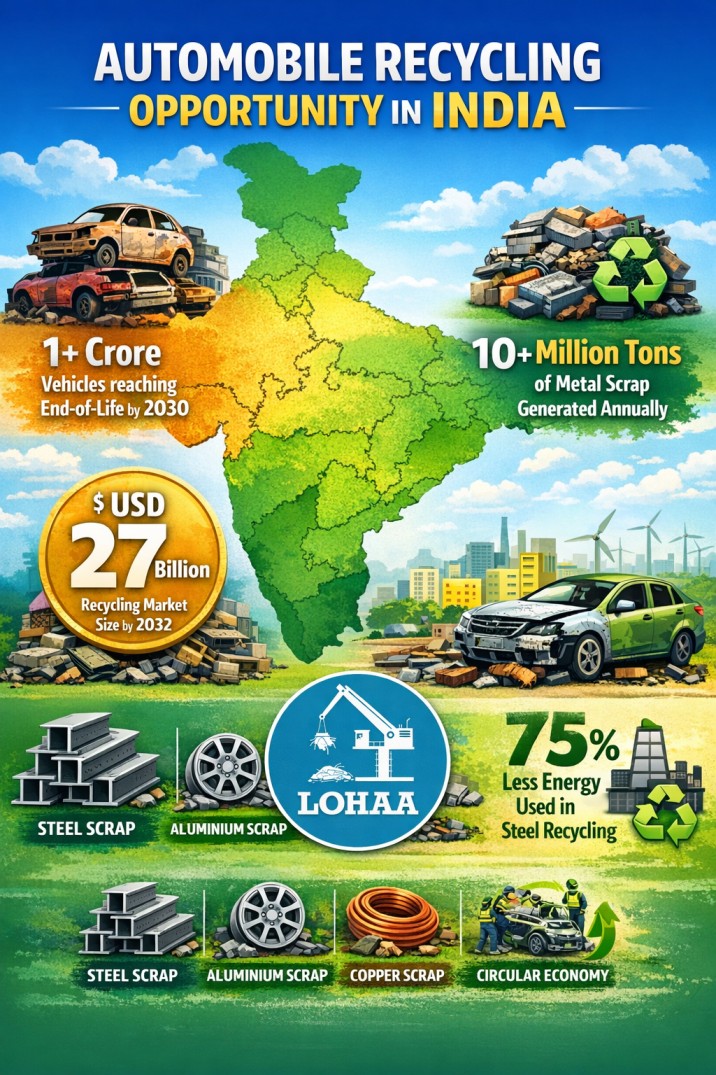
India’s automotive sector is one of the largest in the world, with millions of vehicles added to the road network each year. At the same time, a large number of vehicles are reaching the end of their operational life, creating a significant opportunity for automobile recycling and metal scrap generation.
To address environmental concerns and promote a circular economy, the Government of India introduced the Vehicle Scrappage Policy in 2021, which aims to phase out old vehicles and recover valuable materials such as steel, iron, aluminium, copper, and other metals. Vehicles older than 15 years (commercial vehicles) or 20 years (private vehicles) must undergo fitness tests and can be scrapped if they fail compliance requirements. (Policybazaar)
Automobile recycling is particularly important because a typical car contains large amounts of recyclable metals. On average:
• 65–70% of a vehicle’s weight is steel or iron scrap
• 7–8% aluminium
• 1–1.5% copper
• Remaining materials include plastics, rubber, glass, and fluids (RecycleInMe)
India currently has millions of ageing vehicles approaching end-of-life, providing a large potential supply of recyclable metals. Estimates suggest that by 2025, end-of-life vehicles could generate around 10 million tonnes of steel scrap alone. (blog.cvv.ac.in)
This article evaluates how successful India has been in generating scrap metals through automobile recycling, with regional analysis, data tables for 2024–2026, and insights into the strengths and weaknesses of the system.
Automobile Recycling and Scrap Generation Potential
The automotive recycling industry plays a crucial role in the circular metal economy. Instead of mining new ores, recycled metals from vehicles can be reused in manufacturing, reducing environmental impact and energy consumption.
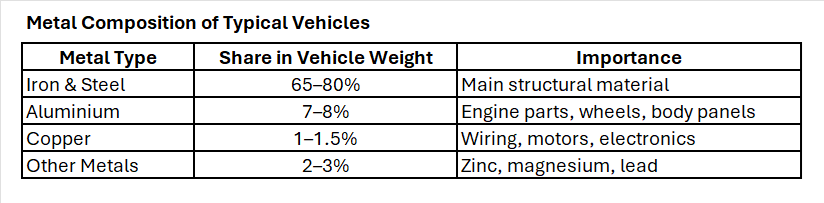
Ferrous metals dominate scrap recovery because most vehicles are built with steel structures. Non-ferrous metals such as aluminium and copper are smaller in volume but higher in economic value. (Metalbook)
Recycling metals from vehicles supports industries such as:
- Steel manufacturing
- Aluminium smelting
- Copper refining
- Automotive parts manufacturing
Growth of Automobile Scrap Recycling in India
India is gradually developing an organized vehicle scrappage ecosystem. The government aims to scrap over 500,000 vehicles annually by 2026, although actual numbers have been lower due to infrastructure limitations and slow adoption. (S&P Global)
The market is expanding rapidly:
- Vehicle scrappage industry estimated at USD 11.2 billion in 2025
- Expected to reach USD 27.5 billion by 2032
- CAGR of about 13.7% (Coherent Market Insights)
Recycling facilities known as Registered Vehicle Scrapping Facilities (RVSFs) are being established across the country to dismantle vehicles scientifically and recover metals.
Scrap Generation from Automobile Recycling (India)
The following table provides estimated scrap generation from automobile recycling in India.
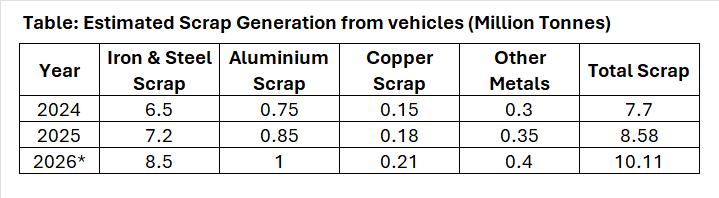
*Projected estimates based on vehicle scrappage growth.
Observations
- Steel scrap dominates due to heavy steel use in vehicles.
- Aluminium scrap is rising because modern vehicles use more lightweight alloys.
- Copper scrap growth is linked to electronic components and electric vehicles.
Regional Distribution of Automobile Scrap Generation in India
Vehicle ownership and scrappage infrastructure vary significantly across India. The distribution of automobile scrap generation is therefore uneven across regions.
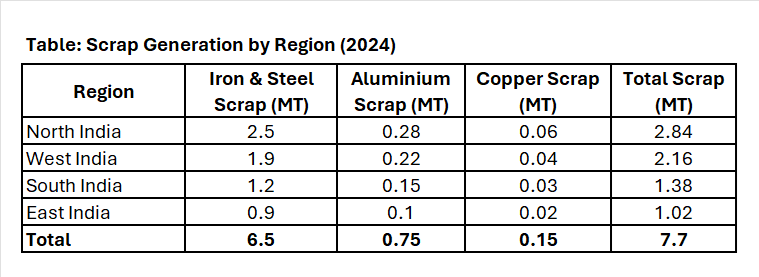
Recent reports show North India leading scrappage volumes, with nearly 70% of vehicles scrapped, largely due to stricter enforcement in the Delhi-NCR region. (The Times of India)
Regional Scrap Generation – 2024
Table: Scrap Generation by Region (2024)
Regional Scrap Generation – 2025
 Table: Scrap Generation by Region (2025)
| Region | iron & Steel (MT) | Aluminum Scrap (MT) | Copper Scrap (MT) | Total Scrap (MT) |
| North India | 2.80 | 0.32 | 0.07 | 3.19 |
| West India | 2.1 | 0.25 | 0.05 | 2.40 |
| South India | 1.4 | 0.18 | 0.03 | 1.61 |
| East India | 0.9 | 0.10 | 0.03 | 1.03 |
| Total | 7.20 | 0.85 | 0.18 | 8.58 |
Regional Scrap Generation – 2026 (Projection)
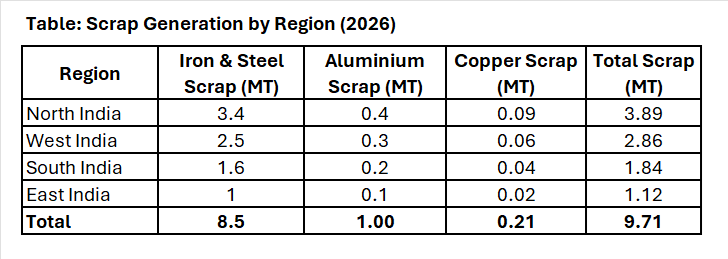
Regional Analysis
North India
Major states include:
• Delhi
• Haryana
• Uttar Pradesh
• Punjab
Reasons for higher recycling:
• Strong pollution regulations
• Mandatory scrapping of government vehicles
• Higher density of scrapping facilities
West India
Major states include:
• Maharashtra
• Gujarat
• Rajasthan
Key features:
• Large automobile market
• Strong steel and metal recycling industry
• Presence of ports supporting scrap trade
South India
States include:
• Tamil Nadu
• Karnataka
• Telangana
• Andhra Pradesh
South India has large automotive manufacturing hubs but relatively slower scrappage implementation due to infrastructure gaps.
East India
States include:
• West Bengal
• Odisha
• Bihar
• Jharkhand
The region is gradually expanding recycling facilities and scrap collection systems.
Types of Scrap Recovered from Automobile Recycling
Automobile recycling produces multiple categories of scrap metals.
1. Ferrous Scrap
Examples:
• Car body structures
• Chassis
• Engine blocks
Used primarily in steelmaking.
2. Aluminium Scrap
Examples:
• Wheels
• Engine components
• Transmission parts
Highly valuable due to lightweight properties.
3. Copper Scrap
Examples:
• Electrical wiring
• Motors
• Electronic circuits
High market value.
4. Other Metals
Examples:
• Zinc
• Magnesium
• Lead
Often recovered in smaller quantities.
Importance of Automobile Scrap Recycling
1. Reduces Import Dependence
India imports large quantities of scrap metal. Domestic recycling can reduce this reliance.
2. Supports Steel Production
India aims to reach 300 million tonnes steel production capacity by 2030, and scrap will play a key role. (Recycling International)
3. Environmental Benefits
Recycling metals reduces:
• Mining activities
• Carbon emissions
• Energy consumption
4. Economic Opportunities
The sector generates jobs in:
• dismantling
• scrap trading
• metal processing
Challenges in India’s Automobile Recycling System
Despite progress, several challenges remain.
1. Informal Recycling Sector
Much of India’s scrap recycling still occurs in informal markets with unsafe dismantling practices.
2. Limited Infrastructure
Many regions lack:
• testing stations
• authorized scrapping facilities
3. Slow Policy Adoption
Vehicle owners often delay scrapping due to emotional attachment or low incentives.
4. Supply Chain Fragmentation
Collection, dismantling, and metal recovery processes are not yet fully integrated.
SWOT Analysis – Automobile Scrap Recycling in India
Strengths
• Large ageing vehicle population
• Strong domestic steel industry
• Government scrappage policy
• Growing recycling infrastructure
Weaknesses
• Dominance of informal sector
• Limited technology in dismantling
• Inconsistent regional policy implementation
• Low public awareness
Opportunities
• Growth of electric vehicles creating new recycling streams
• Expansion of registered scrapping facilities
• Investment in circular economy
• Reduced dependence on imported scrap
Threats
• Illegal scrap dismantling
• fluctuating global scrap prices
• logistics and regulatory challenges
• environmental compliance issues
Future Outlook
India’s automobile recycling industry is expected to expand rapidly in the coming decade. Key developments likely include:
• Expansion of automated testing stations
• Growth of registered scrapping facilities
• Integration of digital vehicle tracking
• Greater recovery of high-value metals
With millions of vehicles expected to reach end-of-life in the next decade, automobile recycling could become one of the largest sources of domestic metal scrap in India.
 Conclusion
India has made important progress in generating metal scrap through automobile recycling, particularly after the introduction of the national vehicle scrappage policy. The country has significant potential due to its large number of ageing vehicles and expanding recycling infrastructure.
However, the sector is still in a transitional phase. While organized recycling facilities are increasing, a substantial portion of scrapping still occurs in informal markets.
If policy enforcement improves and recycling infrastructure expands, automobile recycling could become a major source of steel, aluminium, and copper scrap, supporting India’s metal industry and circular economy goals.
By using digital trade platforms like LOHAA Mobile application, you can reach global buyers, source quality material, and strengthen long-term partnerships.
Download the LOHAA Mobile application today and connect with verified scrap suppliers and manufacturers.
References
- Government of India – Vehicle Scrappage Policy overview (Policybazaar)
- S&P Global – India scrappage policy progress (S&P Global)
- Recycling International – India steel scrap demand (Recycling International)
- SIAM / automotive industry reports on ELV potential (Siam)
- TERI – Vehicle scrappage and recycling policy analysis (TERI)
- Metalbook – Material recovery from end-of-life vehicles (Metalbook)
- Policy discussions on scrap potential in India (blog.cvv.ac.in)
(Notes: market and production volume estimates are synthesized from public market reports and industrial press; exact tonne figures for scrap metal are not centrally published in a single comprehensive public dataset, therefore the numeric projection above is a conservative, documented estimate built from available intelligence and reasonable regional share assumptions.)


