
Metal Scrap Recycling in India: Trends & Challenges
1. Introduction: Why Recycling Matters
India's industrial expansion requires increasing quantities of steel, aluminium, copper, stainless steel and other metals. However, domestic scrap recovery is not keeping pace with demand for several grades.
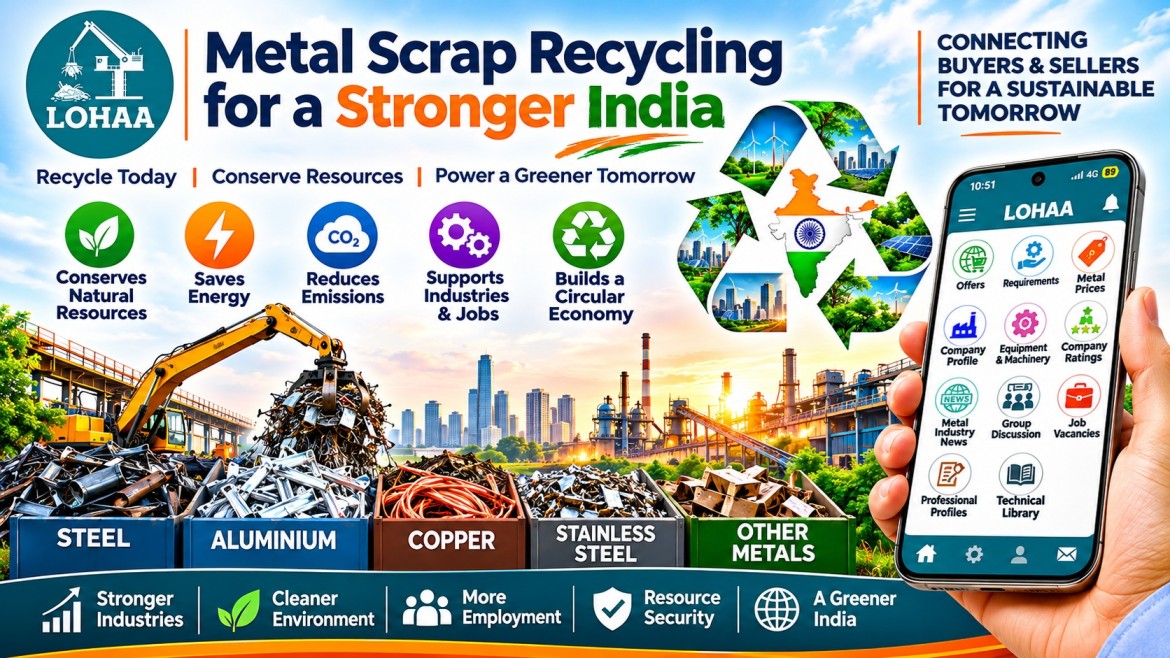
Recycling conserves natural resources, reduces energy consumption, supports employment and strengthens raw-material security. India's Economic Survey 2024–25 highlights approximately 40% lower water consumption and 58% lower greenhouse gas emissions from steel scrap recycling compared with conventional production pathways.
India Budget
Developing an organised metal recycling ecosystem is therefore essential for India's manufacturing competitiveness and green steel ambitions.
2. Domestic Scrap Generation: 2024–2026
a) Ferrous
- Year 2024: 33.36 Mt consumed in FY24
- Year 2025: Domestic generation rising
- Year 2026 outlook: ~28 Mt generated in FY26
b) Aluminium
- Year 2024: Significant import dependence
- Year 2025:Import reliance continued
- Year 2026 outlook: Domestic recovery remains insufficient
c) Copper
- Year 2024: 1.718 Mt consumption in FY24
- Year 2025: 1.878 Mt consumption in FY25
- Year 2026 outlook: 2.10 Mt consumption in FY26
d) Stainless steel
- Year 2024: Generation not separately consolidated
- Year 2025: Alloy segregation remains important
- Year 2026 outlook: Higher demand for clean graded scrap
e) Lead and zinc
- Year 2024: Fragmented collection data
- Year 2025: Formalisation progressing
- Year 2026 outlook:Battery and industrial recycling opportunities
Mt = million tonnes. Fiscal-year figures are not calendar-year totals. The table intentionally distinguishes scrap generation from metal consumption; no reliable comparable 2024–2026 national generation series is available for every metal. Sources: Ministry of Steel and ICA India. Steel Ministry+3
Government figures indicate that approximately 36 Mt of ferrous scrap was consumed during FY2025–26, including about 28 Mt domestically generated. The resulting difference demonstrates continued reliance on external supply.
Gazette Notification PDF
3. Regional Sources of Metal Scrap
Different industries generate different types of recoverable metals.
a) North
- Major scrap sources: Automobiles, engineering, demolition, electrical equipment
- Principal demand: Steel mills, foundries, copper and aluminium recyclers
b) West
- Major scrap sources: Automotive, ports, shipbreaking, brass manufacturing
- Principal demand: Secondary smelters, alloy makers, rolling mills
c) South
- Major scrap sources: Foundries, electronics, automobiles, fabrication
- Principal demand: Steel, stainless steel, aluminium and copper processors
d) East
- Major scrap sources: Steel plants, mining equipment, railways
- Principal demand: Steelmaking, ferro-alloys and foundries
e) Central
- Major scrap sources: Heavy engineering, infrastructure, vehicles
- Principal demand: Secondary steel and industrial recyclers
These are industrial concentration patterns, not measured state-wise generation totals.
Major Material Sources
• Ferrous: Demolition steel, machinery, railway scrap, fabrication offcuts and end-of-life vehicles.
• Aluminium: Automotive castings, UBCs, extrusions, cables and manufacturing offcuts.
• Copper and brass: Motors, transformers, electrical cables, plumbing and brass machining.
• Stainless steel: Food-processing equipment, chemical plants, kitchenware and fabrication.
• Lead and zinc: Batteries, galvanising residues and industrial manufacturing waste.
4. Regional Recycling Units and Organised Infrastructure
India's formal recycling ecosystem includes registered vehicle scrapping facilities, industrial scrap processors, secondary smelters and authorised hazardous-waste recyclers.
State Registered vehicle scrapping facilities*
- Uttar Pradesh: 47
- Haryana: 21
- Maharashtra: 10
- Gujarat: 9
- Punjab: 5
- Madhya Pradesh: 5
- Telangana: 3
- West Bengal: 3
- Andhra Pradesh: 2
- Karnataka: 2
*Government-reported counts as of 12 March 2026, not a complete count of all metal recycling plants. Nationally, 151 registered vehicle scrapping facilities were operational by 24 July 2026. Gazette Notification PDF+1
Government-recognised examples include Mahindra MSTC Recycling facilities in Noida, Chennai, Indore, Ahmedabad, Guwahati and Bengaluru. Press Information Bureau
Registered facilities support controlled dismantling, segregation, recovery and environmentally sound management of end-of-life vehicles.
5. Top 10 States for New Recycling Investment
The following states offer attractive opportunities based on industrial concentration, material availability, logistics and potential downstream customers. This is an indicative investment shortlist, not an official ranking.
i) Maharashtra
- Priority locations: Pune, Mumbai, Nagpur
- Promising recycling activity: Automotive steel, aluminium, copper
ii) Gujarat
- Priority locations: Ahmedabad, Jamnagar, Alang
- Promising recycling activity: Brass, copper, aluminium, ship scrap
iii) Tamil Nadu
- Priority locations: Chennai, Coimbatore, Hosur
- Promising recycling activity: Foundry scrap, aluminium, stainless steel
iv) Uttar Pradesh
- Priority locations: Noida, Kanpur, Ghaziabad
- Promising recycling activity: Vehicles, ferrous and electrical scrap
v) Haryana
- Priority locations: Gurugram, Faridabad
- Promising recycling activity: Automotive and engineering scrap
vi) Karnataka
- Priority locations: Bengaluru, Hubballi
- Promising recycling activity: Electronics, copper, aluminium
vii) Telangana
- Priority locations: Hyderabad, Medak
- Promising recycling activity: Engineering, stainless, aluminium
viii) Punjab
- Priority locations: Ludhiana, Mandi Gobindgarh
- Promising recycling activity: Ferrous and industrial scrap
ix) Odisha
- Priority locations: Angul, Jharsuguda
- Promising recycling activity: Steel and aluminium residues
x) West Bengal
- Priority locations: Kolkata, Howrah, Durgapur
- Promising recycling activity: Ferrous, foundry and engineering scrap
Investment potential depends on reliable scrap sourcing, suitable industrial land, environmental approvals, power costs, technology and assured buyers.
High-potential opportunities include shredding, copper granulation, aluminium decoating, stainless-steel sorting and certified vehicle dismantling.
6. Why Domestic Scrap Supply Falls Short
India consumes large quantities of metal but has historically accumulated a smaller stock of recoverable end-of-life material than many mature industrial economies.
Infrastructure remains in service for decades, delaying scrap generation. Meanwhile, fragmented collection networks, contamination, inadequate segregation and limited processing facilities restrict recovery.
Demand for clean, chemistry-controlled scrap is especially strong among foundries, electric furnace operators and secondary alloy manufacturers.
Consequently, greater metal consumption today does not automatically produce equivalent scrap availability today.
7. Export Restrictions, CBAM and Green Steel
The EU's revised Waste Shipment Regulation introduces tighter controls on non-hazardous waste exports to non-OECD countries from 21 May 2027, with exceptions for approved destinations meeting environmental requirements.
European Commission
These restrictions could influence scrap availability and procurement costs for Indian recyclers.
CBAM creates a separate challenge: emissions reporting and carbon-related compliance for covered exports, including specified steel and aluminium products.
India can respond through stronger domestic collection, diversified international sourcing, better recycling technology, scrap traceability and appropriate use of DRI/HBI alongside scrap.
8. Production, Demand and Recycling Mismatch
a) Steel
- Key mismatch: Clean scrap supply versus furnace demand
- Recommended response: Shredding and domestic recovery
b) Aluminium
- Key mismatch: Secondary smelter requirements versus local availability
- Recommended response: UBC and automotive collection
c) Copper
- Key mismatch: Electrical demand versus recoverable scrap
- Recommended response: Cable and motor recycling
d) Stainless steel
- Key mismatch: Alloy-specific demand versus mixed scrap
- Recommended response: Grade sorting and testing
e) Lead
- Key mismatch: Battery recovery versus safe processing
- Recommended response: Formal collection and licensed recycling
f) Zinc
- Key mismatch: Industrial residues versus recovery capacity
- Recommended response: Specialist recovery technology
9. SWOT Analysis: India's Recycling Industry
Strengths: Large manufacturing base, growing domestic demand and an established network of metal traders and processors.
Weaknesses: Fragmented collection, inconsistent quality, insufficient processing and import dependence.
Opportunities: Vehicle scrapping, green steel, advanced sorting, secondary smelting and digital marketplaces.
Threats: Export restrictions, volatile prices, logistics costs, contamination and environmental non-compliance.
10. How LOHAA Supports Metal Scrap Trading
The LOHAA Mobile Application of Android and iPhone / Portal B2B Metals Marketplace helps connect scrap suppliers, recyclers, traders, foundries and industrial buyers.
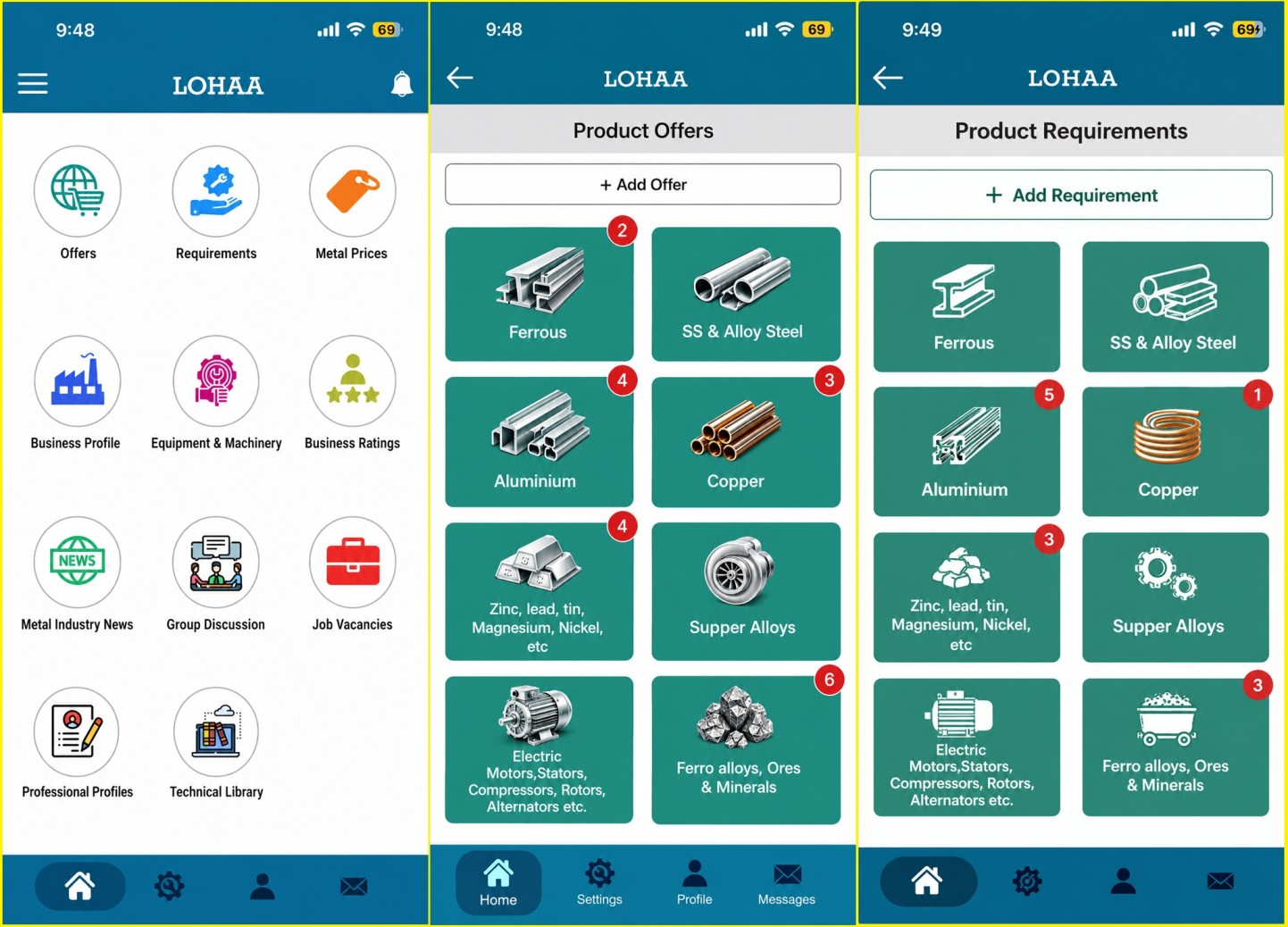
Businesses can publish offers and requirements, discover potential counterparties, access market information and communicate directly.
LOHAA covers ferrous and non-ferrous scrap, aluminium, copper, stainless steel, alloys and other industrial materials.
Digital marketplaces can improve visibility across regions and reduce information gaps. However, buyers should independently verify supplier credentials, material specifications, quantities and commercial terms.
11. Conclusion
India's recycling opportunity extends beyond increasing scrap collection. It requires organised supply chains, quality processing, transparent trading, environmental compliance and reliable industrial demand.
Strengthening domestic recycling can reduce import vulnerability, support green manufacturing and create new investment opportunities.
Metal scrap is a strategic raw material for India's industrial future—not simply waste.
12. Top 10 Frequently Asked Questions
1. Why is metal recycling important for India?
It reduces raw-material imports, conserves resources, lowers emissions and supports industrial employment.
2. How much ferrous scrap does India generate?
Approximately 28 million tonnes were generated domestically during FY2025–26, according to government reporting.
3. Which states offer strong recycling opportunities?
Maharashtra, Gujarat, Tamil Nadu, Uttar Pradesh, Haryana, Karnataka, Telangana, Punjab, Odisha and West Bengal.
4. What are the major sources of aluminium scrap?
Used beverage cans, automotive components, extrusions, electrical cables and manufacturing offcuts.
5. Why does India import scrap?
Domestic collection and processing cannot consistently meet industrial requirements for quantity and quality.
6. Which metal recycling businesses have growth potential?
Steel shredding, aluminium recycling, copper granulation, stainless sorting and vehicle dismantling.
7. How will EU waste shipment restrictions affect India?
They may constrain access to certain EU-origin scrap categories and increase compliance and sourcing requirements.
8. How does CBAM affect Indian metal manufacturers?
It increases the importance of emissions measurement and low-carbon production for covered EU-bound products.
9. How does LOHAA help scrap traders?
LOHAA connects industrial buyers and sellers through offers, requirements, market information and communication features.
10. Can India achieve scrap self-sufficiency?
Improved collection and recycling can narrow shortages, but imports will remain important for some grades and metals.
13. References and Sources
1. Ministry of Steel – Steel Scrap Recycling Policy, March 2026
2. Economic Survey 2024–25 – Industrial Sector
3. Government of India – Setting Up Metal Scrapping Centres
4. International Copper Association – FY2025 Copper Demand
5. IBEF – India's Copper Demand, FY2026
6. European Commission – Waste Shipment Regulation
7. European Commission – Carbon Border Adjustment Mechanism
8. Government of India – Registered Vehicle Scrapping Facilities
By using digital trade platforms like LOHAA Mobile application, you can reach global buyers, source quality material, and strengthen long-term partnerships.
Download the Lohaa Metal Trading App for Android to access live scrap prices and real-time market updates anytime, anywhere.
Download the Lohaa Metal Trading App for iOS to access live scrap prices and real-time market updates anytime, anywhere.
(Notes: market and production volume estimates are synthesized from public market reports and industrial press; exact tonne figures for materials are not centrally published in a single comprehensive public dataset, therefore the numeric projection above is a conservative, documented estimate built from available intelligence and reasonable regional share assumptions.)


