
Minor Ferro Alloys: India 2030 Growth & Market Outlook
1. Introduction
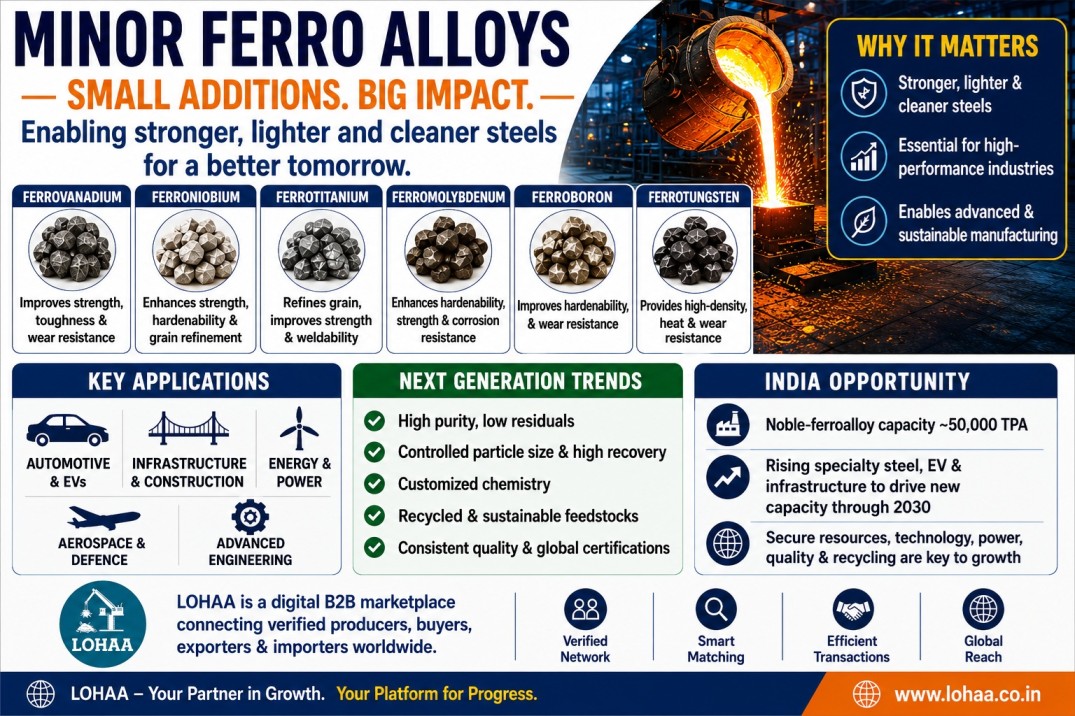
Minor ferro alloys are specialty alloying materials added in small quantities to steel, cast iron and selected non-ferrous alloys to deliver targeted improvements in strength, toughness, hardenability, grain refinement, wear resistance, corrosion resistance and high-temperature performance. Important grades include ferrovanadium, ferroniobium, ferrotitanium, ferromolybdenum, ferroboron, ferrotungsten and ferrozirconium. Although volumes are smaller than bulk ferroalloys, their strategic and economic value is high because advanced steels depend on precise additions. Automotive light weighting, electric vehicles, infrastructure, aerospace, defence, energy and engineering are creating demand for high-purity, low-residual and application-specific minor ferro alloys, giving India an opportunity to expand production and reduce import dependence.
2. Minor Ferro Alloys: Definition and Importance
Ferro alloys are generally divided into bulk ferro alloys and noble or minor ferro alloys. Bulk grades include ferromanganese, silicomanganese, ferrochrome and ferrosilicon, which are consumed in large quantities. Minor or noble ferro alloys are used in smaller quantities but often have considerably higher value per tonne.
The Indian ferroalloy industry itself recognizes ferrovanadium, ferromolybdenum, ferrotungsten, ferroboron, ferrotitanium, ferrosilicon magnesium and related products as noble ferroalloys. The Indian Bureau of Mines reports that noble ferroalloys are vital inputs for special steels and alloys. (IBM Government)
The principal value of minor ferro alloys comes from their ability to produce a large metallurgical effect from a relatively small addition.
For example:
• Vanadium increases strength and wear resistance.
• Niobium promotes grain refinement and precipitation strengthening.
• Titanium controls nitrogen and carbon and refines grain structure.
• Molybdenum improves hardenability and high-temperature performance.
• Boron strongly improves hardenability at very low addition levels.
• Tungsten improves hot hardness and wear resistance.
• Zirconium can assist inclusion modification and grain refinement.
This makes minor ferro alloys especially important for modern steels where manufacturers need to achieve higher performance without significantly increasing material weight.
3. Industrial Applications
Minor ferro alloys are used across a broad range of industries.
- Automotive: AHSS, HSLA, chassis, crash structures, gears, shafts
- EVs: Lightweight structures, high-strength components
- Construction: HSLA structural steel, reinforcement and heavy sections
- Railways: Rail steel and wear-resistant components
- Oil & Gas: Pipeline and pressure-resistant steels
- Aerospace: High-temperature and specialty alloys
- Defence: Armour, high-strength and wear-resistant steels
- Energy: Power plants, wind equipment and high-temperature components
- Engineering: Tools, dies, machinery and wear parts
- Stainless Steel: Controlled alloy additions and performance improvement
- Foundries: Alloy modification and specialized castings
The importance of these applications is increasing as manufacturers move toward higher strength-to-weight ratios.
4. New-Generation Minor Ferro Alloys
The definition of "new-generation" minor ferro alloys is broader than simply increasing the concentration of the principal alloying element.
The next generation is characterized by:
a) High-purity chemistry
b) Low residual elements
c) Controlled particle size
d) High alloy recovery
e) Fast dissolution
f) Consistent batch chemistry
g) Customized alloy composition
h) Cored-wire application
i) Recycled feedstock
j) Multi-element microalloying
This transition is important because advanced steelmakers are increasingly operating with narrow chemical tolerances.
For example, an automotive steel producer may require a very specific Nb, Ti, V, B, C and N relationship. In such cases, consistency of the ferroalloy can be as important as its nominal alloying-element percentage.
5. Importance in the Automobile Industry
The automobile industry is one of the most important growth markets for new-generation minor ferro alloys.
Modern vehicles need to satisfy apparently conflicting objectives:
• Lower vehicle weight
• Higher crash safety
• Higher tensile strength
• Better fatigue resistance
• Better corrosion performance
• Better formability
• Lower manufacturing cost
Advanced high-strength steels help achieve this combination.
Microalloying elements such as Nb, V and Ti allow steelmakers to increase strength while controlling grain size and precipitation behavior.
Automotive relevance
Ferroniobium:
Important in HSLA and advanced automotive steels because niobium contributes to grain refinement and precipitation strengthening.
Ferrovanadium:
Used where higher strength, wear resistance and improved mechanical performance are required.
Ferrotitanium:
Particularly relevant for automotive and stainless steels where low residual chemistry and nitrogen control are important. Bansal Brothers describes its FeTi grades as being used in auto-grade steel, stainless steel and automotive tools and parts. (Bansal Brothers)
Ferroboron:
Used in steels where increased hardenability is required.
Ferromolybdenum:
Used in alloy and stainless steels where hardenability, strength and elevated-temperature performance are important.
The rise of EVs does not eliminate steel demand. Instead, it changes the performance requirements of vehicle structures. Lightweighting and battery weight make high-strength materials particularly valuable.
6. Specifications and Typical Composition
Specifications differ by producer, application and customer standard. The following ranges are representative rather than universal commercial specifications.
- Ferrovanadium - V (50–80%) Strength and wear resistance
- Ferroniobium -Nb (60–70%) Grain refinement and HSLA strengthening
- Ferrotitanium - Ti (30–75%) Grain refinement and residual control
- Ferromolybdenum - Mo (55–75%) Hardenability and heat resistance
- Ferroboron - B (10–20%) Hardenability
- Ferrotungsten W (70–85%) Hot hardness and wear resistance
- Ferrozirconium - Zr (Variable) Inclusion control
- Ferrophosphorus -P (Variable) Alloying and selected cast-iron applications
- Ferrosilicon magnesium - Mg/Si (Variable) Nodular cast iron
- Ferroaluminium - Al (Variable) Deoxidation and alloying
ASTM maintains specifications for grades such as ferrovanadium, ferrotitanium and ferrotungsten, demonstrating the importance of controlled chemical composition. (U.S. Geological Survey)
For commercial purchasing, buyers should specify:
• Principal alloying element
• Carbon
• Silicon
• Aluminium
• Sulfur
• Phosphorus
• Nitrogen
• Oxygen
• Particle size
• Packing
• Test certificate
• Origin
• Heat/batch number
• Required recovery rate
7. India's Ferroalloy Industry and Minor Ferroalloys
India has a substantial ferroalloy manufacturing ecosystem.
The Indian Ferro Alloys Producers' Association reports total ferroalloy capacity of approximately 5.15 million tonnes, comprising about 5.10 million tonnes of bulk ferroalloys and 50,000 tonnes of noble ferroalloys. The noble category includes ferromolybdenum, ferrovanadium, ferrotungsten, ferroboron, ferrotitanium and related products.
The Indian Bureau of Mines' latest available detailed data reports 50,000 tonnes/year of noble ferroalloy capacity and 2023–24 production of 766 tonnes ferromolybdenum, 856 tonnes ferrovanadium, 387 tonnes ferrotitanium and 752 tonnes ferroaluminium in the reported categories. (IBM Government)
This highlights an important point: installed capacity should not be confused with actual production.
India's noble ferroalloy capacity is considerably larger than the production reported for several individual grades, indicating substantial room to improve capacity utilization.
8. India: 2025 Production and Consumption
There is no single official statistical series that separately reports the entire Indian minor-ferroalloy market for calendar year 2025. Therefore, the following table is a market-planning estimate, constructed from official Indian capacity information, trade data, reported production and industry trends.
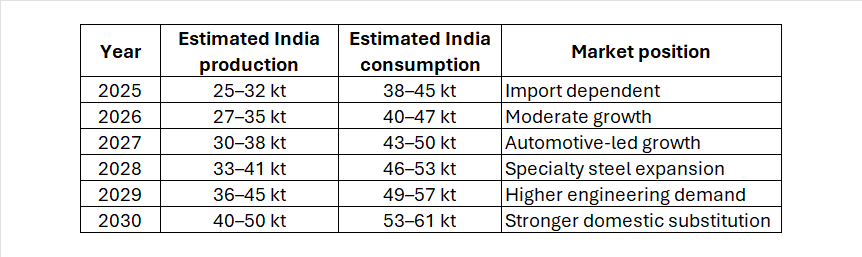 Note: These figures represent the author's market model and should not be treated as official Government of India statistics.
The trade data show India's continuing reliance on imported specialty ferroalloys. In FY2023–24, India imported about 5,079 tonnes of ferroniobium, 2,994 tonnes of ferromolybdenum, 1,528 tonnes of ferrotitanium, 1,206 tonnes of ferrovanadium, 1,028 tonnes of ferroboron and 60 tonnes of ferrotungsten. (IBM Government)
This import dependence creates an opportunity for domestic production.
9. India Forecast: 2026–2030
Five major forces are expected to support Indian demand:
9.1 Specialty steel expansion
India is actively promoting specialty steel production through the PLI scheme. The first phase attracted commitments of ?27,106 crore and downstream capacity additions, while PLI Scheme 1.1 was launched in January 2025. (Steel Authority of India Limited)
9.2 Automotive growth
India is becoming an increasingly important global automotive manufacturing hub. Higher-value steel grades will increase demand for microalloying elements.
9.3 EV lightweighting
EVs need efficient lightweight structures because battery packs add substantial vehicle mass.
9.4 Defence manufacturing
Domestic production of defence equipment requires high-strength and specialty steels.
9.5 Infrastructure
Railways, bridges, pipelines, power infrastructure and high-rise construction all increase demand for advanced structural steels.
10. Leading Countries Producing New-Generation Minor Ferro Alloys
The global market is highly fragmented because individual alloys have different supply chains.
Brazil
Brazil is the dominant country for niobium. USGS estimates that Brazil accounted for approximately 93% of global niobium mine production in 2025, followed by Canada at about 5%. (USGS Publications)
CBMM is the dominant ferroniobium producer. Its 2025 sustainability report states that it produced 100,000 tonnes of ferroniobium equivalent in 2025, while its installed capacity is approximately 150,000 tonnes/year. (CBMM)
China
China is a major producer and consumer of molybdenum, tungsten, vanadium and other specialty alloying materials.
CMOC operates integrated molybdenum and tungsten operations and produces ferromolybdenum and other related products. In 2025, CMOC China produced 13,906 tonnes of molybdenum and 7,114 tonnes of tungsten. (CMOC)
China's 2025 molybdenum output was approximately 133,000 tonnes and domestic consumption about 152,000 tonnes according to company-reported Antaike data. (HKEX News)
South Africa
South Africa is strategically important for vanadium. Glencore operates the Rhovan vanadium operation, while Bushveld Minerals operates Vametco and Vanchem.
Glencore reported 18.0 million pounds of vanadium pentoxide production from its own assets in 2025 and identifies Rhovan as primarily producing ferrovanadium and vanadium pentoxide. (Glencore)
Bushveld produces ferrovanadium, nitrovanadium, vanadium oxides and chemicals. (Bushveld Minerals)
Japan
Japan is an important high-quality specialty-alloy and downstream steel market, particularly for automotive and advanced engineering applications.
Germany and Austria
European producers such as Treibacher and specialty-material companies serve high-quality steel, stainless, tool-steel and advanced engineering customers.
Treibacher's portfolio includes FeV and FeMo for high-quality steels, tool steels, stainless steels and superalloys.
India
India has a smaller but growing specialty ferroalloy manufacturing base and an established steel-consuming market. Bansal Brothers, for example, operates a dedicated FeTi facility with reported capacity of 7,400 tonnes/year. (Bansal Brothers)
11. Global Minor Ferroalloy Market Forecast 2025–2030
Because no international statistical organization publishes one consolidated "minor ferroalloy" category, the following is an indicative market model covering the principal specialty ferroalloys.
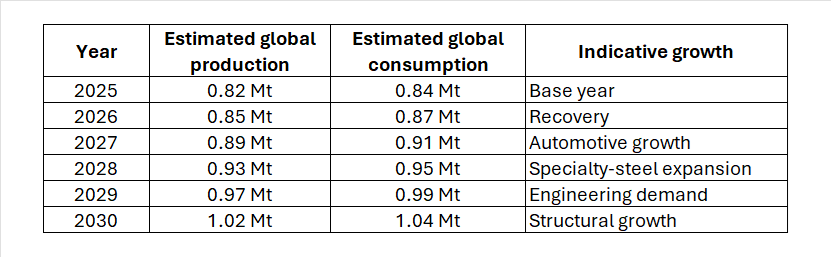 These figures are market estimates, not official global production statistics.
The underlying commodity trends support continued growth. The International Molybdenum Association reported global molybdenum production of 672.6 million pounds in 2025, up 4%, while usage rose 3% to 671.8 million pounds. (Imoa)
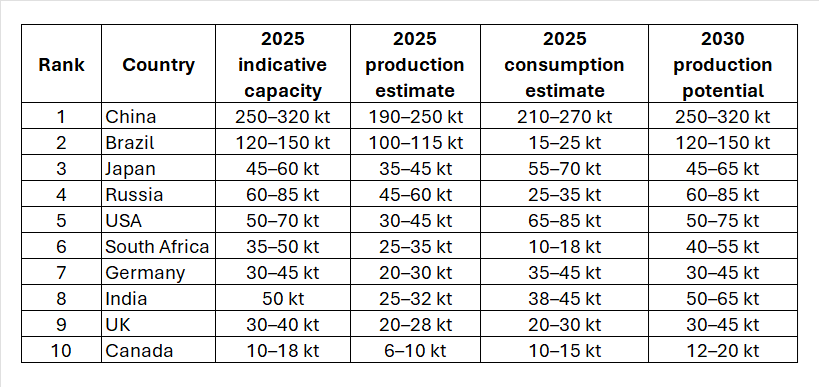
12. Top Ten Countries: Production, Capacity and Consumption
 13. Top 20 Minor Ferroalloy Manufacturers / Producers
There is no globally audited database ranking the top 20 manufacturers across all minor ferroalloys. The following is therefore a practical global producer/supplier universe based on documented production of ferroniobium, ferrovanadium, ferrotitanium, ferromolybdenum, ferrotungsten and other specialty alloying products.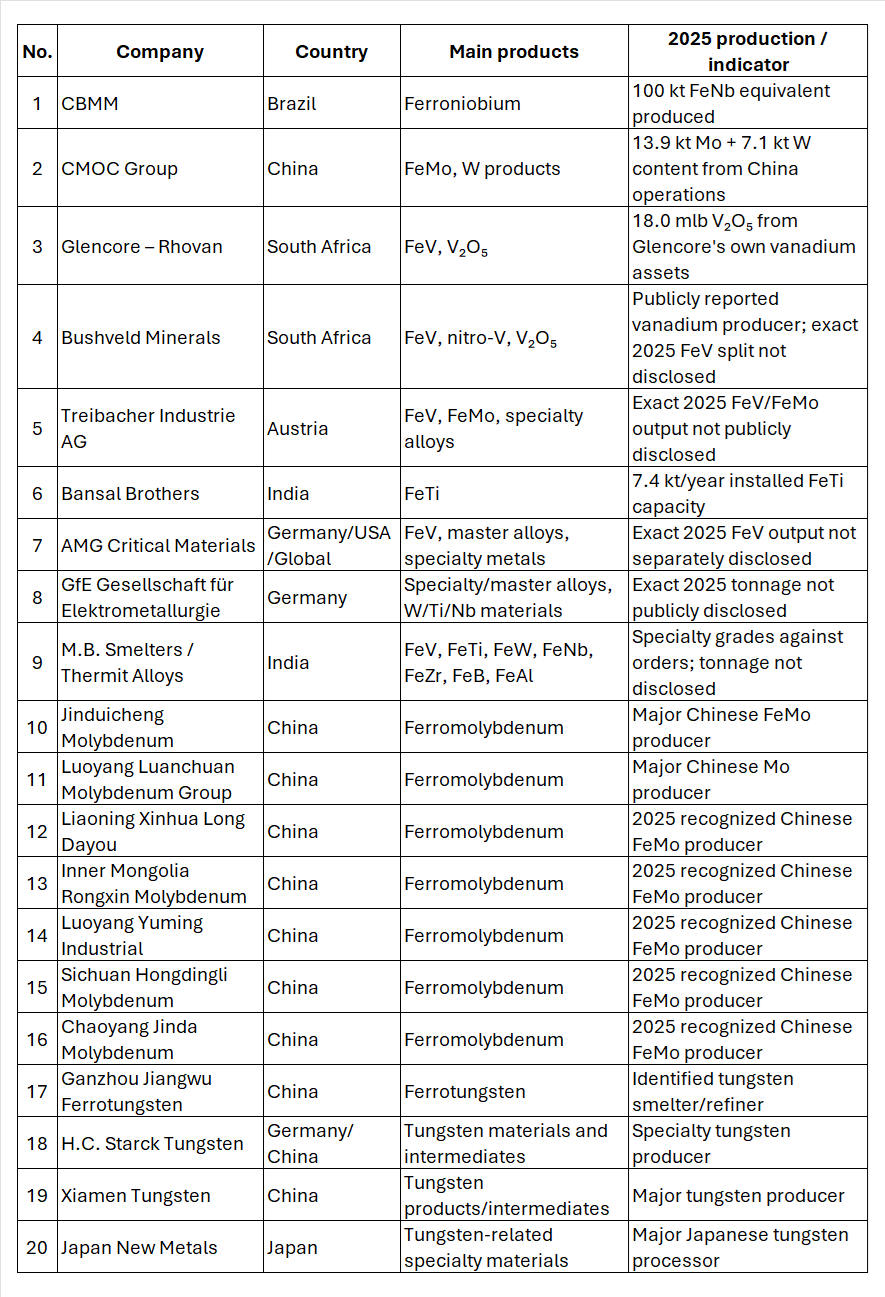 For the Chinese ferromolybdenum companies, FerroAlloyNet's 2026 conference materials identify Jinduicheng, Luoyang Luanchuan, Liaoning Xinhua Long Dayou, Inner Mongolia Rongxin, Luoyang Yuming, Sichuan Hongdingli, Chaoyang Jinda and other companies among the 2025 China Ferromolybdenum Excellent Producers. (FerroAlloyNet)
For tungsten, responsible-mineral supply-chain records identify Ganzhou Jiangwu Ferrotungsten, Xiamen Tungsten, H.C. Starck Tungsten, Japan New Metals and several other processors.
Important production-data qualification
A company's production capacity, actual production, alloy-equivalent production and upstream metal production are not interchangeable.
For example:
• CBMM directly reports ferroniobium-equivalent production.
• Glencore reports vanadium pentoxide production rather than FeV tonnage.
• CMOC reports molybdenum and tungsten metal content rather than a single FeMo tonnage.
• Bansal Brothers publishes FeTi capacity rather than audited 2025 output.
• Many Chinese producers disclose market participation but not company-level annual tonnage.
Therefore, inserting fabricated exact production figures would give a false impression of precision. The table deliberately distinguishes disclosed production from capacity or production indicators.
14. Product Details of Leading Manufacturers
14.1 CBMM — Ferroniobium
CBMM is the most important global ferroniobium producer.
Its 2025 sustainability information reports 100,000 tonnes of ferroniobium-equivalent production, up 4.7% from the previous year. Its installed capacity is approximately 150,000 tonnes/year. (CBMM)
Its products are used extensively in microalloyed steels and increasingly in advanced applications including batteries and other high-performance materials.
14.2 Glencore — Ferrovanadium
Glencore's Rhovan operation in South Africa produces ferrovanadium and vanadium pentoxide. Glencore reported 18.0 million pounds of vanadium pentoxide production from its own assets in 2025. (Glencore)
Vanadium is used for strengthening specialty steels and is also important in vanadium redox-flow batteries.
14.3 Bushveld Minerals — Ferrovanadium and Nitrovanadium
Bushveld's product portfolio includes:
• Ferrovanadium
• Nitrovanadium
• Vanadium pentoxide
• Vanadium oxides
• Vanadium chemicals
The company operates Vametco and Vanchem in South Africa. (Bushveld Minerals)
Its nitrovanadium product is particularly interesting as a next-generation steel microalloying product because it can improve vanadium utilization.
14.4 Treibacher Industrie AG
Treibacher produces high-quality ferrovanadium and ferromolybdenum for:
• HSLA steel
• Structural steel
• Rail steel
• Tool steel
• Stainless steel
• Superalloys
The company also uses vanadium-bearing steelmaking residues to recover vanadium oxides that can subsequently be converted into ferrovanadium, illustrating the circular-economy potential of specialty ferroalloys. (Treibacher Industrie AG)
14.5 Bansal Brothers
Bansal Brothers is one of India's notable FeTi producers.
The company reports:
• 3 induction furnaces
• 7,400 tonnes/year FeTi capacity
• FeTi grades from approximately 30% to 75% Ti
• Dedicated crushing and sizing
• Titanium scrap processing
• Export capability
The company supplies Indian steel producers and exports to several international markets. (Bansal Brothers)
14.6 CMOC Group
CMOC operates an integrated molybdenum and tungsten business in China and produces ferromolybdenum as part of its downstream portfolio. In 2025, its China operations produced 13,906 tonnes of molybdenum and 7,114 tonnes of tungsten. (CMOC)
The company is therefore strategically positioned in the supply chain for high-temperature and specialty steels.
15. New-Generation Minor Ferroalloy Types
15.1 High-Purity Ferrovanadium
Designed for advanced steels requiring tight residual-element control.
15.2 High-Recovery Ferroniobium
Optimized for fast dissolution and high Nb recovery during steelmaking.
15.3 Low-Residual Ferrotitanium
Designed for automotive and stainless steel grades where carbon, oxygen and nitrogen must be carefully controlled.
15.4 Ferroboron
Provides hardenability at extremely low addition levels.
15.5 High-Purity Ferromolybdenum
Used in high-performance stainless, tool, structural and energy steels.
15.6 Ferrotungsten
Important for high-speed steels, tool steels and high-temperature applications.
15.7 Cored-Wire Ferroalloys
The alloy is filled into a steel wire, enabling precise addition and better recovery.
15.8 Multi-Element Microalloys
Examples include Nb-V-Ti systems designed to optimize precipitation, grain refinement and strength.
15.9 Recycled Minor Ferroalloys
Recovery from:
• Titanium scrap
• Vanadium-bearing slag
• Molybdenum-bearing residues
• Tungsten scrap
• Alloy-steel waste
• Industrial catalysts
can reduce dependence on primary mineral resources.
16. Why Recycled Feedstock Is Important
Recycling is likely to become one of the strongest long-term trends in minor ferroalloys.
Treibacher, for example, recovers vanadium from vanadium-bearing steelmaking slag and converts recovered material into ferrovanadium. (Treibacher Industrie AG)
GfE also highlights recovery of high-purity vanadium compounds from residues, catalysts and other secondary sources. (GFE)
This creates an opportunity for India to develop a secondary strategic-alloy industry based on industrial residues.
Potential sources include:
• Alloy-steel scrap
• Stainless-steel scrap
• Tool-steel scrap
• Titanium scrap
• Vanadium-bearing slag
• Spent catalysts
• Tungsten carbide scrap
• Molybdenum-bearing industrial waste
17. Constraints to Developing New-Generation Minor Ferro Alloys
17.1 Raw-material availability
Several strategic elements are geographically concentrated.
Brazil's dominance in niobium is a major example. USGS estimates that Brazil accounted for approximately 93% of global niobium mine production in 2025. (USGS Publications)
17.2 High raw-material prices
Molybdenum, tungsten, vanadium and niobium can experience significant price volatility.
17.3 Electricity cost
Ferroalloy production is energy intensive. IFAPA reports electricity can account for more than 40–70% of ferroalloy production costs depending on the product.
17.4 Limited domestic technology
India has strong bulk-ferroalloy experience but needs additional investment in high-purity specialty grades.
17.5 Small production batches
Automotive customers may require customized chemistry in relatively small quantities, making production economics challenging.
17.6 Quality certification
OEMs increasingly demand:
• Full traceability
• Batch testing
• Statistical process control
• Consistent recovery
• Low residual elements
17.7 Environmental requirements
Furnace emissions, slag handling, dust collection and energy consumption can increase capital and operating costs.
17.8 Supply concentration
Dependence on a small number of countries creates geopolitical and logistics risks.
17.9 Lack of reliable market statistics
The market is fragmented among many HS codes and product categories. This makes capacity and production comparisons difficult.
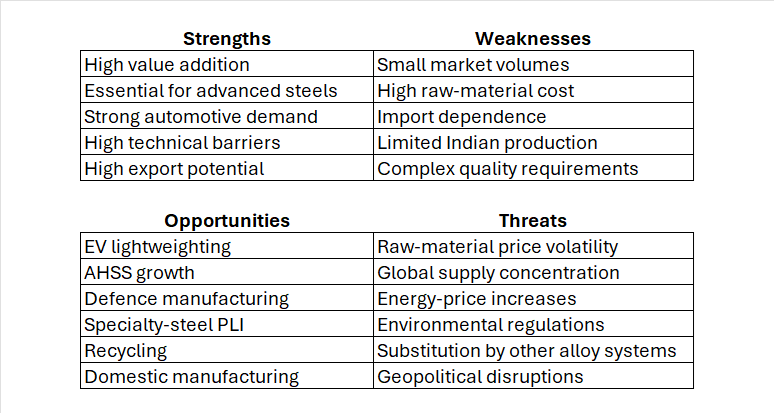
18. SWOT Analysis
 19. India: Strategic Opportunity 2026–2030
India can potentially become an important regional supplier of specialty ferroalloys.
The strongest opportunities are:
Opportunity 1 — Ferrotitanium
India already has commercial production and an established titanium-scrap ecosystem.
Opportunity 2 — Ferrovanadium
Domestic steel demand and strategic supply-chain requirements create room for additional capacity.
Opportunity 3 — Ferroboron
India currently imports ferroboron; domestic production could substitute imports.
Opportunity 4 — Ferromolybdenum
India's stainless, engineering, defence and energy industries can support higher consumption.
Opportunity 5 — Ferrozirconium
Specialty steel and foundry applications can provide a niche market.
Opportunity 6 — Cored-wire products
Cored-wire technology can improve alloy recovery and allow smaller producers to serve specialized steel grades.
Opportunity 7 — Recycling
Recovery of alloying elements from industrial waste can provide a lower-cost and lower-carbon feedstock.
20. Usage of LOHAA Mobile Application of Android and iPhone / Portal for Minor ferro alloys Commercial Transactions
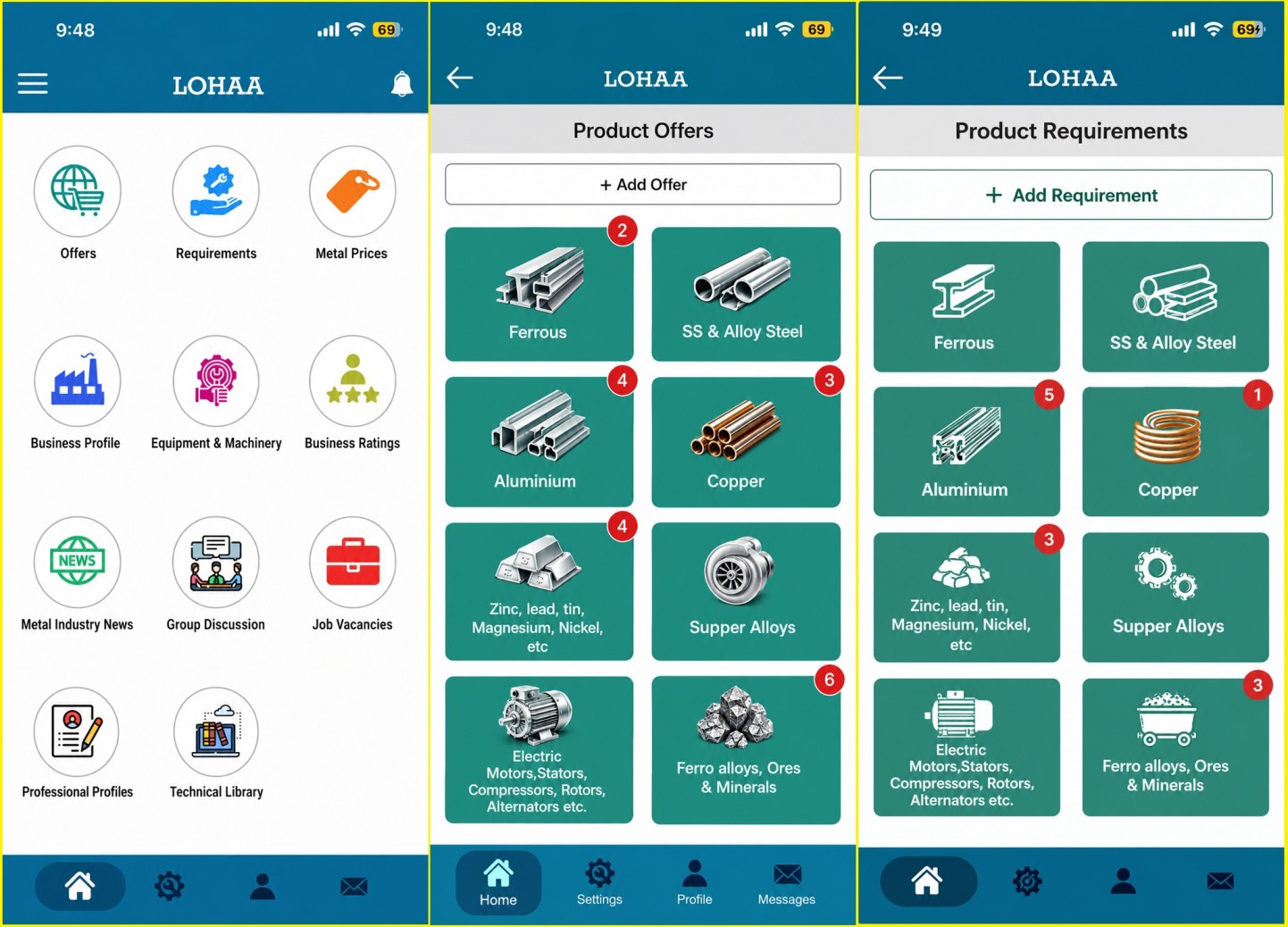
LOHAA can provide a digital B2B channel for producers, buyers, exporters and importers of minor ferroalloys and specialty metals.
The opportunity is particularly relevant because the minor-ferroalloy market is fragmented and buyers often need to identify suppliers based on exact chemical specifications rather than simply product names.
LOHAA applications
a). Buying requirements
Steelmakers can publish requirements for:
• FeV
• FeNb
• FeTi
• FeMo
• FeB
• FeW
• FeZr
b). Selling offers
Manufacturers can publish:
• Grade
• Chemistry
• Quantity
• Size
• Packing
• Origin
• Delivery location
• Price indication
c). Supplier discovery
Buyers can identify domestic and international suppliers.
d). Import sourcing
Indian buyers can use the platform to locate international producers and compare available supply.
e). Commercial leads
The platform can help convert technical requirements into direct commercial enquiries.
f). Verified business ecosystem
LOHAA's business-oriented registration and verification process can be particularly useful for specialty alloy transactions where counterparty credibility is important.
g). Equipment sourcing
Specialty ferroalloy producers can also use the broader platform ecosystem for:
• Induction furnaces
• Crushing equipment
• Screening systems
• Recycling machinery
• Cored-wire equipment
• Laboratory equipment
This creates an opportunity for LOHAA to become a specialized digital marketplace connecting minor ferroalloy manufacturers, steelmakers, foundries, exporters, importers, recyclers and equipment suppliers.
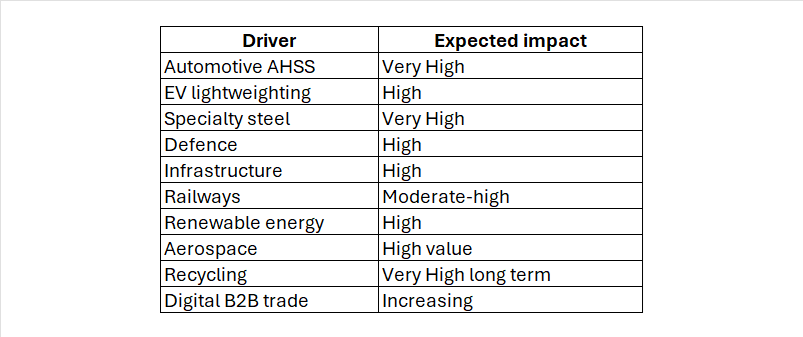
21. Key Market Drivers 2026–2030
 22. India vs Global Opportunity
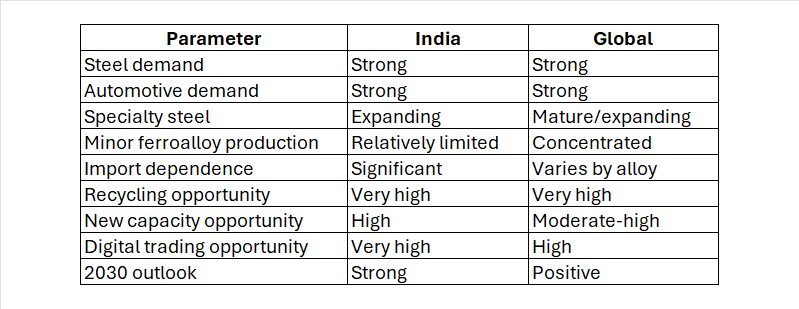 India's specialty-steel policy provides an additional structural advantage. The Ministry of Steel has explicitly identified specialty steel as important for defence, automobiles and electrical applications and is using the PLI programme to promote domestic manufacturing. (Steel Authority of India Limited)
23. Recommended Strategy for Indian Producers
Indian companies entering the new-generation minor ferroalloy sector should avoid competing only on price.
The preferred strategy should be:
Raw material → controlled melting → refining → precise chemistry → automated sizing → laboratory certification → traceability → digital marketing → direct commercial transaction.
Priority investments should include:
a) Modern induction/electric furnaces
b) High-accuracy weighing
c) Automated crushing and screening
d) Laboratory XRF/ICP testing
e) Oxygen and nitrogen analysis
f) Cored-wire production
g) Scrap sorting
h) Slag recovery
i) Waste-heat recovery
j) Renewable electricity
k) Batch traceability
l) Export-quality packaging
The strongest competitive advantage will be consistent quality plus reliable delivery, rather than simply low manufacturing cost.
24. 2025–2030 Market Outlook Summary
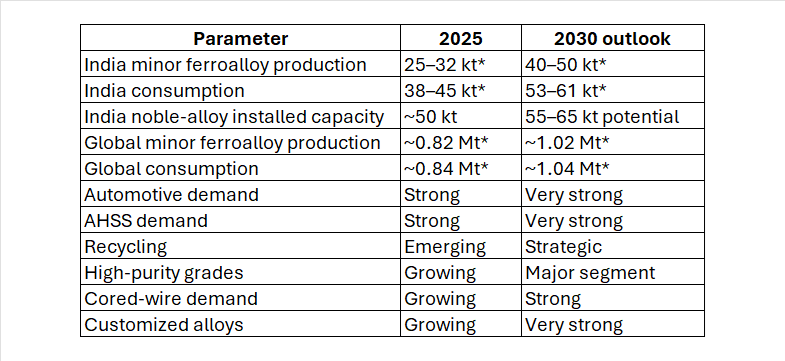 *Market-planning estimates, not official statistics.
25. CBAM Impact on Minor Ferro Alloys: Trade & Exports to Europe
Under the EU CBAM rules in force in 2026, several important minor ferro alloys are explicitly excluded from the iron-and-steel goods currently covered by CBAM. These exclusions include ferro-molybdenum (CN 7202 70), ferro-tungsten (7202 80), ferro-titanium (7202 91), ferro-vanadium (7202 92), ferro-niobium (7202 93), ferro-phosphorus, ferro-silico-magnesium and certain other ferroalloys under 7202 99. (EUR-Lex)
CBAM impact on minor ferro alloys
- Ferrovanadium: Excluded / no direct CBAM charge currently
- Ferroniobium: Excluded
- Ferrotitanium: Excluded
- Ferromolybdenum: Excluded
- Ferrotungsten: Excluded
- Ferro-phosphorus: Excluded
- Ferro-silico-magnesium: Excluded
Certain other Fe-alloys under 7202 99 Excluded
This is important for Indian exporters: exporting FeV, FeNb, FeTi, FeMo or FeW to Europe does not presently create the same direct CBAM carbon-cost exposure as exporting many covered iron and steel products. The definitive CBAM regime has been operating since 1 January 2026, and India is already among the leading origin countries for CBAM-covered imports overall. (Taxation and Customs Union)
However, there are indirect and future risks. European steelmakers themselves face increasing carbon costs, so they are likely to favour ferroalloy suppliers that can demonstrate lower embedded emissions, renewable electricity, recycled raw materials, efficient furnaces and credible carbon accounting. Consequently, even where a ferroalloy is outside CBAM, its carbon footprint can increasingly become a commercial purchasing criterion.
There is also regulatory risk. The EU is already working on strengthening and extending CBAM to additional downstream products and introducing stronger anti-circumvention measures. Therefore, today's exclusions should not automatically be assumed to remain unchanged through 2030.
26. Conclusion
Minor ferro alloys are small-volume but strategically important materials that enable stronger, lighter, cleaner and more durable steels. Ferrovanadium, ferroniobium, ferrotitanium, ferromolybdenum, ferroboron and ferrotungsten are particularly important for automotive, infrastructure, energy, aerospace, defence and advanced engineering applications. The next generation of products will emphasize high purity, low residuals, controlled particle size, high recovery, customized chemistry and recycled feedstocks. India already has a broad ferroalloy ecosystem, while its noble-ferroalloy capacity is about 50,000 tonnes per year; however, domestic production of several specialty grades remains small relative to demand.
Rising specialty-steel production, automotive lightweighting and EV development can therefore support new capacity through 2030. Secure raw-material access, competitive power, technology, quality certification and recycling will be decisive. Digital B2B platforms such as LOHAA can connect verified producers, buyers, exporters and importers, helping convert market opportunities into commercial transactions while improving supplier discovery, specification matching and transaction efficiency across India's metals ecosystem.
26. References
1. U.S. Geological Survey — Mineral Commodity Summaries 2026. The USGS MCS 2026 is the earliest comprehensive source of 2025 global mineral production data. (USGS Publications)
2. USGS — Niobium Commodity Information. Brazil accounted for approximately 93% of global niobium production in 2025, followed by Canada at approximately 5%. (USGS Publications)
3. Indian Bureau of Mines — Indian Minerals Yearbook 2024. Provides Indian ferroalloy capacity, production and foreign-trade information, including noble ferroalloys. (IBM Government)
4. Indian Ferro Alloys Producers' Association (IFAPA). Industry capacity and structure information.
5. Ministry of Steel, Government of India — Specialty Steel / PLI Scheme. (Steel Authority of India Limited)
6. CBMM — 2025 Sustainability Report. 2025 ferroniobium-equivalent production and capacity information. (CBMM)
7. CBMM — 2025 results / production information. 100,000 tonnes of ferroniobium-equivalent sales and 150,000-tonne annual installed capacity. (IBRAM)
8. International Molybdenum Association. Global molybdenum production and use in 2025. (Imoa)
9. CMOC Group. Molybdenum and tungsten operations and 2025 production. (CMOC)
10. Glencore — Ferroalloys. Vanadium and ferroalloy operations, including Rhovan. (Glencore)
11. Bushveld Minerals — Vanadium Products. Ferrovanadium, nitrovanadium and vanadium oxide products. (Bushveld Minerals)
12. Treibacher Industrie AG. Ferrovanadium and ferromolybdenum applications and recycling processes. (Treibacher Industrie AG)
13. Bansal Brothers — Ferro Titanium. FeTi grades, production facility and 7,400-tonne annual capacity. (Bansal Brothers)
14. FerroAlloyNet. Chinese ferromolybdenum producer information and industry awards. (FerroAlloyNet)
15. Responsible Minerals Initiative / SEC disclosures. Global tungsten smelter and refiner information.
16. GfE Gesellschaft für Elektrometallurgie. Specialty alloy and vanadium recovery technologies. (GFE)
17. M.B. Smelters / Thermit Alloys. Indian specialty ferroalloy product range. (MBS Melters)
18. LOHAA — The Metal Marketplace. Digital B2B metal trading and commercial marketplace. (Ferroalloys Connections Summit 2026)
Data & Methodology Note
The term "minor ferro alloys" is not an internationally standardized statistical category. Official agencies generally report vanadium, niobium, molybdenum, tungsten, titanium and related commodities separately, while ferroalloy products are distributed across different trade classifications.
Accordingly:
• Official 2025 figures are used wherever companies or government agencies disclose them.
• India trade data are based on Indian Bureau of Mines information.
• Company capacities are taken from company disclosures where available.
• Country and global 2025–2030 market tables are analytical estimates prepared for market-planning purposes.
• Company-level 2025 production is shown as disclosed production where available; where companies do not publish Fe-alloy-specific output, the table identifies a production indicator or states that the figure is not publicly disclosed.
• Capacity should not be interpreted as actual production.
• Upstream metal production, such as molybdenum or vanadium content, should not automatically be converted into ferroalloy tonnes without a documented conversion factor.
This approach avoids presenting unsupported estimates as official production statistics while still providing a practical 2025–2030 market outlook for investors, manufacturers, steelmakers, traders and commercial sourcing teams.
By using digital trade platforms like LOHAA Mobile application, you can reach global buyers, source quality material, and strengthen long-term partnerships.
Download the Lohaa Metal Trading App for Android to access live scrap prices and real-time market updates anytime, anywhere.
Download the Lohaa Metal Trading App for iOS to access live scrap prices and real-time market updates anytime, anywhere.


