
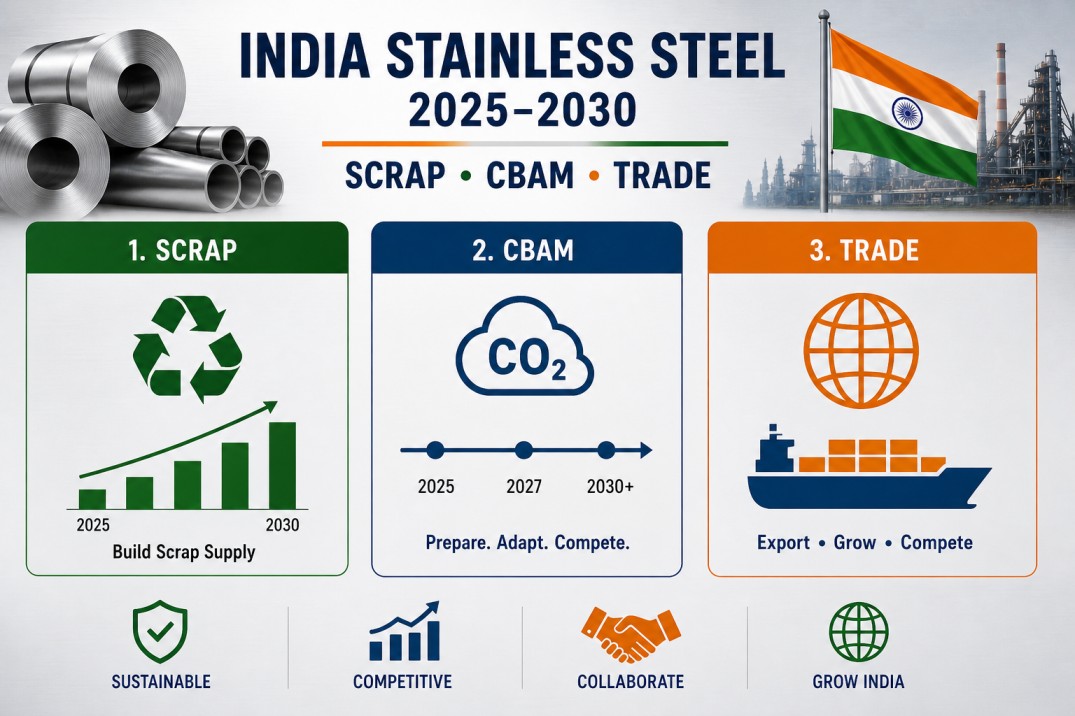
Stainless Steel India Outlook: Scrap, CBAM, Exports
Introduction
India’s stainless steel industry is undergoing a structural transformation, driven by a combination of domestic demand growth, global trade realignment, geopolitical disruptions, and environmental regulations. At the core of this transformation lie two critical pillars—recycling and casting—which together define cost efficiency, sustainability, and industrial capability.
India has emerged as one of the fastest-growing stainless steel markets globally, supported by strong demand from infrastructure, automotive, manufacturing, and energy sectors. However, the country remains heavily dependent on imported stainless steel scrap—particularly high-grade materials such as 304, 316, and duplex—making it vulnerable to global supply chain disruptions.
Recent developments such as the Gulf (West Asia) conflict and the European Union’s Carbon Border Adjustment Mechanism (CBAM) are reshaping the industry landscape. While geopolitical tensions are increasing costs and disrupting supply chains, CBAM is forcing producers to adopt low-carbon manufacturing practices.
This blog presents a comprehensive 360° analysis of India’s stainless steel ecosystem, covering recycling, casting, global trade, pricing trends, and the combined impact of geopolitical and regulatory forces from 2025 to 2030.
1. Importance of Stainless Steel Recycling
Stainless steel recycling is not just an operational activity—it is a strategic necessity for India.
Key Benefits
• Energy Savings: 70–80% lower than primary production
• Cost Efficiency: Reduces dependence on expensive alloys like nickel
• Environmental Impact: Lower CO? emissions
• Supply Security: Reduces import dependency
• Circular Economy: Supports sustainability goals
Key Challenges in Stainless Steel Recycling in India
• Scrap collection inefficiency
• Dependence on imports
• Quality inconsistency
• Policy and duty barriers
• Informal sector dominance
2025 Snapshot

Recycling is now the backbone of India’s stainless steel industry.
2. Scrap Availability & Import Dependency
India’s scrap ecosystem is uneven across grades.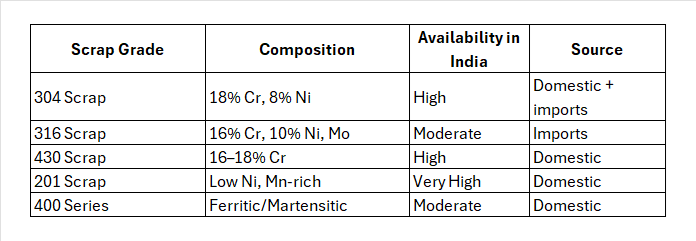 Key Insight
• High-nickel grades → import-dependent
• Low-nickel grades → domestically abundant
This imbalance creates structural supply risk.
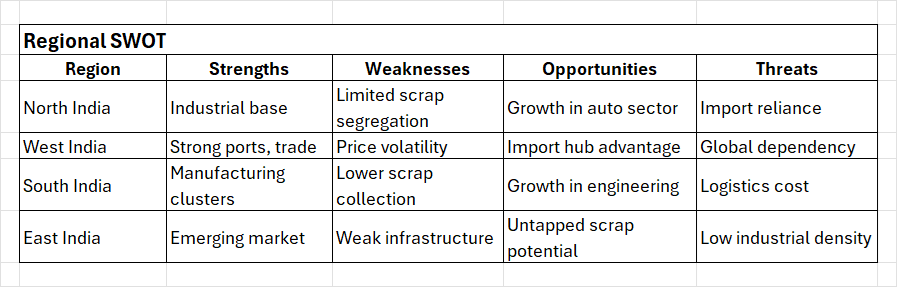
SWOT Analysis – Scrap Availability (Region-wise India)
3. Availability of Stainless Steel Scrap Grades in India
India has mixed domestic + imported scrap availability.
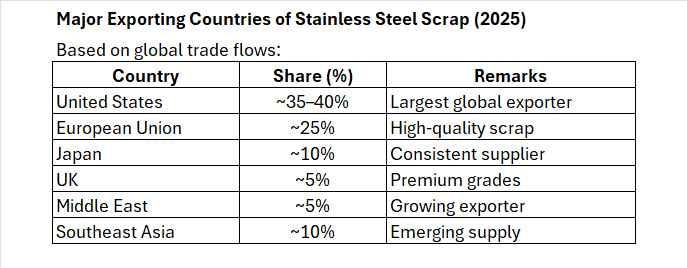
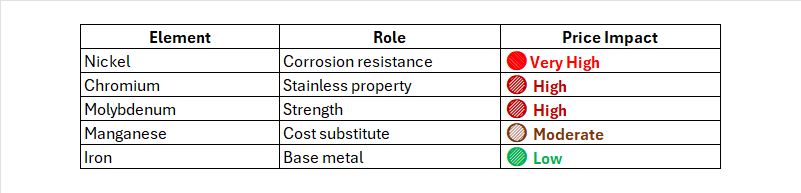
4. Alloy Price Impact on Stainless Steel
Cost Structure Drivers
 5. Gulf War Impact on Scrap Imports
The West Asia conflict has exposed vulnerabilities in India’s scrap supply chain.
Key Impacts
a). Supply Chain Disruption
• Middle East is a key scrap trading hub
• Disruptions in Red Sea & Suez routes
b). Freight Cost Surge
• Increase of 15–30%
• Higher insurance premiums
c). Delayed Shipments
• Lead times extended by 2–4 weeks
d). Currency Volatility
• USD fluctuations impacting landed cost
Grade-wise Impact
 316 and duplex are the most vulnerable grades.
6. Gulf War Impact on Exports
India’s exports are also affected, especially in energy-linked sectors.
Key Export Challenges
• Higher freight costs reduce margins
• Delays in Middle East deliveries
• Payment risks in conflict regions
• Reduced demand in oil-dependent economies
Product Impact

7. Most Affected Stainless Steel Grades
Imports
 Exports
 High-alloy grades are the most exposed to global disruptions.
8. CBAM Impact on Stainless Steel Industry
CBAM introduces a new dimension—carbon cost.
What is CBAM?
A mechanism imposing carbon-based tariffs on imports into the EU.
Impact on Scrap Imports Impact on Finished Exports
 Product Impact
 9. Combined Impact: Gulf War + CBAM
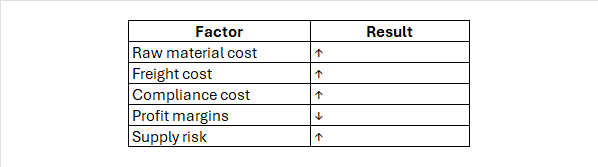
Industry faces dual pressure: cost + compliance.
10. Stainless Steel Casting Industry
India is emerging as a global casting hub.
Applications
• Oil & Gas
• Chemical
• Marine
• Automotive
• Infrastructure
Capacity
 11. Alloy Cost Impact
 12. 2026 Pricing Analysis
India Price Trends depends upon the type of finished product
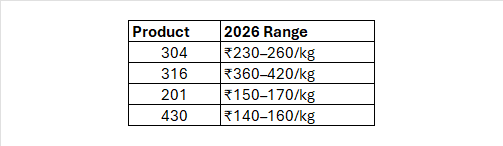 Scrap Prices
 Note: Prices are for references only and varaying from time to time
Key Drivers
• Gulf War → logistics cost ↑
• CBAM → export cost ↑
• Nickel volatility → price swings
13. Sector-wise Demand
- Infrastructure: 30%
- Automotive: 20%
- Industrial: 20%
- Consumer 15%
- Oil & Gas: 10%
Oil & gas sector most impacted.
14. Key Challenges
• Import dependency
• Scrap quality inconsistency
• Energy costs
• CBAM compliance
• Geopolitical risks
15. Opportunities
• China+1 supply shift
• Growth in exports
• Digital scrap trading (LOHAA)
• Green steel adoption
16. Stainless Steel Future Outlook (2025–2030)
Industrial Applications of Stainless Steel Grades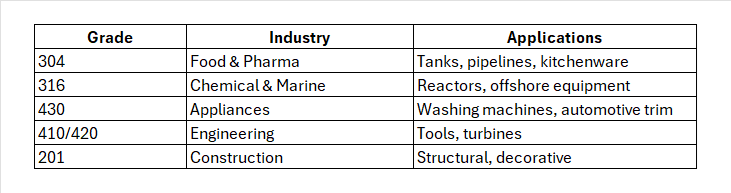
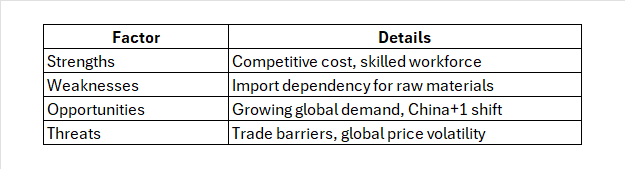
SWOT Analysis – Stainless Steel Finished Exports
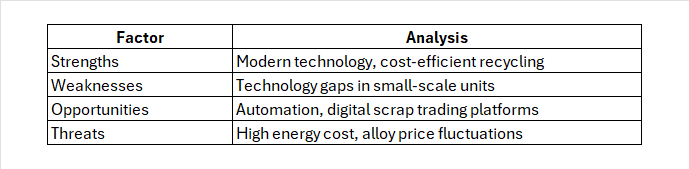
 SWOT – Technology & Cost Benefit Analysis
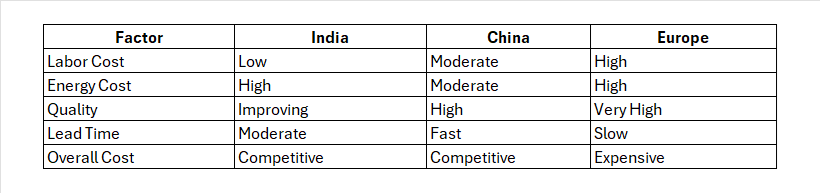
Cost Benefit Analysis – India vs Global Markets
 a) Global Market Growth Outlook
- Global stainless steel market expected to reach ~$257–281 billion by 2030
- CAGR: ~5%–8% (steady, not explosive growth)
- Long-term trend: $350+ billion by 2034
Key Insight:
Stainless steel is a mature but steadily expanding industry, driven by infrastructure, sustainability, and industrial demand—not speculative growth.
b) Regional Outlook (Shift Toward Asia & India)
Asia-Pacific Dominance
- Accounts for ~70%+ of global demand
- China remains dominant but growth is slowing due to:
- Real estate slowdown
- Carbon restrictions (2026–2030 output control)
India – Fastest Growth Engine
- CAGR: ~9.1% (highest among major economies)
- Market size: ~$15.8 billion by 2030
Key Insight:
India will be the most important incremental demand driver globally, replacing China’s growth momentum.
c) Demand Drivers (2025–2030)
i) Infrastructure & Construction
- Smart cities, railways, airports, metros
- Green buildings (corrosion-resistant materials)
ii) Automotive & EV Sector
- Stainless steel in:
- Exhaust systems
- EV battery components
- ~45–50% of steel used in automotive exhausts
iii) Energy Transition
- Hydrogen, nuclear, solar thermal plants
- LNG and chemical industries
iv) Consumer & Industrial Goods
- Appliances, kitchenware, medical equipment
Key Insight:
Demand is shifting from traditional construction → high-performance & clean energy applications
Conclusion
India’s stainless steel industry is at a pivotal stage. While recycling and casting continue to drive growth, external forces such as geopolitical tensions and environmental regulations are reshaping the competitive landscape.
The Gulf War underscores the risks of import dependence—especially for high-grade scrap like 316 and duplex—while CBAM is pushing the industry toward low-carbon transformation.
The future will belong to companies that can:
- Secure scrap supply
- Manage alloy price volatility
- Adopt green production
- Adapt to global trade changes
India is well-positioned to become a global leader in stainless steel recycling, casting, and exports, provided it navigates these challenges strategically.
References
1. World Bank Trade Data (WITS)
2. Volza Trade Intelligence
3. MetalsHub Industry Insights
4. Ministry of Steel, Government of India
5. Indian Institute of Foundrymen (IIF)
6. CRISIL & Industry Reports
By using digital trade platforms like LOHAA Mobile application, you can reach global buyers, source quality material, and strengthen long-term partnerships.
Download the LOHAA Mobile application today and connect with verified scrap suppliers and manufacturers.
(Notes: market and production volume estimates are synthesized from public market reports and industrial press; exact tonne figures for materials are not centrally published in a single comprehensive public dataset, therefore the numeric projection above is a conservative, documented estimate built from available intelligence and reasonable regional share assumptions.)


